Ecommerce
How Ecommerce Brands Turn a Product Launch Into a 30-Day Automated Social Campaign
Most ecommerce product launches follow the same painful pattern. The team spends weeks on the product itself, then scrambles in the final days to throw together social posts. They publish a few things on launch day, maybe follow up once or twice, and then the momentum dies. Sales flatten. The algorithm stops showing your content. And three weeks later, you're wondering why the launch didn't perform. The problem isn't the product. It's the social strategy, or the lack of one that runs itself. Agentic AI workflows change this completely. Instead of manually creating, scheduling, and analyzing posts across Instagram, TikTok, Facebook, and LinkedIn for 30 days straight, AI agents handle the entire campaign arc while you focus on the business. Here's exactly how ecommerce brands build a repeatable, automated launch system that works the same way every time.

By Wilzer Jean-Baptiste
Published 11 min read
Most ecommerce product launches follow the same painful pattern. The team spends weeks on the product itself, then scrambles in the final days to throw together social posts. They publish a few things on launch day, maybe follow up once or twice, and then the momentum dies. Sales flatten. The algorithm stops showing your content. And three weeks later, you're wondering why the launch didn't perform.
The problem isn't the product. It's the social strategy, or the lack of one that runs itself.
Agentic AI workflows change this completely. Instead of manually creating, scheduling, and analyzing posts across Instagram, TikTok, Facebook, and LinkedIn for 30 days straight, AI agents handle the entire campaign arc while you focus on the business. Here's exactly how ecommerce brands build a repeatable, automated launch system that works the same way every time.
Building the 30-Day Launch Arc Before Day One
The brands that win product launches on social aren't the ones posting the most. They're the ones posting with intention across a planned arc. Sporadic posting kills momentum. If you drop a launch post, go quiet for five days, then post again, the algorithm treats you like a stranger. Your audience does too.
A 30-day launch campaign has a shape to it. Teasers build anticipation. The reveal drives the spike. Social proof extends the tail. Each phase serves a different job, and the content inside each phase needs to match that job. When you plan the full arc before you publish a single post, everything that follows becomes execution, not improvisation.
Why Sporadic Posting Kills Launch Momentum
Product launches fail on social when brands post sporadically instead of maintaining momentum across 30 days. This isn't an opinion. It's a pattern that repeats constantly in ecommerce. A brand posts on launch day, gets a burst of engagement, then goes quiet for a week because the team is exhausted or busy shipping orders. By the time they post again, the algorithm has moved on and so has the audience.
Agentic workflows solve this by letting you plan the entire campaign arc upfront, from teaser to reveal to social proof, and then execute it without daily manual work. You define the phases, the content types, and the posting frequency once. The AI agents handle the rest. The campaign runs whether you're at your desk or not. Momentum doesn't depend on someone remembering to post. It's built into the system from the start, and that consistency is what keeps your product in front of people long enough to convert them.
Mapping the Three Phases: Teaser, Reveal, Social Proof
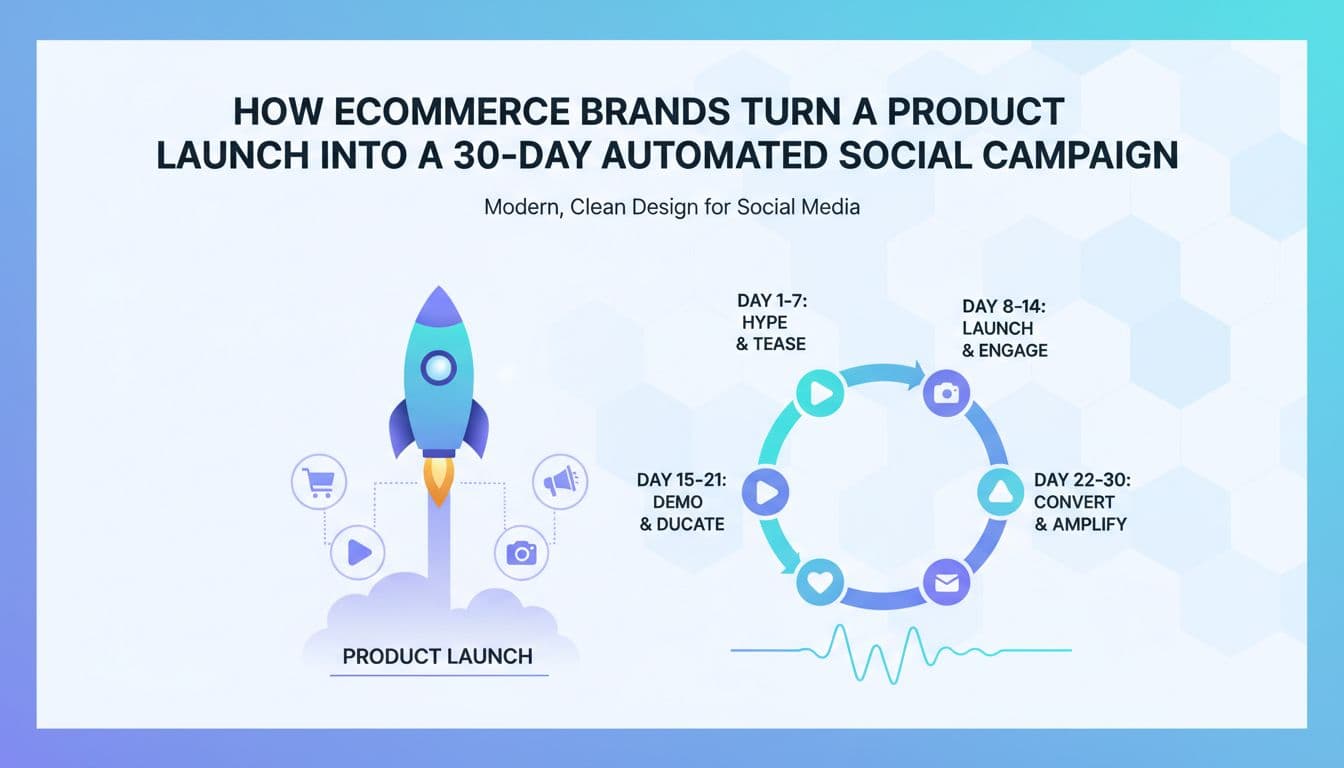
A 30-day launch arc breaks cleanly into three phases, and each one has a different content job.
- Days 1 to 7 (Teaser phase): Build curiosity without giving everything away. Behind-the-scenes clips, cryptic product details, countdown posts. The goal is to get people asking questions before you answer them.
- Days 8 to 14 (Reveal phase): This is launch week. Full product reveals, feature breakdowns, launch offers, and direct calls to action. This is where you drive the initial sales spike.
- Days 15 to 30 (Social proof phase): Customer photos, reviews, unboxing videos, FAQs, and use-case content. This phase converts the people who were watching but not ready to buy yet.
When you map this out before you start, you know exactly what content you need and when it needs to run. The AI can generate drafts for every phase in one session, and your content calendar fills itself.
From Brief to Full Campaign in One Workflow
The practical magic of agentic workflows is that you write one brief and the AI builds the campaign from it. You describe the product, the target customer, the key benefits, the launch date, and the tone you want. The AI agent takes that brief and generates content for every phase, every platform, and every week of the campaign. You review, approve, and the calendar populates. What used to take a marketing team a full week of planning now takes a few hours. And because the content was generated from a single brief, the messaging stays consistent across all 30 days, even as the content type shifts from teaser to social proof.
Creating Platform-Optimized Content Without the Extra Work
Here's a time trap that most ecommerce teams fall into. They write a product launch post, then manually rewrite it for Instagram, then rewrite it again for TikTok, then again for LinkedIn, then again for Facebook. Four platforms means four separate workflows, four different tones, four sets of character limits, and four chances for the messaging to drift apart.
This is where most teams either burn out or start cutting corners. They post the same caption everywhere and hope it works. It doesn't. A TikTok caption that works is nothing like a LinkedIn post that works. The audiences are different, the formats are different, and what triggers engagement on each platform is completely different.
AI agents fix this by generating platform-optimized variations from a single piece of source content. You write the brief once. The agent produces a punchy TikTok caption, a longer Instagram caption with hashtags, a professional LinkedIn post, and a conversational Facebook update. Same message, different format, built for each audience.
One Brief, Four Platforms, Zero Rewrites
Ecommerce brands waste hours every week creating separate content for Instagram, TikTok, LinkedIn, and Facebook. Multiply that by a 30-day launch campaign and you're looking at a significant chunk of someone's full-time job, just on reformatting content that already exists.
AI agents generate platform-optimized variations from one brief, keeping messaging consistent while respecting each platform's format and audience. This matters more than most people realize. Consistent messaging across platforms builds brand recognition. When someone sees your product teaser on TikTok and then encounters your launch post on Instagram, they should feel like it's the same brand telling the same story, just in a different voice for a different room. That coherence builds trust faster than any single viral post. With Aidelly's AI content drafting, you get platform-aware variations that feel native to each channel without starting from scratch every time.
The First 72 Hours and Why Timing Is Everything
The first 72 hours after launch drive roughly 40% of initial sales for most ecommerce products. This is when your audience is most primed, your launch offer is freshest, and the algorithm is deciding whether to amplify your content or bury it. Missing the optimal posting windows during this window doesn't just cost you engagement. It costs you revenue.
Most teams scramble to post at the right times across time zones during launch week. Someone is staying up late to hit publish at 9 PM Pacific so it lands at the right time for East Coast customers. Someone else is setting phone alarms to post during European morning hours. This is not a system. It's a stress response.
Autonomous scheduling ensures your best content hits when your audience is online, without anyone staying up to hit publish. You set the schedule once, the AI identifies the optimal posting windows based on your audience data, and the posts go out automatically. Your launch content reaches people when they're actually scrolling, not when it was convenient for your team to post.
Keeping Brand Voice Consistent When AI Writes the Copy
Brand consistency breaks down when AI generates copy without knowing your voice, product positioning, or visual style. This is the failure mode that makes a lot of ecommerce teams nervous about using AI for launch content. They've seen the generic, flat copy that AI produces when it doesn't have context. They don't want that representing their brand during the most important launch of the quarter.
Storing brand guidelines and assets in one place means every AI-drafted post reflects your brand before it goes live, not after. When the AI knows your tone of voice, your product positioning, your visual style rules, and your audience, the output sounds like you. Not like a robot trying to sound like you. Aidelly's brand voice and asset management stores all of this in one place so every generated post starts from your brand context, not from a blank slate. You spend less time editing and more time approving content that's already close to right.
Tracking Performance and Adjusting While the Campaign Is Still Running
Most ecommerce teams do their launch post-mortem after the campaign ends. They pull the analytics, figure out what worked, write it up, and file it away for next time. This is better than nothing. But it means you spent 30 days running a campaign that you could have improved on day 10 if you'd been watching the right signals.
Real-time performance data changes how you run a launch campaign. When you can see which posts are driving clicks, saves, and conversions across all platforms in one dashboard, you can make decisions while there's still time to act on them. If your TikTok content is outperforming your Instagram content by a wide margin, you shift resources. If a specific product angle is generating more saves than your main messaging, you lean into that angle for the rest of the campaign.
The brands that treat launch campaigns as living things, not set-it-and-forget-it schedules, consistently outperform the ones that don't. The data tells you what's working. You just have to be able to see it in time to use it.
Real-Time Dashboards That Actually Change Your Decisions
Post-launch analytics reveal what worked, but by then the campaign is over. This is one of the most frustrating parts of running social campaigns the traditional way. You do the work, you wait 30 days, and then you find out what you should have done differently. The insight arrives too late to matter for this launch. Maybe it helps next time, maybe it doesn't.
Real-time dashboards let you see which content drives clicks, saves, and conversions across all channels in one view, so you can adjust messaging mid-campaign. This is a fundamentally different way to run a launch. Instead of guessing which content angle resonates and hoping for the best, you watch the data as it comes in and make adjustments while the campaign still has runway. If week two content is underperforming, you know by day 12, not day 31. That's the difference between a campaign you manage and a campaign that manages you.
Using Approval Workflows to Keep Quality High at Scale
When AI generates 30 days of content across four platforms, the volume gets high fast. Without a review process, things slip through. A caption that's slightly off-brand. A hashtag set that doesn't match the platform. A post that went out during a product shortage you forgot to flag. Approval workflows give you a quality gate without slowing everything down to a crawl.
The key is building the review step into the workflow, not bolting it on as an afterthought. When your team can see every scheduled post before it goes live, leave comments, request edits, and approve with one click, you get the speed of automation with the confidence of human oversight. Nothing goes live that someone hasn't signed off on. And because the AI is generating content that already reflects your brand voice and guidelines, most posts need minimal edits before approval. The review step becomes a quick check, not a rewrite session.
Building a Repeatable System for Every Future Launch
The real payoff of building an automated 30-day launch campaign isn't just this launch. It's every launch after it. When you have a documented arc, a brand voice stored in your AI workspace, a scheduling system that knows your audience's best posting windows, and a dashboard that shows you what's working in real time, you have a system. Not a one-time campaign.
The next product launch takes a fraction of the time to set up. You update the brief, swap in the new product assets, adjust the phases if needed, and the machine runs. Your team spends time on strategy and creative decisions, not on manually reformatting captions or staying up to hit publish at midnight. That's the shift from scrappy to scalable, and it compounds over time as your system gets smarter with every campaign you run through it.
A product launch doesn't have to be 30 days of manual work spread across a team that's already stretched thin. When you plan the full campaign arc upfront, let AI generate platform-optimized content from a single brief, schedule posts autonomously across time zones, and watch performance data in real time, you run a completely different kind of launch. One that maintains momentum, stays on-brand, and gives you room to adjust while it still matters. The right tools make this the standard, not the exception. If you're ready to run your next product launch without the scramble, Aidelly's agentic workflows are built exactly for this.
A 30-day product launch campaign shouldn't mean 30 days of manual work. Agentic workflows let you plan your entire social strategy upfront, then let AI agents handle content creation, platform optimization, timezone-smart scheduling, and real-time performance tracking while you focus on what actually moves the needle. See how to turn your next product launch into a scalable system by visiting aidelly.ai.
Compare social scheduling tools
Evaluating software for your content workflow? Use our buyer guides and comparisons to compare scheduling, approvals, analytics, and AI workflow fit.