Ecommerce
Pinterest Scheduling for Ecommerce: How to Automate Product Pins That Actually Drive Traffic
Most ecommerce brands treat Pinterest like an afterthought. They post a few product photos, forget about it for two weeks, then wonder why they're not seeing traffic. Here's what they're missing: Pinterest drives 3x more traffic to ecommerce sites than other social platforms combined. But that only happens when you show up consistently, with optimized pins, at the right times. The brands quietly winning on Pinterest aren't manually scheduling one pin at a time. They're using agentic AI workflows to generate optimized product pins for their entire catalog, schedule them months in advance, and let the algorithm do the rest. This guide breaks down exactly how to build that system, what makes a product pin actually perform, and how forward-thinking ecommerce teams are automating the whole thing end-to-end.

By Wilzer Jean-Baptiste
Published 13 min read
Most ecommerce brands treat Pinterest like an afterthought. They post a few product photos, forget about it for two weeks, then wonder why they're not seeing traffic. Here's what they're missing: Pinterest drives 3x more traffic to ecommerce sites than other social platforms combined. But that only happens when you show up consistently, with optimized pins, at the right times. The brands quietly winning on Pinterest aren't manually scheduling one pin at a time. They're using agentic AI workflows to generate optimized product pins for their entire catalog, schedule them months in advance, and let the algorithm do the rest. This guide breaks down exactly how to build that system, what makes a product pin actually perform, and how forward-thinking ecommerce teams are automating the whole thing end-to-end.
Why Pinterest Is Still the Underdog Traffic Machine for Ecommerce
The Traffic Numbers Most Brands Are Ignoring
Pinterest users aren't scrolling to kill time. They're planning purchases. Someone saving a pin of a linen throw blanket is probably furnishing a room. Someone pinning a skincare routine product is likely about to buy. That purchase intent is what makes Pinterest so different from Instagram or TikTok, where discovery happens but buying decisions take longer.
Pinterest drives 3x more traffic to ecommerce sites than other social platforms, but the catch is real: that traffic only shows up when you post consistently and at the right times. A brand that posts 15 pins one week and then goes quiet for three weeks won't see those numbers. Pinterest's algorithm rewards steady, predictable publishing. It treats your account like a signal of reliability. When you post regularly, the algorithm pushes your content to more users. When you go dark, your reach shrinks fast and takes time to rebuild.
The opportunity here is big. Most of your competitors are either ignoring Pinterest entirely or posting sporadically. Consistent, optimized pinning is one of the few remaining places in social media where you can still build meaningful organic reach without a big ad budget.
Pinterest Users Are Buyers, Not Just Browsers
The average Pinterest user has a household income above the national average and uses the platform to find products and ideas before making a purchase. According to Pinterest's own data, 85% of weekly users have bought something based on a pin they saw. That's not a vanity metric. That's a direct line between your content and your checkout page.
Compare that to TikTok or Instagram, where discovery is high but the path to purchase is longer and harder to track. Pinterest users come to the platform with buying intent already baked in. Your job is to show up when they're searching for what you sell, which means your pins need to be findable, visually compelling, and linked directly to the right product pages.
The Compounding Effect of Pinterest Content
One thing that makes Pinterest different from every other social platform is how long content lives. A tweet disappears in hours. An Instagram post gets most of its engagement in the first 48 hours. A Pinterest pin can drive traffic for months or even years after you post it. That compounding effect means every optimized pin you publish today is still working for you next quarter. When you combine that longevity with consistent posting, you build a traffic engine that gets stronger over time instead of requiring constant attention to maintain.
What Actually Makes a Product Pin Perform
Platform-Specific Optimization Is Non-Negotiable
Posting a standard product photo to Pinterest and hoping for clicks is like running a Google ad with no keywords. The format matters, the description matters, and the context matters. Product pins need platform-specific optimization to actually perform, and that means getting three things right every single time.
First, the aspect ratio. Pinterest is a vertical platform. The ideal pin size is 1000x1500 pixels, a 2:3 ratio. Pins that use this format take up more space in the feed, which means more visibility and more clicks. Square images and horizontal photos get buried. If you're repurposing product photos from your website, you almost always need to reformat them before they'll perform well on Pinterest.
Second, the description. Pinterest is a search engine as much as it is a social platform. Rich descriptions with relevant keywords are how your pins get discovered. A description like "Blue linen throw blanket" won't rank. A description like "Soft blue linen throw blanket for living room decor, perfect for minimalist home styling and cozy reading corners" gives Pinterest's algorithm the context it needs to match your pin to the right searches. Aim for 150 to 300 words in your pin descriptions and include the keywords your buyers use.
Third, lifestyle context. Product-only photos underperform on Pinterest. Pins that show a product in use, styled in a real space, or paired with complementary items consistently outperform white-background product shots. A candle photographed on a bathroom shelf next to a book and a plant performs better than the same candle on a white background. The lifestyle context helps users picture the product in their own lives, which is what drives saves and clicks.
Keywords Are Your Discovery Engine
Pinterest SEO works differently than Google SEO, but the principles overlap. Users search for ideas and products using natural language phrases. Your pin titles and descriptions need to reflect how real buyers search, not how your product team describes inventory. If you sell handmade ceramic mugs, your buyers are searching for things like "aesthetic coffee mug for home office" or "minimalist ceramic mug gift idea," not "SKU-4421 stoneware vessel."
Do keyword research using Pinterest's own search bar. Type in your product category and look at the autocomplete suggestions. Those are real searches from real users. Build your pin descriptions around those phrases. Use them naturally in the first sentence of your description, since Pinterest weighs early keywords more heavily. Include secondary keywords throughout the rest of the description to catch related searches.
Board Strategy Supports Pin Performance
Where you save a pin matters almost as much as the pin itself. Pinterest uses board context to understand what a pin is about and who to show it to. Saving a kitchen product to a board called "My Stuff" tells Pinterest nothing. Saving it to a board called "Small Kitchen Organization Ideas" gives the algorithm clear context and helps your pin appear in related searches.
Create boards around the topics and search terms your buyers use, not around your product categories. A home decor brand might have boards like "Cozy Living Room Ideas," "Minimalist Bedroom Decor," and "Small Space Storage Solutions" instead of just "Living Room" and "Bedroom." Each board becomes its own discovery channel, and every pin you save to it benefits from that topical authority.
The Real Cost of Manual Pinterest Scheduling
Where the Hours Actually Go
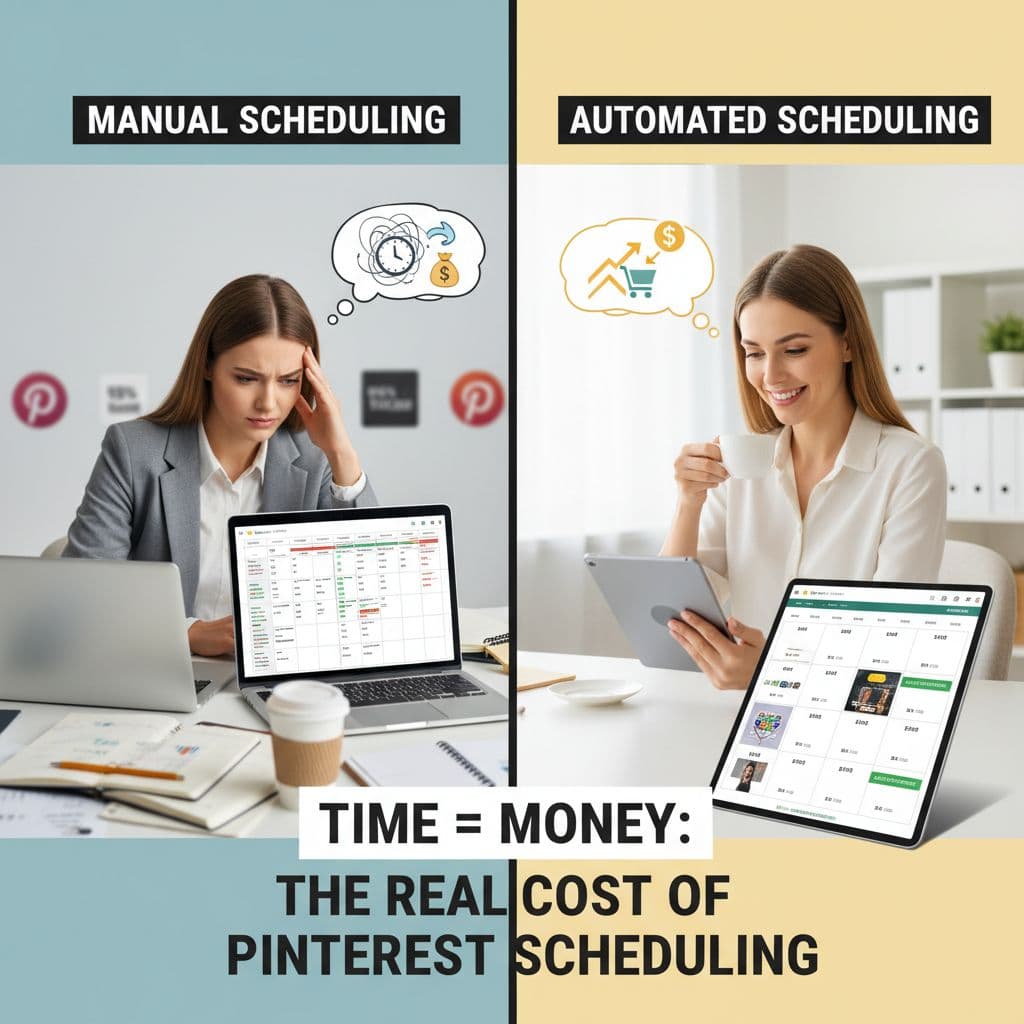
Manual Pinterest scheduling wastes 5 to 10 hours per week for ecommerce brands, and most owners don't realize how fast those hours add up until they try to track them. Think through what manual pinning actually involves. You pull product photos from your catalog. You resize them to the right dimensions. You write a keyword-rich description for each one. You choose the right board. You log into Pinterest and schedule the pin. Then you do it again for the next product. And the next. For a brand with 50 to 100 products, doing this manually even once a month is a serious time sink.
Multiply that by the posting frequency Pinterest rewards, which is 5 to 15 pins per day for active brands, and you're looking at a part-time job just to keep your Pinterest presence alive. That's time you're not spending on product development, customer service, or the parts of your business that need your brain.
Automation changes the math entirely. When you batch-create pins for your entire product catalog and schedule them months in advance, you front-load the work once and then let the system run. A few hours of setup gives you weeks or months of consistent publishing without touching it again.
Batch Creation Is the Unlock
The most efficient Pinterest strategy for ecommerce isn't posting one pin at a time. It's batching. You sit down once, create 30 to 60 pins for your current product lineup, and schedule them to publish over the next four to eight weeks. That single session handles your entire Pinterest presence for the month. Then you check performance, adjust what's not working, and batch again.
This approach works even better when you create multiple pin variations for each product. A single product listing can generate five or six different pins: a lifestyle shot, a close-up detail photo, a flat lay, a pin with seasonal context, and a pin targeting a different keyword. Each variation reaches a slightly different audience and gives you more chances to show up in search results. Tools like Aidelly make this practical by letting you generate multiple pin variations from one product listing inside a single workflow, so you're not manually recreating the same pin five times.
Consistency Beats Intensity Every Time
Pinterest's algorithm favors fresh, consistent content over sporadic bursts of activity. Brands that post 5 to 15 pins weekly see 2x higher click-through rates than brands that post irregularly, even if the irregular posters publish more total pins. The algorithm interprets consistent posting as a signal that your account is active and trustworthy, and it rewards that with wider distribution.
This is why scheduling matters so much. You can't maintain that posting frequency manually without it becoming your full-time job. But with a scheduler, you set the cadence once and the system handles it. Your account stays active and the algorithm keeps distributing your content, even when you're focused on other parts of your business. Sporadic posting, no matter how high-quality the pins, simply doesn't compound the same way.
How Agentic AI Workflows Handle Pinterest End-to-End
From Product Listing to Published Pin Without Manual Work
AI-powered scheduling tools can analyze your audience data and automatically suggest the best posting times, generate keyword-rich pin descriptions, and create multiple pin variations from a single product listing. That's not a future feature. That's what agentic social media platforms are doing right now in 2026.
Here's what that workflow looks like in practice. You connect your product catalog. The AI agent pulls your product images, titles, and descriptions. It generates multiple pin variations for each product, each with a unique description optimized for different keyword clusters. It analyzes your audience data to identify the times when your specific followers are most active on Pinterest, which varies by niche, and schedules each pin to publish at peak engagement windows. You review the queue, approve what looks good, and the system handles the rest.
Platforms like Aidelly are built specifically for this kind of agentic workflow. The AI doesn't just help you write one pin. It handles the entire pipeline, from content generation to scheduling to performance analysis, so you can focus on strategy instead of execution. For an ecommerce brand with a growing catalog, that's the difference between Pinterest being a traffic channel you actually use and one you keep meaning to get to.
Optimal Timing Is a Data Problem, Not a Guessing Game
Most Pinterest scheduling advice tells you to post between 8 PM and 11 PM or on weekends. That's generic advice based on broad averages. Your audience might be most active at 6 AM on Tuesdays. Or Saturday afternoons. The only way to know is to look at your actual audience data, and the only practical way to act on that data consistently is to let an AI agent do it automatically.
AI scheduling tools pull engagement data from your Pinterest analytics and identify the specific windows when your followers are online and engaging. Then they automatically slot your scheduled pins into those windows. You're not guessing anymore. You're publishing based on real behavior patterns from your actual audience. Over time, as the AI collects more data, those timing recommendations get sharper and your engagement rates improve without you changing anything manually.
Performance Analysis Closes the Loop
The last piece of an agentic Pinterest strategy is understanding what's working and feeding that back into your content creation. Which pin formats are driving the most clicks? Which keyword clusters are generating saves? Which product categories are getting traction and which ones are flat? Manual analysis of this data takes hours and most brands skip it entirely, which means they keep posting the same things without improving.
AI-powered analytics close that loop automatically. Aidelly's cross-platform analytics dashboard tracks performance across every channel in one place, so you can see how your Pinterest traffic compares to your other platforms, which pins are driving actual website visits, and where your content strategy needs to shift. That data feeds back into your next batch of content, so each cycle of pins performs better than the last. That's the compounding effect of agentic social media management: the system learns, improves, and keeps working even when you're not actively managing it.
Pinterest is one of the few platforms where consistent, optimized content still builds real organic traffic for ecommerce brands, but consistency at scale is nearly impossible to maintain manually. The ecommerce brands seeing the biggest results in 2026 aren't grinding through one pin at a time. They're setting a strategy, letting AI agents handle the execution, and using performance data to keep improving. The right tools make the difference between Pinterest being a traffic channel that compounds over time and one that sits on your to-do list indefinitely. If you're ready to stop doing this manually and start building a Pinterest presence that works while you focus on everything else, the infrastructure to do it already exists.
If you want a low-lift way to apply these ideas, Aidelly helps you keep your social content consistent without extra busywork.Your Pinterest strategy doesn't have to live in spreadsheets and manual uploads. With agentic workflows, you set your product catalog and audience strategy once, then let AI agents autonomously generate optimized pins, schedule them at peak times, and track what's actually driving traffic. That's how ecommerce brands go from posting sporadically to running a consistent, high-performing Pinterest channel without the 5-10 hour weekly time commitment. Start automating your Pinterest strategy at aidelly.ai.
Compare social scheduling tools
Evaluating software for your content workflow? Use our buyer guides and comparisons to compare scheduling, approvals, analytics, and AI workflow fit.