Ecommerce
Post-Purchase Social Proof: How Ecommerce Brands Automate Review and UGC Campaigns
Your customers are writing your best marketing content right now. Five-star reviews, unboxing videos, DMs that say 'I told all my friends about this' — it's all sitting there, mostly unused. Most ecommerce brands collect reviews manually, maybe screenshot a testimonial once a month, and call it a social media strategy. That's not a strategy. That's a missed opportunity running on repeat. The brands winning on social in 2026 have figured out something important: post-purchase content is not a nice-to-have. It's a content engine. And when you automate the process of collecting, formatting, and scheduling that content across platforms, you stop scrambling for ideas and start publishing proof. This guide breaks down exactly how to build that system — and why the gap between collecting reviews and actually posting them is where most brands quietly lose.

By Wilzer Jean-Baptiste
Published 11 min read
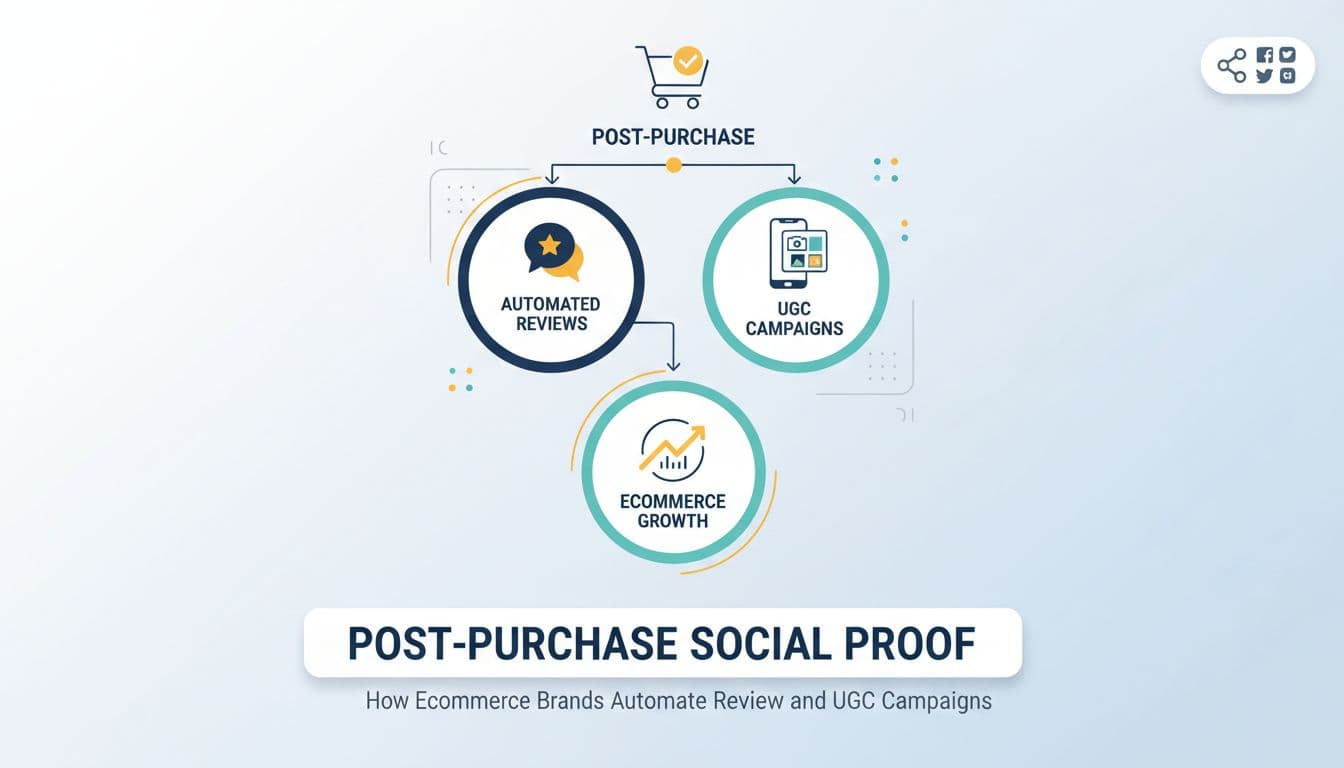
Your customers are writing your best marketing content right now. Five-star reviews, unboxing videos, DMs that say 'I told all my friends about this' — it's all sitting in your review platforms, your email inbox, and your tagged posts. And most of it never gets posted.
That's the quiet failure most ecommerce brands share. Not a lack of good content. A lack of a system to turn that content into something that actually ships.
In 2026, the brands pulling ahead on social aren't the ones with the biggest creative budgets. They're the ones that figured out how to make their customers' words work harder — automatically, consistently, and across every platform where buyers spend time. This guide breaks down exactly how to build that system.
Why Post-Purchase Social Proof Is Your Most Valuable Content Asset
The 79% Problem Most Brands Ignore
Here's a number worth sitting with: 79% of purchase decisions are influenced by social proof. Reviews, testimonials, photos from real customers — that content moves product. And yet most ecommerce brands treat it like an afterthought.
The typical workflow looks like this. A customer leaves a glowing five-star review on Shopify or Amazon. Someone on the team sees it, thinks 'we should post that,' and then moves on to seventeen other things. The review sits there. The moment passes. Three months later, someone suggests 'we should be doing more with our reviews' in a team meeting, and the cycle starts over.
This isn't a motivation problem. It's an infrastructure problem. Post-purchase social proof — reviews, testimonials, and user-generated content — drives nearly 8 in 10 purchase decisions, but most ecommerce brands collect this content manually and never repurpose it across social channels in any systematic way. The content exists. The demand for it exists. The missing piece is a repeatable system that turns customer feedback into published posts without requiring someone to manually copy, format, resize, caption, and schedule every single piece across six platforms.
When you look at where ecommerce brands actually spend their content budget, the irony is sharp. Teams pay for professional photography, ad creative, and influencer partnerships while sitting on hundreds of authentic customer photos and reviews that would outperform all of it — if they ever got posted.
The fix isn't hiring more people. It's building a system.
What 'Social Proof Content' Actually Includes
Before building an automation system, it helps to get specific about what you're working with. Post-purchase social proof isn't just star ratings. It includes written reviews on platforms like Shopify, Amazon, Google, and Trustpilot. It includes customer photos and videos tagged on Instagram or TikTok. It includes DMs and email replies where customers describe their experience. It includes unboxing videos, before-and-after photos, and comment sections where customers recommend your product to strangers.
Each of these content types works differently on different platforms. A detailed written review makes a great LinkedIn carousel or Instagram caption. A short punchy quote works as an Instagram Story overlay or a TikTok text post. A customer video is perfect for TikTok and Instagram Reels. The raw material is rich — the problem is that turning it into platform-ready content takes time and a system most teams don't have.
The Real Cost of Doing This Manually
Think about what it actually takes to manually repurpose one customer review across your social channels. You find the review. You decide if it's strong enough to post. You write a caption for Instagram. You resize the graphic for Stories. You reformat the quote for LinkedIn. You schedule each post individually. You repeat this for TikTok, Facebook, and X.
For one piece of content, you might spend 45 minutes to an hour. If you're posting three to five pieces of social proof per week — which is a reasonable cadence for an active ecommerce brand — that's three to five hours per week just on this one content type. Across a month, that's a full workday gone. And that's before you factor in the approval process, the asset management, or the performance tracking. This is why most brands don't do it consistently. Not because they don't see the value, but because the manual effort doesn't scale.
Building an Autonomous Review-to-Social Pipeline
Automating Collection and UGC Scheduling: The 10-Hour Equation
Automating review collection and UGC scheduling saves 10 or more hours per week for ecommerce teams while increasing content velocity by three to five times — without making the content feel less authentic. That's not a small efficiency gain. That's the difference between a team that's constantly behind and one that has a content calendar filled three weeks out.
Here's what that automation looks like in practice. Instead of manually checking review platforms, an automated system monitors your review sources and flags high-quality testimonials as they come in. Instead of manually reformatting content for each platform, AI handles the resizing, caption writing, and hashtag research. Instead of scheduling posts one by one, your entire week's social proof content gets queued up and published at optimal times — automatically.
The content velocity increase is real and measurable. A brand that was posting one or two testimonials per week manually can publish six to ten pieces of social proof content per week with automation, across multiple platforms, without adding headcount. The content is more consistent, more frequent, and — because it's based on real customer language — more authentic than anything a copywriter would produce from scratch.
Aidelly's agentic workflows are built for exactly this. AI agents handle the end-to-end process: pulling high-performing reviews, generating platform-specific captions that match your brand voice, and scheduling posts at peak engagement windows. Your team reviews and approves before anything goes live, but the heavy lifting is done.
How AI Agents Handle Platform-Specific Formatting
One of the hardest parts of repurposing social proof content is that every platform has different requirements, different audiences, and different content norms. What works on Instagram Stories does not work on LinkedIn. What performs on TikTok needs a completely different approach than what you'd post on Facebook.
AI agents can autonomously identify high-performing customer reviews, format them for platform-specific requirements — Instagram Stories, TikTok, LinkedIn carousel posts — and schedule them at optimal times without human intervention. This is where the technology stops being a novelty and starts being useful infrastructure.
A five-star review that says 'This skincare routine completely changed my skin in 30 days — I've tried everything and nothing worked until this' can become five different pieces of content. On Instagram Stories, it's a bold quote card with your brand colors. On TikTok, it becomes a text-overlay hook for a short video. On LinkedIn, it anchors a carousel post about your product development process. On X, it's a short punchy quote with a link to the full review. Each version is formatted for that platform's dimensions, character limits, and audience expectations — automatically. The AI doesn't just copy and paste. It rewrites the content to fit each context, applies your brand voice guidelines, selects from your approved asset library, and queues everything for review.
The Approval Layer: Keeping Humans in the Loop
Full automation doesn't mean zero human oversight. The best ecommerce social proof systems have a clear approval gate before anything goes live. This matters for a few reasons. You need to verify you have permission to use a customer's photo or quote. You want to catch anything that might be taken out of context. And you want to make sure the content still feels intentional, not robotic.
Approval workflows in a well-designed system are fast. You're not writing from scratch or reformatting anything — you're reviewing a finished draft and clicking approve or request changes. That review step might take five minutes per post instead of 45. The time savings are dramatic, and you maintain full control over what gets published. Aidelly's approval workflow is built into the scheduling process, so content moves from AI draft to team review to scheduled post in one place. Nothing gets published without a human sign-off, but the human's job is judgment, not production.
What Happens When You Actually Publish Consistently
Engagement Rates and Repeat Purchase Intent: The Data Behind the Strategy
Brands that systematically repurpose post-purchase content see 23 to 34% higher engagement rates and an 18% increase in repeat purchase intent. Those are significant numbers, and the reason behind them is worth understanding — because it changes how you think about social proof content.
The engagement lift comes from authenticity. When a real customer says your product changed their life, that post performs differently than a polished brand ad. Social media algorithms pick up on engagement signals, and audiences respond to content that feels real. A screenshot of a genuine review with a simple caption consistently outperforms a professionally designed promotional graphic because people trust other people more than they trust brands.
The repeat purchase intent increase is even more interesting. When existing customers see their own community reflected back at them on social media — people like them, with similar problems, getting real results — it reinforces their decision to buy again. Social proof content isn't just acquisition marketing. It's retention marketing. It reminds your existing customers why they chose you and gives them new reasons to come back.
Brands that post social proof content sporadically, maybe once a month when someone remembers to do it, don't see these results. The lift comes from consistency. When customers see real reviews and UGC showing up regularly in their feeds, it builds a cumulative impression. The brand feels trusted, popular, and worth recommending.
The Collection-to-Publishing Gap: Where Most Brands Fail
The gap between collection and publishing is where most ecommerce brands fail. They have customer testimonials. They have tagged photos. They have DMs from happy customers. But they lack a system to transform, approve, and schedule that content across six platforms simultaneously — so it just sits there.
This gap is not a content quality problem. Most ecommerce brands have excellent social proof content available to them. The problem is operational. The content lives in too many places: review platforms, email inboxes, Instagram DMs, TikTok comment sections, Google reviews. There's no central place where it gets collected, evaluated, and moved into a publishing workflow.
Then there's the transformation problem. Even when someone finds a great review, turning it into six platform-ready posts requires design skills, copywriting, platform knowledge, and time. Most small ecommerce teams don't have all of those things available on demand. So the review gets saved in a folder somewhere, and the folder grows, and the content never ships. The brands that close this gap treat their review content like a production pipeline with defined inputs, a transformation layer, an approval step, and a publishing schedule. Each stage is systematized. Nothing depends on someone remembering to do it.
Building a Review Content Calendar That Actually Holds
A content calendar for social proof works differently than a standard editorial calendar. You're not planning topics in advance — you're building a system that pulls from a live stream of incoming customer content and keeps your publishing queue filled automatically.
The cadence matters. For most ecommerce brands, two to four pieces of social proof content per week per platform is a sustainable and effective rhythm. That means your system needs to be generating and scheduling eight to sixteen posts per week across your active channels. Manually, that's a part-time job. With automation, it's a background process that runs while your team focuses on strategy, product, and customer relationships.
The visual content calendar in a tool like Aidelly lets you see your entire social proof pipeline at a glance. You can spot gaps, rebalance content types, and make sure you're mixing reviews, UGC photos, and video testimonials rather than posting the same format repeatedly. The calendar view also makes it easy to coordinate social proof content with product launches, seasonal campaigns, or sale periods — so your automation runs alongside your intentional marketing, not separate from it.
Cross-Platform Analytics: Knowing What Social Proof Actually Works
Not all customer reviews make equally good social media content. A detailed, story-driven testimonial might perform well on LinkedIn and Facebook but get ignored on TikTok. A short punchy quote might drive saves on Instagram but get lost on X. The only way to know what's working is to track performance across platforms and feed that data back into your content selection process.
Cross-platform analytics let you see which types of social proof content drive the most engagement, saves, link clicks, and conversions — by platform. Over time, you build a clear picture of what your audience responds to. You learn that before-and-after testimonials outperform general praise. You learn that reviews mentioning specific results — lost 12 pounds, saved $200, delivered in two days — outperform vague positive feedback. You learn which posting times get the most reach on each channel.
This data makes your content selection smarter over time. When you know that detailed outcome-based reviews perform 40% better than general praise on Instagram, you start prioritizing that content type in your queue. The pipeline gets more effective without requiring manual analysis or strategy sessions every week. You review the data, adjust the inputs, and the results improve.
Your customers are already doing the work. They're writing reviews, posting photos, and telling their friends about your product. The only question is whether you have a system to capture that content and put it to work across every platform where your next customer is scrolling right now. The brands that build this system — automating the collection, formatting, approval, and scheduling of social proof content — don't just save time. They publish more, engage more, and convert more, without burning out their teams or sacrificing the authenticity that makes social proof work in the first place. If your review content is sitting in a folder somewhere waiting for someone to have time, that's the bottleneck worth fixing first — and the right tools make it a lot more solvable than it looks.
If you want a low-lift way to apply these ideas, Aidelly helps you keep your social content consistent without extra busywork.The brands winning with post-purchase social proof aren't the ones collecting more reviews. They're the ones who've automated the entire pipeline: collection, formatting, approval, and scheduling across every platform at once. That's where most ecommerce teams get stuck. With agentic workflows, you hand off the repetitive work to AI agents that identify your best customer content, adapt it for Instagram, TikTok, and LinkedIn, and publish it when your audience is actually paying attention. Your team stays focused on strategy and brand voice while the system handles the operational load. Ready to turn your customer reviews into a content machine? Start with Aidelly.
Compare social scheduling tools
Evaluating software for your content workflow? Use our buyer guides and comparisons to compare scheduling, approvals, analytics, and AI workflow fit.