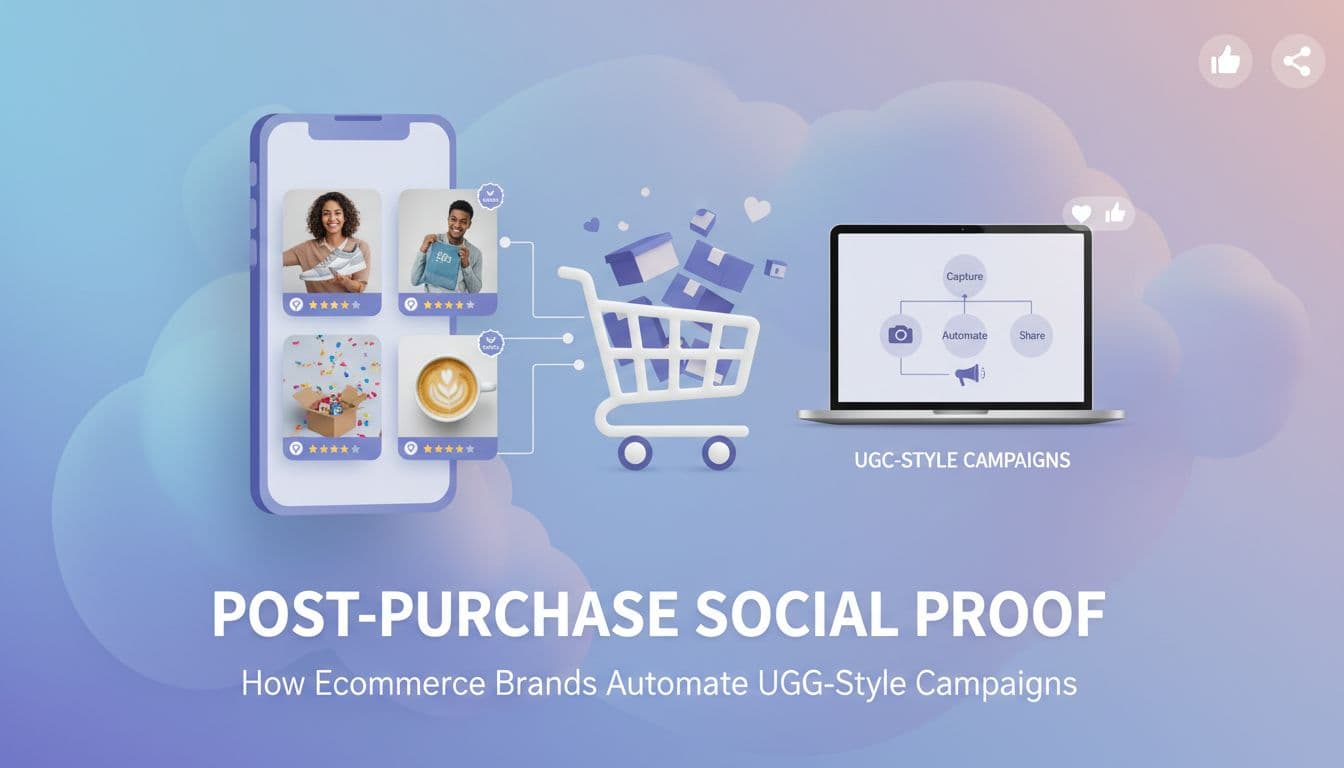
Post-Purchase Social Proof: How Ecommerce Brands Automate UGC-Style Campaigns
Most ecommerce brands know that customer content converts better than branded content. A real photo from a real buyer beats a studio shot almost every time. But knowing that and actually building a system around it are two completely different things. The gap between those two things is where most brands lose. They collect a few customer photos, post them when someone remembers to, and wonder why their UGC strategy never gains traction. The problem is not the content. The problem is the workflow. Post-purchase social proof campaigns drive 29% higher conversion rates on repeat purchases, but only when that content reaches your audience fast enough to matter. This article breaks down why timing is everything, where manual workflows fall apart, and how agentic AI is helping small ecommerce teams run always-on UGC campaigns without adding headcount.

Wilzer Jean-Baptiste
10 min read
You already know that customer content converts better than anything your creative team produces. A real buyer holding your product beats a studio shot. A genuine review beats a tagline. You know this. But knowing it and actually building a system that captures, approves, and posts that content before the moment passes are two completely different things. Most ecommerce brands are stuck in the gap between those two things, and it is costing them more than they realize.
Why Post-Purchase Social Proof Works (And Why Timing Is Everything)
The 29% Conversion Lift Is Real, But It Has a Catch
Post-purchase social proof campaigns drive 29% higher conversion rates on repeat purchases when customers see peer validation immediately after buying. That stat gets passed around a lot in ecommerce circles, but the second half of it gets ignored: the word immediately.
Here is what actually happens in a buyer's brain right after a purchase. They feel a mix of excitement and mild anxiety. Did I make the right call? Is this going to be as good as it looked? That window, the 24 to 48 hours after checkout, is when social proof hits hardest. When a new customer sees someone else unboxing the exact product they just bought, or reading a glowing review from a buyer with a similar problem, it does two things. It confirms their decision. And it primes them to buy again.
This is not just about first-time buyers either. Repeat purchase rates climb when customers stay in your social ecosystem after checkout. They see your feed. They see other customers. They feel like part of something. That feeling is worth a lot more than a discount code in a follow-up email.
The catch is that this only works if the content is fresh. A customer photo posted three weeks after purchase does not create urgency. It does not feel current. It does not make someone think, "people are buying this right now." Timing is the mechanism that makes social proof work, and most brands are blowing it.
UGC Within 24-48 Hours Creates FOMO That Branded Content Cannot
UGC-style content, customer photos, reviews, and testimonials, posted to brand social channels within 24 to 48 hours of purchase creates urgency and FOMO that influences lookalike audiences in a way that polished branded content cannot replicate.
Think about what a lookalike audience sees when they land on your Instagram profile or scroll past one of your posts. If your feed is full of studio shots and promotional graphics, it looks like advertising. Their guard goes up. But if they see a real person holding your product, writing about how it solved their problem, that reads as evidence. Someone chose this brand and liked it enough to share it publicly. That is a completely different signal.
The 24 to 48 hour window matters for a specific reason. When a customer posts about a purchase right after it arrives, the content carries a timestamp of excitement. It feels like news. When that content gets reshared by the brand within that same window, it amplifies the moment. New buyers see it and feel the pull. Prospective customers who have been sitting on the fence see real people making decisions and feel the momentum.
Platforms like Instagram and TikTok also reward recency. Content that gets engagement quickly gets pushed further. A customer photo reshared within 24 hours has a better chance of reaching new eyes than the same photo posted a week later. The algorithm and the psychology work together, but only if you move fast.
The Window Closes Faster Than You Think
There is a reason most brands struggle to act on this knowledge. The window is narrow. A customer's excitement peaks in the first day or two after delivery. After that, life moves on. They are not thinking about your brand anymore. If you want to capture that energy and turn it into content that drives your next wave of buyers, you need a system that moves at the speed of that excitement, not the speed of your team's to-do list.
Most brands do not have that system. And that gap is exactly where the opportunity lives. The brands that figure out how to close the gap between purchase and published social proof are the ones building real community momentum, not just a content calendar that looks busy.
Where Manual UGC Workflows Break Down
The Bottleneck Nobody Talks About
Manual UGC collection and posting creates bottlenecks that kill momentum. This is the part of the conversation that most ecommerce content guides skip, probably because the solution used to be "just hire someone to manage it." But even with a dedicated person, the workflow has structural problems that headcount alone cannot fix.
Here is what the manual process looks like at most brands. A customer posts a photo or leaves a review. Someone on the team spots it, saves it, and adds it to a shared folder or Slack channel. Then it sits there until someone has time to write a caption, get approval from a manager or brand lead, figure out which platform it should go on, and schedule it. By the time that post goes live, it is often five to ten days after the original purchase. Sometimes longer.
That delay is not just a logistics problem. It is a conversion problem. The customer who posted that photo has already moved on. The algorithm has already buried their original post. The lookalike audience that could have seen that content at peak relevance never saw it at all. You did not lose the content. You lost the timing, and timing was the whole point.
Approval workflows are often the biggest culprit. A brand manager needs to check that the content meets guidelines. Legal might need to confirm usage rights. A designer might want to add a frame or logo. Each of those steps adds hours or days. Multiply that across dozens of customer posts per week and you have a content pipeline that is permanently behind.
Small Teams Feel This Pain the Most
If you are running social media for a DTC brand with a team of two or three people, this bottleneck hits differently. You are not just managing UGC. You are also writing product descriptions, running ads, answering DMs, planning launches, and trying to keep a content calendar from falling apart. UGC collection and posting is important, but it rarely feels urgent enough to jump the queue until you realize your feed has gone three weeks without a customer post.
Agencies managing multiple ecommerce clients feel this too. Each client has different approval processes, different brand guidelines, different platforms they care about. Coordinating UGC across five or six clients manually is not a content strategy. It is a second job.
The result is that most brands end up with a UGC strategy that looks great on paper and underperforms in practice. They have the customer content. They believe in it. They just cannot move fast enough to make it work the way it should. The content exists. The system to deploy it does not.
Momentum Is the Asset You Keep Losing
Here is the thing about social proof: it compounds when it is consistent and loses its power when it is sporadic. A brand that posts customer content every two or three days builds a feed that feels alive and trusted. A brand that posts customer content once every few weeks just looks like it occasionally remembers to do it.
Consistency is not a creative problem. Most brands have enough customer content sitting in their mentions, their review inboxes, and their tagged posts. The problem is operational. And operational problems need operational solutions, not more creative effort or another hire you cannot afford. The gap between having UGC and deploying it effectively is almost always a workflow problem, and that is a solvable problem.
How Agentic Workflows Make UGC Campaigns Hands-Off
What Agentic AI Actually Does in a UGC Pipeline
Agentic workflows eliminate the UGC bottleneck by automatically requesting, curating, and publishing customer content to the right platforms at peak engagement times. That sentence sounds simple, but it represents a complete shift in how ecommerce brands think about content operations.
An agentic workflow does not wait for a human to notice a customer post and add it to a folder. It monitors for customer content, flags it, checks it against brand guidelines, drafts a caption in the brand's voice, routes it through an approval step if needed, and schedules it for the optimal posting time on the right platform. All of that happens without someone manually moving a file from one place to another.
Aidelly's agentic workflows are built for exactly this kind of pipeline. AI agents handle the end-to-end process: from content drafting to scheduling to performance tracking. For ecommerce brands using post-purchase UGC, that means a customer photo can go from inbox to scheduled post in a fraction of the time it would take a human to process it. The brand voice and asset management features make sure every reshared post sounds like the brand, not like a generic caption someone typed in thirty seconds.
The approval workflow piece is important here. Agentic does not mean unreviewed. It means the heavy lifting, the drafting, the formatting, the timing decisions, happens automatically so that human review becomes a quick yes or no instead of a multi-step production. That is the difference between a bottleneck and a checkpoint.
3-5x Faster Content Velocity Without Adding Headcount
Brands that automate post-purchase social campaigns see 3 to 5 times faster content velocity and reduce the time-to-post from weeks to hours, keeping social feeds fresh without hiring more creators. That is not a marginal improvement. It is a structural change in what a small team can produce.
Think about what 3 to 5 times faster means in practice. If your current workflow gets a customer post from submission to published in ten days, an automated pipeline gets it live in two days or less. If you are currently publishing four UGC posts per month, that same team effort could support fifteen to twenty posts per month with automation handling the logistics.
That volume matters because social media algorithms reward consistent posting. A feed that updates regularly gets more reach. More reach means more impressions on your UGC content. More impressions on customer photos means more social proof in front of more prospective buyers. The compounding effect of faster content velocity is real, and you do not need a bigger team to capture it.
Aidelly's visual content calendar and auto-scheduling features make this visible. You can see your entire UGC pipeline mapped out across platforms, know exactly when each post is going live, and adjust without rebuilding the whole schedule from scratch. For a social media manager juggling multiple channels, that visibility alone saves hours every week.
The Always-On UGC Campaign Is Now Possible for Small Brands
Until recently, always-on UGC campaigns were mostly a big-brand advantage. Enterprise teams had the headcount to monitor customer content, manage approvals, and keep posting schedules tight. Smaller brands had to pick their spots and accept that their UGC strategy would be inconsistent.
Agentic AI changes that equation. A two-person marketing team at a DTC skincare brand can now run a post-purchase social proof campaign that operates around the clock, posting customer content within 24 to 48 hours of purchase, optimized for each platform, without anyone staying late to queue up posts.
The competitive advantage here is not just efficiency. It is the ability to show up consistently in your customer's feed at the exact moment they are most likely to buy again or tell a friend. That kind of presence used to require a team. Now it requires a workflow. And the brands that build that workflow first are the ones that will own the social proof advantage in their category.
Post-purchase social proof is one of the highest-leverage moves in ecommerce marketing, but it only works when the content reaches your audience fast enough to matter. The 29% conversion lift, the FOMO it creates in lookalike audiences, the compounding effect of consistent UGC posting — all of that depends on a system that moves at the speed of your customers' excitement, not the speed of a manual approval queue. The brands winning at this in 2026 are not the ones with the biggest creative teams. They are the ones that built agentic workflows to handle the logistics automatically, so their team can focus on strategy instead of file management. If you are ready to turn your post-purchase content into an always-on campaign that runs without you babysitting it, the right platform makes all the difference.
If you want a low-lift way to apply these ideas, Aidelly helps you keep your social content consistent without extra busywork.The brands winning with post-purchase UGC aren't spending more time on social media. They're spending less. Instead of juggling approvals, scheduling, and platform management across your team, agentic workflows handle the entire cycle for you. Your AI agents request content from customers, curate what works, and publish it at peak times across all your channels. while you focus on what actually moves the needle. Ready to turn UGC from a bottleneck into your competitive edge? Start building at aidelly.ai.
Compare Social Scheduling Tools
Evaluating software for your content workflow? Use our buyer guides and comparisons to compare scheduling, approvals, analytics, and AI workflow fit.
Share this article
Related Articles
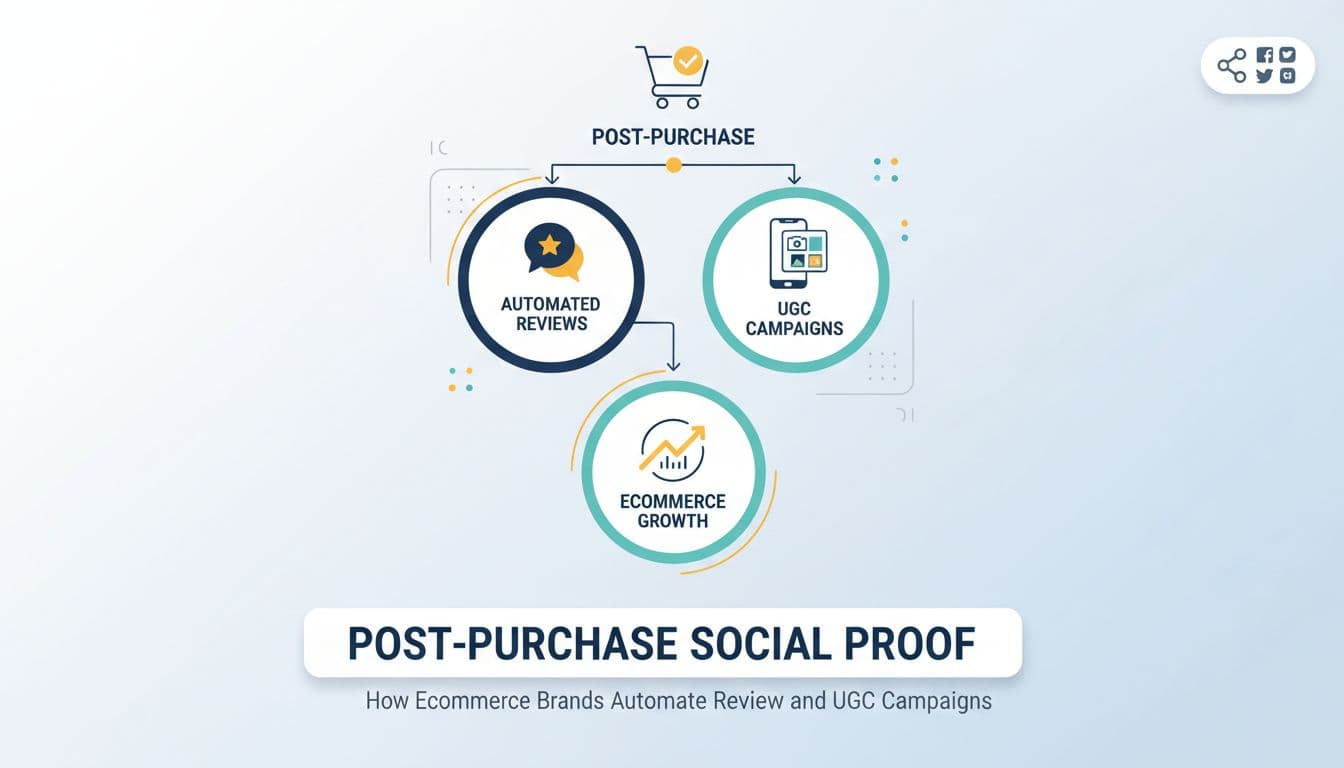
Post-Purchase Social Proof: How Ecommerce Brands Automate Review and UGC Campaigns
Your customers are writing your best marketing content right now. Five-star reviews, unboxing videos, DMs that say 'I told all my friends about this' — it's all sitting there, mostly unused. Most ecommerce brands collect reviews manually, maybe screenshot a testimonial once a month, and call it a social media strategy. That's not a strategy. That's a missed opportunity running on repeat. The brands winning on social in 2026 have figured out something important: post-purchase content is not a nice-to-have. It's a content engine. And when you automate the process of collecting, formatting, and scheduling that content across platforms, you stop scrambling for ideas and start publishing proof. This guide breaks down exactly how to build that system — and why the gap between collecting reviews and actually posting them is where most brands quietly lose.
Jul 12, 2026
Read more
How Ecommerce Brands Build Always-On Social Campaigns Between Product Launches
Most ecommerce brands treat social media like a launch megaphone. They go loud for a drop, then go quiet. The audience forgets them. The algorithm buries them. And when the next launch comes, they're starting from scratch again. There's a better way to run social between launches, and it doesn't require a content team on standby or a brainstorm session every Monday. It requires a system. Always-on social media campaigns keep your brand visible, build trust with your audience, and warm people up before your next drop. The brands doing this well aren't posting more manually. They're running agentic AI workflows that handle content creation, scheduling, and optimization in the background while the human team focuses on the next product. This article breaks down exactly how to build that engine.
Jun 19, 2026
Read more
Social Media ROI for Ecommerce: How to Tie Scheduled Posts to Revenue
Most ecommerce brands spend hours every week on social media and have no idea how much money it actually makes them. They can tell you their follower count. They can tell you which post got the most likes last month. But ask them how much revenue came from Instagram last Tuesday, and you get a shrug. That gap between posting and profit is not a content problem. It's an infrastructure problem. This article breaks down exactly how to connect your scheduled posts to real sales numbers, starting with the metrics that matter, moving through UTM tracking and attribution models, and ending with how agentic AI workflows can close the loop automatically. If you're tired of posting into the void and ready to treat social media like a revenue channel, this is where you start.
Jun 5, 2026
Read moreReady to never miss a post again?
Tell Aidelly what to post. It drafts, schedules, and publishes across 9 platforms while you focus on your business.