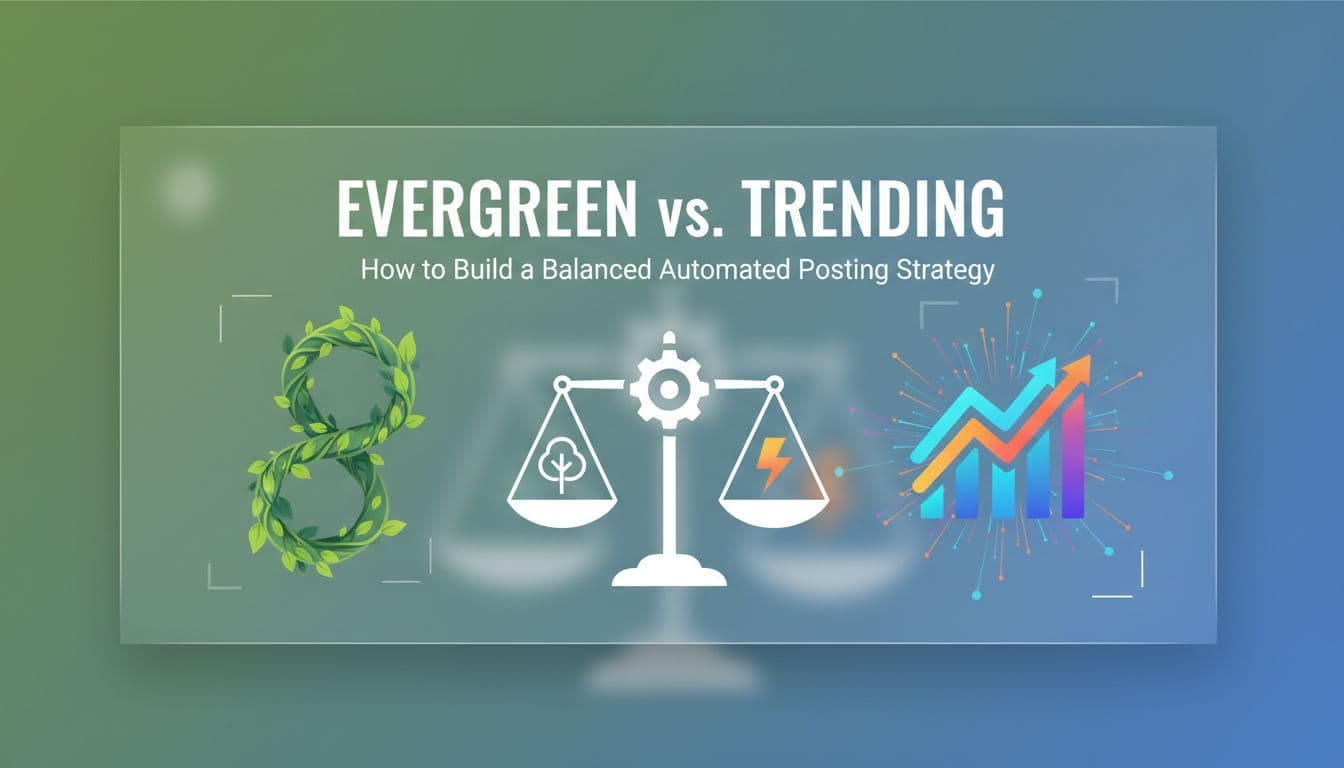
Evergreen vs. Trending: How to Build a Balanced Automated Posting Strategy
Most social media managers are stuck in one of two traps. They either batch a month of evergreen content and go quiet when something big happens, or they spend every week chasing trends and never build a content library that compounds over time. Neither approach works on its own. The real answer is a system that handles both, automatically. This guide breaks down how to split your content between evergreen and trending posts, which platforms reward which type, and how agentic AI can run the whole operation without you manually babysitting every post. If you want a content calendar that stays consistent and stays relevant, without burning out your team, this is the strategy you need.

Wilzer Jean-Baptiste
13 min read
You probably already know you need both evergreen and trending content. What nobody tells you is how to actually run both at the same time without losing your mind. Most teams pick one. They either batch a library of evergreen posts and autopilot for weeks, or they spend every Monday scrambling to react to whatever blew up over the weekend. Both approaches leave money on the table. The fix is not working harder on both sides. The fix is building a system where evergreen content runs on autopilot and trending content gets handled the moment it matters. That system exists. And once it is running, your content calendar basically manages itself.
Understanding the Two Types of Content and Why You Need Both
Before you can build a system, you need to understand what each type of content actually does for you. They serve completely different purposes, and treating them the same way is one of the most common mistakes social media managers make.
Evergreen Content: Your Always-On Foundation
Evergreen content is the stuff that keeps earning attention long after you hit publish. A tip about how to write a better email subject line is just as useful in October as it was in January. A customer success story about how a small bakery doubled its online orders does not expire. FAQs, product explainers, how-to guides, and beginner tutorials all fall into this category.
Here is why this matters: evergreen content compounds. A well-written post about LinkedIn profile optimization might get 200 views the week you publish it, then quietly collect another 2,000 over the next six months through search, shares, and reposts. You do the work once and it keeps delivering. That is a fundamentally different return on effort than a trending post that peaks in 48 hours and then goes silent.
The other advantage is that evergreen content is plannable. You can write it ahead of time, batch it in a single session, and schedule it weeks or months out. That predictability is what gives you breathing room to handle everything else. Think of it as the bedrock of your content calendar. Everything else gets built on top of it.
Trending Content: Your Reach Multiplier
Trending content does something evergreen content cannot: it puts you in front of people who have never heard of you, right now, while they are already paying attention to something. A meme that references a viral moment, a Reel using a trending audio clip, a hot take on a news story in your industry, a TikTok that riffs on a format everyone is using this week. These posts can spike your reach dramatically in a short window.
The catch is timing. Trending content has a shelf life measured in hours, sometimes days. React too slowly and the moment is gone. Post something that was trending last week and you look out of touch. This is why so many brands either skip trending content entirely or post something cringe-worthy because they rushed it without thinking.
But when you get it right, the payoff is real. A single trending post can bring in more new followers in one day than a month of evergreen content. The key is having a system that lets you move fast without making mistakes. That means having your brand voice documented, your approval process tight, and your creative team ready to execute quickly when a moment appears.
The Right Mix: 60 to 80 Percent Evergreen, 20 to 40 Percent Trending
There is no universal ratio that works for every brand, but the most reliable starting point is 60 to 80 percent evergreen content and 20 to 40 percent trending. For a brand posting five times a week, that might look like four evergreen posts and one trending post. For a brand posting daily, it might be five evergreen posts and two trending posts per week.
The exact split depends on three things: your audience, your platform, and your resources. A B2B software company on LinkedIn can lean heavily evergreen because their audience is there for insights, not entertainment. A streetwear brand on TikTok probably needs to flip that ratio because their audience expects to see them participating in culture in real time. A solopreneur with no team needs to be realistic about how much trending content they can actually produce without it becoming a second full-time job.
Start with 70 percent evergreen and 30 percent trending. Run it for 60 days. Then look at your analytics and adjust. You will quickly see whether your audience responds more to consistent educational content or to reactive, culturally aware posts. Let the data move the dial, not your gut.
Building a System Where Both Types Run Without Constant Babysitting
Knowing the right content mix is one thing. Actually executing it without burning out your team is another. The answer is not hiring more people. The answer is building a workflow where evergreen content is handled automatically so your team has capacity to handle trending moments when they happen.
Auto-Scheduling Evergreen Content to Free Up Your Team
The single best thing you can do for your content strategy is to get your evergreen posts off your plate completely. Batch-write a month of evergreen content in one or two sessions. Load it into your scheduler. Set it and walk away. Your tips, tutorials, customer stories, and FAQs go out on schedule without anyone touching them.
This is not just a time-saver. It is a strategic move. When your evergreen queue is full, your team is not scrambling to fill the calendar every week. They have mental bandwidth to watch for trends, write reactive posts, and actually think creatively instead of just keeping the lights on. You do not have to choose between consistent content and timely content. Auto-scheduling evergreen posts means you get both. Aidelly's visual content calendar makes this easy to see at a glance: you can see exactly which days are covered by evergreen posts and which slots are open for trending content to slot in.
The other benefit is consistency. Brands that post consistently outperform brands that post in bursts. Auto-scheduling keeps your cadence steady even during holidays, product launches, or the weeks when your team is slammed. Your audience keeps seeing you. Your engagement baseline stays healthy. And when a trending moment hits, you can jump on it without worrying that you are going dark on your regular content.
Platform Rhythms: Matching Your Content Type to the Right Channel
Not every platform rewards the same type of content. Posting the same thing everywhere at the same frequency is one of the fastest ways to underperform on all of them. Each platform has its own culture, its own algorithm, and its own audience expectations.
LinkedIn rewards long-form evergreen thought leadership. A 500-word post about a hard lesson you learned building your business will outperform a meme every single time on that platform. The LinkedIn audience is there to learn and grow professionally. Give them insight and they will reward you with comments, shares, and profile visits. Trending content can work on LinkedIn, but it needs to be tied to something genuinely relevant to your industry, not just a viral moment from pop culture.
TikTok and Instagram Reels are the opposite. They are built for fast-turn, format-native content. Trending audio, popular video formats, and culturally aware hooks drive discovery on these platforms. Evergreen content can still work here, but it needs to be packaged in a way that fits the platform's energy. A tutorial or tip video can absolutely be evergreen content, but it needs to feel current in its presentation.
X sits in the middle. It can handle both long-form threads that age well and rapid-fire reactive posts that ride a news cycle. Many brands use X as their trending content hub and cross-post polished evergreen content from other platforms. The key is knowing what your audience on each platform actually wants and building your scheduling strategy around that, not around what is easiest for you to produce.
Timing Your Posts for Maximum Impact
The best time to post is not the same for every platform, every audience, or every type of content. A LinkedIn post published at 7am on a Tuesday will outperform the same post published at 9pm on a Saturday. A TikTok posted during peak evening scroll time will get more initial push than one posted at 6am. These patterns are real and they matter.
Scheduling tools solve this problem by letting you queue evergreen content at proven peak times for each platform. You write the post once, set it to publish at the optimal window, and the tool handles the rest. You are not manually logging into six platforms at 7am to hit the right timing. The queue does it for you.
The smarter move is to use your analytics to find your specific audience's peak times, not just generic industry benchmarks. Your followers might be night-shift workers who scroll at 11pm. Your B2B audience might be most active on Thursday mornings. Real data from your own account always beats averages. Once you know your windows, you fill your evergreen queue to hit those times automatically and leave a few open slots each week for trending posts that need to go out fast, regardless of the optimal time, because timeliness matters more than timing when a trend is moving.
Using AI and Agentic Workflows to Run the Whole System
Everything covered so far can be done manually with enough discipline and the right tools. But the real unlock is using AI to handle both sides of the content equation, not just as a writing assistant, but as an autonomous system that monitors, drafts, schedules, and analyzes without you managing every step.
Guardrails for Trending Content: Brand Voice and Approval Workflows
Trending content is where brands get into trouble. A reactive post written in a hurry, without proper review, can go off-brand fast. A joke that lands wrong. A meme that misreads the room. A news hook that accidentally associates your brand with something you do not want to touch. These mistakes happen when speed is prioritized over process.
The fix is guardrails. Specifically, two of them. First, a stored brand voice document that anyone writing reactive content can reference instantly. What words do you use? What tone do you take? What topics do you avoid? When this is documented and accessible, even a new team member can write a trending post that sounds like your brand. Aidelly's brand voice and asset management feature keeps these guidelines stored and attached to every drafting session, so the AI and your team are always working from the same foundation.
Second, an approval workflow. Before any trending post goes live, it goes through a quick review gate. This does not have to be slow. A one-person approval step that takes five minutes is enough to catch most mistakes. Aidelly's approval workflow lets you set up team review gates so nothing publishes without the right eyes on it. Speed and safety do not have to be in conflict. With the right process, you can move fast and still protect your brand.
Analytics That Feed Your Next Content Calendar
A content strategy without analytics is just guessing. And most teams look at their analytics after the fact, note what performed well, and then promptly forget about it when they sit down to plan next month's content. The data never actually changes what they do. That is a waste.
The right way to use analytics is as a feedback loop. Look at your evergreen posts. Which ones are still earning engagement three months after you published them? Those are your best performers. Repurpose them. Turn a top-performing LinkedIn post into a carousel. Turn a high-traffic FAQ into a video. Schedule them again in a different format. Evergreen content that already proved itself is the safest bet for your next batch.
For trending content, the question is different. Which trends actually converted? Getting 10,000 views from a trending audio clip is exciting, but if none of those viewers followed you or clicked through, the trend did not work for your business. Track which trending posts drove real outcomes: follows, link clicks, saves, DM inquiries. That tells you which types of trends are worth chasing again and which ones just generate noise. Cross-platform analytics in one dashboard make this comparison fast. You can see at a glance which content is working across Instagram, LinkedIn, TikTok, and X without exporting spreadsheets from four different apps.
AI Content Planning and Agentic Workflows: The Full Automation Stack
AI content planning speeds up both sides of your strategy in ways that go beyond just writing faster. On the evergreen side, AI can take your core topics, your brand voice, and your past top performers and draft a full series of posts. Give it your five main content pillars and it will generate a month of evergreen content in the time it used to take you to write one week's worth. You review, refine, and approve. The drafting is done.
On the trending side, AI can monitor real-time signals, identify what is gaining traction in your industry or niche, and suggest angles that fit your brand. Instead of spending an hour scrolling Twitter and TikTok every morning looking for something to react to, the AI surfaces the opportunities and drafts the post. You make the call on whether to publish. The creative work is already done.
Agentic workflows take this to the next level. This is where AI stops being a tool you use and starts being a system that runs. AI agents can monitor trends continuously, draft posts when something relevant surfaces, queue evergreen content at optimal times, and publish across platforms without you approving every individual action. You set the parameters: the brand voice, the content pillars, the approval rules, the posting schedule. The agents execute within those parameters. Aidelly's agentic workflows and MCP server make this possible, letting you connect AI assistants like Claude directly to your social media publishing pipeline. You can even trigger posts from a conversation with Claude without ever opening a separate scheduling tool. It is not automation for automation's sake. It is a system that keeps your content running while you focus on the work only you can do.
The evergreen versus trending debate is a false choice. You do not have to pick one and ignore the other. The brands winning on social media in 2026 are the ones that built a system where evergreen content runs automatically and trending content gets handled fast, without either side suffering. That means a full evergreen queue, platform-specific scheduling, documented brand voice, approval guardrails, and analytics that actually inform your next move. It is a lot to manage manually, and that is exactly why the right tools change everything. When your scheduler, your AI drafting, your approval workflow, and your analytics all live in one place, the system runs itself and you stop being the bottleneck.
If you want a low-lift way to apply these ideas, Aidelly helps you keep your social content consistent without extra busywork.You do not need to choose between evergreen posts that build trust and trending posts that grab attention. With Aidelly, AI agents handle both. They queue your evergreen content, spot real-time trends, draft platform-native posts, and publish across channels so your team can focus on strategy instead of scheduling.
See how agentic workflows run your entire social media process from creation to analysis. Start building a balanced strategy that works while you sleep at aidelly.ai.
Compare Social Scheduling Tools
Evaluating software for your content workflow? Use our buyer guides and comparisons to compare scheduling, approvals, analytics, and AI workflow fit.
Share this article
Related Articles
Content Creator Burnout Is a Scheduling Problem: Here's How to Fix It With Automation
Most creators assume burnout means they've lost their passion. But when you dig into what's actually draining them, it's rarely the filming, writing, or designing. It's the posting. The logging in, the reformatting, the guessing about timing, the context switching between six different apps before 9am. That's the part that grinds people down. This article breaks down why creator burnout is fundamentally an operations problem, not a creativity problem, and what you can actually do about it. You'll learn how agentic social media automation removes the repetitive work that causes burnout, how batching content in focused blocks protects your creative energy, and how tools like visual content calendars and cross-platform analytics help you stay consistent without staying stressed. If you're tired of dreading the posting part of your job, this one is for you.
Sep 13, 2026
Read more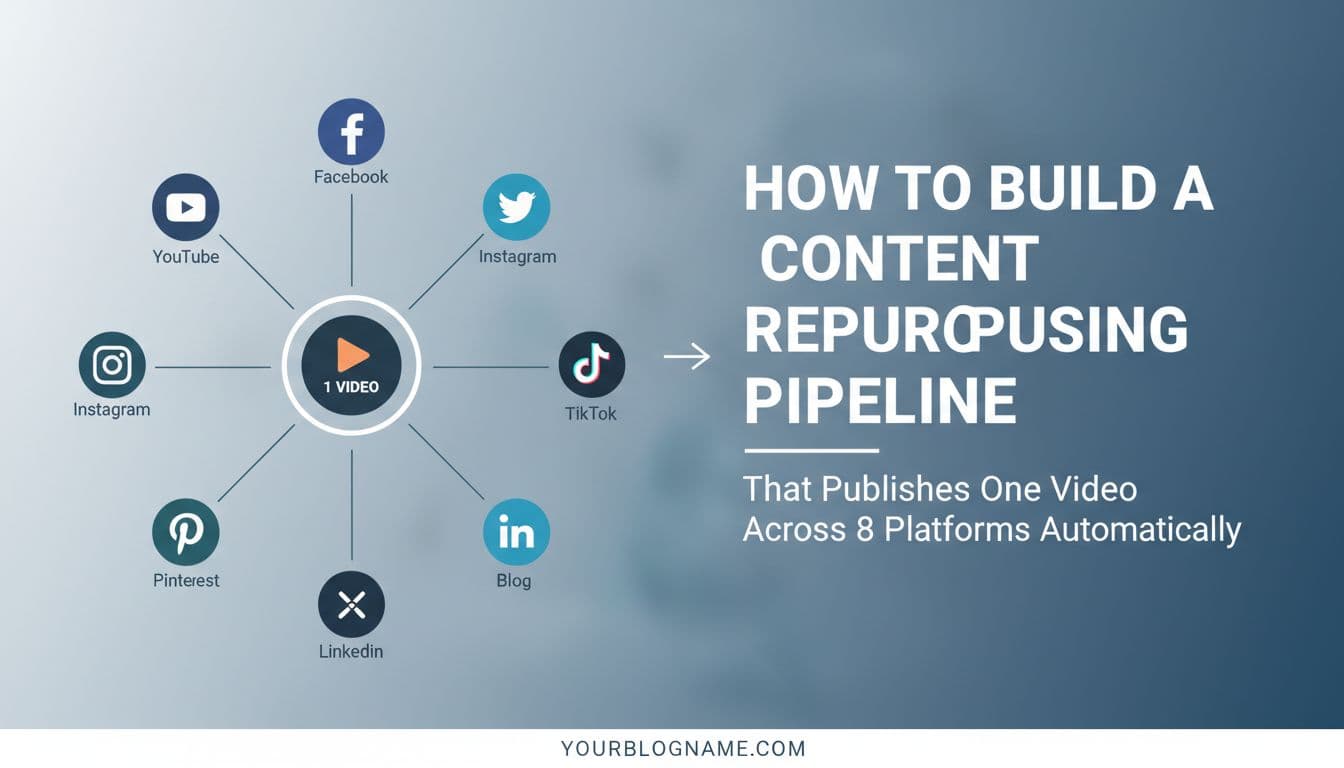
How to Build a Content Repurposing Pipeline That Publishes One Video Across 8 Platforms Automatically
You film one video. Maybe it's a 10-minute YouTube tutorial, a product demo, or a behind-the-scenes walkthrough. Then you spend the next three hours manually cutting clips, rewriting captions, adjusting aspect ratios, and scheduling posts one platform at a time. By the time you're done, the momentum is gone and you're too burned out to film the next one. There's a better way. One video can fuel your entire content calendar across Instagram, TikTok, LinkedIn, YouTube Shorts, Facebook, and X without you touching each post individually. The key isn't just repurposing — it's building an autonomous pipeline that does the adapting, scheduling, and analyzing for you. This guide breaks down exactly how to set that up, what platform-specific optimization actually looks like, and why AI agents are the missing piece most creators overlook.
Aug 26, 2026
Read more
How to Use Cross-Platform Analytics to Kill Underperforming Content Fast
Most marketing teams and solopreneurs post content, check a few numbers, and move on. But without a clear view across every platform, you're flying blind. You might be pouring time and budget into posts that nobody cares about while your best-performing content goes unnoticed on a channel you barely check. Cross-platform analytics changes that. It gives you a unified picture of what's working, what's dead weight, and where to focus next. This guide breaks down how to spot underperforming content fast, make smarter kill-or-keep decisions, and redirect your energy toward content that actually drives results. Whether you manage one brand or ten, the teams that win in 2026 are the ones who move quickly on data, not gut feeling.
Sep 5, 2026
Read moreReady to never miss a post again?
Tell Aidelly what to post. It drafts, schedules, and publishes across 9 platforms while you focus on your business.