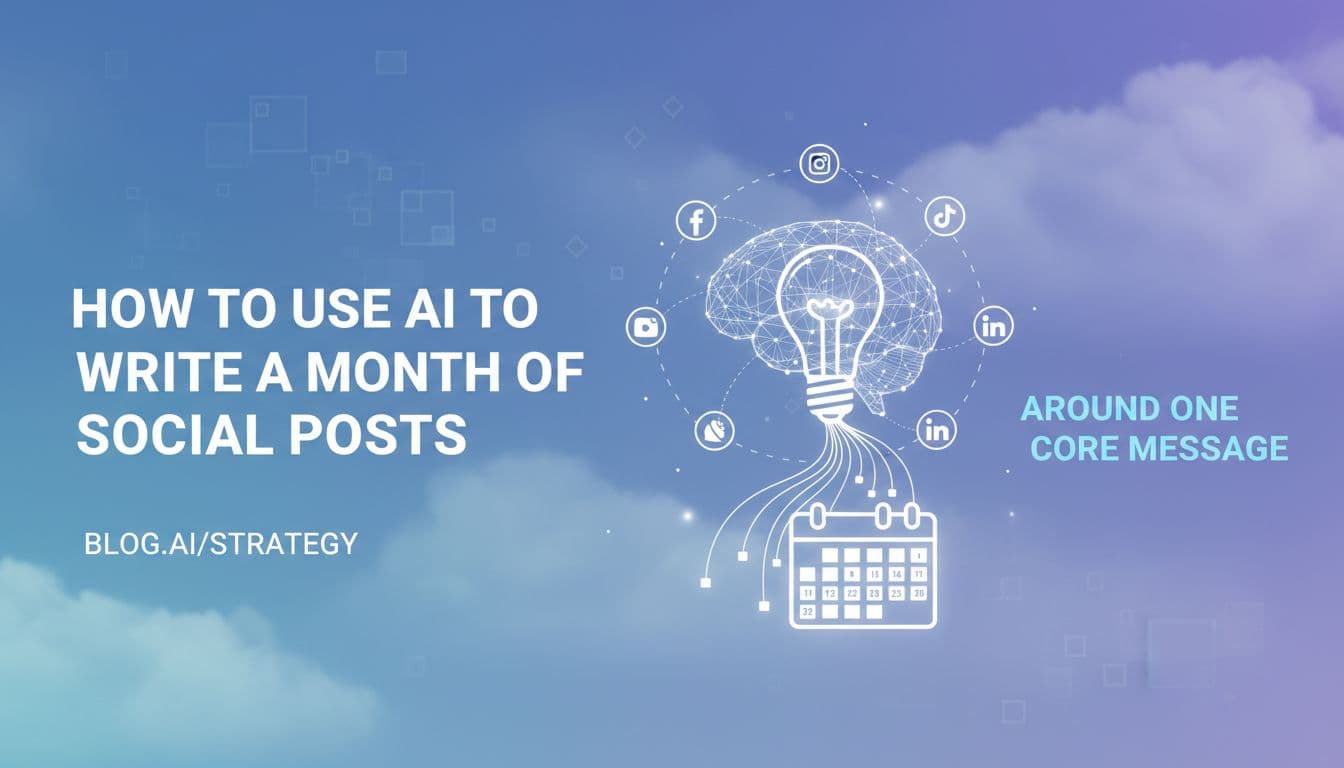
How to Use AI to Write a Month of Social Posts Around One Core Message
Most solopreneurs don't have a content problem. They have a decision problem. Every week starts with the same question: what do I post today? That question alone burns more time and mental energy than the actual writing. Here's what works instead: pick one core message per month, then let AI generate every variation you need across every platform in a single session. This approach cuts content creation time by 8-12 hours a month, keeps your brand voice consistent, and removes the daily scramble that kills creative momentum. This guide walks through exactly how to build that system, from choosing your core message to letting AI agents handle drafting, scheduling, and performance tracking automatically. If you manage social media without a full content team behind you, this is the workflow that makes it sustainable.

Wilzer Jean-Baptiste
11 min read
You don't have a content problem. You have a decision problem. Every week, you face the same question: what do I post today? That question burns more time and mental energy than the writing itself. You open a blank doc, second-guess your idea, scroll for inspiration, close the tab, and eventually publish something mediocre just to stay consistent. There's a better way to work. Pick one core message for the month, hand it to AI, and generate every post you need across every platform in a single two-hour session. You save 8-12 hours a month. Your brand voice stays consistent. And the daily scramble disappears entirely. This guide walks through exactly how to build that system, from choosing the right core message to letting AI agents handle drafting, scheduling, and performance tracking without you touching a scheduler.
Why One Message Is a Strategy, Not a Shortcut
Decision Fatigue Is Your Real Content Problem
Here's what actually happens when you sit down to write social posts without a plan. You open a blank doc, stare at it, check Instagram for inspiration, spiral into a competitor's feed, close the tab, and eventually write something mediocre just to have something. That's not a creativity problem. That's a decision problem.
A core message strategy reduces decision fatigue and ensures consistency across platforms. AI can generate 20-30 variations of one message in minutes instead of hours of brainstorming. This is the part most people skip: AI doesn't just speed up writing. It multiplies your starting point. One idea becomes a full month of content before you've had a second cup of coffee.
You choose one central idea for the month, something like "consistency beats perfection" or "your pricing should reflect your expertise" or "email list growth is the only metric that matters for coaches." That's your anchor. Every post you write in the next 30 days connects back to it. When you feed that single message into an AI tool, it can generate 20-30 distinct variations in minutes. Not paraphrases. Real variations with different angles, hooks, formats, and tones. One becomes a personal story for Instagram. Another becomes a data-backed argument for LinkedIn. A third becomes a quick tip for X. The core idea stays the same. The execution changes for each platform.
How to Choose a Core Message That Actually Works
A good core message is specific enough to be interesting and broad enough to stretch across 20-30 posts. "I help people" is too vague. "Pricing your services based on value instead of hours changes everything for freelancers" is specific, has a point of view, and gives AI something real to work with.
Start by asking: what's the one thing I want my audience to believe or do differently this month? Not what you want to post about. What shift do you want to create? If you're a real estate agent in Q1 2026, maybe it's "buyers who wait for rates to drop are missing the inventory window." If you're a fitness coach, maybe it's "training twice a week beats training six days inconsistently." The more specific the belief, the stronger the content.
Once you have it, write it as a single sentence. That sentence becomes your brief. You hand it to AI and say: give me 25 posts built around this idea, across Instagram, LinkedIn, TikTok, and X, using these formats: story, tip, question, stat, and opinion. What comes back is your month of content, ready to refine.
Why Constraints Make AI Perform Better
There's a counterintuitive thing that happens when you give AI a narrow brief instead of a wide-open one. The output gets sharper. When you ask an AI to "write some social posts about marketing," you get generic content. When you ask it to "write 5 LinkedIn posts for a B2B SaaS founder arguing that most companies overspend on ads and underspend on content," you get something with a real edge.
Constraints force specificity. They also make the AI's job easier because there are fewer directions to go wrong. The core message strategy works the same way for you. You're not limiting your creativity. You're channeling it. The decision of what to say is already made. The only question left is how to say it for each audience, and that's exactly where AI shines. A tight brief produces tight content. Every time.
How to Batch a Full Month of Content in One Session
Setting Up Your Batch Session the Right Way
Batch content creation with AI is not about dumping a prompt and copying whatever comes out. It's a structured session with a clear input and a clear output. Here's how to run it.
Block two hours, ideally at the start of the month. Gather three things before you start: your core message for the month, your brand voice notes (tone, words you use, words you avoid, any specific phrases that are distinctly yours), and a list of the platforms you're posting on with their formats. That last part matters more than people think. A LinkedIn post that performs well is usually 150-300 words with a strong opening line and no hashtag spam. A TikTok caption is 3-5 lines max. An Instagram carousel needs a hook slide and a clear takeaway on the last frame. These aren't interchangeable.
Feed all of this into your AI workflow at once. You're not writing one post at a time. You're generating a full content library in a single session. Aidelly's AI Chat Workspace is built for exactly this, letting you draft, refine, and schedule posts through one guided workflow so you're not bouncing between five different tools to get a single post out the door.
Adapting One Message Across Platforms Without Losing Your Voice
Batch creating a month of posts around one core message lets you maintain brand voice while adapting tone, format, and hooks for each platform's audience expectations. This is the part that trips people up. They think adapting for platforms means rewriting everything from scratch. It doesn't. It means adjusting the delivery, not the idea.
Take the message: "You don't need more followers. You need better content for the followers you already have." On LinkedIn, it becomes a 200-word post opening with a counterintuitive claim, backed by a specific example, ending with a question that invites comments from marketing managers and founders. On Instagram, it becomes a carousel: slide one is the hook statement, slides two through five break down what "better content" means with one example per slide, the last slide has a call to action. On TikTok, it's a 30-second script starting with "Stop chasing followers and do this instead." On X, it's a single punchy line or a short thread with three tight points.
Same message. Four completely different executions. When you run this through an AI tool with your brand voice guidelines loaded, every version sounds like you. The tone shifts slightly because LinkedIn readers want data and TikTok viewers want energy, but the underlying voice stays consistent. That consistency builds audience trust over time.
Building a Review System That Doesn't Slow You Down
The risk with batch creation is approving bad content in bulk because you're moving fast. A quick review system prevents this without adding hours back to your process.
After your batch session, do one pass through all the drafts. You're not editing for style at this point. You're checking for three things: does this match the core message, does it sound like me, and is the format right for the platform? Flag anything that misses on one of those three. Send it back to AI with a specific note, not "make this better" but "this LinkedIn post sounds too casual, tighten the opening and add a specific number or stat." That second pass takes about 20 minutes for a full month of content.
If you work with a team or a client, Aidelly's approval workflows let you route drafts for review before anything goes live. That's a real safeguard for agencies managing multiple brands, where one off-brand post can cost a client relationship. The review step stays fast because you're checking against a clear standard: the core message and the brand voice doc you set at the start.
Making AI Agents Handle the Rest Automatically
What Agentic Workflows Actually Do for You
AI agents can autonomously handle the entire workflow: drafting variations, optimizing for platform specs, scheduling at peak times, and pulling performance data. This is where the efficiency gain goes from significant to transformative.
Most people think of AI as a writing assistant. You type a prompt, it writes something, you edit it, you copy it into a scheduler, you pick a time, you hit publish. That's still a manual process with AI bolted on. Agentic social media workflows are different. The agent doesn't wait for you to move it from one step to the next. It handles the full pipeline.
Here's what that looks like in practice. You finalize your 30 posts after your batch session. You hand them to an agentic workflow. The agent checks each post against platform specs, adjusting character counts, hashtag counts, and image dimensions automatically. It looks at your historical performance data to identify when your audience is most active on each platform and schedules posts accordingly. It publishes on schedule. After posts go live, it pulls engagement data and surfaces which variations performed best. You see the results. You use them to inform next month's core message. You didn't touch a scheduler. You didn't manually pick posting times. You didn't pull a performance report. The agent did all of it.
The Real Time Math Behind Monthly Batching
Monthly batching with AI saves 8-12 hours per month on content creation while reducing the context-switching that kills creative momentum. Let's make that concrete.
If you post five times a week across three platforms, that's roughly 60 posts a month. Without a system, most solopreneurs spend 15-20 minutes per post on average, factoring in the thinking, writing, formatting, and scheduling. That's 15-20 hours a month just on execution, not strategy, not analytics, not client work.
With a batch session and agentic scheduling, the math changes. Your two-hour batch session produces all 60 drafts. A 20-minute review pass cleans them up. The agent handles scheduling automatically. You've spent about 2.5 hours total. You save 10-15 hours a month compared to doing it post by post.
But the time savings aren't even the most valuable part. The bigger win is eliminating context-switching. Every time you stop what you're doing to write a post, you break your focus. It takes 20-plus minutes to fully re-engage with deep work after an interruption. If you're writing posts daily, you're not just spending time on the posts. You're losing the time around them. Monthly batching removes that tax entirely. You think about content once a month. Then you move on.
Keeping Every Post On-Brand When AI Is Doing the Heavy Lifting
Using brand guidelines and asset libraries within AI workflows ensures every variation stays on-brand even when the platform or format changes. This is the piece that makes the whole system trustworthy instead of just fast.
Without brand guidelines loaded into your workflow, AI defaults to generic. It writes in a neutral, competent voice that could belong to anyone. That's fine for a first draft, but it's not what builds a recognizable brand. The fix is simple: give the AI your brand voice document before it writes anything. A brand voice document doesn't have to be long. It needs: three to five words that describe your tone (direct, warm, no-nonsense, slightly irreverent), words or phrases you use often, words or phrases you never use, and one or two examples of posts you've written that feel "very you." That's enough for AI to calibrate.
Aidelly's Brand Voice and Asset Management feature stores these guidelines inside the platform so they apply automatically every time you generate content. You're not pasting your voice doc into every prompt. It's already there. Your logo, brand colors, and approved image library all live in one place and feed into every draft the AI produces. The result is content that sounds like you wrote it, even when you were on a call or on vacation when it went out.
The system here is not complicated. Pick one core message. Run a two-hour batch session with AI to generate a month of platform-specific variations. Do a quick review pass. Let agentic workflows handle scheduling, publishing, and performance tracking. Review the data at the end of the month. Pick your next core message. Repeat. What makes this work is the combination: the constraint of one message forces clarity, the batch session removes daily decision fatigue, the agentic workflow removes manual execution, and the brand guidelines keep everything consistent. Together, they turn content creation from a daily grind into a monthly system you can actually maintain. When your AI platform handles drafting, scheduling, analytics, and brand consistency in one place, you stop managing your content and start managing your strategy. That's the shift worth making, and Aidelly is built to make it happen.
The hardest part isn't coming up with one core message—it's turning that message into a month of posts, scheduling them, and actually tracking what works. Agentic workflows handle all of it for you: your AI agent drafts variations, optimizes each one for its platform, schedules at peak times, and pulls the performance data so you know what landed. See how it works at aidelly.ai.
Compare Social Scheduling Tools
Evaluating software for your content workflow? Use our buyer guides and comparisons to compare scheduling, approvals, analytics, and AI workflow fit.
Share this article
Related Articles

The Solopreneur's Guide to Choosing a Social Media Scheduler in 2026
If you run a one-person business, social media probably eats more of your week than it should. The average solopreneur spends 6 hours every week on content tasks that a good scheduler could handle automatically. That is a full workday, gone. In 2026, the gap between basic scheduling tools and agentic AI schedulers has never been wider. Basic tools still make you do most of the work. Agentic ones handle the full workflow without you touching it. This guide breaks down exactly what to look for when picking a social media scheduler as a solo operator. You will learn the five questions that cut through the noise, why brand voice matters more than any feature list, and how to think about price in a way that actually reflects what your time is worth. By the end, you will know which type of tool fits your business and what to expect from it.
Jul 1, 2026
Read more
Social Media Calendar vs. Content Queue: Which Scheduling Model Actually Fits Your Business
Most articles about social media calendars and content queues treat them like opposite sides of a debate. Pick one, stick with it, done. But that framing misses what actually happens when you run a real business. You need planned campaign posts to go out on the right day, and you need evergreen content filling the gaps when you're too busy to think about posting. This article breaks down how each model works, when each one fits, and why most businesses end up needing both. It also covers why agentic AI is changing this conversation entirely — because when an AI agent handles drafting, scheduling, and optimization on its own, the calendar vs. queue question stops being something you have to solve manually. If you've ever stared at a half-empty content calendar on a Monday morning, this one's for you.
Jul 5, 2026
Read more
Always-On Social Media: How to Keep Posting During Vacations and Busy Seasons
Most solopreneurs and small business owners hit a wall the moment life gets busy. A vacation, a product launch, a packed Q4 — and suddenly the content calendar goes dark. The problem is that going quiet on social media isn't neutral. Algorithms punish inconsistency. Reach drops. Follower growth stalls. And the momentum you spent months building can evaporate in two weeks of silence. The good news is that staying visible no longer means being glued to your phone. There's a real difference between scheduling tools that still require you to write and queue every post manually, and agentic social media management, where an AI agent handles ideation, drafting, formatting, scheduling, and performance tracking without you logging in. This article walks you through what it actually looks like to hand your social media to an AI agent before a vacation or a busy season — and come back to a pipeline that ran itself.
Jun 10, 2026
Read moreReady to never miss a post again?
Tell Aidelly what to post. It drafts, schedules, and publishes across 9 platforms while you focus on your business.