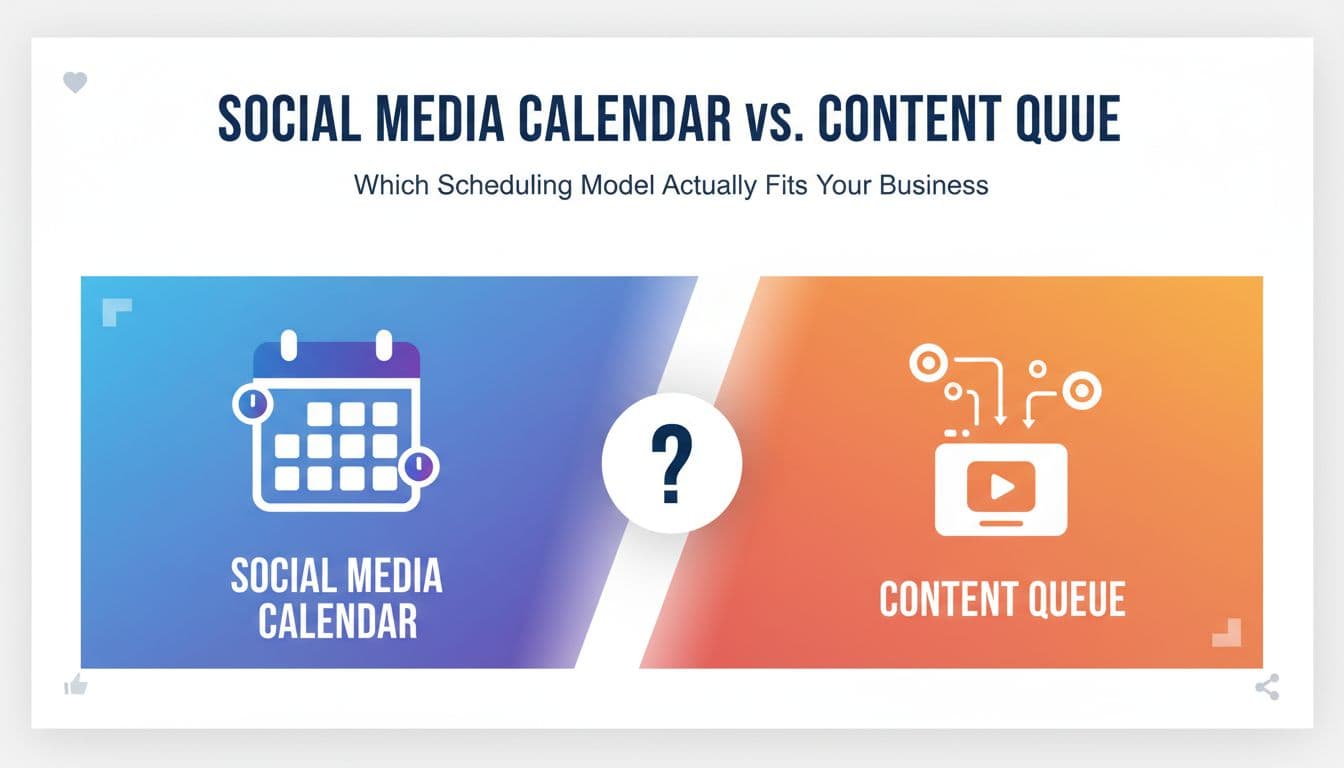
Social Media Calendar vs. Content Queue: Which Scheduling Model Actually Fits Your Business
Most articles about social media calendars and content queues treat them like opposite sides of a debate. Pick one, stick with it, done. But that framing misses what actually happens when you run a real business. You need planned campaign posts to go out on the right day, and you need evergreen content filling the gaps when you're too busy to think about posting. This article breaks down how each model works, when each one fits, and why most businesses end up needing both. It also covers why agentic AI is changing this conversation entirely — because when an AI agent handles drafting, scheduling, and optimization on its own, the calendar vs. queue question stops being something you have to solve manually. If you've ever stared at a half-empty content calendar on a Monday morning, this one's for you.

Wilzer Jean-Baptiste
11 min read
You've probably felt it before. You sit down to schedule content, you fill in a few posts, and then two weeks later you realize your Instagram has been dead silent during your biggest sale of the year. Or you set up a content queue, loaded it with evergreen tips, and felt great — right up until a customer asked why you never mentioned the new product you launched last month.
Both situations are scheduling failures. And both are more common than anyone likes to admit. The social media calendar vs. content queue debate has been framed as a simple choice you make once and move on. But that framing skips over what actually happens when you run a real business with real deadlines, limited time, and content needs that change week to week.
This article breaks down how each model works, when each one fits, and why the smartest move in 2026 isn't choosing between them — it's using agentic AI to handle both at once.
Two Scheduling Models, One Real Problem
Before you can pick the right scheduling model, you need to understand what each one actually does — and what it costs you when you pick the wrong one.
What a Content Calendar Actually Does
A content calendar gives you a fixed, date-based view of what posts go live when. Think of it like a publishing schedule. You decide on Tuesday that a post goes out on Friday at 10am, and it does. Every post has a specific date, time, and platform attached to it.
This model works best for businesses with planned campaigns, seasonal content, or team approval workflows that need visibility across time. A clothing brand running a Black Friday campaign needs every post to land in the right order, on the right day. A marketing agency managing five client accounts needs a bird's-eye view of what's scheduled, what's approved, and what still needs work. A restaurant promoting a Valentine's Day menu needs that content live on February 10th — not February 16th.
The calendar model gives you control and visibility. You can see gaps, spot conflicts, and plan around real-world events. For teams where multiple people touch content before it goes live, a calendar with approval workflows is almost non-negotiable. You can't have a social media manager publishing something a client hasn't reviewed yet. The downside is maintenance. A calendar only works if someone fills it. When life gets busy — a product launch, a sick week, a hiring sprint — the calendar empties out and posting stops entirely.
What a Content Queue Actually Does
A content queue is a rotating stack of evergreen posts that auto-publishes on a set cadence. You load it once, set a posting schedule like three times a week on Instagram, and the queue pulls from the stack and publishes automatically. When it runs out of posts, it loops back to the beginning or pauses, depending on your settings.
This model works best for solopreneurs or small teams who want consistent output without manually scheduling every single post. A business coach who posts productivity tips, a real estate agent who shares home-buying advice, a fitness creator who recycles workout content — these are all good queue candidates. The content doesn't expire. It's useful on any given Tuesday, not just during a specific campaign window.
The queue gives you consistency without daily effort. You batch-create content once a month, load it up, and let it run. That's useful when you're a one-person operation wearing ten hats. The problem shows up when something time-sensitive happens. A trending topic hits your industry. Your product gets featured in a major publication. The queue doesn't know any of that. It just keeps publishing your evergreen tips while the moment passes.
The Real Cost of Picking the Wrong Model
Choosing the wrong model creates real problems. A calendar-only approach leads to scheduling gaps when life gets busy, while a queue-only approach misses timely moments and can feel stale if the content isn't refreshed regularly.
Think about what a scheduling gap actually costs. If you run a small e-commerce brand and go dark on Instagram for two weeks because your calendar ran out, you lose momentum with an algorithm that rewards consistency. Followers notice when an account goes quiet. Rebuilding that rhythm after a gap takes longer than maintaining it would have.
On the other side, a queue that never gets updated becomes a liability. If you loaded your queue in January and it's now August, some of those posts might reference outdated offers, old pricing, or products you no longer sell. Worse, if your queue is the only thing running, you're missing every seasonal moment, every trending conversation, and every campaign window that could drive real revenue. Neither failure is dramatic. They're both slow leaks — the kind that don't feel urgent until you look at your analytics and realize engagement has been dropping for three months.
Most Businesses Actually Need Both
Here's where most articles stop: they tell you to pick one. Calendar for campaigns, queue for evergreen. Done. But that's not how real content strategies work. The real decision is not calendar vs. queue in isolation. Most businesses need both — a calendar for campaign-specific and time-sensitive content, and a queue for always-on evergreen posts that fill the gaps.
How the Two Models Work Together
Picture a coffee shop with a solid social media presence. They have a queue running with evergreen content — latte art photos, coffee origin stories, morning ritual posts. That queue keeps the account active three times a week without anyone having to think about it.
But in November, they're launching a holiday menu. That campaign has a start date, specific posts in a specific order, and a hard deadline before the menu goes away. That content lives on the calendar, not in the queue. The calendar posts take priority during that window. When the campaign ends, the queue picks back up and fills the gaps until the next campaign starts.
This is the hybrid model most businesses end up running once they get serious about social media. The queue handles baseline consistency. The calendar handles intentional moments. Together, they cover the full range of what a business needs to post. The challenge is managing both at once without a tool that supports it. If your scheduler treats calendars and queues as separate features that don't talk to each other, you end up doing a lot of manual coordination to make sure a campaign post doesn't conflict with a queued post on the same day.
When You Should Lean More Calendar
Some businesses genuinely skew toward the calendar model. Agencies managing multiple clients need visibility across accounts and time. A content calendar with color-coded status indicators — draft, in review, approved, scheduled — makes it easy to see where every piece of content stands at a glance. Aidelly's visual content calendar is built for exactly this. Drag-and-drop scheduling, multi-platform visibility, and approval workflows mean a team of five can manage 10 client accounts without anyone stepping on each other's work.
E-commerce brands with frequent product launches, seasonal sales, and promotional windows also live in the calendar. When a flash sale runs for 48 hours, every post in that campaign needs to land at the exact right time. That's not a job for a queue. Marketing managers at startups often fall into this camp too. When you're coordinating content across a product team, a design team, and a social media manager, a shared visual calendar with approval workflows is the only way to keep everyone aligned without a daily status meeting.
When You Should Lean More Queue
Solopreneurs and content creators usually get more value from a well-maintained queue. If you're a business coach posting thought leadership on LinkedIn, most of what you share is relevant any week of the year. Loading 30 posts into a queue and setting it to publish four times a week means you stay visible without checking your scheduler every day.
The same applies to service businesses that don't run traditional campaigns. A freelance designer, a bookkeeper, a personal trainer — these businesses post for brand awareness and lead generation, not for time-sensitive promotions. A queue keeps them consistent without eating into client work time.
The key is refreshing the queue regularly. Set a reminder every 60 to 90 days to audit what's in rotation, pull anything outdated, and add new content. A queue that runs on autopilot for a full year without a refresh will eventually surface something irrelevant or embarrassing. Treat it like a garden, not a set-it-and-forget-it appliance.
Why Agentic AI Makes This Decision Irrelevant
Here's the thing most scheduling tool comparisons don't address: the calendar vs. queue question assumes you're the one making all the decisions. You decide what to post. You decide when. You decide if it goes in the calendar or the queue. You manage the whole thing. Agentic AI changes this decision entirely. When an AI agent autonomously drafts, schedules, and optimizes posts based on performance data and brand voice, the line between calendar and queue blurs. The agent handles both models at once.
What an Agentic Workflow Actually Looks Like
An agentic social media workflow doesn't wait for you to open a calendar and start typing. The AI agent pulls from your brand voice guidelines, looks at what's performed well in the past, checks what's already scheduled, and drafts new content to fill gaps. It decides whether a post belongs on a specific date — because it's tied to an event or campaign — or whether it goes into the evergreen rotation.
You're not choosing between a calendar and a queue. The agent manages both, in real time, based on actual performance data. If a certain type of post consistently gets high engagement on Wednesday mornings, the agent schedules more of that content on Wednesday mornings. If a campaign is coming up, it creates campaign-specific posts and slots them into the calendar automatically. This is what Aidelly's agentic workflows do. Instead of forcing you to manage two separate systems and coordinate between them, the AI handles the logic. You review, approve, and occasionally redirect. The agent does the scheduling work.
The Role of Performance Data in Autonomous Scheduling
One of the biggest advantages of agentic scheduling is that it doesn't treat all time slots equally. A traditional queue posts on a fixed cadence — Monday, Wednesday, Friday at 9am — regardless of whether that timing actually works for your audience. A traditional calendar relies on you to pick good times, which usually means guessing or copying advice from a generic blog post about the best time to post on Instagram.
An AI agent uses your actual analytics. It looks at when your audience engages, which content formats drive the most clicks or saves, and which platforms are performing best for your specific account. The best time to post for a fitness creator in Austin is not the same as the best time for a B2B software company targeting procurement managers in Chicago. Agentic AI figures that out from your data, not from a universal recommendation. Aidelly's cross-platform analytics feed directly into this loop. Performance data from Instagram, LinkedIn, TikTok, and every other connected channel informs how the AI agent makes scheduling decisions going forward. It's a feedback loop that gets sharper over time.
Brand Voice and the Always-On Agent
One concern people have about AI-generated social content is that it sounds generic. And honestly, a lot of it does — if you're prompting a general-purpose AI with no context about your brand. Agentic scheduling built around brand voice storage is different. When your tone, messaging guidelines, content pillars, and audience details are baked into the system, the AI drafts content that actually sounds like you.
A solopreneur who has spent two years building a specific voice on LinkedIn doesn't want AI posts that sound like they came from a corporate press release. They want posts that match the way they already talk to their audience. Aidelly's brand voice and asset management features handle this. Your guidelines live in the platform. Every draft the AI generates pulls from them. The result is content that fits your calendar, fills your queue, and sounds like it came from you — without you writing every single post from scratch. That's the real value of agentic social media management in 2026. It's not just automation. It's automation that knows your brand.
The calendar vs. queue debate has a real answer: most businesses need both, and the businesses getting the most out of social media in 2026 aren't managing either one manually. A content calendar keeps your campaigns on track. A rotating queue keeps you visible between campaigns. And agentic AI ties them together so you're not the one deciding which post goes where on which day.
Getting your scheduling model right is the foundation of a social media presence that actually works. When the right content goes out at the right time — consistently, on-brand, and informed by real performance data — social media stops feeling like a task you're always behind on and starts working like a system that runs without constant attention.
If you're ready to stop managing the calendar and queue manually and let an AI agent handle the logic for you, Aidelly is worth a look.
You don't have to choose between a calendar and a queue if an AI agent is handling both for you. Aidelly's agentic workflows draft your content, schedule it, and adjust based on what's actually working, so your social media stays consistent without you manually managing every post. See how it works at aidelly.ai.
Compare Social Scheduling Tools
Evaluating software for your content workflow? Use our buyer guides and comparisons to compare scheduling, approvals, analytics, and AI workflow fit.
Share this article
Related Articles
The Solopreneur's Guide to Choosing a Social Media Scheduler in 2026
If you run a one-person business, social media probably eats more of your week than it should. The average solopreneur spends 6 hours every week on content tasks that a good scheduler could handle automatically. That is a full workday, gone. In 2026, the gap between basic scheduling tools and agentic AI schedulers has never been wider. Basic tools still make you do most of the work. Agentic ones handle the full workflow without you touching it. This guide breaks down exactly what to look for when picking a social media scheduler as a solo operator. You will learn the five questions that cut through the noise, why brand voice matters more than any feature list, and how to think about price in a way that actually reflects what your time is worth. By the end, you will know which type of tool fits your business and what to expect from it.
Jul 1, 2026
Read more
X (Twitter) Scheduling for Coaches and Consultants: How to Stay Visible Without Daily Posting
Most coaches and consultants know they should be active on X. They post a few times, get busy with client work, and then disappear for six weeks. When a prospect Googles them before a discovery call and sees a dead profile, the credibility damage is done before the conversation even starts. This article shows you how to build a 30-day content system in one sitting using AI-powered drafting and agentic scheduling so your X profile always looks active, on-brand, and authoritative. You will learn the best times to post for B2B audiences, the four content types that drive real leads, how agentic AI workflows cut your weekly time cost from hours to minutes, and how to use X analytics to double down on what actually works. No daily posting required.
Jun 7, 2026
Read more
Always-On Social Media: How to Keep Posting During Vacations and Busy Seasons
Most solopreneurs and small business owners hit a wall the moment life gets busy. A vacation, a product launch, a packed Q4 — and suddenly the content calendar goes dark. The problem is that going quiet on social media isn't neutral. Algorithms punish inconsistency. Reach drops. Follower growth stalls. And the momentum you spent months building can evaporate in two weeks of silence. The good news is that staying visible no longer means being glued to your phone. There's a real difference between scheduling tools that still require you to write and queue every post manually, and agentic social media management, where an AI agent handles ideation, drafting, formatting, scheduling, and performance tracking without you logging in. This article walks you through what it actually looks like to hand your social media to an AI agent before a vacation or a busy season — and come back to a pipeline that ran itself.
Jun 10, 2026
Read moreReady to never miss a post again?
Tell Aidelly what to post. It drafts, schedules, and publishes across 9 platforms while you focus on your business.