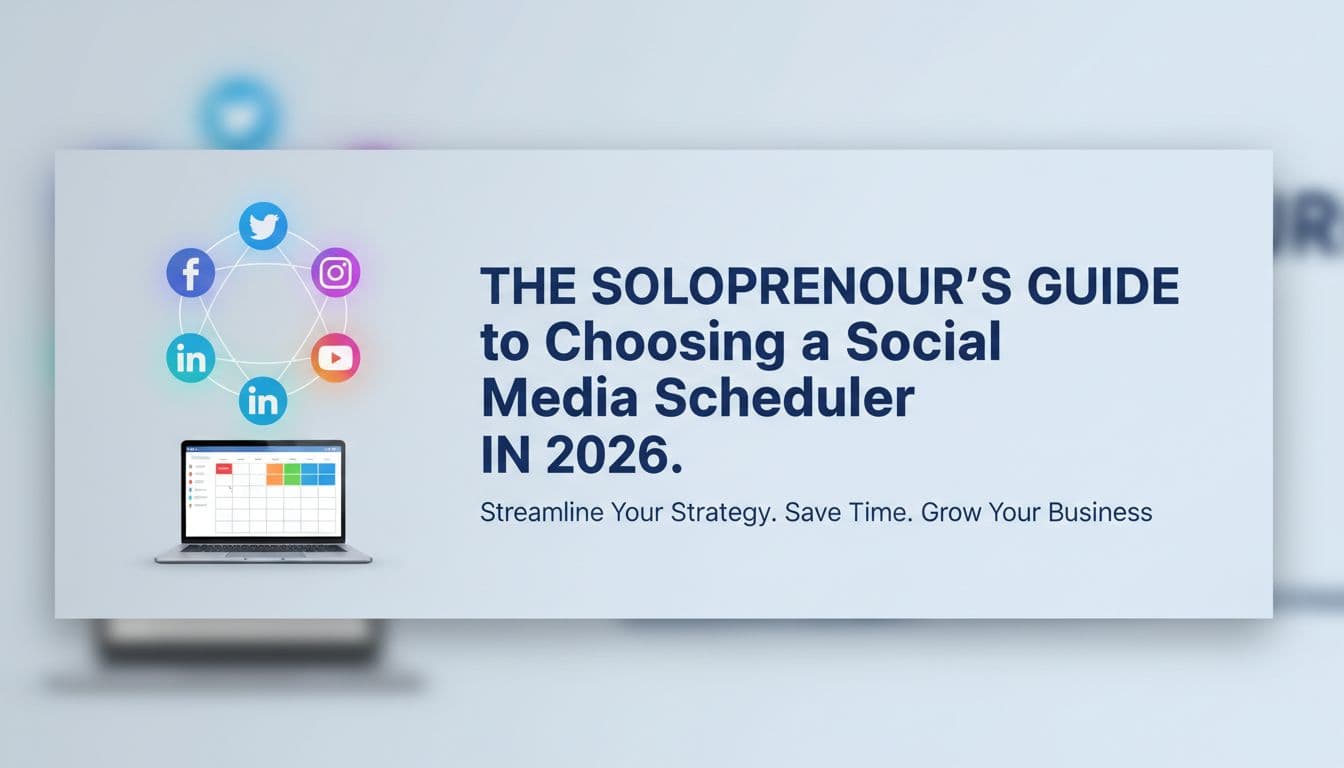
The Solopreneur's Guide to Choosing a Social Media Scheduler in 2026
If you run a one-person business, social media probably eats more of your week than it should. The average solopreneur spends 6 hours every week on content tasks that a good scheduler could handle automatically. That is a full workday, gone. In 2026, the gap between basic scheduling tools and agentic AI schedulers has never been wider. Basic tools still make you do most of the work. Agentic ones handle the full workflow without you touching it. This guide breaks down exactly what to look for when picking a social media scheduler as a solo operator. You will learn the five questions that cut through the noise, why brand voice matters more than any feature list, and how to think about price in a way that actually reflects what your time is worth. By the end, you will know which type of tool fits your business and what to expect from it.

Wilzer Jean-Baptiste
9 min read
You started your business to do the work you are good at. Somewhere along the way, social media became a part-time job on top of that. You write posts, find images, figure out hashtags, schedule everything manually, and then do it again next week. If that sounds familiar, the problem probably is not your content strategy. It is the tool you are using, or the fact that the tool you are using was not built for someone who has to do everything alone.
In 2026, solopreneurs have more options than ever when it comes to social media schedulers. That is the good news. The harder part is that most of those options still require you to do most of the work. This guide will help you cut through the noise, understand what actually matters in a scheduler when you are a one-person operation, and walk away with a clear framework for picking the right one.
The Real Cost of the Wrong Scheduler
You Are Losing More Than Time
Here is a number worth sitting with: solopreneurs waste an average of 6 hours per week on social media tasks that could be automated. That is not 6 hours of strategy or creative thinking. That is 6 hours of writing captions from scratch, resizing images for different platforms, manually scheduling posts one by one, and then checking to see if anything landed. Multiply that by 52 weeks and you have lost over 300 hours a year to work a decent scheduler should be doing for you.
The wrong tool makes this worse, not better. A scheduler that requires you to write every post, approve every draft, and manually set every publish time is not saving you anything. It is just moving the work around. You still touch every piece of content before it goes live. You still spend Sunday nights planning out the week. The tool becomes another tab to manage instead of a system that runs without you.
Choosing the right scheduler is not a minor decision. For a solopreneur, time is the most expensive thing you have. Every hour you spend on content is an hour you are not spending on client work, product development, or sales. The right tool gives those hours back. The wrong one quietly takes more.
What Changed in 2026
A few years ago, the best you could hope for from a social media scheduler was a clean calendar and a queue. You wrote the posts. The tool published them. That was the deal. In 2026, that model is outdated.
The real dividing line between schedulers now is not features but autonomy. Basic tools still require you to write, schedule, and review every post manually. Agentic AI schedulers handle the full workflow end-to-end without you touching it. That means content ideation, drafting, platform optimization, scheduling, and performance analysis all happen automatically. You set the parameters once and the system runs.
This shift matters enormously for solopreneurs. A marketing team can afford to have one person managing the scheduler, another writing copy, and a third reviewing approvals. You cannot. You need a tool that plays all three roles. Agentic AI schedulers are built for exactly that situation. They do not assume you have a team behind you.
The tools that have not made this shift still look similar on the surface. They have calendars, analytics dashboards, and some kind of AI writing button. But that AI button generates generic content you have to rewrite before it sounds anything like you. That is not automation. That is a first draft machine with extra steps.
The Five-Question Framework
Before you pick a tool, run it through these five questions. They are not about features. They are about how much the tool can do without you.
- Does it understand my brand voice without me rewriting every post? If the answer is no, you will spend as much time editing as you would have writing from scratch.
- Can it handle the full workflow end-to-end? Drafting, scheduling, and publishing should all happen in one place without you stitching together multiple tools.
- Does it learn from my past performance? A scheduler that does not adapt is just a calendar. You want one that gets smarter over time.
- Does it cover all the platforms I post on? If you need a separate tool for TikTok and another for LinkedIn, you are not saving money or time.
- What is the real cost when I factor in hours saved? A $10 tool that saves you nothing is more expensive than a $40 tool that hands back 5 hours a week.
Brand Voice and Autonomy: The Two Things That Actually Matter
Generic Content Is a Hidden Tax
Solopreneurs need a scheduler that understands brand voice out of the box, not one that produces generic content they have to rewrite every time before it can go live. This sounds obvious, but most tools fail here in a specific and frustrating way. They have AI writing features, but those features produce content that sounds like every other brand in your category. Same hooks, same CTAs, same vague value propositions. You read the draft, cringe a little, and spend 20 minutes making it sound like you. Every time.
That rewriting time adds up fast. If you post five times a week across three platforms and spend 15 minutes rewriting each AI draft, you are spending over an hour a week just fixing content the tool was supposed to handle. That is not automation. That is a tax on using a bad tool.
Brand voice is not just about tone. It is about the specific words you use, the stories you tell, the way you open a post, and what you never say. A scheduler that stores your brand guidelines, learns from your past content, and generates drafts that match your style is worth far more than one that writes clean but generic copy. The goal is to read a draft and think, yes, that sounds like me, not, I guess I can work with this.
Aidelly stores your brand voice and asset guidelines directly in the platform. When the AI drafts content, it pulls from those guidelines automatically. You are not starting from a blank template every time.
Autonomy Is Not a Feature. It Is the Product.
Auto-scheduling and best-time-to-post logic are now table stakes. Every serious scheduler has them. What separates good tools from great ones is whether the AI can learn from your past performance and adjust future content without you prompting it.
Think about what that means in practice. A basic tool posts at the times you set or at statistically optimal windows based on general data. It does not know that your audience on Instagram engages most on Tuesday mornings, or that your longer-form LinkedIn posts consistently outperform short ones, or that posts where you share a personal story get three times the comments of your product posts. It just schedules.
An agentic scheduler does something different. It watches what performs, builds a picture of what works for your specific audience, and adjusts what it creates and when it posts without you going in to manually tweak settings. That feedback loop is what makes autonomy real. The system gets better at being you over time, without you teaching it every lesson manually.
For a solopreneur, this is the difference between a tool that requires weekly maintenance and one that runs in the background while you focus on the work that pays you.
Agentic Workflows in Plain Language
The word agentic gets thrown around a lot right now, so here is what it means in practice for social media. An agentic workflow is one where an AI agent takes a goal, breaks it into steps, executes those steps, and adjusts based on results. All without you managing each step manually.
For social media, that looks like this: you tell the system your brand, your goals, and your platforms. It creates a content plan, drafts posts, schedules them at optimal times, publishes them, tracks performance, and uses what it learns to improve the next round of content. You check in when you want to. You are not required to.
Aidelly is built around agentic workflows from the ground up. That is different from legacy schedulers that added an AI writing button to an existing product. The entire platform is designed for autonomous operation, which matters when you are the only person running it. The AI Chat Workspace, for example, lets you create and schedule posts through one guided workflow instead of jumping between tools to piece it all together.
How to Think About Price as a Solopreneur
The Real Math on Affordability
Affordability for a solopreneur is not just about the monthly price. It is about the cost per hour saved, the number of platforms covered, and whether you need to pay for five separate tools to do what one agentic platform does.
Here is a concrete example. Say you pay $15 a month for a basic scheduler. It covers two platforms, has no AI drafting, and requires you to write and schedule everything manually. You still spend 5 hours a week on content. Now say you pay $49 a month for an agentic scheduler that covers six platforms, drafts content in your brand voice, schedules automatically, and learns from your performance data. You spend 1 hour a week reviewing and approving. You saved 4 hours a week. At a conservative value of $50 per hour for your time, that is $200 a week in recovered capacity. The $49 tool is not more expensive. It is dramatically cheaper when you do the actual math.
The other piece of this is tool sprawl. A lot of solopreneurs end up paying for a scheduler, a separate AI writing tool, a hashtag research tool, and maybe a basic analytics platform. Add those up and you are often at $80 to $120 a month, and you are still doing the work of connecting them manually. One platform that handles all of it is almost always the better deal, even if the sticker price looks higher at first glance.
Platform Coverage Matters More Than You Think
If you post on Instagram, LinkedIn, and TikTok, and your scheduler only covers two of those, you are not actually saving time. You are saving time on two platforms and doing everything manually on the third. That gap grows as your presence grows.
Cross-platform scheduling is only valuable when it is genuinely cross-platform. That means the tool handles the format differences between platforms automatically. A LinkedIn post and a TikTok caption are not the same thing. A scheduler that makes you adapt the copy yourself for each platform is adding work, not removing it. Look for tools that optimize content per platform as part of the drafting process, not as an afterthought.
Aidelly covers Instagram, TikTok, LinkedIn, YouTube, Facebook, and X from one dashboard. The AI drafts platform-specific versions of your content automatically, so the same core idea becomes a LinkedIn article opener, a punchy TikTok caption, and a conversational Instagram post without you writing each one from scratch.
What You Should Actually Pay For
When you evaluate price, weight these three things above everything else. First, does the tool cover every platform you actively use? Second, does it reduce the hours you spend on content to something close to zero for routine posts? Third, does it handle the full workflow, drafting through publishing, without requiring you to manage each step?
If the answer to all three is yes, the price is almost certainly worth it. If the answer to any of them is no, you are paying for a partial solution and filling the gaps with your own time. That is the most expensive option of all.
One more thing worth checking: does the tool include analytics that actually tell you something useful? Cross-platform analytics in one dashboard means you can see what is working without logging into four different apps. That visibility is what lets you make better decisions about content without spending hours pulling data manually. It is not a nice-to-have. It is how you know whether the automation is working.
Picking a social media scheduler in 2026 comes down to one question: how much of this can the tool do without you? The best schedulers understand your brand voice, handle the full workflow from drafting to publishing, learn from your performance data, and cover every platform you post on without making you stitch together five separate subscriptions. Your time is the most expensive thing in your business. A scheduler that treats it that way will pay for itself faster than almost any other tool you buy.
Social media does not have to be the thing that eats your evenings and weekends. With the right agentic scheduler, it becomes something that runs in the background while you focus on the work that actually moves your business forward. The technology is there. The only question is whether the tool you are using is built to use it.
If you are ready to stop managing social media manually and start letting it run on autopilot, take a closer look at what an agentic platform can actually do for a one-person business like yours.
If you want a low-lift way to apply these ideas, Aidelly helps you keep your social content consistent without extra busywork. ```htmlIf you've read this far, you already know the right scheduler isn't the one with the longest feature list. It's the one that works without you. Aidelly is built around agentic workflows that handle content creation, scheduling, and performance analysis from start to finish, so you stop trading hours for posts. See what that looks like for your business at aidelly.ai.
```Compare Social Scheduling Tools
Evaluating software for your content workflow? Use our buyer guides and comparisons to compare scheduling, approvals, analytics, and AI workflow fit.
Share this article
Related Articles
X (Twitter) Scheduling for Coaches and Consultants: How to Stay Visible Without Daily Posting
Most coaches and consultants know they should be active on X. They post a few times, get busy with client work, and then disappear for six weeks. When a prospect Googles them before a discovery call and sees a dead profile, the credibility damage is done before the conversation even starts. This article shows you how to build a 30-day content system in one sitting using AI-powered drafting and agentic scheduling so your X profile always looks active, on-brand, and authoritative. You will learn the best times to post for B2B audiences, the four content types that drive real leads, how agentic AI workflows cut your weekly time cost from hours to minutes, and how to use X analytics to double down on what actually works. No daily posting required.
Jun 7, 2026
Read more
Always-On Social Media: How to Keep Posting During Vacations and Busy Seasons
Most solopreneurs and small business owners hit a wall the moment life gets busy. A vacation, a product launch, a packed Q4 — and suddenly the content calendar goes dark. The problem is that going quiet on social media isn't neutral. Algorithms punish inconsistency. Reach drops. Follower growth stalls. And the momentum you spent months building can evaporate in two weeks of silence. The good news is that staying visible no longer means being glued to your phone. There's a real difference between scheduling tools that still require you to write and queue every post manually, and agentic social media management, where an AI agent handles ideation, drafting, formatting, scheduling, and performance tracking without you logging in. This article walks you through what it actually looks like to hand your social media to an AI agent before a vacation or a busy season — and come back to a pipeline that ran itself.
Jun 10, 2026
Read more
Social Media Scheduling for Coaches: A 90-Day Launch Content Plan That Actually Gets Executed
Most 90-day content plans for coaches end up as abandoned spreadsheets by week three. Not because the plan was bad, but because the execution was too heavy. Writing posts from scratch, figuring out what to say on LinkedIn versus Instagram, remembering to actually post — it piles up fast when you're also running discovery calls and delivering coaching sessions. This guide shows you how to build a phase-based 90-day content plan tied to a real launch goal, then hands the execution to agentic AI workflows that draft, schedule, and optimize your posts without daily manual input. Month 1 builds trust. Month 2 nurtures leads. Month 3 drives enrollment. And you stay in your zone of genius — coaching — instead of staring at a blank caption box every Monday morning.
Jun 4, 2026
Read moreReady to never miss a post again?
Tell Aidelly what to post. It drafts, schedules, and publishes across 9 platforms while you focus on your business.