Solopreneurs
Social Media Scheduling for Coaches: A 90-Day Launch Content Plan That Actually Gets Executed
Most 90-day content plans for coaches end up as abandoned spreadsheets by week three. Not because the plan was bad, but because the execution was too heavy. Writing posts from scratch, figuring out what to say on LinkedIn versus Instagram, remembering to actually post — it piles up fast when you're also running discovery calls and delivering coaching sessions. This guide shows you how to build a phase-based 90-day content plan tied to a real launch goal, then hands the execution to agentic AI workflows that draft, schedule, and optimize your posts without daily manual input. Month 1 builds trust. Month 2 nurtures leads. Month 3 drives enrollment. And you stay in your zone of genius — coaching — instead of staring at a blank caption box every Monday morning.

By Wilzer Jean-Baptiste
Published 12 min read
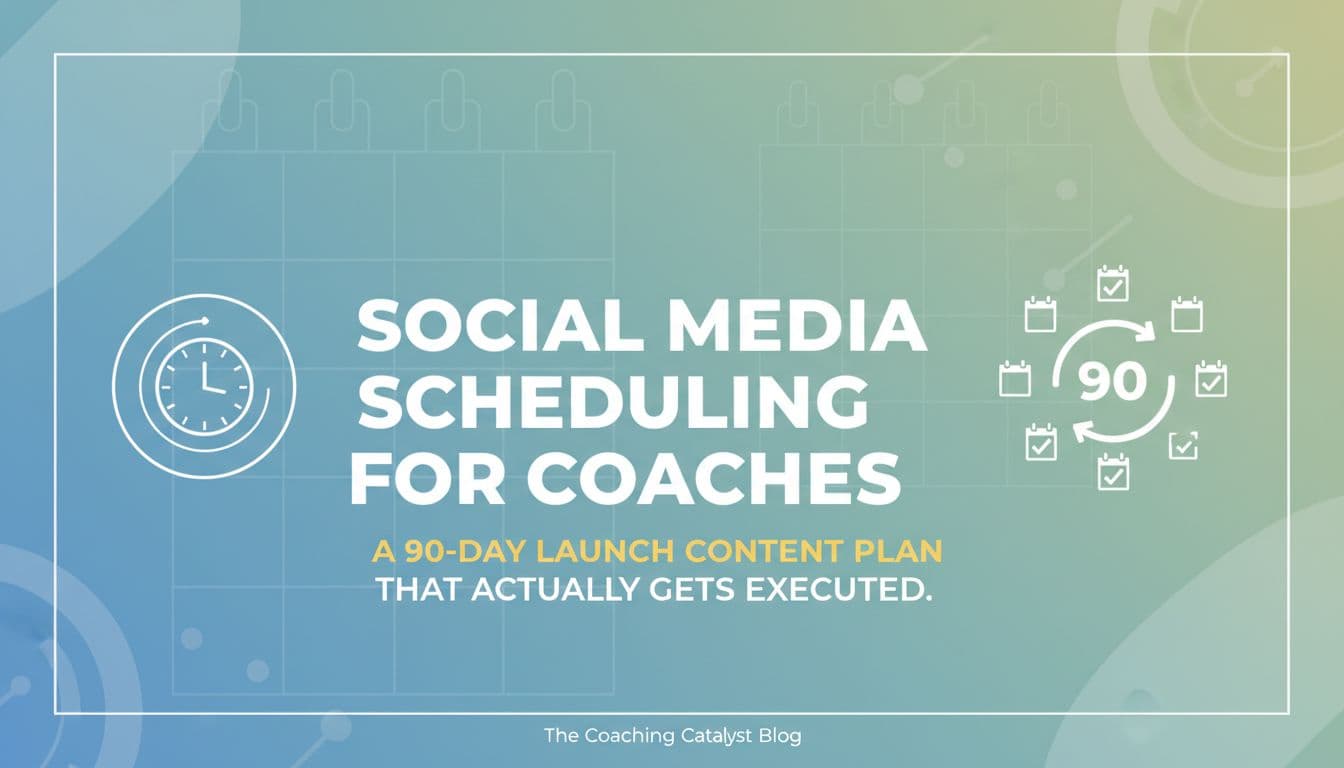
Most 90-day content plans for coaches end up as abandoned spreadsheets by week three. The plan looked great on a Sunday afternoon. By the following Thursday, real life took over and the whole thing quietly died. This isn't a discipline problem. It's a design problem. A plan that requires you to manually write, format, schedule, and publish every post is a plan that depends on you having unlimited time and energy — and you don't, because you're also running a coaching business. This article shows you how to build a phase-based 90-day content plan tied to a real launch goal, then remove yourself from the daily execution so the plan actually runs for all 90 days.
Why Most Coach Content Plans Fall Apart Before Month Two
The Real Problem Isn't Ideas. It's the System.
Ask any coach what they struggle with on social media and you'll hear the same answer: consistency. But dig a little deeper and the real issue comes out. It's not that they lack things to say. They have stories, frameworks, client wins, and hard-earned lessons. The problem is that every single week, they sit down and start from zero.
No content pillars. No repeatable structure. No plan that connects Monday's post to the bigger story they're trying to tell over 90 days. So they write something random, post it, get decent engagement, and then disappear for two weeks because life got busy.
A 90-day content plan built around your core offer, your client transformation stages, and three to four content pillars fixes this. Instead of asking "what should I post today," you ask "what phase am I in and what does my audience need to hear right now." Those are very different questions, and the second one has a clear answer every time.
Your content pillars might look like this: one pillar for your client's biggest problem, one for your methodology or framework, one for social proof and results, and one for your personal story and values. Every post you write for 90 days fits into one of those buckets. You're not starting from scratch. You're filling in a structure that already exists.
When you add a tool like Aidelly's AI Chat Workspace to this, you're not even filling in the structure manually. You feed in your brand voice, your offer, and your content pillars, and the AI drafts platform-ready posts that already fit your system. The Monday morning blank-page problem disappears because the system knows what you're trying to say and who you're trying to reach.
The 90-Day Window Maps Directly to How Coaching Works
Here's why 90 days is the right window for a coaching launch plan. Most coaching engagements run 90 days. Your clients go from problem-aware to transformation-ready in roughly three months. Your content should follow the same arc.
Month 1 is about awareness and trust. Your audience doesn't know you well enough to buy yet. They need to see that you understand their problem better than they do. Posts in this phase are heavy on relatability, personal story, and naming the exact pain your ideal client feels. The call to action is soft: follow me, save this post, reply with your biggest struggle. You're not asking for money yet. You're asking for attention and building the foundation of a relationship.
Month 2 shifts to nurturing. Now you bring in proof. Client case studies, before-and-after transformations, educational content that shows your methodology in action. This is where carousels and longer LinkedIn posts earn their keep. Your audience has been watching you for a month. They're starting to wonder if this could work for them. Your content answers that question with evidence, not hype. A post like "How Sarah went from charging $500 per client to $3,000 in eight weeks" does more work than any generic motivational quote ever could.
Month 3 is enrollment. The call to action changes completely. You're inviting people into a discovery call, a free training, a waitlist, or a direct application. The content gets more direct. Urgency becomes appropriate because it's real — you're opening spots. Your posts in this phase are shorter, more specific, and built around one clear next step. Each phase needs a different posting frequency too. Month 1, three to four posts per week builds momentum. Month 2, hold at three posts and add one longer piece. Month 3, push to five or six posts per week because you're in active launch mode.
Build Your Content Pillars Before You Write a Single Post
Before you open any scheduling tool or AI assistant, spend one hour defining your content pillars. This is the most important step and the one most coaches skip.
A content pillar is a repeatable theme that connects directly to your offer. If you're a business coach helping service providers hit their first $10K month, your pillars might be: pricing and packaging, client attraction, mindset around money, and client success stories. Every post you write for 90 days lives inside one of those four themes. You're not reinventing the wheel each week. You're rotating through a structure that already makes sense to your audience.
Once your pillars are set, map them to the three phases. In Month 1, you lean on mindset and personal story. In Month 2, you lean on methodology and proof. In Month 3, you lean on urgency and direct invitation. The pillars don't change. The emphasis does. This structure is what makes agentic AI useful for coaches. When your brand voice, offer details, and content pillars are stored in a system like Aidelly's Brand Voice and Asset Management, the AI isn't guessing what to write. It's working from a brief that sounds like you, talks about the right things, and fits the phase you're in. That's the difference between AI content that feels generic and AI content that sounds like it came from you.
Platform Strategy: Where Coaches Should Show Up and How
LinkedIn and Instagram Are Not the Same Channel
Coaches often make one of two mistakes with platforms. They either try to be everywhere at once and spread themselves thin, or they pick one platform and ignore the other because the content formats feel too different to manage. Both mistakes cost you reach.
LinkedIn and Instagram are the two highest-leverage platforms for most coaching niches, but they serve different purposes and different audiences. LinkedIn skews toward B2B coaching — executive coaches, leadership coaches, career coaches, and business coaches targeting corporate professionals. Instagram skews toward B2C — life coaches, health coaches, relationship coaches, and anyone whose ideal client is a consumer rather than a business buyer.
But even if your primary audience lives on one platform, having a presence on both extends your reach without doubling your work — as long as your scheduler handles the format adaptation automatically.
On LinkedIn, long-form thought leadership wins. A 400-word post that walks through a real client problem and how you solved it will outperform a short caption every time. LinkedIn's algorithm rewards dwell time, and professional audiences read. Use it to share your framework, your contrarian takes, and your client transformations in detail. On Instagram, short video and carousels carry the most weight in 2026. A five-slide carousel breaking down your three-step process gets saved and shared. A 30-second Reel showing one mindset shift gets played on repeat. Captions matter but they're secondary to the visual hook.
A good social media scheduler doesn't just post the same content to both platforms. It adapts the format. Aidelly's AI-powered content drafting does this automatically — taking your core idea and producing a LinkedIn version and an Instagram version that each feel native to the platform. You write the idea once. The AI handles the translation.
Optimal Posting Times Matter More Than Most Coaches Think
You can write the best post of your life and bury it by publishing at the wrong time. For coaches on LinkedIn, Tuesday through Thursday between 8am and 10am in your audience's time zone consistently outperforms evening posts. On Instagram, the sweet spot shifts to early morning and lunch hour, with Reels getting extra reach when posted between 9am and 11am. But these are averages. Your actual best times depend on your specific audience and when they're online.
That's why auto-scheduling based on performance data beats any generic best-practices guide. When your scheduler learns from your past posts and adjusts timing automatically, you stop guessing and start optimizing based on what's actually working for your account. This is one of the clearest wins agentic AI delivers for coaches. You're not checking analytics every week and manually adjusting your posting schedule. The system watches performance, identifies patterns, and schedules future posts at the times your audience is most likely to engage. You get the benefit of a full-time social media manager's analysis without the full-time social media manager's salary.
Content Formats by Phase and Platform
Matching the right format to the right phase on the right platform is where most coaches leave results on the table. Here's a simple way to think about it.
In Month 1, prioritize personal story posts on LinkedIn and short Reels on Instagram. Both formats build emotional connection fast. A LinkedIn post that starts with "Three years ago I was charging $75 an hour and working 60 hours a week" pulls in your ideal client because they recognize themselves in that story. A Reel that opens with "The one thing I wish someone told me when I started coaching" gets watched because curiosity is hard to scroll past.
In Month 2, shift to carousels on Instagram and educational long-form on LinkedIn. A carousel titled "The 4 reasons your discovery calls aren't converting" gives your audience real value and positions you as the person who knows how to fix their problem. In Month 3, lean into direct calls to action on both platforms. A LinkedIn post that says "I'm opening 3 spots for my 90-day program in February — here's who it's for and how to apply" is not pushy. It's clear. Clarity converts. On Instagram, Stories with a link-in-bio call to action work well alongside your feed posts because they meet people where they already are.
Making the Plan Stick: Execution Without Burnout
Why Coaches Quit Social Media (And How to Stop the Pattern)
Coaches don't quit social media because they run out of ideas. They quit because the execution is too manual. Writing a post, formatting it for two platforms, finding the right image, figuring out the best time to post, actually publishing it, then doing it all again three days later — that's a part-time job on top of a full-time business.
The gap between having a content plan and actually executing it for 90 days straight is almost entirely a friction problem. Every extra step between the idea and the published post is a place where the plan can break down. You get busy with a client crisis. You travel for a speaking engagement. You have a week where your energy is low and the last thing you want to do is write captions.
Auto-scheduling removes the biggest friction point. When you batch your content once a week or once every two weeks and your scheduler handles the publishing automatically, a bad week doesn't break your streak. The posts go out whether you're on your laptop or not. Your audience sees consistency even when your behind-the-scenes looks anything but.
Approval workflows add another layer of protection, especially if you have a VA or a small team. You review and approve before anything goes live, but you're not the one doing the drafting, formatting, or scheduling. Aidelly's approval workflow lets you stay in control of what goes out without being in the weeds of how it gets there. That's a meaningful shift for coaches who care deeply about their brand but don't want to manage a content operation day to day.
The Visual Content Calendar Changes How You Think About Planning
One of the underrated benefits of a visual content calendar is that it changes your relationship with your plan. When you can see 30 or 60 days of content laid out in front of you, you stop thinking post by post and start thinking in campaigns. You notice gaps. You see when you've posted three educational pieces in a row and nothing personal. You spot the week before your launch where you need to increase frequency and adjust before it's too late.
A spreadsheet doesn't give you this. A spreadsheet is a list. A calendar is a map. And when you're running a 90-day launch, you need a map. When your visual calendar is connected to your drafting and scheduling tools, you can drag and drop posts, adjust timing, and see the full picture without switching between five different apps. You plan once, adjust as needed, and let the system handle the rest. For coaches who think visually and plan in sprints, this is the difference between a content plan that feels manageable and one that quietly collapses under its own weight by week four.
Using Performance Data to Improve as You Go
A 90-day plan isn't set in stone. The best coaches treat Month 1 as a learning phase, not just a publishing phase. Which posts got the most saves? Which Reels got watched all the way through? Which LinkedIn posts generated DMs? Those signals tell you what to do more of in Month 2 and Month 3.
This is where cross-platform analytics earn their value. Instead of logging into LinkedIn, then Instagram, then pulling numbers into a spreadsheet, you see everything in one dashboard. You know which content pillar is resonating most. You know which platform is driving the most profile visits. You know whether your Month 2 case study posts are generating more engagement than your Month 1 story posts.
Agentic AI takes this a step further. Instead of reading the data and deciding what to change yourself, the system surfaces the insights and adjusts your content recommendations automatically. It tells you that your carousel posts on Instagram are getting three times the saves of your single-image posts, so your next batch should include more carousels. You're not analyzing. You're approving recommendations and moving forward. That feedback loop — from drafting to publishing to analyzing to improving — is what makes a 90-day plan actually get better over time instead of just grinding forward on autopilot.
A 90-day content plan works when it's built around three things: a clear phase structure tied to your launch goal, a platform strategy that matches your audience, and an execution system that doesn't depend on you showing up perfectly every single day. The plan is the strategy. The execution is where most coaches lose the game — and where the right tools make the biggest difference.
Agentic AI handles the drafting, the scheduling, the timing optimization, and the performance analysis so you can stay focused on the work that actually requires you — coaching your clients and closing your next cohort. Consistency stops being a willpower problem when the system runs whether you're in it or not.
If you're ready to stop rebuilding your content strategy from scratch every month and start running a 90-day plan that executes itself, Aidelly was built for exactly that.
A 90-day content plan only works if you can actually execute it for 90 days straight. Aidelly's agentic workflows handle the full loop for you: drafting posts in your voice, scheduling them across platforms at the right times, and surfacing the data that tells you what's working. Your job becomes reviewing and approving, not writing and posting from scratch every week. If you're ready to stop restarting and start building momentum, head to aidelly.ai.
Compare social scheduling tools
Evaluating software for your content workflow? Use our buyer guides and comparisons to compare scheduling, approvals, analytics, and AI workflow fit.