Solopreneurs
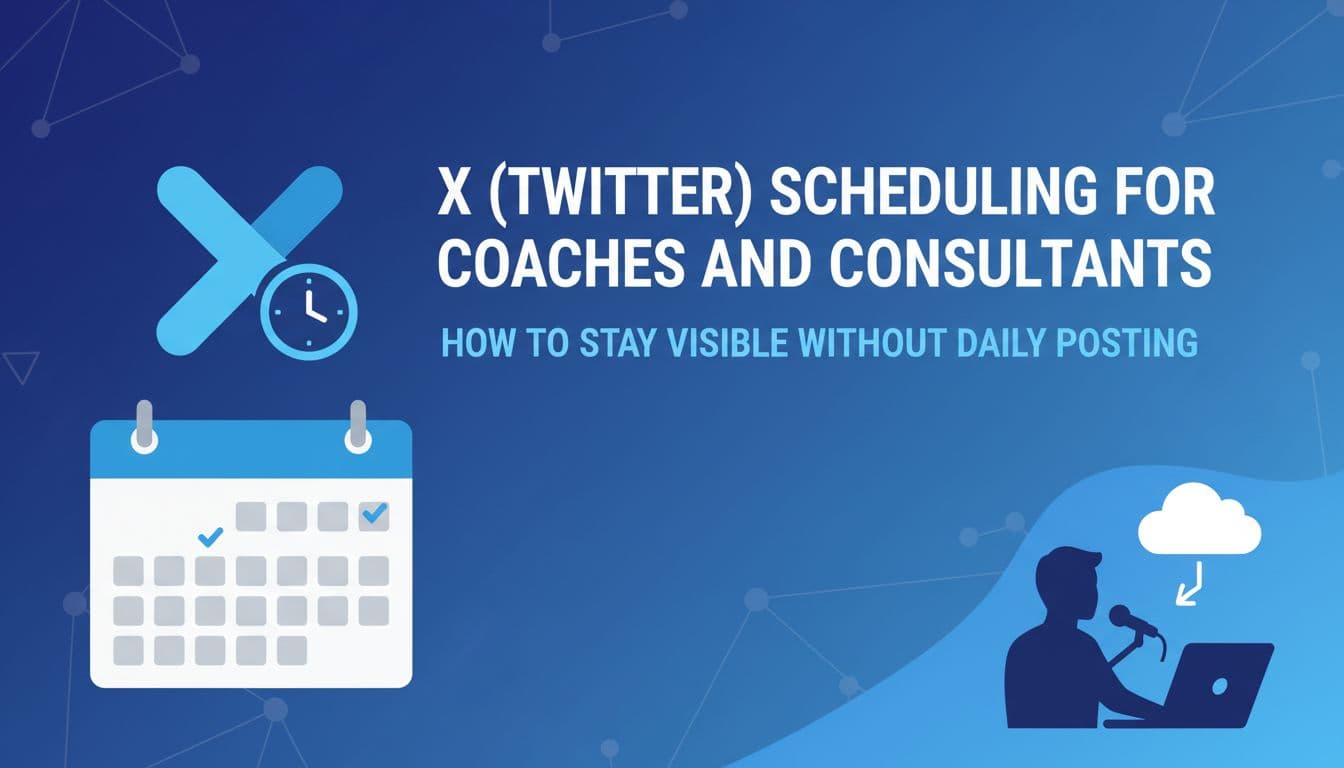
X (Twitter) Scheduling for Coaches and Consultants: How to Stay Visible Without Daily Posting
Most coaches and consultants know they should be active on X. They post a few times, get busy with client work, and then disappear for six weeks. When a prospect Googles them before a discovery call and sees a dead profile, the credibility damage is done before the conversation even starts. This article shows you how to build a 30-day content system in one sitting using AI-powered drafting and agentic scheduling so your X profile always looks active, on-brand, and authoritative. You will learn the best times to post for B2B audiences, the four content types that drive real leads, how agentic AI workflows cut your weekly time cost from hours to minutes, and how to use X analytics to double down on what actually works. No daily posting required.

By Wilzer Jean-Baptiste
Published 13 min read
A prospect finds you through a referral. They are interested. Before they book a call, they Google your name. Your X profile comes up. Your last post was seven weeks ago.
That silence costs you the client.
Coaches and consultants are not losing business because they lack expertise. They are losing it because they disappear from X for weeks at a time, and a dead profile reads as a dead business to someone who does not know you yet. The fix is not posting every day. It is building a system that keeps your profile active and authoritative while you focus on the work you are actually paid to do.
This article shows you how to do that in one sitting.
Your X Profile Is Working For You or Against You Right Now
The Credibility Gap Nobody Talks About
When someone is deciding whether to hire a coach or consultant, they are looking for signals that you know your stuff and that you are still active in your field. A dead X profile sends the opposite signal. It says you are either too busy to show up or not serious enough to bother. Neither reads well to a prospect who is about to wire you a few thousand dollars.
The coaches who win on X are not the ones posting 10 times a day. They are the ones who show up consistently enough that their name stays familiar. Familiarity builds trust. Trust drives bookings. The math is simple even if the execution feels hard.
Think about the last time you hired someone for a high-stakes project. You probably checked their LinkedIn, their website, maybe their X. If their social presence looked active and smart, it reinforced your decision. If it looked abandoned, it planted doubt. Your prospects are doing the same thing with you right now.
Why Disappearing From X Costs You Clients
Coaches and consultants lose clients not because they lack expertise but because they disappear from X for weeks at a time. Consistent visibility on X builds the trust that converts followers into paying clients, and scheduling is the only sustainable way to maintain that presence without burning out.
Client work will always feel more urgent than posting. That is not a discipline problem. It is a systems problem. And the fix is not willpower. It is building a content engine that runs without you having to think about it every day.
The consultants who stay booked are not necessarily the most talented ones. They are the ones who stayed visible long enough to become the obvious choice when a prospect was ready to hire. Visibility is the gap between being great at your work and actually getting paid for it.
Why Manual Posting Fails Solo Operators
The problem with telling a coach to just post more consistently is that it ignores how they actually spend their days. A full client roster means back-to-back sessions, prep work, follow-up emails, proposal writing, and somewhere in there, running an actual business. Sitting down to write three posts before lunch is not realistic when you have a 9am client call and a proposal due by noon.
Manual posting also means you are always starting from zero. You open a blank text box, try to think of something smart to say, second-guess yourself, and either post something mediocre or close the tab and tell yourself you will do it tomorrow. Tomorrow becomes next week. Next week becomes that six-week gap on your profile.
Scheduling changes this entirely. You batch your content in one focused session, load it into a scheduler, and your profile stays active while you focus on client work. The posts go out whether you are in a session, on a flight, or taking a long weekend.
Timing Matters More Than Frequency on X
The Best Windows for B2B Audiences on X
The best time to post on X for B2B audiences and coaches is typically Tuesday through Thursday between 8am and 10am or 12pm and 1pm in your audience's time zone. These windows catch people when they are settling into their workday or taking a midday break and scrolling before their next meeting. Scheduling tools let you hit those windows every week without being glued to your phone.
If your clients are primarily in the US, Eastern Time is usually your anchor. But if you work with a global audience, look at where the bulk of your followers are located and optimize for that. Most scheduling tools let you set post times in any time zone so you are not doing timezone math in your head every time you queue something up.
Posting four to five times a week in these windows beats posting twice a day randomly. You are reaching people when they are actually paying attention, and you are doing it without burning yourself out trying to maintain a daily posting habit that does not fit your schedule.
Building a Weekly Rhythm That Holds
Once you know your best posting windows, build a weekly rhythm around them. Monday can be your planning day where you review what is queued. Tuesday through Thursday are your primary posting days. Friday is optional, a lighter day for engagement or a casual take.
The goal is a rhythm that feels predictable to your audience and manageable for you. When someone follows you and sees you posting smart, useful things three to four times a week, they start to expect it. That expectation is what keeps your name in their head when they are ready to hire someone.
A visual content calendar makes this easy to maintain. You can see the whole week at a glance, spot gaps before they become problems, and adjust timing without scrambling. When your content pipeline is visible and organized, staying consistent stops feeling like a chore and starts feeling like a system you actually trust.
What Happens When You Miss a Window
Missing one post is not a crisis. Missing two weeks is. The algorithm on X rewards recency and consistency. When you go quiet for a stretch, your posts get less reach when you come back because the system has deprioritized your account. It takes a few weeks of consistent posting to rebuild that momentum.
This is exactly why scheduling matters so much. When your posts are queued in advance, missing a window because you got busy does not mean missing the post. The scheduler handles it. Your profile stays active even when your day goes sideways.
Think of your content calendar as a buffer between your chaotic schedule and your audience's consistent experience of you. They never see the chaos. They just see someone who shows up reliably, which is exactly the impression you want to make before a prospect decides to book a call.
The Four Content Types That Actually Build Authority
Frameworks: Your Thinking Made Visible
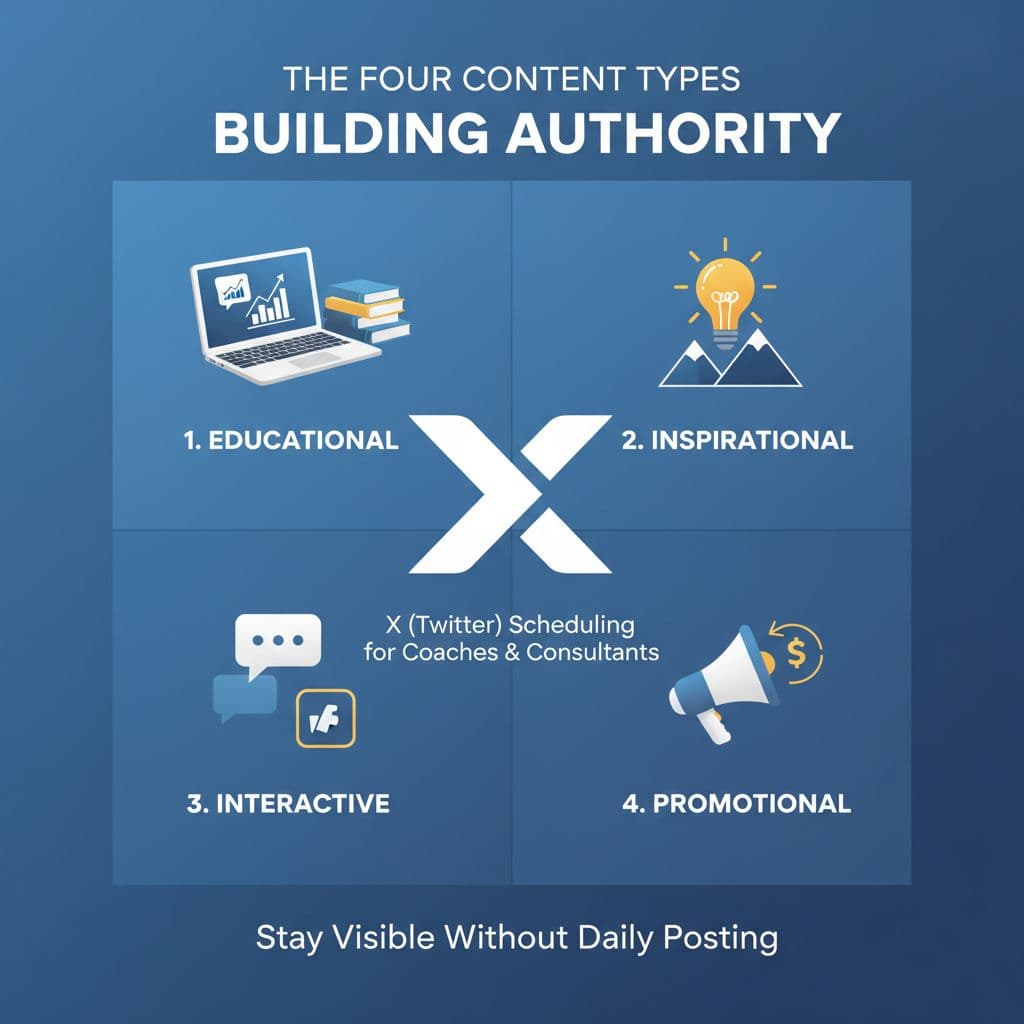
Thought leadership on X is not about posting more. It is about posting the right things repeatedly: your frameworks, your client results, your contrarian takes, your process. A content calendar built around these four content types gives you 30 days of material from one afternoon of work.
A framework is any structured way you think about a problem your clients face. If you are a leadership coach, maybe you have a three-part model for how leaders handle conflict. If you are a sales consultant, maybe you have a specific sequence you use to diagnose why a team is underperforming. These are gold on X because they are repeatable and shareable.
When someone reads your framework and thinks, that is exactly how I think about this too, they trust you instantly. When someone reads it and thinks, I never thought about it that way, they follow you immediately. Either reaction builds your audience. And you do not need to invent new frameworks every week. Post the same core frameworks multiple times, worded differently, from different angles. Your newest followers have never seen it. Your longtime followers are reminded why they followed you in the first place.
Client Results and Process Posts
Client results are your social proof. You do not need to share names or sensitive details. You can say something like: a client came to me six months ago stuck at $8k months. We rebuilt her offer and her sales process. She hit $22k last month. That is a real result that tells a real story without violating anyone's privacy.
Process posts are the behind-the-scenes version of this. Walk people through how you actually work. What does your onboarding look like? How do you structure a 90-day engagement? What do you do in week one with a new client? These posts attract exactly the kind of people who are already considering hiring someone like you, because they are trying to understand what working with a consultant actually looks like.
Together, client results and process posts do the selling for you. They answer the questions a prospect is already asking before they ever reach out. By the time someone books a call with you, they already feel like they know how you work. That is a warmer conversation from the first minute.
Contrarian Takes: The Posts That Get Shared
Contrarian takes are the content type most coaches avoid because they feel risky. They should not. A contrarian take is not about being provocative for its own sake. It is about saying something true that most people in your space are not saying out loud.
If you are an executive coach, maybe your take is that most leadership training fails because it focuses on skills instead of identity. If you are a marketing consultant, maybe your take is that most small businesses need fewer channels, not more. These posts get shared because they make people feel like they just heard something honest in a space full of generic advice.
One contrarian take per week is enough to keep your content from feeling like a highlight reel. It shows you have opinions. And people hire consultants with opinions, not ones who hedge everything with phrases like it depends and every situation is different. Have a point of view. Post it. See who agrees loudly enough to follow you.
How Agentic AI Cuts Your Weekly Time Cost to Minutes
What an Agentic Workflow Actually Looks Like
Agentic AI workflows change the game for solo operators. Instead of manually writing, scheduling, and reviewing every tweet, an AI agent can draft posts based on your brand voice, slot them into your content calendar, and queue them for approval, cutting the weekly time cost from hours to minutes.
Here is what the old way looks like. You sit down Sunday evening to plan your content for the week. You stare at a blank document, try to remember what you wanted to write about, draft something, decide it is not good enough, rewrite it, schedule it manually across five days, and realize you spent two hours on what amounts to five posts.
Here is what an agentic workflow looks like with a tool like Aidelly. You set your brand voice once, add your content pillars, and the AI agent drafts posts for you based on those inputs. You review them, approve what looks good, adjust anything that needs tweaking, and the agent slots them into your calendar at your optimal posting times. The whole process takes 20 minutes instead of two hours. The agent is not just scheduling. It is making decisions about timing, content variety, and platform fit so you do not have to.
Approval Workflows for Small Consulting Teams
If you run a small consulting firm and manage social for a team of consultants, the approval workflow piece becomes critical. You want each consultant's posts to sound like them, but you also need everything to stay on-brand and legally safe before it goes live. Manual review of every post across five consultants is not sustainable.
Aidelly's approval workflows let you build a review gate into the process. Posts get drafted, queued for review, and nothing goes live until someone with approval access signs off. This gives you brand consistency without micromanaging every word. Your consultants can contribute content ideas and drafts, and you maintain oversight without it becoming a full-time job.
For solo operators, the approval workflow is still useful. It gives you a moment to review what the AI drafted before it goes live, which means you are never publishing something you have not seen. You stay in control without being in the weeds every day. That balance between automation and oversight is what makes the system actually work in practice.
Brand Voice as a System, Not a Document
Most coaches and consultants have some version of brand voice guidelines somewhere. A PDF nobody reads. A notes doc from a branding session two years ago. These documents do not help you write better posts because they are not connected to where the writing actually happens.
When your brand voice is stored inside your content tool, it becomes active instead of passive. Every draft the AI generates is informed by your tone, your vocabulary, your positioning. You are not starting from a blank page and trying to remember how you sound. The system already knows.
That is the difference between a guideline document and a working system. One sits in a folder. The other shapes every post you publish. When an AI agent is drafting content for you, the brand voice layer is what makes those drafts sound like you instead of sounding like every other generic consultant on the platform. It is a small setup investment that pays off every single week.
Staying visible on X as a coach or consultant does not require daily effort. It requires a system. Batch your content around four proven types, schedule it into your best posting windows, let an agentic AI handle the drafting and queuing, and check your analytics every two weeks to see what is actually moving people toward your booking page.
The coaches and consultants who stay top of mind are not the ones grinding out posts every morning. They are the ones who built a content engine once and let it run. The right tools make that engine possible without adding another job to your plate.
If you are ready to stop disappearing from X and start building the kind of consistent presence that turns followers into clients, the system is simpler to set up than you think.
If you want a low-lift way to apply these ideas, Aidelly helps you keep your social content consistent without extra busywork.Your X profile is either building trust with prospects or losing it. There's no middle ground. Aidelly's agentic workflows handle the whole system for you — drafting posts in your voice, slotting them into your content calendar, and queuing them for approval — so your profile stays active while you stay focused on client work. If you're ready to stop disappearing from X, head to aidelly.ai and see how it works.
Compare social scheduling tools
Evaluating software for your content workflow? Use our buyer guides and comparisons to compare scheduling, approvals, analytics, and AI workflow fit.