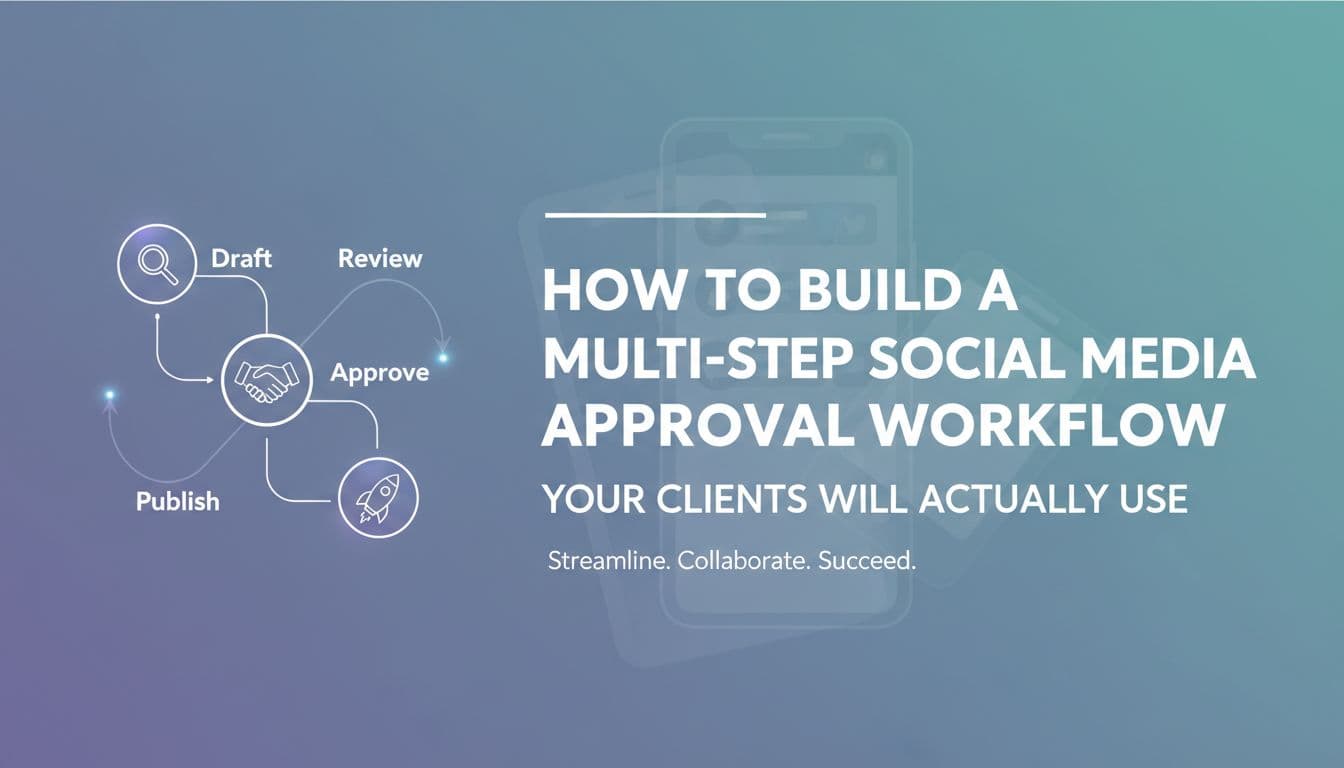
How to Build a Multi-Step Social Media Approval Workflow Your Clients Will Actually Use
Most agencies treat approval workflows like a necessary evil. You build a process, clients ignore it, and you end up back in a 47-message Slack thread trying to figure out if that Instagram post got approved or not. The real problem is not that clients are difficult. It is that most approval systems are built around the agency's convenience, not the client's reality. This article breaks down how to build a multi-step social media approval workflow that clients actually follow, speeds up review cycles instead of slowing them down, and pairs with agentic AI to handle the heavy lifting before content ever reaches a human reviewer. When you get this right, approvals stop being a bottleneck and start being a quality gate that protects your clients and your reputation.

Wilzer Jean-Baptiste
10 min read
Your client approved the post. You are pretty sure. There was a thumbs-up emoji in a Slack thread from Tuesday, or maybe it was Monday, and the Google Doc has three versions with comments that may or may not reflect the final call. The post goes live. The client calls. That was not the approved version.
This happens in agencies every single week. Not because teams are careless. Because approval workflows are broken by design. They are built from duct-taped tools that were never meant to work together, and they create just enough ambiguity to cause real problems.
Building a multi-step approval workflow that clients actually use is not about adding more steps or more tools. It is about designing a system that makes approvals faster, clearer, and harder to mess up. And when you pair that system with agentic AI that handles drafting and optimization before content ever reaches a human reviewer, the whole thing becomes something your clients will not just tolerate. They will ask for it.
Why Most Approval Workflows Break Down Before They Even Start
The Brand Damage You Don't See Coming
Here is a scenario that plays out more than agencies want to admit. A junior team member drafts a post for a healthcare client, schedules it without a second look, and it goes live with a claim that violates FDA guidelines. Or a restaurant client's post about a "limited-time deal" goes out three weeks after the promotion ended. Or a real estate agent's post uses a competitor's listing photo by accident.
None of these are catastrophic on their own. But they are the kind of mistakes that end client relationships. And they all share one root cause: no one caught it before it published.
Multi-step approval workflows exist to prevent exactly this. When you build a process where content passes through at least two sets of eyes before it goes live, you catch the off-brand language, the outdated offers, the poorly timed posts, and the factual errors that slip through when one person is managing 10 client accounts at once.
The key word is "multi-step." A single approval gate is better than nothing, but it creates a single point of failure. If your one reviewer is sick, traveling, or just slammed, everything stops. A multi-step workflow distributes that responsibility. A copywriter drafts, a strategist reviews for brand voice and timing, and the client gives final sign-off. Each step catches something different. The strategist might flag that a post is too promotional for a platform that rewards educational content. The client might catch that a product name changed last month. Together, they protect the brand in ways a solo reviewer never could.
This matters even more when you are publishing across multiple platforms. What works on LinkedIn does not work on TikTok. A post that is perfectly timed for a US audience might land at 3am for your client's UK customers. A multi-step review process that includes platform-specific checks is not bureaucracy. It is brand protection.
The Hidden Cost of Skipping the Process
Most agencies know they need an approval workflow. The problem is they build one and then quietly abandon it when deadlines get tight. You skip the review step "just this once" because the client needs the post up by noon. Then it becomes a habit. Then something goes wrong.
The cost of skipping the process is not just the occasional mistake. It is the time you spend doing damage control, rewriting apology captions, and rebuilding trust with a client who now questions everything you publish on their behalf. That cost is almost always higher than the 20 minutes the review step would have taken.
A well-designed workflow makes skipping it harder than following it. When the system is clunky, people work around it. When it is simple and fast, people use it. That is the design challenge worth solving. Build the path of least resistance toward the right behavior, and most people will take it.
What "Multi-Step" Actually Means in Practice
Multi-step does not mean complicated. For a small agency, it might look like this: AI drafts the content, your team reviews it for brand fit, the client approves it, and it auto-schedules. Four steps, but only two require human time. For a larger team or a more regulated industry, you might add a legal or compliance review between the strategy check and the client sign-off.
The steps you need depend on your client's industry, the stakes of a mistake, and how much trust you have built over time. A new client probably needs more oversight than one you have worked with for two years. A financial services brand needs tighter compliance checks than a local bakery. Build your workflow around the actual risk, not a one-size-fits-all template. The goal is a process that is light enough to move fast and thorough enough to catch what matters.
The Real Cost of Broken Approval Systems
Email Chains Are Killing Your Productivity
If you are managing 10 or more client accounts and your approval process lives in email, you are losing hours every week to threads that look like this: "See attached for this week's posts," followed by "Looks good except for post 3," followed by "Which version of post 3?" followed by silence for four days.
This is not a client problem. It is a systems problem. Email was not built for content approval. There is no version control, no clear status tracking, no way to know at a glance what is approved, what needs changes, and what is still waiting on a response. You end up building a spreadsheet to track the email threads, which means you are now maintaining two broken systems instead of one.
Agencies that move to a centralized approval workflow typically cut review time by around 60 percent. That is not a small efficiency gain. For an agency billing 10 clients, that is potentially 10 or more hours a week back in your team's schedule. Hours that go toward strategy, creative work, and client relationships instead of inbox archaeology.
Centralized workflows work because everything lives in one place. The draft, the feedback, the revision history, the approval status, and the scheduled publish time are all visible to everyone who needs to see them. No one has to ask "did this get approved?" because the answer is right there in the system. That clarity alone changes how your team and your clients experience the whole process.
The Bottleneck Problem Nobody Talks About
Approval bottlenecks are one of the most common reasons agencies lose clients. Not because the content was bad. Because it was slow. A client asks for a post to go live by Thursday. Your team sends it for approval on Monday. The client is busy and does not look until Wednesday afternoon. They request one change. You make it and resend. They approve it Friday morning. The moment has passed.
Clients want fast turnarounds. They are watching trends, responding to news cycles, and trying to stay relevant in feeds that move fast. A week-long review cycle for a single post is not just inefficient. It makes your agency feel like a liability instead of an asset.
Smart workflows fix this by building urgency into the process. Automated reminders go out when a review has been sitting for 24 hours. Approval deadlines are set at the start of each content cycle. Clients know exactly what they need to review and when. You stop chasing people and start managing a system that does the chasing for you. That shift alone changes the dynamic with clients who have historically been slow to respond.
Disconnected Tools Create Invisible Problems
Here is what a typical agency approval process looks like when it has not been intentionally designed. Content is drafted in Google Docs. Feedback comes in via Slack. Final approval happens over email. Someone manually copies the approved post into a scheduling tool. A week later, a post goes live that the client thought they rejected, because the "approved" version in the scheduling tool was an earlier draft.
Disconnected tools do not just slow you down. They create confusion about what is approved and when things will publish. That confusion erodes trust. Clients start to feel like they are not in control of their own brand, even when they technically approved everything.
The fix is not using more tools. It is using fewer, better-connected ones. When drafting, approvals, feedback, and scheduling all live in the same system, there is no gap between "approved" and "published." The approved version is the version that gets scheduled. No manual copying, no version mix-ups, no surprise posts going live on a Friday afternoon.
Building a Workflow That Runs Itself
Let AI Handle the Work Before It Reaches a Human
Here is the shift that changes everything. Most approval workflow conversations focus on making the review step faster. But the bigger opportunity is reducing how much humans need to review in the first place.
Agentic workflows change the game here. Instead of a copywriter drafting a post from scratch, an AI agent generates platform-optimized content based on your client's brand guidelines, past performance data, and the current content strategy. The draft that reaches the reviewer is not a rough first pass. It is a polished, on-brand post that already accounts for platform best practices, optimal posting times, and the client's tone of voice.
When the content is better before it reaches the review step, reviews go faster. Clients spend less time rewriting and more time approving. Your team spends less time explaining creative choices and more time on strategy. The whole cycle compresses because the AI did the heavy lifting upfront.
Aidelly's agentic workflows are built around exactly this idea. AI agents handle ideation, drafting, and platform optimization autonomously. By the time content reaches the approval queue, it is ready. Clients review polished output, not work-in-progress drafts. That single change makes approval workflows feel less like a chore and more like a quick quality check that takes two minutes instead of twenty.
Routing, Reminders, and Auto-Scheduling
A workflow that requires manual handoffs is a workflow that breaks. Someone forgets to forward the draft to the client. The client approves it but no one sees the notification. The post sits in a queue, approved but never scheduled, until someone notices it three days later.
Agentic approval workflows eliminate manual handoffs by automating the routing. When a draft is ready, it automatically routes to the right reviewer based on pre-set rules. When the reviewer approves it, it automatically moves to the next step, whether that is a second reviewer, a final client sign-off, or straight to the schedule. When it is approved and a publish time is set, it schedules itself.
This is where Aidelly's approval workflows and visual content calendar work together. Once content is approved, it drops into the calendar at the optimal time based on platform data and past performance. You are not manually picking times. The system handles it. Your job is to set the rules once and let the workflow run. That is what autonomous social media management actually looks like in practice.
Making It Easy for Clients to Say Yes
The best approval workflow in the world fails if clients find it annoying to use. This is where most agencies get it wrong. They build a system that works great internally but requires clients to learn a new tool, remember a login, and navigate an interface they only touch once a week.
The solution is to design the client-facing experience around the client's actual behavior. Most clients want to review content on their phone, during a five-minute gap in their day. They want to see the post exactly as it will look when it publishes. They want to leave a quick note if something needs changing and move on.
Build your workflow around that reality. Use a tool where the client review interface is clean, mobile-friendly, and requires minimal setup. Give clients a simple approve or request-changes option. Let them leave comments directly on the post instead of in a separate thread. When the experience is that simple, clients use it. Your approval cycle shrinks from days to hours. Content momentum stays alive. And clients feel like partners in the process instead of the last obstacle between your team and the publish button.
A good approval workflow does two things at once. It protects your clients from content mistakes that damage their brand, and it protects your agency from the chaos of disconnected tools and missed sign-offs. When you add agentic AI to the mix, the whole system gets sharper. AI handles the drafting, the optimization, and the scheduling. Humans handle the judgment calls. Everyone does less busywork and more of what they are actually good at.
Social media moves fast. Feeds are unforgiving. A post that goes live with the wrong message, the wrong timing, or the wrong version of a product name can undo weeks of good work. The right approval system is not just a process improvement. It is a brand protection strategy that runs in the background while your team stays focused on growth.
If your current approval process still lives in email threads and Slack messages, it is worth taking a hard look at what a centralized, agentic workflow could do for your team and your clients.
If you want a low-lift way to apply these ideas, Aidelly helps you keep your social content consistent without extra busywork.The approval workflows that work best aren't just faster. They're built on AI agents that handle the heavy lifting from start to finish. Instead of reviewing rough drafts and sending feedback loops, your clients see polished, on-brand content that's already optimized for their platforms and audience. That's where agentic workflows come in. They let your team skip the bottlenecks and focus on strategy while AI handles ideation, drafting, scheduling, and performance tracking. Ready to turn approval workflows from a pain point into your competitive edge? See how Aidelly works.
Compare Social Scheduling Tools
Evaluating software for your content workflow? Use our buyer guides and comparisons to compare scheduling, approvals, analytics, and AI workflow fit.
Share this article
Related Articles
LinkedIn Automation for Agencies: How to Scale Client Content Without Losing the Human Touch
Managing LinkedIn content for 10, 15, or 20+ clients at once is not a scheduling problem. It is a voice problem. The moment your posts start sounding like they came from the same template, clients notice, and so does the algorithm. This article breaks down exactly how agencies can use agentic AI workflows, stored brand voice profiles, approval gates, and smart scheduling to triple their LinkedIn output without adding headcount or sacrificing quality. If you have ever stared at a blank doc trying to write a post that sounds like a B2B SaaS founder one minute and a commercial real estate broker the next, this one is for you.
Jun 20, 2026
Read more
Multi-Client Social Media Reporting: How Agencies Automate Analytics Delivery
If you manage more than five client accounts, you already know the reporting grind. Every month, you pull numbers from Instagram, TikTok, LinkedIn, Facebook, X, and YouTube, drop them into a spreadsheet or a deck, write a summary, and send it off. Then you do it again for the next client. And the next. For a mid-size agency, that process can eat 40 or 50 hours a month before you've done any actual strategy work. But the real problem isn't the time. It's what manual reporting signals to your clients. When you're buried in data entry, you're not thinking about what's next for their brand. You're just catching up. This article is about a different model: one where AI agents handle the data collection, the formatting, and the delivery, so your team shows up to client calls with insights instead of spreadsheets. That shift changes how clients see you.
May 31, 2026
Read more
White-Label Social Media Automation: How Agencies Use Agentic AI to Sell a Content Pipeline, Not Hours
Most agencies still bill for social media by the hour. One person handles content for five clients. Another handles ten. Eventually you hit a ceiling — more clients means more hires, and margins shrink. But a different model is taking hold in 2026. Agencies are packaging AI-powered social media automation as a productized service, delivering consistent branded content for dozens of clients without growing headcount. The shift isn't just about scheduling tools. It's about agentic AI workflows that handle ideation, drafting, scheduling, and reporting end-to-end. This article walks through what that model looks like operationally: how to pick the right platform, how to protect client brand voice at scale, how to structure your service tiers, and how REST APIs and MCP server connections let you build a custom client experience on top of existing infrastructure. If you run an agency and you're still selling hours, this is worth reading.
Jun 9, 2026
Read moreReady to never miss a post again?
Tell Aidelly what to post. It drafts, schedules, and publishes across 9 platforms while you focus on your business.