Agencies
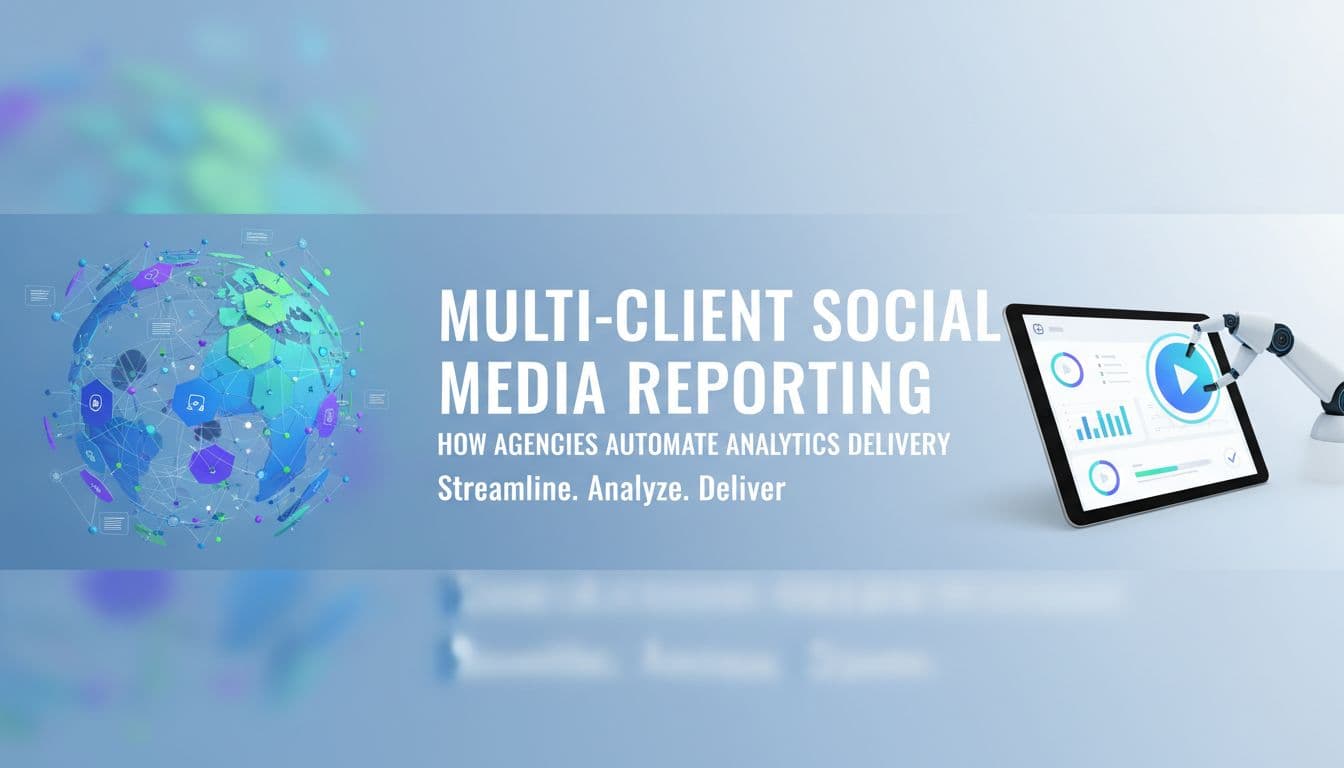
Multi-Client Social Media Reporting: How Agencies Automate Analytics Delivery
If you manage more than five client accounts, you already know the reporting grind. Every month, you pull numbers from Instagram, TikTok, LinkedIn, Facebook, X, and YouTube, drop them into a spreadsheet or a deck, write a summary, and send it off. Then you do it again for the next client. And the next. For a mid-size agency, that process can eat 40 or 50 hours a month before you've done any actual strategy work. But the real problem isn't the time. It's what manual reporting signals to your clients. When you're buried in data entry, you're not thinking about what's next for their brand. You're just catching up. This article is about a different model: one where AI agents handle the data collection, the formatting, and the delivery, so your team shows up to client calls with insights instead of spreadsheets. That shift changes how clients see you.

By Wilzer Jean-Baptiste
Published 12 min read
If you run a social media agency and you manage more than ten client accounts, there's a good chance your team spends more time building reports than doing strategy. Pulling numbers from Instagram, TikTok, LinkedIn, Facebook, X, and YouTube. Formatting them. Writing summaries. Sending them to each client on a different schedule. It's a grind that repeats every month, and it scales terribly. Add five new clients and you don't just add revenue — you add 25 to 50 hours of monthly reporting work. But the time isn't even the worst part. The worst part is what it costs you in positioning. When your team is buried in data exports, they're not thinking about what's next for your clients. They're just catching up. This article is about a different model: one where AI agents handle the collection, the formatting, and the delivery, so your agency can show up to every client conversation as a strategist instead of a spreadsheet builder.
The Reporting Tax Every Agency Pays
Manual client reporting is one of the biggest time drains in agency work, and most agency owners don't fully realize how bad it is until they sit down and count the hours. Pulling data from Instagram, TikTok, LinkedIn, Facebook, X, and YouTube separately, formatting it into something readable, and sending it to each client can eat 5 to 10 hours per week per account manager. Multiply that across a growing client roster and you're looking at a part-time job that produces no billable work and no strategic value.
Where the Hours Actually Go
It's not one big task. It's a hundred small ones. You log into Instagram Insights and export the numbers. Then LinkedIn. Then TikTok, which has its own analytics interface with its own quirks. Then Facebook Business Suite. Then X. Then YouTube Studio. Each platform uses different date ranges by default, different metric names, and different export formats. By the time you've collected everything, you've spent two hours and haven't written a single word of the actual report.
Then comes the formatting. You copy numbers into a template, make sure the charts update, write a narrative that ties it together, and do a final check before it goes to the client. For one client, that's maybe two more hours. For ten clients, that's a week of someone's life, every single month. Each new client you add doesn't just add revenue — it adds reporting overhead. And because reporting usually happens at the end of the month, it creates a crunch that burns out account managers and leaves no room for proactive work.
The Hidden Cost Beyond Hours
There's a cost that doesn't show up in a time tracker. When your team is heads-down in data exports and slide decks, they're not thinking about what's working for a client's audience, what content angle to try next month, or which competitor just shifted their strategy. The cognitive load of manual reporting crowds out strategic thinking.
Clients don't always see the hours you're spending. What they see is the report that shows up in their inbox. If that report is a PDF with some bar charts and a two-paragraph summary, it doesn't communicate the depth of work behind it. You did 10 hours of work and delivered something that looks like 30 minutes of effort. That perception gap quietly erodes client confidence, even when your results are solid.
Why This Gets Worse as You Grow
The math is brutal. At five clients, manual reporting is annoying. At fifteen, it's a bottleneck. At thirty, it's a reason clients leave — because quality drops when your team is stretched thin. Agencies that try to grow without fixing their reporting process end up hiring more account managers just to keep up with admin work. That's expensive, and it doesn't solve the problem. It just adds more people doing the same manual process.
The only way out is to change the process itself. Not optimize it. Not add another template. Change the model entirely, so that reporting happens without a human initiating it every single time.
What Agentic AI Does to the Reporting Model
Agentic AI workflows change reporting from a monthly manual task into a continuous, automated system. Instead of a person pulling data and building decks, AI agents autonomously collect cross-platform analytics, surface what is working, flag what needs attention, and package it into a branded report on a set schedule — no manual trigger required. That's not a small efficiency gain. It's a fundamentally different way of operating.
Agents That Work While You Sleep
The word 'agentic' matters here. A regular automation tool might pull a report if you click a button or set a scheduled job. An AI agent does something more: it understands context, makes decisions, and takes action without being told to each time. In a reporting workflow, that means the agent knows which clients are due for a weekly summary versus a monthly deep-dive, collects the right data for each, identifies the metrics that moved significantly, writes a plain-language summary of what happened, and sends the report at the right time.
No human has to initiate any of it. For an agency with 25 clients, that's 25 reporting workflows running in parallel, each one tailored to that client's platforms and goals. The account manager's job shifts from building reports to reviewing them — which takes 10 minutes instead of two hours. That's the real unlock: not just saving time, but changing what your team does with their time.
From Data Collection to Insight Delivery
There's a difference between a report that shows numbers and a report that explains what the numbers mean. Manual reports often end up being the former, because the person building them is too tired from data collection to do deep analysis. Agentic workflows flip that. Because the data collection is automated, the AI has the processing capacity to do the analysis layer too.
It can compare this month's engagement rate to the previous three months, flag that a client's TikTok reach dropped 18% week over week, and note that the two posts with the highest saves were both product tutorials posted on Tuesday mornings. That's the kind of insight that makes a client feel like you're paying close attention. And it shows up automatically, without anyone on your team having to dig for it.
Scheduling Reports Like You Schedule Posts
One of the cleanest things about agentic reporting is that it runs on a schedule, just like content publishing. You set the cadence — weekly, bi-weekly, monthly — and the system delivers. Clients get used to receiving reports on a predictable schedule, which builds trust. They stop emailing you asking how last month went because the answer is already in their inbox.
Platforms like Aidelly bring this together by connecting the analytics layer directly to the content calendar and scheduling workflow, so the reporting cadence is part of the same system that manages content creation and publishing. Everything lives in one place, and the data flows between the pieces automatically. That's a very different experience from logging into six platforms and stitching it together by hand.
White Label Reporting as a Retention Tool
White label reporting is a competitive differentiator for agencies. Clients who receive polished, branded reports with their agency's logo and color scheme perceive more value, trust the relationship more, and churn less than clients who get raw data exports or generic dashboard links. This isn't about vanity. It's about what professional presentation signals to the people paying your retainer.
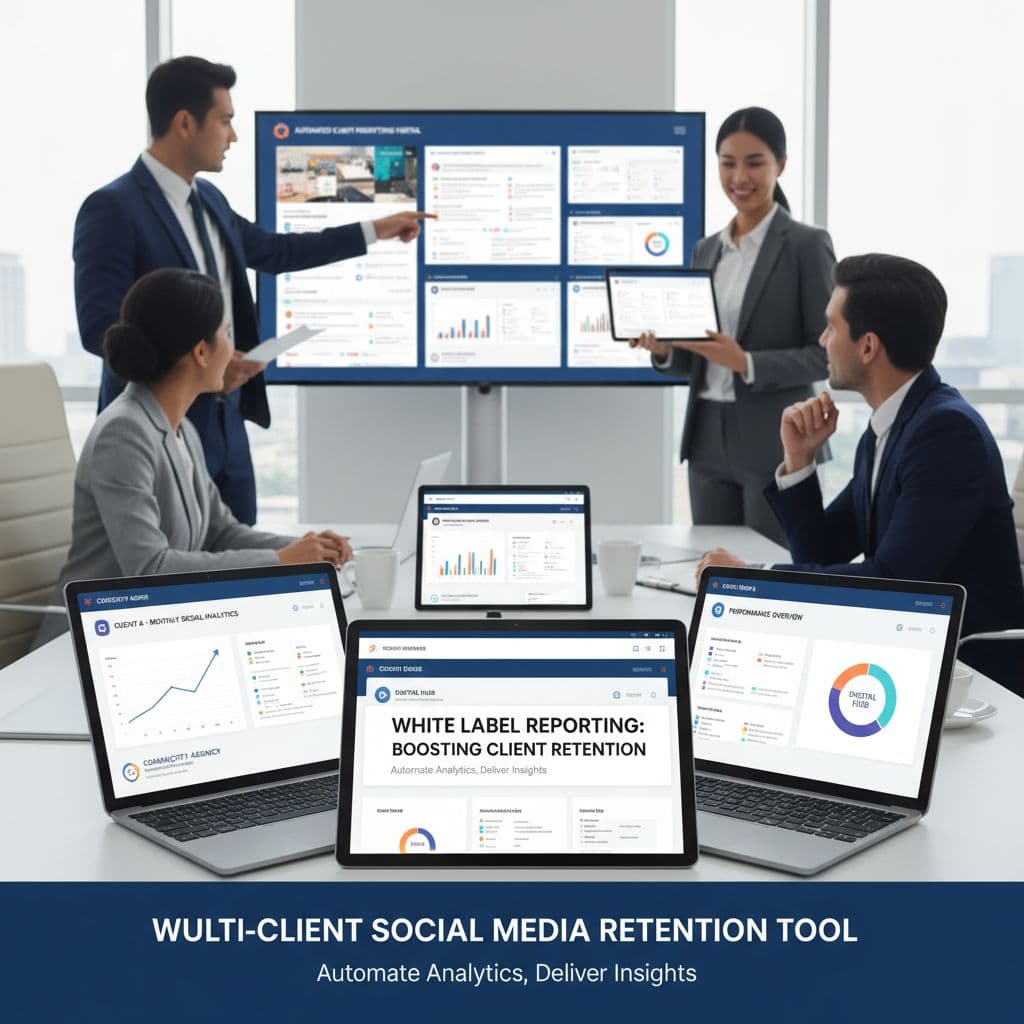
What a Branded Report Actually Communicates
When a client opens a report that has your agency's logo, their brand colors, and a clean layout with clear sections, they read it differently than a CSV export or a screenshot of a dashboard. The presentation tells them that someone thought about this, organized it, and made it easy to understand. Even if the underlying numbers are identical, the experience of receiving a polished report creates more confidence in your work.
White label reports also remove the friction of clients seeing your tool stack. If you send a client a link to a generic analytics dashboard, they can see the platform branding. Some clients start wondering if they could just use that tool themselves and cut out the agency. A white label report keeps the focus on your agency's work and analysis, not the software behind it. That's a subtle but important boundary to maintain.
The Churn Connection
Client churn in social media agencies is often not about results. It's about perceived value. A client who sees consistent engagement growth but receives sloppy, inconsistent reporting will still question whether the agency is worth the retainer. A client who receives a clean, branded monthly report with clear metrics, trends, and recommendations feels informed and confident in the relationship.
That feeling is worth more than any single campaign result. Agencies that invest in professional reporting infrastructure keep clients longer, which means more lifetime value per account and lower acquisition costs overall. If white label reporting keeps one client for three extra months at a $2,000 retainer, that's $6,000 from a workflow change that costs a fraction of that to implement. The ROI on good reporting is real and it compounds.
Consistency Across Every Client
Manual reporting is inconsistent by nature. Different account managers have different templates, different levels of detail, and different writing styles. One client gets a thorough three-page report. Another gets a quick summary because their account manager was slammed that week. Clients talk to each other. That inconsistency gets noticed.
Automated white label reporting fixes this. Every client gets the same quality, the same format, and the same level of detail — regardless of how busy your team is. That consistency signals operational maturity. It tells clients that your agency has systems, not just people scrambling to keep up. And in a market where most agencies are still doing this manually, it's a real point of difference.
The Closed-Loop System: From Analytics Back to Content
Connecting reporting automation to content scheduling and publishing creates a closed-loop system. Agencies can see which post types, formats, and posting times drove results, feed that data back into the content calendar, and let agentic scheduling optimize future posts based on actual performance rather than guesswork. This is where reporting stops being a backward-looking summary and starts being a forward-looking engine for better content.
Performance Data as a Content Brief
Most agencies treat analytics and content creation as separate workflows. The analytics side pulls the numbers. The content side makes the posts. Those two groups might meet once a month to review results, but the connection between 'what worked' and 'what we make next' is loose and slow. A closed-loop system changes that entirely.
When your analytics feed directly into your content planning workflow, last week's performance data becomes this week's content brief. If the data shows that a restaurant client's short-form video posts on Thursday evenings drove 3x more saves than their static image posts on Monday mornings, that insight should immediately shape the next two weeks of content. The calendar should reflect it. The scheduling should prioritize it. In Aidelly's agentic workflow, the analytics layer and the content calendar connect inside the same platform, so the feedback loop is tight and the decisions happen faster.
Agentic Scheduling That Gets Smarter Over Time
Agentic scheduling is different from regular scheduling. A regular scheduler posts content at the time you tell it to. An agentic scheduler learns from performance data and adjusts. It knows that for a specific client, carousel posts on LinkedIn perform best at 8 a.m. on Tuesdays, and that TikTok videos posted on Friday afternoons get twice the reach of videos posted on Monday mornings. It uses that knowledge to recommend or automatically select posting times for new content.
Over time, the system gets better at predicting what will perform well for each client's specific audience. The difference between posting at the right time and the wrong time can mean a 30 to 50% difference in reach for the same piece of content. Agencies using agentic scheduling consistently outperform agencies picking posting times manually, because the system processes more historical data and acts on it faster than any human can.
Proactive Reporting and the Strategist Shift
The shift from reactive to proactive reporting is where agencies win. Instead of answering 'how did we do last month?' after the fact, automated analytics delivery lets agencies send insights before clients ask. That reframes the agency as a strategic partner rather than a vendor, and it changes the entire tone of client relationships.
Vendors respond to requests. Strategists anticipate needs. When your system flags mid-month that a client's engagement is trending up and surfaces a recommendation to push harder on Reels before the weekend, you can forward that to the client before they even noticed the trend. They didn't ask for it. But they're glad they got it. Proactive communication is one of the top reasons clients stay with agencies long-term, and automated reporting makes it easy to deliver consistently. The closed-loop system also makes ROI easier to prove: you can show a client that the strategy shift you made based on last quarter's data produced a 22% increase in engagement this quarter. That's not just a number. It's a story about how your agency thinks and acts.
Manual reporting doesn't just cost you time. It costs you positioning, client trust, and the headspace your team needs to do real strategy work. The agencies that grow without burning out their teams are the ones that have replaced the monthly reporting grind with automated, always-on systems that deliver insights continuously and connect performance data directly back to content decisions. That's the shift worth making in 2026 — not just to save hours, but to change how clients see you. The right platform makes all of this possible in one place: content creation, scheduling, publishing, analytics, and reporting, all connected and all driven by AI agents that work without constant human input. If you're ready to stop catching up and start leading, the tools are there.
If you want a low-lift way to apply these ideas, Aidelly helps you keep your social content consistent without extra busywork.If your team is still pulling reports by hand, that time is coming out of strategy, growth, and the work clients actually hired you for. Aidelly's agentic workflows handle the full loop for you — content creation, scheduling, publishing, and performance reporting — without needing a human to kick it off each time. See how it works at aidelly.ai.
Compare social scheduling tools
Evaluating software for your content workflow? Use our buyer guides and comparisons to compare scheduling, approvals, analytics, and AI workflow fit.