AI Content Approval Workflows: How Agencies Cut Review Time in Half
If you run a social media agency, you know the approval process can kill momentum faster than anything else. A post gets drafted, sent to the client, and then it sits. Days pass. You follow up. They request changes. You revise. They forward it to someone else. By the time it gets approved, the moment has passed. In 2026, agencies that are still running manual approval chains are leaving time and money on the table. AI content approval workflows change how the whole process works — not by replacing human judgment, but by handling the slow, repetitive parts automatically. This guide breaks down exactly how these workflows operate, where they save the most time, and what agencies need to put one in place today.

Wilzer Jean-Baptiste
9 min readUpdated
If you run a social media agency, you know the approval process can kill momentum faster than almost anything else. A post gets drafted, sent to the client, and then it sits. Days pass. You follow up. They request changes. You revise. They forward it to someone else who has notes too. By the time it gets approved, the moment has passed and your team has moved on mentally. In 2026, agencies still running manual approval chains are losing hours every week to coordination work that should not require human effort at all. AI content approval workflows fix this, not by cutting humans out of the decision, but by handling the slow, repetitive parts automatically so your team can focus on the work that actually requires their judgment.
Why the Old Approval Process Breaks Down
Most agencies built their content approval process around email threads and shared Google Docs. It worked well enough when you had two or three clients. But once you scale past that, the cracks show fast.
The Real Cost of a Slow Review Cycle
A slow approval process is not just annoying. It has a real price tag. When a post misses its ideal publish window, reach drops. When a client sits on feedback for four days, your team has to context-switch back into a project they mentally closed. And when multiple rounds of revision pile up across ten clients at once, your team burns hours on coordination instead of creation.
Research from project management studies consistently shows that knowledge workers lose significant time to status updates and follow-ups rather than actual work. In an agency context, that often means an account manager spends more time chasing approvals than building strategy. That is a problem you can fix without hiring more people.
Where Manual Workflows Fall Apart
Manual approval chains break in predictable places. The first is visibility. When a post lives in an email thread, nobody has a clear picture of what is approved, what is pending, and what is stuck. The second is accountability. Without a system that timestamps actions, it is hard to know who dropped the ball when a deadline gets missed. The third is version control. Clients leave feedback in comments, in reply emails, and sometimes in a separate Slack message, and your team has to piece it all together.
These are not people problems. They are process problems. And process problems respond well to automation.
What Clients Actually Want From the Review Process
Most clients do not want a complicated approval system. They want to see the content, give a thumbs up or a few notes, and move on. The problem is that most agency tools make this harder than it needs to be. Clients get asked to log into platforms they do not use daily, navigate dashboards built for marketers, and figure out where to leave feedback. When the experience is friction-heavy, approvals slow down.
A good AI content approval workflow removes that friction. It brings the content to the client in a format they can act on quickly, captures their feedback in a structured way, and routes it back to your team without anyone having to chase it down.
How AI Content Approval Workflows Actually Work
The phrase AI content approval workflow gets used loosely. Here is what it actually means in practice for agencies managing social media in 2026.
AI Drafts, Humans Decide
The first stage is content creation. AI tools like Aidelly's AI-powered content drafting generate platform-optimized posts based on your client's brand voice, content calendar, and campaign goals. The AI does not just spit out generic copy. It pulls from stored brand guidelines, past performance data, and platform-specific best practices to produce drafts that are already close to ready.
This matters for the approval process because the quality of the draft determines how many revision rounds you need. When the first draft is already on-brand and well-structured, clients spend less time asking for changes. That alone cuts review cycles significantly. Agencies that used to average three rounds of revisions often get it done in one when the AI draft is the starting point.
The human role here is not eliminated. Your team reviews the AI output before it ever reaches the client. You catch anything that feels off, add context the AI could not know, and make sure the post fits the moment. Then it moves into the formal approval stage.
Automated Routing and Notifications
Once a draft is ready for client review, the workflow takes over. Instead of someone manually emailing a PDF or pasting copy into a Slack message, the system routes the content directly to the right reviewer. The client gets a notification, clicks through to a clean review interface, and sees exactly what is up for approval: the copy, the visual, the scheduled time, and the platform it will go live on.
If the client does not respond within a set window, the system sends an automatic follow-up. No one on your team has to remember to chase it. The workflow handles it. This single change removes one of the biggest time sinks in the agency approval process: the follow-up email. Approval workflows built into platforms like Aidelly let you set these rules once per client and run them automatically from that point forward.
Feedback Capture and Version Tracking
When a client requests changes, the feedback goes directly into the workflow rather than landing in a side channel. The system logs what was requested, who requested it, and when. Your team gets a clear revision task with the original draft and the client's notes in one place. No archaeology through email threads required.
Version tracking means everyone can see the history of a post from first draft to final approval. This is useful when a client later asks why something was changed, or when you want to audit your own process to find where delays consistently happen. The data is there, and you can use it to get faster over time.
The Metrics That Show the Time Savings Are Real
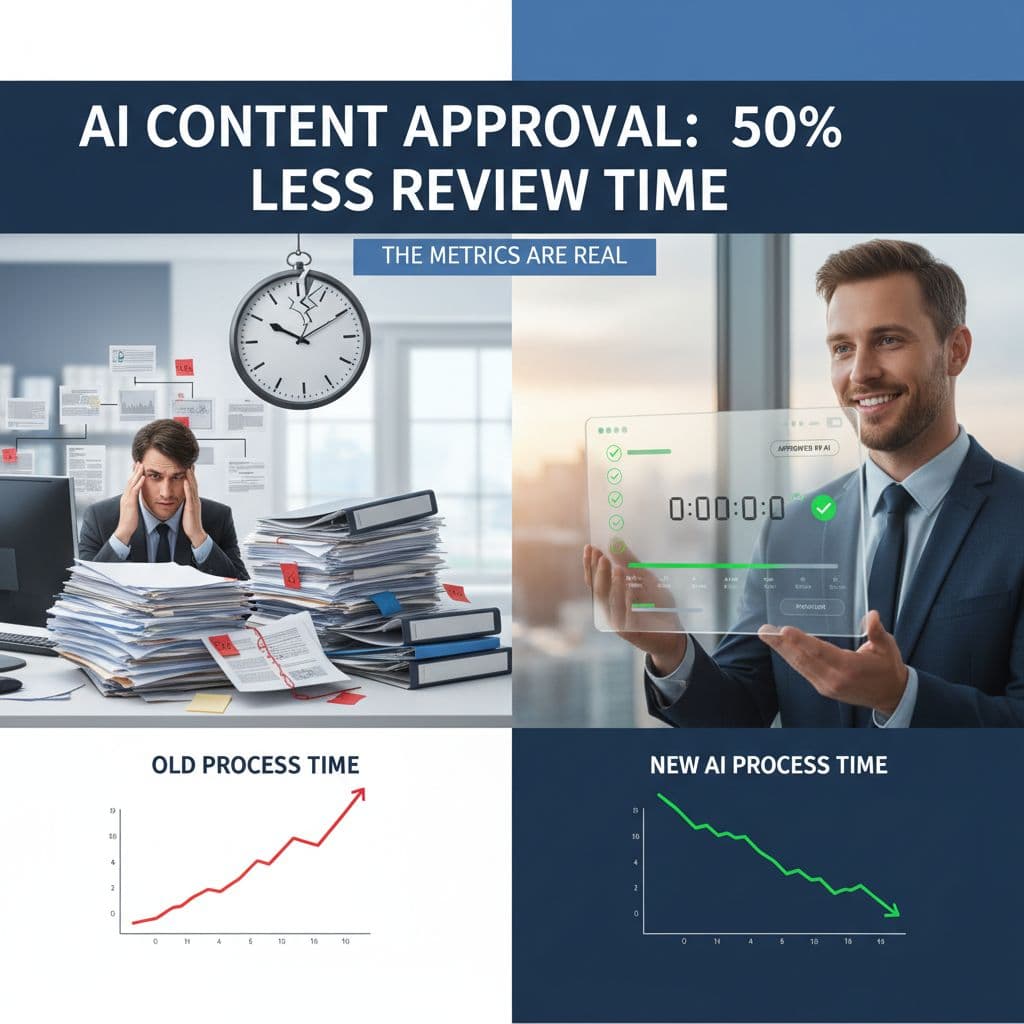
Cutting review time in half sounds like a marketing claim. But the math behind it is straightforward once you map out where time actually goes in a manual process.
Mapping the Old Timeline
Take a typical social media post going through a manual agency approval process. The copywriter finishes the draft and hands it off. The account manager reviews it, formats it for the client email, and sends it. The client receives it, reads it when they get a chance, and either approves it or sends back notes. If there are notes, the copywriter revises, the account manager reviews again, and the email goes back out.
Average time from draft to approval in a manual process: three to five business days per post. Multiply that across a client with 20 posts per month and you have an enormous coordination overhead. Most of that time is not spent on the actual content. It is spent waiting and following up.
What Changes With Automation
With an AI content approval workflow, the draft goes from creation to client review in minutes rather than hours. The client gets a notification immediately. The follow-up is automatic. Feedback is captured in one place. The revision goes back through the same clean channel.
Average time from draft to approval in an automated workflow: under 24 hours for straightforward posts, and rarely more than two days even when revisions are needed. For an agency managing 10 clients with 20 posts each per month, cutting average approval time from four days to one day frees up hundreds of hours of coordination work over the course of a year. That time goes back into strategy, creative, and growth.
Quality Improves Along With Speed
Here is something that surprises agencies when they first switch to automated approval workflows: quality goes up at the same time speed does. When the process is cleaner, clients engage with it more carefully. They are not skimming a dense email. They are looking at a formatted preview of the actual post. They give better feedback because the context is clear. Your team produces better revisions because the feedback is specific and consolidated.
The result is content that performs better because it went through a more focused review, not a faster but sloppier one. Speed and quality are not opposites here. A cleaner process produces both.
Building an AI Content Approval Workflow for Your Agency
Knowing the theory is one thing. Here is how to actually build a workflow that works for your team and your clients.
Start With a Content Calendar as the Foundation
Every approval workflow needs a source of truth. That source is your content calendar. Before you automate anything, get your calendar organized by client, platform, and publish date. When your calendar is clear, the approval workflow has something to route. Without it, you are just automating chaos.
Aidelly's visual content calendar gives agencies a single place to see every client's upcoming posts across every platform. You can see what is drafted, what is in review, what is approved, and what is scheduled. That visibility is what makes automated routing possible. The system knows what needs to go where because the calendar tells it, and your team stops spending time answering the question of what is even supposed to go out this week.
Set Up Approval Gates That Match Each Client's Process
Not every client has the same review process. Some want to approve every single post. Others are happy to approve a content batch once a week. Some have an internal marketing person who reviews before the final decision-maker sees it. Your workflow needs to reflect these differences.
Good approval workflow tools let you configure these gates per client. You set the rules once: who gets notified, in what order, what the deadline is, and what happens if no one responds. Then the system runs it automatically every time. You are not rebuilding the process from scratch for each post. You set it up once and it runs. This is where agencies save the most time in the long run. The setup takes an hour. The time savings compound every month after that.
Use Performance Data to Close the Loop
The approval workflow does not end when a post goes live. The best agencies use post-performance data to improve the drafts they create next time. When you can see which types of posts get approved faster and which ones consistently come back with revision requests, you learn something about what your clients actually want.
Cross-platform analytics, like the kind Aidelly surfaces in one dashboard, let you connect approval history to performance outcomes. A post that went through three rounds of revision and finally got approved might have outperformed the one that sailed through on the first try. Or it might not have. Either way, that data shapes how you brief the AI on the next batch of content. The workflow gets smarter over time because you are feeding it better inputs, and your clients notice that the content keeps getting more aligned with what they actually want to say.
The content approval process does not have to be the slowest part of running a social media agency. When you replace manual email chains with an AI-driven workflow, you get faster approvals, cleaner feedback, and more time to spend on the work that actually grows your clients' accounts. The agencies winning in 2026 are not the ones with the biggest teams. They are the ones with the tightest processes. Getting your approval workflow right is one of the highest-leverage changes you can make, and the tools to do it are available right now.
If you want a low-lift way to apply these ideas, Aidelly helps you keep your social content consistent without extra busywork.A faster approval process only helps if your content actually gets out the door on time, across every platform, without things falling through the cracks. Aidelly's multi-platform publishing keeps your brand voice consistent and your schedule moving, so you're not manually copying posts between tools after a client finally approves at 11pm. If you want to see how it fits into your workflow, head to aidelly.ai.
Compare Social Scheduling Tools
Evaluating software for your content workflow? Use our buyer guides and comparisons to compare scheduling, approvals, analytics, and AI workflow fit.
Share this article
Related Articles
How to Manage 10+ Client Accounts Without Burning Out: An Agency Automation Playbook
Managing 10 or more social media clients without burning out isn't about working longer hours. It's about building a system that handles the repetitive work so you can focus on what actually grows accounts. Most agency owners hit a wall around 5 to 7 clients. The content calendar feels like a second job. Approval emails pile up. Every new client means rebuilding the same workflows from scratch. This playbook walks through the five stages where agency time gets lost: client onboarding, content creation, approvals, scheduling, and reporting. At each stage, you'll see what the manual version costs you in time, and what the automated version looks like in practice. Whether you're a solopreneur managing 6 clients or an agency lead trying to grow to 15 without hiring two more people, this is the operating system you've been looking for.
May 23, 2026
Read more
How Restaurants Can Schedule a Month of Social Content in Under Two Hours
Most restaurant owners spend 5 to 10 hours a month on social media and still post inconsistently. The problem is not effort. It is the lack of a repeatable system. This guide gives you a real, three-phase framework that takes under two hours once a month and keeps your restaurant visible all 30 days. You will learn how to batch your content, use agentic AI to handle the heavy lifting, and schedule everything across Instagram, Facebook, TikTok, and more without touching it again until next month. Whether you are running a busy dinner service solo or managing social for a handful of restaurant clients, this system works because it is built around how restaurants actually operate, not how marketing textbooks say they should.
May 21, 2026
Read more
How to Build an Agentic Social Media Workflow That Posts While You Sleep
Most social media tools promise automation but still leave you doing most of the work. You batch-write posts, pick times, upload images, and hit publish — just in a slightly more organized way. That is scheduling, not automation. A true agentic social media workflow is different. AI agents handle content ideation, copywriting, platform optimization, scheduling, and performance analysis without you approving each step. This article breaks down exactly what that looks like in practice: the four layers every agentic workflow needs, why brand voice is the piece most people get wrong, and how smart scheduling is not the same as picking a time slot on a calendar. If you are a solopreneur or running a lean team and social media feels like a part-time job you never signed up for, this is the architecture that changes that.
May 22, 2026
Read moreReady to never miss a post again?
Tell Aidelly what to post. It drafts, schedules, and publishes across 9 platforms while you focus on your business.