How Restaurants Can Schedule a Month of Social Content in Under Two Hours
Most restaurant owners spend 5 to 10 hours a month on social media and still post inconsistently. The problem is not effort. It is the lack of a repeatable system. This guide gives you a real, three-phase framework that takes under two hours once a month and keeps your restaurant visible all 30 days. You will learn how to batch your content, use agentic AI to handle the heavy lifting, and schedule everything across Instagram, Facebook, TikTok, and more without touching it again until next month. Whether you are running a busy dinner service solo or managing social for a handful of restaurant clients, this system works because it is built around how restaurants actually operate, not how marketing textbooks say they should.

Wilzer Jean-Baptiste
13 min read
It is 11pm. You just closed. The floors are mopped, the staff is gone, and your last Instagram post was nine days ago. You meant to share something about the new pasta dish. You never got around to it. This is not a discipline problem. It is a systems problem. And the fix is not carving out more time you do not have. It is building a workflow you only run once a month, for about two hours, and then letting it run on its own.
Why Restaurant Owners Stay Stuck in the Posting Trap
The Effort Is There. The System Is Not.
Here is something most social media advice gets wrong: restaurant owners are not lazy about marketing. They are exhausted. They are ordering produce at 7am, managing a lunch rush, dealing with a no-show line cook, and somehow supposed to write a clever Instagram caption by 6pm. The effort is there. What is missing is a repeatable system that does not require mental bandwidth at the end of a double shift.
Most restaurant owners spend 5 to 10 hours per month on social media and still post inconsistently. Think about that. Ten hours is a full shift. And the result is still a feed that goes dark for two weeks, then explodes with three posts in a day, then goes dark again. That pattern hurts you. Algorithms reward consistency, and so do customers. When someone checks your Instagram before deciding where to eat Friday night, a feed that has not been updated since March does not inspire confidence.
The real problem is not effort. It is the lack of a repeatable system. A content calendar built once and templated can cut that time to under two hours. When you stop making decisions from scratch every time you post, the whole process gets faster. You are not asking yourself what to post, when to post it, or how to write the caption. You already decided. You just need to fill in the blanks. That shift from reactive to planned is the single biggest unlock for restaurant owners who want a consistent social presence without it consuming their week.
What Inconsistent Posting Actually Costs You
It is easy to treat social media as a nice-to-have. But for a local restaurant, your Instagram and Facebook pages are often the first place a new customer looks before deciding to visit. If your last post was three weeks ago, that customer does not know if you are still open, still good, or still worth the drive. A quiet feed is not neutral. It sends a signal.
Restaurants that post consistently, even just three times a week, stay top of mind. When someone is picking a spot for a birthday dinner, the restaurant they saw a Reel from on Tuesday has a real edge over one they have not heard from in a month. That is not about going viral. That is about staying visible.
The Myth of the Perfect Post
A lot of restaurant owners wait until they have the perfect photo or the perfect caption before they post. That is a trap. The bar is lower than you think. A well-lit shot of tonight's special, posted at the right time with a simple caption, will outperform a polished graphic you spent two hours designing. Your customers want to see your food, your space, and your people. They do not need a production budget. They need to see you showing up.
Your Restaurant Already Has More Content Than You Think
The Content Advantage You Are Not Using
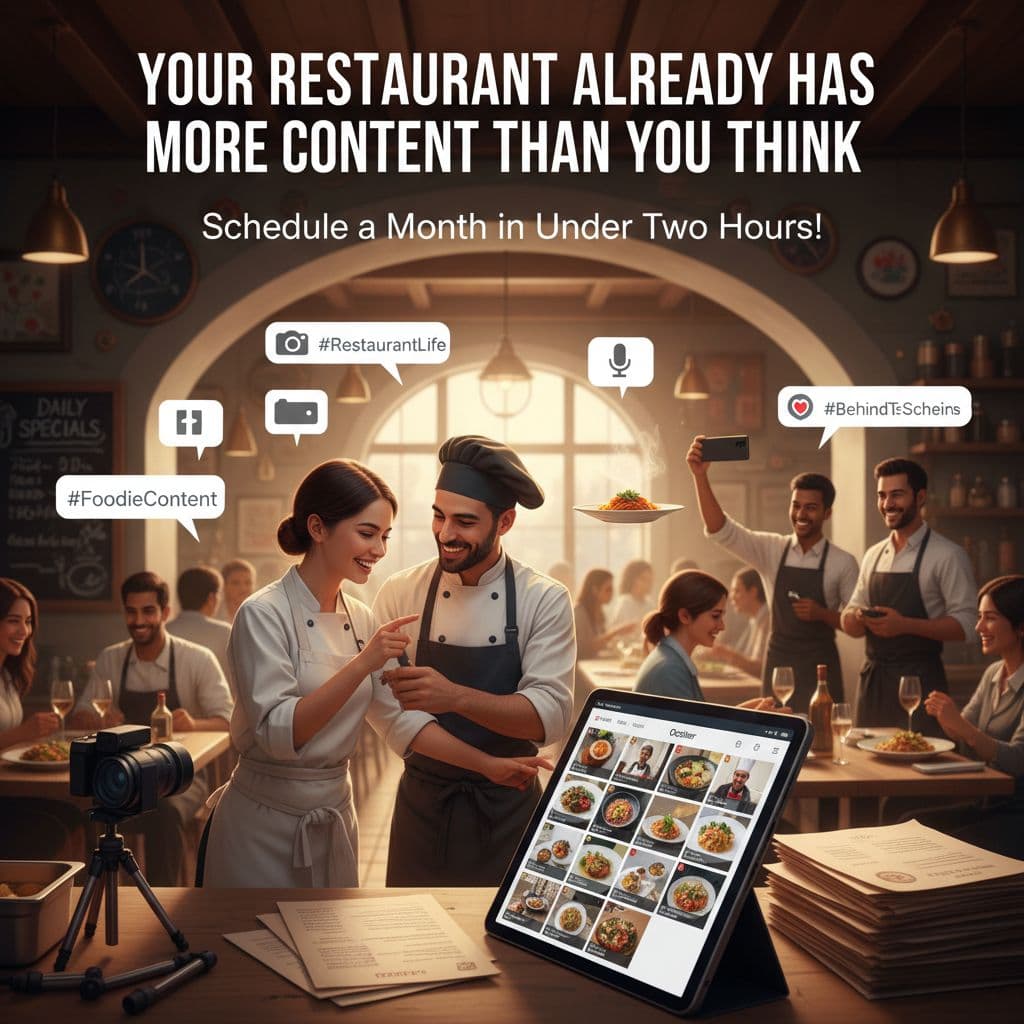
Restaurants have a natural content advantage most businesses do not. A law firm or an accounting practice has to work hard to find something visual and engaging to post. You have it walking out of your kitchen every single day. Food photos, daily specials, behind-the-scenes kitchen moments, and seasonal menus give you fresh material every week without brainstorming from scratch.
Think about what happens in a normal week at your restaurant. You plate a new dish on Tuesday. Your chef does something impressive with a knife on Wednesday. Your bartender creates a new cocktail special on Thursday. Your dining room fills up on Friday night and the lighting looks great. That is four pieces of content without trying. The problem is not that the content does not exist. It is that no one is capturing it and no one has a plan for what to do with it once they do. Once you start seeing your restaurant through that lens, the calendar writes itself. You are not brainstorming. You are documenting what is already happening around you every shift.
Building a Repeatable Content Mix
You do not need to reinvent your content every month. A simple repeating mix works well for most restaurants. Think about splitting your posts across a few categories: food and drink shots, behind-the-scenes moments, specials and promotions, and community or team content. If you post three times a week, that is roughly 12 to 13 posts a month. You can assign categories to days of the week so the decisions are already made before you sit down to create anything.
For example, Mondays could be a weekly special. Wednesdays could be a behind-the-scenes kitchen shot or a team moment. Fridays could be a food photo designed to drive weekend traffic. That structure means you are never staring at a blank screen wondering what to post. You know the category. You just need the asset.
Seasonal Menus and Events Are Built-In Content Calendars
Every time you update your menu, run a happy hour promotion, host a private event, or bring in a guest chef, you have a content moment. Seasonal changes are especially powerful because they give you a reason to post that feels timely and relevant. A new summer cocktail menu is not just a menu update. It is three posts: the announcement, a close-up of a signature drink, and a behind-the-scenes of the bartender building it. One event, three pieces of content. That is how you stretch your assets without creating more work.
The Two-Hour Monthly Framework
Phase One: 30 Minutes to Gather Your Assets
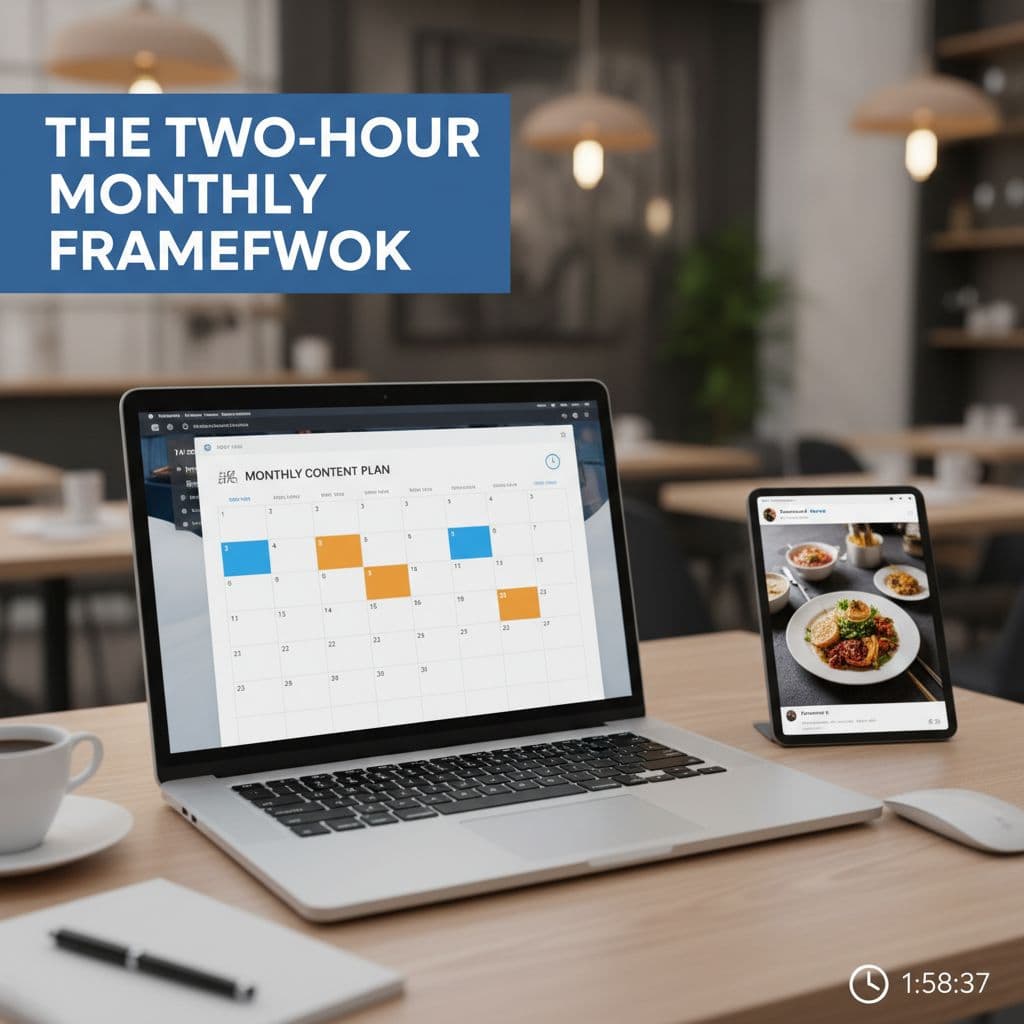
The two-hour framework works in three phases, and the first is the shortest and the most important. You spend 30 minutes gathering everything you need before you create a single post. That means pulling food photos from your phone or your team's phones, writing down the specials and events for the coming month, and noting anything worth highlighting like a menu change, a new hire, or a restaurant anniversary.
This phase works best when you make it a habit at the same time each month. Pick a Sunday morning before service, or a slow Tuesday afternoon. Block it in your calendar like a vendor meeting. The goal is to walk away with a folder of photos and a simple list of what is happening next month. You do not need 30 photos. You need enough to cover 12 to 13 posts, which is usually 8 to 10 solid images and a few notes about upcoming specials or events. If your team knows this is happening, they can help. Ask your line cook to grab a quick video of a dish being plated. Ask your front-of-house manager to snap the dining room on a busy Friday. You are not asking for professional photography. You are asking for real moments.
Phase Two: 45 Minutes to Batch-Create Posts with AI Drafting
This is where the time savings really show up. Once you have your assets, you spend 45 minutes batch-creating all your posts for the month using AI drafting tools. Instead of writing one caption at a time over 30 separate sessions, you do it all at once. You upload your photos, feed in your specials and events, and let an AI drafting tool generate platform-optimized captions across Instagram, Facebook, TikTok, and more.
Agentic AI workflows can handle the full loop here: generating caption drafts, selecting the best posting times per platform, scheduling across all your channels, and flagging performance data so you know what to repeat next month. You are not just getting a caption. You are getting a caption written for Instagram's tone, a shorter version for Facebook, and a hook-style opener for TikTok, all from the same source material. That is the kind of output that used to take a marketing team. Now it takes 45 minutes and a good workflow. Aidelly's AI Chat Workspace is built for exactly this kind of batch session. You bring the assets and the context. The AI handles the drafting, adapts the tone to your brand voice, and queues everything up for review. You are editing and approving, which is a much faster job than writing from scratch.
Phase Three: 45 Minutes to Review, Approve, and Schedule
The last 45 minutes is your review and scheduling session. You go through every draft, make any edits, swap out a photo if something looks off, and approve the posts you are happy with. Then you drop everything into a visual content calendar and schedule the full month in one go.
This is where a visual calendar matters. When you can see all 30 days laid out in front of you, you catch gaps, spot where you have three food photos in a row with no team content, and make sure your promotional posts are spaced out enough to not feel pushy. Aidelly's visual content calendar gives you that full-month view so you can adjust before anything goes live. Once you approve and schedule, you are done. The posts go out automatically, at the right times, on the right platforms, without you touching anything again until next month.
Consistency Is the Strategy. Virality Is the Bonus.
Why Three Posts a Week Beats Seven Posts in One Day
Consistency beats virality for restaurants. A local restaurant that posts three times a week at optimal times will outperform one that posts daily for a week and then disappears. This is not just about algorithms, though those do reward consistent posting. It is about how people actually discover and remember local businesses.
When someone follows your restaurant on Instagram, they are not going to check your profile every day. They are going to see your posts in their feed. If you post three times a week, you show up in their feed three times a week. You stay in their head. When you go quiet for two weeks, you drop out of the rotation. Out of sight, out of mind is real, and it costs you tables. Scheduled content keeps your brand visible between busy service windows. Your kitchen is not running at 2pm on a Tuesday, but your social media is. A post about your weekend brunch special goes out Thursday morning while you are doing prep. A behind-the-scenes Reel drops Wednesday afternoon while you are on a supplier call. The content is working even when you are not thinking about it. That is the whole point of scheduling a full month in advance.
Optimal Posting Times Are Not a Guess Anymore
One of the things that slows restaurant owners down is figuring out when to post. The answer used to be generic advice like post at 11am or 7pm and hope for the best. Now, agentic AI tools can analyze your account's historical performance and tell you exactly when your specific audience is most active on each platform. That is a different conversation entirely.
For most restaurants, Instagram engagement peaks around lunchtime and early evening, which makes sense because people are thinking about food. But TikTok has a different rhythm, and LinkedIn is different again if you are trying to reach a business lunch crowd. Getting the timing right for each platform without manually researching it is one of the clearest ways AI scheduling saves you time and gets you better results at the same time.
What to Do With Performance Data Next Month
The last piece of the system is the feedback loop. When you come back for your next two-hour session, you want to know what worked. Which posts got the most saves? Which ones drove the most profile visits? Which caption style got the most comments? That data tells you what to repeat and what to drop. Aidelly's cross-platform analytics pull all of that into one dashboard so you are not logging into five different apps to piece together a picture. You spend five minutes reviewing last month's performance at the start of your next session, then use that to shape your content mix for the coming month. Over time, you build a clearer picture of what your audience responds to, and your two-hour sessions get more effective, not just faster.
Two hours once a month. That is the whole ask. You gather your assets, batch-create your posts with AI drafting, and schedule everything into a visual calendar before your next service starts. The rest of the month, your content runs on its own while you focus on the work that actually needs you in the room.
The restaurants that win on social in 2026 are not the ones with the biggest budgets or the most followers. They are the ones that show up consistently, post at the right times, and learn from what works. A repeatable system makes that possible without adding hours to your week.
The right platform handles the creation, the scheduling, the timing, and the analytics so you are not managing social media so much as reviewing it once a month. If you are ready to stop posting reactively and start running your social presence like a system, that is exactly what Aidelly is built to do.
Two hours a month is enough to keep your restaurant's social presence consistent, but only if the work between sessions runs itself. Aidelly's agentic workflows handle the full loop for you: drafting captions, picking the best times to post, scheduling across every platform, and flagging what's working so next month takes even less effort. If you're ready to stop posting in bursts and start showing up every week without thinking about it, head to aidelly.ai.
Compare Social Scheduling Tools
Evaluating software for your content workflow? Use our buyer guides and comparisons to compare scheduling, approvals, analytics, and AI workflow fit.
Share this article
Related Articles
Social Media Analytics for Coaches: Which Numbers Actually Tell You If It's Working
Most coaches post consistently, watch the likes roll in, and still wonder why their discovery calls aren't filling up. The problem isn't the content. It's the metrics they're watching. Follower count and likes feel good, but they don't pay the bills. The numbers that actually connect to client bookings are hiding in plain sight: profile visits, link clicks, DMs triggered by a specific post, and how many of those conversations turn into calls. This article breaks down exactly which metrics matter for coaches, how different platforms serve different stages of your client journey, and how to stop guessing about what's working. If you're posting three to seven times a week and still unsure whether social media is building your business, this is the clarity you've been looking for.
May 19, 2026
Read more
TikTok Scheduling for Small Businesses: How to Stay Consistent Without Being Glued to Your Phone
Most small business owners know they should post on TikTok more often. The problem is not motivation. It is that posting consistently while running a real business feels impossible when TikTok seems to demand you show up every single day, in real time, on demand. This article makes the case that consistency is not a willpower problem. It is an infrastructure problem. When you treat TikTok like a daily task you have to remember, you will always lose to the hundred other things competing for your attention. But when you build a system that handles creation, timing, and scheduling without you touching your phone every day, consistency becomes the default. Here is how small business owners in 2026 are using batch content creation, smart scheduling, and agentic AI workflows to stay active on TikTok without it eating their week.
May 20, 2026
Read more
9 B2B Marketing Channels That Actually Work in 2026 (Ranked by Effort vs. Return)
Most B2B marketing advice tells you which channels to use. It stops there. The real problem isn't knowing the channels — it's staying consistent across them when you're running a lean team and wearing five hats at once. This article breaks down the 9 marketing channels that move the needle for B2B companies, ranked by effort versus return. You'll get a clear picture of where to put your time and budget, why some channels compound over time while others drain fast, and how AI content creation and social media automation are changing what's actually realistic for small and mid-size teams. Whether you're a founder doing your own marketing or a two-person team trying to punch above your weight, this is the practical breakdown you've been looking for.
May 18, 2026
Read moreReady to never miss a post again?
Tell Aidelly what to post. It drafts, schedules, and publishes across 9 platforms while you focus on your business.