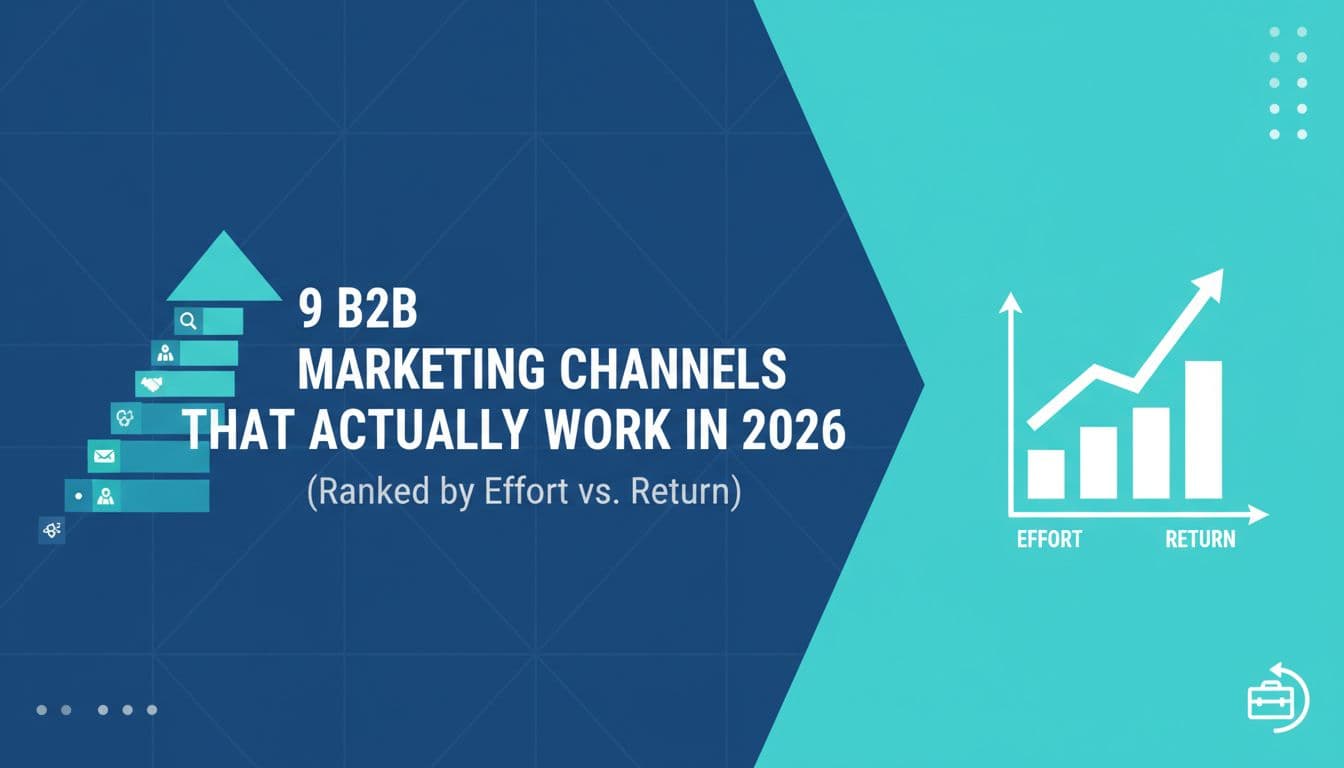
9 B2B Marketing Channels That Actually Work in 2026 (Ranked by Effort vs. Return)
Most B2B marketing advice tells you which channels to use. It stops there. The real problem isn't knowing the channels — it's staying consistent across them when you're running a lean team and wearing five hats at once. This article breaks down the 9 marketing channels that move the needle for B2B companies, ranked by effort versus return. You'll get a clear picture of where to put your time and budget, why some channels compound over time while others drain fast, and how AI content creation and social media automation are changing what's actually realistic for small and mid-size teams. Whether you're a founder doing your own marketing or a two-person team trying to punch above your weight, this is the practical breakdown you've been looking for.

Wilzer Jean-Baptiste
15 min read
Most B2B marketers already know the channels they should be using. LinkedIn. Email. SEO. Paid search. The list isn't a mystery. What's hard is actually running all of them consistently when you've got a small team, a tight budget, and about a dozen other things competing for your attention every week.
That's the execution gap. And it's why so many B2B companies have a half-updated blog, an inconsistent LinkedIn presence, and an email list they haven't touched in two months. Not because they don't care. Because production is slow, capacity is thin, and something always takes priority over content.
This article covers the 9 B2B marketing channels worth your time in 2026, ranked by effort versus return. More importantly, it addresses the execution side — what it actually takes to run these channels, and how AI-powered tools are making it possible for lean teams to show up consistently without burning out.
The High-ROI Channels That Compound Over Time
The High-ROI Channels That Compound Over Time
Some marketing channels pay you back slowly at first, then keep paying you back long after you've stopped working on them. These are the ones worth building first — even if the results take a few months to show up.
1. Content Marketing + SEO: The Highest-ROI Long-Term Channel
1. Content Marketing + SEO: The Highest-ROI Long-Term Channel
Content marketing and SEO work together as the highest-ROI long-term channel for B2B. The reason is simple: decision-makers search for answers before they search for vendors. A CFO evaluating spend management software isn't typing "best spend management software" into Google on day one. They're typing "how to reduce SaaS overspend" or "signs your procurement process is broken." Blog posts, case studies, and comparison pages that answer those questions put you in the room before a sales conversation ever starts.
The compounding effect is real. A well-optimized blog post can drive qualified traffic for three to five years. A comparison page that ranks for "[your category] vs. [competitor]" captures buyers who are already close to a decision. Case studies build credibility and rank for problem-specific searches at the same time.
The catch is that SEO takes time. You won't see results in week two. But teams that commit to publishing two to four solid pieces per month and optimizing for search intent consistently outperform teams running paid ads alone. The content you publish in Q1 is still working for you in Q4.
Start with a small cluster of content around your core problem space. Pick five to ten questions your best customers asked before they bought from you. Answer each one in depth. That's your content strategy.
2. Email Marketing: The Most Direct Channel With the Highest Average ROI
2. Email Marketing: The Most Direct Channel With the Highest Average ROI
Email marketing remains the most direct B2B channel with the highest average ROI — but it only works when paired with strong top-of-funnel content that earns the subscription in the first place. A list of cold contacts you scraped or bought isn't an email marketing strategy. It's a spam complaint waiting to happen.
The B2B email channels that actually work are the ones where someone opted in because they got value first. They downloaded your guide. They read your newsletter. They attended your webinar. That relationship changes everything about how your emails land.
Once you have a warm list, email is where you can go deep. Share a case study. Walk through a framework. Invite them to a product demo. The conversion rates on a warm B2B email list consistently beat almost every other channel because you're talking to people who already trust you enough to stay subscribed.
The key is that email is a middle and bottom-of-funnel tool. It doesn't replace content and social — it depends on them. Your top-of-funnel content builds the list. Your email nurtures it toward a conversation or a conversion.
3. LinkedIn Organic: Where B2B Trust Gets Built
3. LinkedIn Organic: Where B2B Trust Gets Built
LinkedIn is where B2B buyers spend time before they ever get on a sales call. Founders, marketing managers, procurement leads, and department heads are all scrolling LinkedIn between meetings. They're watching how companies show up, what their people say, and whether the brand feels credible or hollow.
Organic LinkedIn content — posts from founders, team members, and company pages — builds that credibility over time. A consistent presence on LinkedIn means that when a prospect does a quick check on your company before a call, they see a brand that's active, thoughtful, and worth talking to. That's not a small thing. It's often the difference between a prospect who shows up ready to buy and one who ghosts after the first email.
The format matters too. Short-form text posts that share a real insight or a hard-won lesson consistently outperform polished promotional content. LinkedIn rewards authenticity more than polish. Show the thinking, not just the result.
The Paid Channels That Accelerate What's Already Working
The Paid Channels That Accelerate What's Already Working
Paid channels can move fast. They can put you in front of the right buyer in 48 hours. But they're expensive, and they stop the moment you stop paying. The B2B teams that get the most out of paid aren't using it as a standalone strategy — they're using it to amplify organic content that already works.
4. Paid Search (Google Ads): Fast Access to High-Intent Buyers
4. Paid Search (Google Ads): Fast Access to High-Intent Buyers
Paid search and LinkedIn Ads are the fastest ways to reach B2B buyers with budget and intent. A well-structured Google Ads campaign targeting high-intent keywords — like "[your category] software for [industry]" or "[your category] pricing" — can generate qualified leads within days of launch. That speed is the whole point.
But paid search drains fast without organic content backing it up. If someone clicks your ad and lands on a thin website with no case studies, no blog, and no social proof, they leave. The ad spend is wasted. The brands that win with paid search use it to amplify what already works organically. They're sending traffic to a landing page that has proof. They're retargeting people who already read their blog. They're bidding on competitor comparison terms because they already have a comparison page that converts.
Paid search works best as a multiplier, not a foundation. Build the organic base first, then use paid to accelerate the parts that are already converting.
5. LinkedIn Ads: Precise Targeting for B2B Decision-Makers
5. LinkedIn Ads: Precise Targeting for B2B Decision-Makers
LinkedIn Ads are expensive compared to most other paid channels. Cost per click can run three to five times higher than Google. But the targeting is unmatched for B2B. You can reach VPs of Marketing at SaaS companies with 50 to 200 employees in specific regions. No other ad platform gets that specific about professional attributes.
The campaigns that work on LinkedIn typically promote something valuable — a guide, a webinar, a case study — rather than pushing a direct product pitch. Lead gen forms that offer a useful resource in exchange for contact info consistently outperform ads that just say "Book a Demo." Warm the prospect up first. The demo request follows naturally.
Like paid search, LinkedIn Ads work best when they're pointing to content that already has legs. Boost a post that's already getting organic engagement. Promote a case study that's already converting warm traffic. Use the ad spend to extend the reach of what's working, not to test whether something works at all.
6. YouTube: The B2B Channel Most Teams Underestimate
6. YouTube: The B2B Channel Most Teams Underestimate
B2B buyers spend significant time on YouTube before making purchase decisions. A product manager evaluating a new tool will watch three to five YouTube videos about it before they ever request a demo. A founder researching a marketing strategy will watch a 20-minute breakdown before they read a single blog post. YouTube is where B2B research happens, and most companies aren't showing up there at all.
You don't need a production team. Screen recordings, walkthroughs, and talking-head videos filmed on a decent webcam work fine for B2B YouTube. What matters is that the content answers a real question your buyer is searching for. Tutorials, product demos, comparison videos, and behind-the-scenes process content all perform well. And like blog content, YouTube videos compound. A video you publish today can still drive views and leads two years from now.
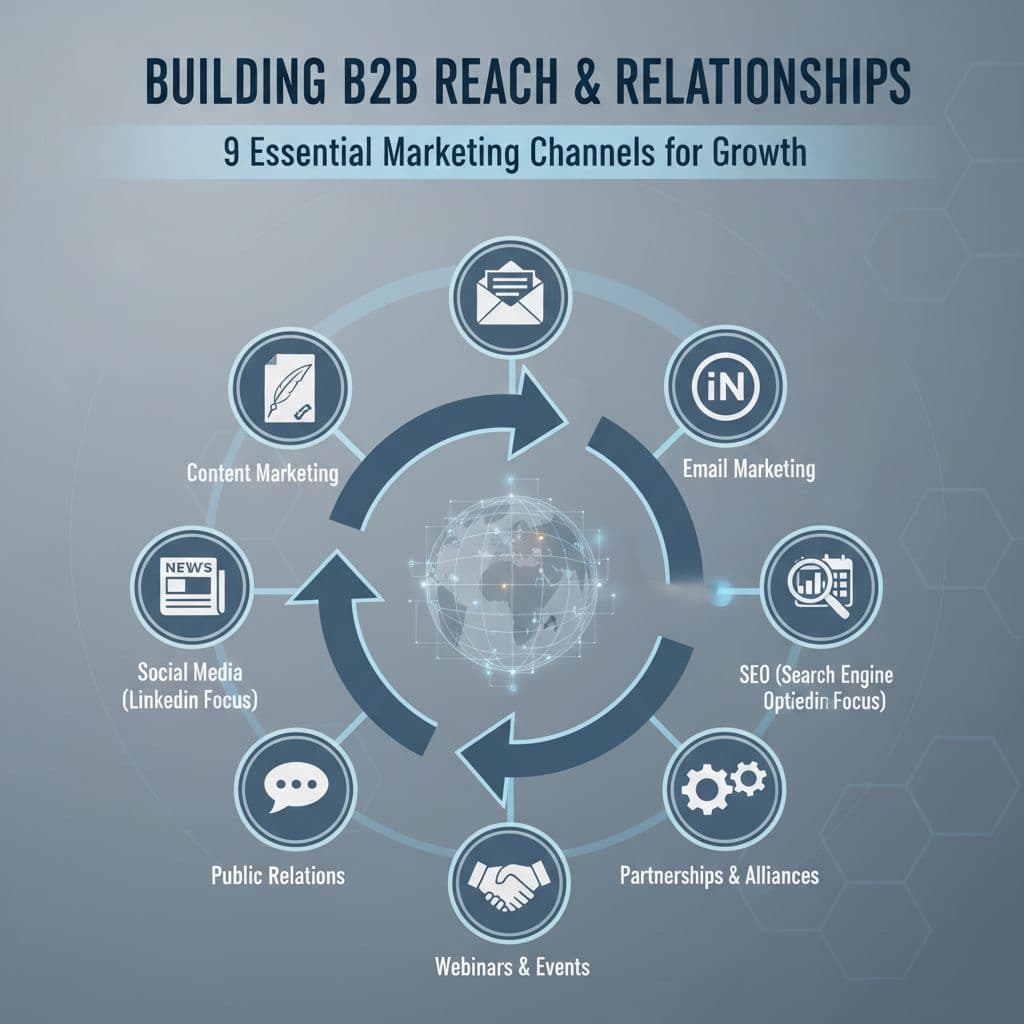
The Supporting Channels That Build Reach and Relationships
The Supporting Channels That Build Reach and Relationships
Not every channel needs to be a lead generation machine. Some channels do their best work by building familiarity, expanding your reach, and keeping you visible to buyers who aren't ready to buy yet. These three channels belong in your mix — especially if you're building a brand that people recognize before they need you.
7. Instagram and Short-Form Social: Trust Before the Sales Call
7. Instagram and Short-Form Social: Trust Before the Sales Call
Instagram isn't just for consumer brands. B2B buyers are people, and people use Instagram. A B2B software company that shows its team, its culture, its product in action, and its point of view on industry trends is building trust with buyers who will think of them first when the budget unlocks. Social media is not optional for B2B — it's where trust gets built before a sales call ever happens.
Short-form content on Instagram, TikTok, and even LinkedIn Reels lets you show personality and expertise in 30 to 60 seconds. Behind-the-scenes clips, quick tips, and reaction content to industry news all work. The bar for production quality is low. The bar for consistency is high. Showing up three to four times a week matters more than any single perfect post.
This is exactly where tools like Aidelly make a real difference for lean B2B teams. Instead of spending hours drafting and scheduling posts across Instagram, LinkedIn, and TikTok, you can use Aidelly's AI Chat Workspace to generate platform-optimized content in your brand voice and schedule it across every channel from one place. The content calendar stays full. The team stays focused on strategy.
8. Podcasting and Audio: Depth Over Reach
8. Podcasting and Audio: Depth Over Reach
Podcasting won't give you the fastest results on this list. But it builds something most channels can't: deep familiarity. A prospect who has listened to 10 episodes of your podcast knows how you think, what you believe, and whether they trust you — before you've ever spoken to them directly. That's a different kind of warm lead.
B2B podcasts work best when they're tightly focused on a specific audience problem. A podcast called "Growth Marketing for SaaS Founders" will build a smaller but far more qualified audience than a general business podcast. Guest episodes also work well — both as a host and as a guest on other shows — because they put you in front of audiences that already trust the host.
The investment is real. Recording, editing, and distributing a podcast takes time. But if you're in a category where buyers spend a lot of time researching, a podcast is one of the most efficient ways to stay top of mind across a long sales cycle.
9. Referral and Partner Marketing: The Channel That Scales on Trust
9. Referral and Partner Marketing: The Channel That Scales on Trust
Referrals close faster than almost any other lead source. A warm introduction from a trusted peer compresses a six-week sales cycle into a two-week one. And for B2B companies with strong customer relationships, referral marketing is one of the most cost-effective channels available.
Partner marketing works similarly. Co-marketing with a complementary tool or service — a joint webinar, a co-authored guide, a bundled offer — puts you in front of a qualified audience that already trusts your partner. If you sell project management software and your partner sells time tracking tools, your audiences overlap almost perfectly.
The catch is that referral and partner marketing require you to have something worth referring. That means delivering real results for customers and making it easy for them to share. A simple referral program with a clear incentive, a set of shareable assets, and a warm ask at the right moment in the customer journey is often all it takes to turn happy customers into a consistent lead source.
How AI and Automation Close the Execution Gap
How AI and Automation Close the Execution Gap
Here's the honest truth about multi-channel B2B marketing: knowing the nine channels is the easy part. The hard part is actually running them consistently when you're a team of two or three people who also have to handle sales calls, customer success, product feedback, and everything else that comes with building a company.
That's the execution gap. And it's why most B2B companies are inconsistent across their channels even when they know exactly what they should be doing.
AI Content Creation: From Blank Page to Scheduled Post
AI Content Creation: From Blank Page to Scheduled Post
Automation and AI are reshaping how B2B teams manage multi-channel marketing. Teams using AI content creation and social media automation publish more consistently, test faster, and free up time to focus on strategy instead of production. That's not a small shift. Consistency is the single biggest predictor of whether a social media or content strategy works. Most teams fail not because their ideas are bad but because production is slow and life gets in the way.
AI content tools can take a blog post, a customer quote, or a product update and generate a week's worth of platform-specific posts in minutes. The best ones — like Aidelly's AI-powered content drafting — do it with brand voice awareness, so the output actually sounds like your company instead of generic AI copy. That means your LinkedIn post sounds different from your Instagram caption, and both sound like you.
The result is a content calendar that stays full without requiring a full-time content manager. A founder can spend 30 minutes on Monday reviewing and approving AI-drafted posts for the week, then spend the rest of the week on the work that actually requires their brain.
Agentic Workflows: Marketing That Runs Without You
Agentic Workflows: Marketing That Runs Without You
The next step beyond AI content drafting is agentic marketing — AI agents that handle the full production cycle from ideation to scheduling to performance analysis without needing a human in the loop for every step. This is where B2B marketing automation is heading in 2026, and teams that adopt it early are building a real operational advantage.
Aidelly's agentic workflows let AI agents create content, schedule it across platforms, and analyze performance data to inform the next round of content — all without manual intervention. For a lean B2B team, that means your social presence stays active and on-brand even during a product launch crunch, a hiring sprint, or a week when everyone is heads-down on a big deal.
Pair that with Aidelly's approval workflows, and you get the best of both worlds: AI handles production, humans review before anything goes live. The team stays in control without being the bottleneck.
Analytics Across Every Channel: Know What's Actually Working
Analytics Across Every Channel: Know What's Actually Working
Running nine marketing channels without a unified view of performance is how teams end up doubling down on channels that aren't working and ignoring the ones that are. Cross-platform analytics matter because B2B buyers move across channels before they convert. They might find you on LinkedIn, read your blog, watch a YouTube video, and then sign up for your email list before they ever request a demo. If you're only looking at last-click attribution, you're missing most of the story.
Good analytics tell you which content is driving engagement, which channels are generating the most qualified traffic, and where prospects are dropping off in the funnel. That data should inform your content strategy, your ad spend, and your channel prioritization every quarter. Without it, you're making decisions based on gut feel instead of evidence.
The teams that win at multi-channel B2B marketing aren't the ones with the biggest budgets. They're the ones who know what's working, cut what isn't, and put their energy into the channels that compound over time.
Running nine marketing channels sounds like a full-time job because, without the right systems, it is. The B2B teams that stay consistent across content, social, email, and paid aren't necessarily bigger or better resourced — they've just built smarter workflows that let production happen without eating every hour of the week. The channel strategy matters. But execution is what separates the brands that grow from the ones that stay stuck in planning mode.
If your social media presence is the first thing that slips when things get busy, that's worth fixing. Aidelly handles the production side — drafting, scheduling, approving, and analyzing posts across LinkedIn, Instagram, YouTube, and every other platform your buyers are on — so your team can stay focused on the strategy behind it.
```htmlRunning nine channels as a lean B2B team means production work piles up fast. Aidelly's REST API lets you plug social media automation directly into the tools you already use, so you can draft, schedule, and publish across every platform without switching tabs or rebuilding your workflow. If you want to stay consistent across the channels that actually move the needle, start at aidelly.ai.
```Compare Social Scheduling Tools
Evaluating software for your content workflow? Use our buyer guides and comparisons to compare scheduling, approvals, analytics, and AI workflow fit.
Share this article
Related Articles
15 Marketing Tips for New Businesses (That Actually Work When You're Doing It Alone)
Most marketing advice for new businesses assumes you have a team, a budget, and about 40 free hours a week. You probably have none of those things. You launched something, you're trying to get customers, and everyone online is telling you to 'be consistent on social media,' 'build your brand voice,' and 'track your analytics' — without explaining how a single person is supposed to do all of that while also running the business. This article is different. Every tip here is built for founders who are doing it alone in the first 90 days. You'll learn which marketing moves actually drive results, how to stop wasting time on channels your customers don't use, and how AI-powered tools have made it possible for a solopreneur to market like a full team. No fluff. No advice that requires a marketing hire. Just what works.
May 16, 2026
Read more
15 Marketing Tips for New Businesses (That Actually Fit Your Schedule and Budget)
Most new businesses don't fail at marketing because they lack ideas. They fail because they run out of time. You know you need to post consistently, show up on multiple platforms, and build a brand people recognize. But you're also running operations, handling customer service, and trying to sleep. This guide is for founders, solopreneurs, and first-time marketers who launched in the last 12 months and need a marketing plan that works with a one- or two-person team. Each tip here is built around the real constraint you're working with: limited hours, limited budget, and no agency on speed dial. You'll find specific tactics, honest time estimates, and a clear explanation of how AI-powered social media tools close the gap between knowing what to do and actually doing it. Bookmark this one. You'll come back to it.
May 17, 2026
Read more
Facebook Marketing for Beginners: How to Promote Your Small Business on Facebook in 2026
Most small business owners set up a Facebook page, post a few times, and then go quiet. Not because they do not care, but because they run out of time and have no system to keep going. This guide is not about theory. It is about what you actually do this week to get your Facebook page working for your business. You will learn how to set up your page the right way, understand what the algorithm actually rewards, build a content mix that gets engagement, dip your toes into Facebook Ads without wasting money, and use AI automation to stay consistent without burning out. Whether your page is brand new or has been sitting dormant for two years, this is your clear starting point. By the end, you will have a repeatable weekly workflow you can run even if you are a team of one.
May 15, 2026
Read moreReady to never miss a post again?
Tell Aidelly what to post. It drafts, schedules, and publishes across 9 platforms while you focus on your business.