15 Marketing Tips for New Businesses (That Actually Work When You're Doing It Alone)
Most marketing advice for new businesses assumes you have a team, a budget, and about 40 free hours a week. You probably have none of those things. You launched something, you're trying to get customers, and everyone online is telling you to 'be consistent on social media,' 'build your brand voice,' and 'track your analytics' — without explaining how a single person is supposed to do all of that while also running the business. This article is different. Every tip here is built for founders who are doing it alone in the first 90 days. You'll learn which marketing moves actually drive results, how to stop wasting time on channels your customers don't use, and how AI-powered tools have made it possible for a solopreneur to market like a full team. No fluff. No advice that requires a marketing hire. Just what works.

Wilzer Jean-Baptiste
12 min read
You launched a business. Now everyone is telling you to 'market yourself' — post on social media, build a brand, grow an audience, run ads, send emails, start a blog, and do it all consistently while also running the actual business. It's a lot to hear when you're one person with a to-do list that never gets shorter.
Most marketing advice for new businesses is written for companies that already have a team. It assumes you have a content strategist, a designer, a scheduler, and time to spare. You probably have none of those things. What you have is a real product or service, a limited number of hours in the day, and a strong need to get customers without burning out in the first six months.
These 15 tips are built for that situation. Every one of them is something you can act on this week, with no team and no big budget. And where AI-powered tools fit into the picture, we'll say so directly — not as a bonus tip at the end, but as the practical answer to the time problem every new founder faces.
Start Smart: Pick Your Channels, Define Your Brand
1. Go Where Your Customers Already Are
New businesses waste money on marketing channels that don't match their audience. This is one of the most common and most expensive mistakes early-stage founders make. You hear that TikTok is blowing up, so you spend three weeks learning short-form video. You hear LinkedIn is great for B2B, so you start posting there too. Then you add Instagram because everyone has Instagram. Six weeks in, you've spread yourself across four platforms and gotten traction on none of them.
Here's what actually works: pick one or two platforms where your specific customers already spend time, and go deep there first. A local restaurant owner will get more out of Instagram and Facebook than LinkedIn. A B2B SaaS founder will see faster results on LinkedIn than TikTok. A fitness coach targeting Gen Z should be on TikTok before anywhere else.
The way to figure out which platforms fit is simple. Think about who your best customer is. Where do they scroll when they're bored? Where do they go when they want to find a product or service like yours? Ask your first few customers directly. You'll get a clear answer faster than any marketing guide can give you.
Once you have traction on one or two platforms — meaning you're getting saves, shares, DMs, or clicks — then you expand. Not before. Trying to be everywhere before you've figured out what works is how new businesses burn time and budget without anything to show for it.
2. Build Your Brand Voice Before You Post Anything
Brand voice is a business asset from day one. Most new founders skip this step because it sounds like something big companies worry about. It's not. If you publish 30 posts without a defined voice, you'll end up with content that sounds like three different people wrote it — one post is casual and funny, the next is stiff and corporate, the next is somewhere in between. Customers notice inconsistency even when they can't name it. It makes a brand feel untrustworthy.
Defining your brand voice doesn't have to take a week. Spend one hour answering these questions: What three words describe how you want to sound? What topics are on-brand for you? What phrases or tones do you want to avoid? Write it down. Keep it somewhere you can reference before you publish anything.
For example, a bookkeeping service for freelancers might define their voice as: clear, calm, and a little bit funny. They'd use plain language, avoid jargon, and never sound alarmist about money stuff. A streetwear brand might be bold, unapologetic, and community-driven. Every post sounds like the same person wrote it because they know exactly who that person is.
Tools like Aidelly let you store your brand voice guidelines directly inside the platform, so every piece of AI-generated content starts from your voice, not a generic template. That's the difference between content that sounds like you and content that sounds like everyone else.
3. Set Up Your Profiles to Do the Selling for You
Before you run a single ad or post a single piece of content, make sure your social profiles are doing their job. Your bio, profile photo, link, and pinned post are the first things a potential customer sees. If your bio doesn't clearly explain what you do and who you help in two sentences, you're losing people before they even look at your content.
Write your bio like you're explaining your business to someone at a coffee shop. Not 'I help entrepreneurs unlock their potential through transformative coaching experiences.' Try: 'I help first-time founders build a 90-day sales plan. No fluff, no jargon.' That's specific. That's clear. That's the kind of bio that makes someone click follow or tap your link.
Pin your best post or a direct offer to the top of your profile. On Instagram, use your highlights to answer common questions. On LinkedIn, fill out the featured section with a lead magnet or a testimonial. These small things take 30 minutes to set up and keep working for you every day after that.
Build Consistency Without Burning Out
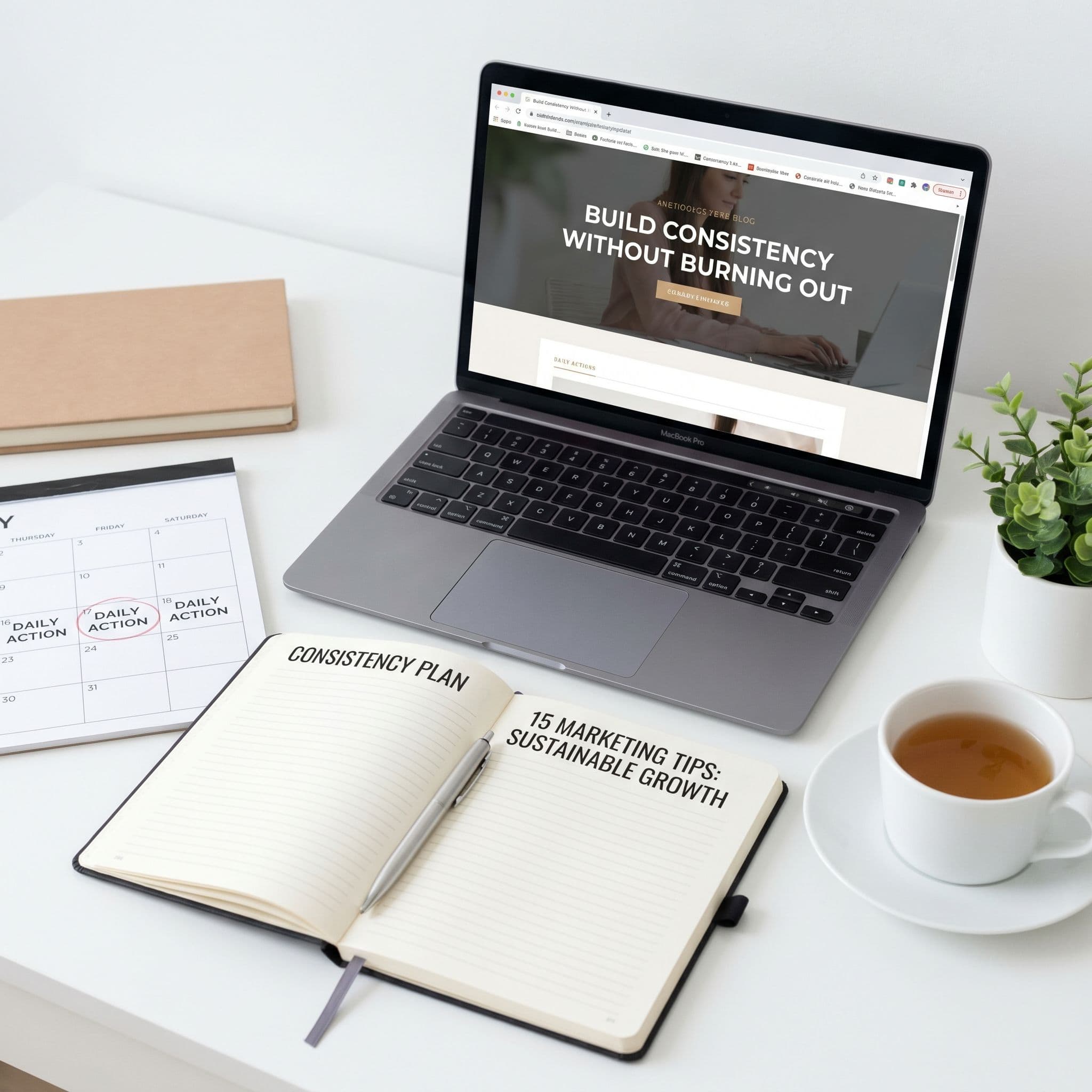
4. Consistency Beats Volume Every Time
Posting every day for two weeks and then going silent for a month does more damage than posting three times a week without fail. Algorithms on every major platform reward accounts that show up regularly. More importantly, your audience does too. When someone finds your page and sees you haven't posted in six weeks, they assume you're not active or not serious.
Three posts a week, every week, will outperform a burst of daily posts followed by silence. This is true on Instagram, LinkedIn, TikTok, and everywhere else. The math is simple: 12 posts a month beats 14 posts in two weeks and then nothing. The 12 posts build a habit in your audience. The burst-and-silence pattern breaks trust.
The real reason most new businesses can't stay consistent isn't laziness. It's that content creation is time-consuming, and when the business gets busy, marketing is the first thing to drop. That's where AI social media automation changes the equation. Tools that let you batch-create content, schedule it weeks in advance, and auto-publish without you touching anything on posting day make consistency achievable without adding 10 hours to your week.
With a tool like Aidelly, you can sit down for two hours on a Sunday, generate a month's worth of posts using the AI Chat Workspace, review them, and schedule them all at once. Then you don't think about it again until next month. That's not cutting corners. That's smart time management for a founder who has 50 other things to do.
5. Batch Your Content Creation
Context-switching is a time killer. Every time you stop what you're doing to write one post, you lose 15 to 20 minutes of focus getting back into the work you left. Batching solves this. Set aside one block of time per week or per month to create all your content at once. Write all your captions. Pull all your images. Draft all your hooks. Then schedule everything and move on.
When you batch, you also get better at spotting patterns. You'll notice when you've written the same type of post four times in a row. You'll catch when your content has no variety. Seeing 12 posts at once is much easier to edit than reviewing them one at a time over three weeks.
If writing captions from scratch feels slow, use AI content creation to speed up the drafting. You're not outsourcing your voice. You're outsourcing the blank page. You still review, edit, and approve everything before it goes out. The AI handles the first draft; you make it sound like you.
6. Use a Content Calendar to Plan Before You Post
A content calendar is one of the most underrated tools for new businesses. It forces you to think about your content before you're scrambling to post something because you haven't put anything up in five days. It also helps you see the bigger picture. Are you only posting promotional content? Are you mixing in educational posts, behind-the-scenes content, and social proof? A calendar makes that visible.
You don't need a complicated system. A simple spreadsheet works. But a visual content calendar inside a scheduling tool is even better because you can see your posts laid out by date, spot gaps, and move things around without rewriting anything. Planning two to four weeks ahead gives you enough buffer to handle the inevitable chaos of running a business.
Track What Works and Use AI to Scale It
7. Track the Right Metrics from the Start
Social media analytics tell you what's working within 30 to 60 days — but only if you're looking at the right numbers. Most new business owners check follower count. Follower count is the least useful metric you can track in the first 90 days. A post can reach 10,000 people and get you zero new followers but 200 saves. Those saves mean people found that content valuable enough to come back to. That's the metric that matters.
Here's what to track instead: saves (people bookmarking your content for later), shares (people sending your content to someone else), click-throughs (people tapping your link or profile), and comments that include actual questions or reactions. These are signals of real engagement. Likes are fine, but they're passive. Saves and shares tell you that your content hit something real.
After 30 to 60 days of consistent posting, look at which posts got the most saves and shares. Then make more content like that. This is how you build a content strategy based on data, not guessing. You don't need a marketing degree to do this. You need a platform that shows you the numbers in one place and makes it easy to compare posts. Cross-platform analytics in a tool like Aidelly pull all of this into one dashboard so you're not logging into five different apps to figure out what's working.
8. Stop Chasing Vanity Metrics
Follower count, like count, and view count feel good. They're easy to see and easy to compare. But a business with 800 followers and a 12% engagement rate will outperform a business with 15,000 followers and a 0.5% engagement rate every single time. The smaller audience is more interested, more likely to buy, and more likely to refer friends.
New founders often get discouraged when their follower count grows slowly. But slow follower growth with high saves and shares is a sign that your content is working. The algorithm on Instagram, TikTok, and LinkedIn all prioritize content that gets meaningful engagement over content that gets passive scrolls. Focus on making content worth saving and sharing, and the reach will follow.
Set a simple monthly check-in. Look at your top three posts by saves and shares. Look at your bottom three. Ask what's different. That 30-minute review will teach you more about your audience than any marketing course.
9. AI Has Closed the Gap Between Solo Founders and Full Teams
AI content creation tools have closed the gap between solo founders and brands with full marketing teams. In 2026, a solopreneur using AI-powered social media tools can produce, schedule, and analyze content at the same speed as a five-person team. The tools that used to require a content strategist, a copywriter, a designer, a scheduler, and an analyst are now available to a single founder for a fraction of the cost.
Think about what a five-person marketing team does: they plan content, write copy, build a calendar, schedule posts, track performance, and adjust the strategy based on results. Every single one of those steps now has an AI-powered equivalent. You can generate platform-optimized captions in minutes. You can schedule a month of content in one sitting. You can pull analytics from every channel in one dashboard and see what to do next.
Aidelly's agentic workflows take this further. AI agents handle content creation, scheduling, and performance analysis end-to-end, without you manually triggering each step. For a founder who is also the salesperson, the customer support team, and the product developer, that kind of automation isn't a luxury. It's what makes consistent, professional marketing possible without hiring anyone.
The playing field has changed. A solo founder with the right tools can look and perform like a brand with a full team behind it. The founders who figure this out early are the ones who build an audience before their competitors even get consistent.
10. Talk to Your First 10 Customers Before You Write Any Content
Your first customers will tell you exactly what to say in your marketing if you ask them the right questions. Ask them: What made you decide to buy? What were you worried about before you bought? How would you describe what we do to a friend? Their answers are your best marketing copy. Use their words, not yours. The phrases they use to describe the problem you solve are the same phrases your next customer is typing into Google or TikTok search. When your content uses their language, it feels like you're reading their mind. That's what makes people stop scrolling and pay attention.
11. Write One Piece of Content That Answers the Biggest Question in Your Niche
Every industry has one question that every beginner asks. Answer it thoroughly. Make it the most useful piece of content on that topic. Post it, share it, and refer back to it. Content that genuinely helps people gets shared, saved, and found in search. One great post will outperform 20 mediocre ones. If you run a meal prep business, that post might be 'How to meal prep a full week of lunches in under two hours.' If you're a freelance designer, it might be 'What to include in a client brief so you never redo a project.' Find the question, answer it better than anyone else has, and put it out there.
12. Show the Work Behind the Work
Behind-the-scenes content consistently outperforms polished promotional content for new businesses. Show how you make your product. Show a mistake you fixed. Show what your workspace looks like at 7am before the day gets going. People connect with people, not brands. The more human you are, the more trust you build. A candle maker showing the pour process on a Tuesday morning will get more saves than a product photo with a discount code. A freelance developer showing a bug they spent three hours fixing will get more engagement than a post about their services. Authenticity isn't a trend. It's what makes people feel like they know you before they ever buy from you.
13. Use Social Proof Early and Often
A screenshot of one happy customer message is worth more than five posts about your product features. Ask every early customer for a quick testimonial. Post it. Tag them if they're comfortable with it. Social proof removes the risk in a buyer's mind faster than any sales copy can. When someone is on the fence about buying from a brand they've never heard of, seeing that a real person had a good experience is often the thing that tips them over. You don't need 50 reviews to start. One specific, genuine testimonial that describes a real result is enough to build credibility in the first 90 days.
14. Don't Run Paid Ads Until You Know What Converts Organically
Paid ads amplify what's already working. If you don't know what content your audience responds to, you'll pay to boost content that doesn't convert. Spend your first 60 to 90 days posting organically and tracking what gets saves, shares, and clicks. Then put money behind the posts that already proved they work. A post that got 40 saves and drove 15 profile visits organically is a strong candidate for a paid boost. A post that got 12 likes and no clicks is not. This approach saves you from the most common paid ads mistake new businesses make: spending money before they have data.
15. Treat Your Email List Like Your Most Valuable Asset
Social media platforms can change their algorithms, limit your reach, or shut down entirely. Your email list is yours. Start collecting emails from day one, even if it's just a simple signup form with a free resource attached. A short guide, a discount code, or a useful checklist is enough to get someone to hand over their email. Email converts at a higher rate than any social platform because you're landing in someone's inbox, not competing with 200 other posts in a feed. Build it early, email your list at least twice a month, and treat those subscribers like the warm audience they are. They opted in. They want to hear from you.
Marketing a new business is hard when you're doing it alone. But it's a lot more manageable when you're clear on where to show up, what to say, and how often to say it. Start with one or two platforms. Define your voice before you post. Track saves and shares instead of followers. And use AI-powered tools to stay consistent without it taking over your week.
The founders who build real audiences in their first 90 days aren't the ones with the biggest budgets. They're the ones who show up consistently, sound like themselves, and pay attention to what their audience responds to. The right tools make all three of those things easier to pull off.
If you're ready to stop scrambling and start scheduling with a system that actually keeps you consistent, Aidelly is built exactly for that.
Consistency is the tip every new business hears and almost no one pulls off, not because it's hard to understand, but because it takes time most solo founders don't have. Aidelly's automation workflows let you turn a rough idea into a scheduled, on-brand post without the back-and-forth that eats up your week. If you're building a business alone and want marketing that actually keeps up with you, start at aidelly.ai.
Compare Social Scheduling Tools
Evaluating software for your content workflow? Use our buyer guides and comparisons to compare scheduling, approvals, analytics, and AI workflow fit.
Share this article
Related Articles
Facebook Marketing for Beginners: How to Promote Your Small Business on Facebook
Most small business owners set up a Facebook page, post a few times, and then go quiet. Not because Facebook stopped working, but because they never had a system. This guide covers everything a beginner needs to build a real Facebook presence: how to set up your page the right way, which content types actually get traction in 2026, how to grow without paying for every click, and how AI tools can handle the heavy lifting so you stay consistent without burning out. Whether you run a restaurant, a coaching practice, a retail shop, or a side hustle, the same core principles apply. Facebook still has over three billion monthly active users. Your customers are on it. The question is whether your page gives them a reason to stop scrolling. By the end of this article, you will have a clear, practical path from zero to a consistent Facebook presence that works even on your busiest weeks.
May 14, 2026
Read more
Facebook Marketing for Beginners: How to Promote Your Small Business on Facebook in 2026
Most small business owners set up a Facebook page, post a few times, and then go quiet. Not because they do not care, but because they run out of time and have no system to keep going. This guide is not about theory. It is about what you actually do this week to get your Facebook page working for your business. You will learn how to set up your page the right way, understand what the algorithm actually rewards, build a content mix that gets engagement, dip your toes into Facebook Ads without wasting money, and use AI automation to stay consistent without burning out. Whether your page is brand new or has been sitting dormant for two years, this is your clear starting point. By the end, you will have a repeatable weekly workflow you can run even if you are a team of one.
May 15, 2026
Read moreReady to never miss a post again?
Tell Aidelly what to post. It drafts, schedules, and publishes across 9 platforms while you focus on your business.