Content Approval Workflows for Marketing Teams: How to Cut Review Time in Half
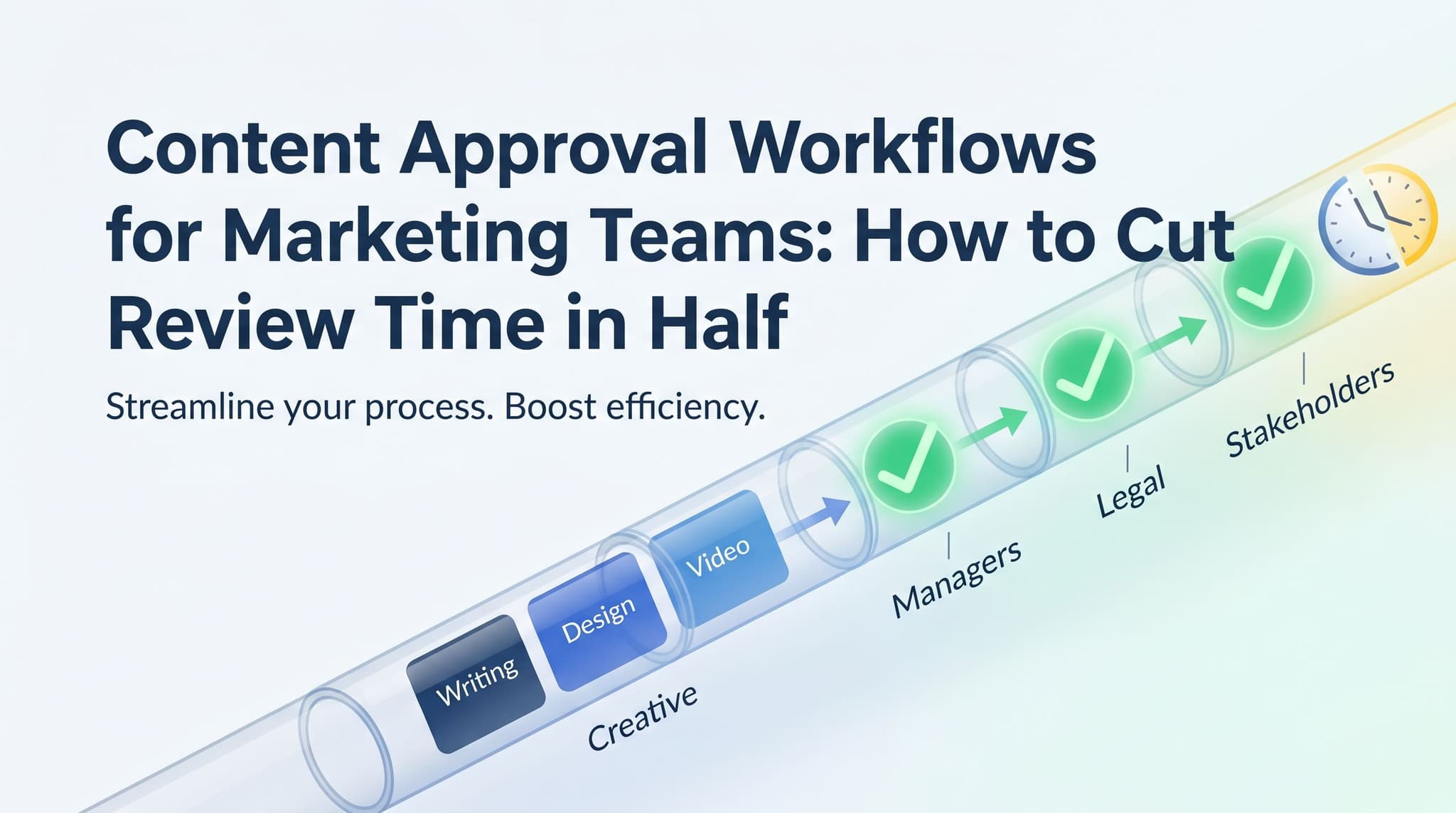
Your content approval process is probably costing you more than you think. Not in money, but in days. A post that should take 48 hours from draft to publish ends up taking a week because someone's waiting on feedback, someone else sent edits to the wrong thread, and the client just got back from vacation. Sound familiar? The problem isn't your team. It's the workflow, or more accurately, the lack of one. And in 2026, there's a better way to run it.
Why Your Content Approval Process Is Slower Than It Should Be
Most marketing teams lose 3 to 5 days per content cycle to back-and-forth email threads, unclear ownership, and feedback that arrives after the post was supposed to go live. The fix is not working faster. It is building a system where everyone knows their role before review starts.
Think about what a typical approval cycle looks like. A social media manager drafts five posts in a Google Doc. She drops a link in Slack and asks for feedback. Two people comment in the doc. One person emails her directly with a different set of changes. The client responds four days later with a completely new direction. By the time everyone aligns, two of the posts were supposed to publish yesterday.
This is not a people problem. It is a systems problem. When there is no defined process, every review becomes a negotiation. People don't know if they're giving input or making a final call. They don't know the deadline. They don't know what platform the post is for or when it's set to go live. So they take their time, and the pipeline backs up.
The teams that fix this don't chase people down faster. They build a workflow where the rules are set before anyone touches the content. That means defined stages, clear owners, and hard deadlines baked into the process. When that structure exists, approvals stop being a bottleneck and start being a quick checkpoint. The difference between a team that publishes on time and one that's always scrambling isn't talent. It's structure.
The Real Cost of a Broken Approval Loop
Three to five days per cycle adds up fast. If your team runs two content cycles per month, that's up to 10 days lost to process friction every single month. That's not time spent on strategy, creative thinking, or client work. It's time spent waiting, chasing, and re-explaining decisions that were already made.
There's also a compounding effect. When posts miss their window, they either go live at the wrong time or get scrapped. Either outcome hurts. A post about a trending topic that publishes three days late is basically useless. A post that gets scrapped after two revision rounds is wasted creative effort. Fixing the approval workflow isn't just about efficiency. It's about protecting the work itself.
Why Email and Slack Threads Fail as Approval Tools
Email and Slack are great communication tools. They are terrible approval tools. There is no version history, no clear status, and no way to see at a glance what's approved, what's pending, and what's stuck. A comment buried in a thread from Tuesday doesn't automatically update the post scheduled for Thursday. Someone has to manually carry that change across tools, and that handoff is where things break.
The other problem is that email and Slack treat every message as equal. A quick question and a final approval look exactly the same. There's no built-in way to signal that a decision has been made and the content can move forward. Without that signal, people keep commenting, keep second-guessing, and the post never actually gets locked in.
The Four Stages Every Content Approval Workflow Needs
A content approval workflow has four stages that must be defined: creation, internal review, stakeholder sign-off, and scheduled publishing. When any stage lacks a clear owner or deadline, the whole pipeline stalls. Teams that assign a single decision-maker per stage cut revision cycles by 40 to 60 percent.
Here's why that number matters. Most revision cycles don't drag on because the content is bad. They drag on because two people think they both have final say, or because nobody does. When you assign one decision-maker per stage, the feedback loop collapses. The reviewer knows it's their call. They make it. The content moves forward.
Each stage needs three things defined before the cycle starts: who owns it, what done looks like, and when it has to move. Without all three, any stage can become a black hole where content disappears for days.
Creation and Internal Review: Setting the Foundation
Creation is where most teams spend the most time, and it's the stage most ready for automation. Someone has to write the caption, size the image, pick the hashtags, and match the brand voice. If that falls entirely on a human every single time, the workflow starts slow before anyone even reviews anything. Defining this stage means deciding who creates the content, what tools they use, and what a complete draft looks like before it enters review. A draft without a platform, a scheduled time, and a visual attached is not ready for review. Setting that standard cuts the back-and-forth at the very start.
Internal review is the in-house pass before anything goes to a client or senior stakeholder. This stage needs one owner, not a committee. Assign one person to check for brand voice, accuracy, and platform fit. Give them a 24-hour window. If they need input from someone else, that's their job to gather, not the content creator's. When this stage runs on a committee, everyone waits for everyone else. When it runs on one person with a deadline, it takes a morning.
Stakeholder Sign-Off and Scheduled Publishing: Closing the Loop
Stakeholder sign-off is where most workflows die. The client or senior stakeholder gets a link to a Google Doc, has no context about when the post is going live, and responds three days later with a comment that reopens every decision already made. Fixing this stage means giving approvers the right context upfront. Show them the post, the platform, the scheduled time, and where it fits in the broader content plan. When they have that picture, they approve faster because the deadline is visible and the stakes are clear.
Scheduled publishing should require zero human effort once the post is approved. If someone still has to manually copy a caption into a scheduling tool after sign-off, you've added a step that introduces errors and delay. Publishing should be automatic the moment approval is given. That means your approval tool and your scheduling tool need to be connected, or better yet, the same platform. The post goes live when it should, without anyone touching it again.
Context Switching Is the Real Time Killer
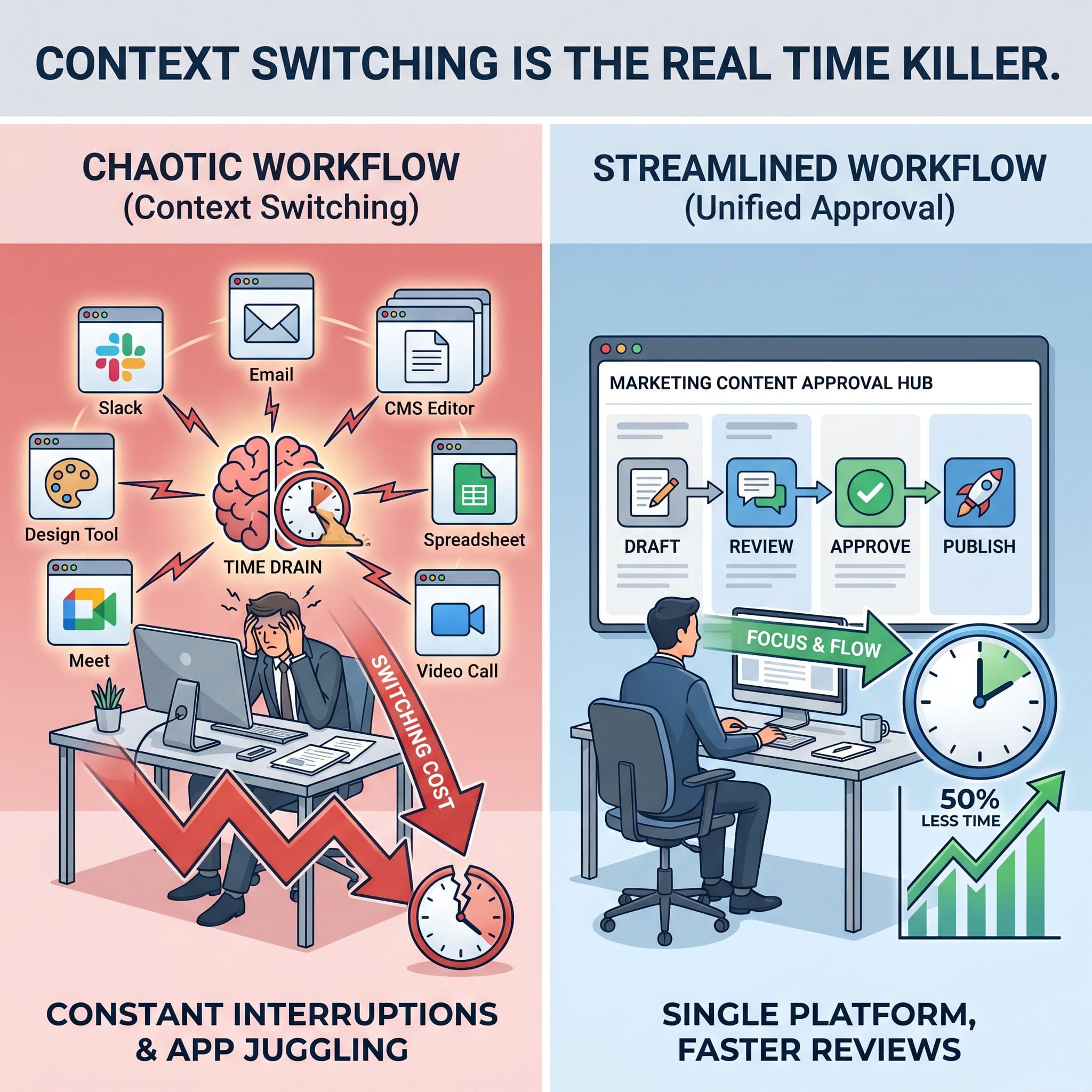
Consolidating creation, review, and scheduling into one tool eliminates the biggest time killer in most workflows: context switching. When a reviewer has to jump between a Google Doc, a Slack thread, and a scheduling tool, feedback gets lost and posts get delayed.
Here's a concrete example. A content lead at a five-person agency manages 12 client accounts. Her review process runs across three tools: Notion for drafts, Slack for feedback, and a separate scheduling platform. Every time a post moves between stages, someone has to manually transfer information. A comment left in Notion doesn't automatically update the scheduled post. A change made in Slack doesn't make it back to the draft unless someone copies it over. Small errors compound. Posts go live with old copy. Clients get frustrated. And the content lead spends two hours a week just reconciling versions across tools.
This is not an edge case. It's the default state for most marketing teams in 2026. The tools weren't designed to work together, so the humans have to fill the gaps. And filling gaps is not a good use of anyone's time.
One Tool, One Source of Truth
When creation, review, and scheduling live in the same place, there is no transfer step. The draft is the scheduled post. The comment is attached to the actual content. The approval triggers the publish. Nothing gets lost in translation because there is no translation. This sounds simple, but it changes the entire feel of the workflow. Reviewers stop second-guessing whether they're looking at the final version. Creators stop asking if their edits were captured. Everyone works from the same file at the same time.
Aidelly's approval workflow is built this way. Content is created, reviewed, and scheduled inside one platform, so the post a reviewer approves is the exact post that goes live. There's no export step, no copy-paste, and no version mismatch. The approval is the trigger. That's a fundamentally different experience from managing three tools that were never meant to talk to each other.
What Gets Lost When Tools Are Fragmented
Fragmented tools don't just slow things down. They create specific failure modes. Feedback gets duplicated across channels and nobody knows which version is current. Approved posts sit unscheduled because the person who handles scheduling wasn't looped in on the approval. Clients approve a post in a doc but the scheduled version still has the old copy because the update never made it over. Each of these failures looks like a people problem when it's actually a tools problem.
Consolidation removes the gaps where things fall through. When there's one place to look, one status to check, and one action that moves the post forward, the workflow becomes auditable. A manager can open the platform and see exactly where every post stands, who touched it last, and what's blocking it. That visibility alone changes how quickly teams respond. Nobody wants to be the bottleneck when the bottleneck is visible.
How Agentic AI Changes the Whole Equation
Agentic AI workflows change the approval process by handling the creation and scheduling steps autonomously, so human reviewers only touch the work that needs a judgment call. This shifts the team's job from producing content to approving it, which is a much faster loop.
This is the reframe that matters most. Most articles about content approval treat it as a process optimization problem. How do you get people to respond faster? How do you write clearer briefs? How do you reduce revision rounds? Those are real questions, but they're working on the wrong constraint. The real question is: how much of this workflow actually requires a human?
Creation doesn't require a human every time. Scheduling definitely doesn't. Research, platform optimization, hashtag selection, posting time analysis — none of that needs a person. When an agentic AI system handles those steps autonomously, the human workflow shrinks to a single gate: approval. And approving a piece of content that's already drafted, optimized, and scheduled is a five-second decision, not a five-day process.
This is not about replacing your team. It's about redirecting them. The judgment calls — does this match our voice, is this the right message for this moment, does this represent us well — those still need humans. Everything else can run on its own.
What Agentic Workflows Actually Do
An agentic workflow isn't just AI-assisted writing. It's a system where AI agents take a content brief, generate platform-specific drafts, match the brand voice, pick the best posting times, and queue everything up for review, without anyone prompting each step. The human sets the parameters once. The agent runs the workflow end-to-end.
Aidelly's agentic workflows operate this way. They handle the full pipeline from ideation to scheduling so that by the time a post reaches a reviewer, the only question left is: does this represent us well? That's a fast question to answer. It doesn't require a rewrite. It doesn't require a meeting. It requires a yes or a quick note, and the post moves forward. The team's job changes from production to quality control, and quality control at that level takes minutes, not days.
The Shift From Producer to Approver
When your team stops producing content and starts approving it, the dynamic changes in a real way. Approvers are no longer reviewing rough drafts that need work. They're reviewing finished posts that are ready to go. The cognitive load drops. The time drops. A reviewer who used to spend 45 minutes rewriting a caption now spends 30 seconds confirming it looks right. Multiply that across 20 posts a week and you've recovered hours of capacity that can go toward strategy, client relationships, or anything else that requires human judgment.
There's also a morale piece here. Content teams burn out when they're stuck in endless revision cycles on work that feels repetitive. When AI handles the repetitive parts, the humans get to do the interesting parts. They make calls, shape direction, and catch things that matter. That's a better job, and it produces better work.
Auto-Scheduling and the Visual Content Calendar
Auto-scheduling and a visual content calendar give approvers the context they need to make fast decisions. When a reviewer can see where a post fits in the broader content plan and what time it is set to publish, they approve faster because they understand the stakes.
This is underrated. Most approval delays aren't about the content itself. They're about uncertainty. A reviewer looks at a post and thinks: is this the right tone for this week? Are we posting too much on LinkedIn right now? Does this conflict with the campaign we're running? Without a visual calendar, those questions require digging through old threads or asking the content manager. With a calendar, the reviewer sees the full picture in seconds and makes a call.
A visual content calendar shows every scheduled post across every platform in one view. When a reviewer opens a post for approval, they can see exactly where it sits in the week, what else is scheduled around it, and when it's set to go live. That context eliminates the most common approval hesitation: not knowing whether the post fits the moment. When you can see that Tuesday already has two LinkedIn posts and this one is slotted for Thursday at 10 AM, you either approve it or flag the conflict. Either way, you make the decision fast.
Auto-scheduling closes the loop. Once a post is approved, it publishes at the right time without anyone touching it again. The system picks the optimal time based on platform and audience data. The reviewer doesn't have to coordinate with a scheduler. The post goes live when it should, every time. There's also a psychological piece worth naming: when a reviewer can see that a post goes live in six hours and it's part of a product launch sequence, they don't sit on it. Urgency that's shown is more effective than urgency that's told.
The teams that publish consistently and on time in 2026 aren't working harder than everyone else. They've built a workflow where AI handles the creation and scheduling, and humans make the fast calls at the approval gate. Four defined stages, one decision-maker per stage, one tool that holds everything together. That's the whole system.
Social media management doesn't have to feel like a fire drill every week. When the right structure is in place and the right tools back it up, the process runs on its own and your team focuses on the work that actually needs them.
If you're ready to see what an agentic approval workflow looks like in practice, Aidelly brings creation, review, scheduling, and analytics into one place so your team can stop managing the process and start trusting it.
If your team is still spending hours drafting social posts before anyone even gets to review them, the workflow problem starts earlier than you think. Aidelly's agentic workflows handle content creation, scheduling, and performance analysis automatically, so your team shows up to approve, not to produce. See how it works at aidelly.ai.
Compare Social Scheduling Tools
Evaluating software for your content workflow? Use our buyer guides and comparisons to compare scheduling, approvals, analytics, and AI workflow fit.
Share this article
Related Articles
LinkedIn Automation for B2B: How to Schedule and Scale Without Losing the Human Touch
Most LinkedIn automation articles warn you about bots or pitch outreach tools. This one is different. The real LinkedIn automation problem for B2B marketers is not lead gen spam. It is inconsistent content. You miss a week, the algorithm buries you. You scramble to post something, it sounds off-brand. You hand it to an intern, it goes live without a review. This article shows you how to build a content engine that posts consistently, sounds like you, and gets better over time using AI. The key insight is this: automation does not kill the human touch. Bad automation does. Good automation creates space for you to be more human, because you are not writing a post at 7am before a client call. You handle the ideas and the voice. The right tools handle everything else.
May 10, 2026
Read more
Social Media Scheduling API: The Developer's Guide to Multi-Platform Publishing in 2026
Most social media APIs in 2026 are still built like it's 2019. You authenticate against five different platforms, wrangle five different payload formats, and babysit five different rate limit systems. Then you do it again every time a platform changes something. There's a better way to think about this. The scheduling API is no longer a dumb pipe that accepts a post and returns a 200. In 2026, it's the backbone of an agentic content pipeline where AI agents do the drafting, the scheduling, the analytics pulls, and the optimization — without a human in the loop between steps. This guide walks through what that pipeline actually looks like, what API capabilities it requires, and how to tell whether a social media API was built for agent-first workflows or just had an API bolted onto a legacy product after the fact.
May 8, 2026
Read more
REST API vs Native Scheduler: When to Build vs Buy Your Social Media Stack
Most build vs buy decisions treat social media tools as a simple choice: write code or buy a SaaS seat. But in 2026, that framing misses the real question. Who — or what — is doing the posting? When a human clicks publish, a native scheduler works fine. When an AI agent, a CRM trigger, or an automated pipeline needs to publish across six platforms without anyone touching a button, you need an API layer. And building that from scratch means owning auth flows, rate limits, format rules, and versioning for every platform, indefinitely. This article gives developers, technical founders, and marketing ops leads a concrete framework for making this decision based on their actual use case. We cover what raw platform APIs really cost to maintain, where native schedulers hit their ceiling, and why agentic social media workflows are making this choice more urgent than it was even two years ago.
May 7, 2026
Read moreReady to never miss a post again?
Tell Aidelly what to post. It drafts, schedules, and publishes across 9 platforms while you focus on your business.