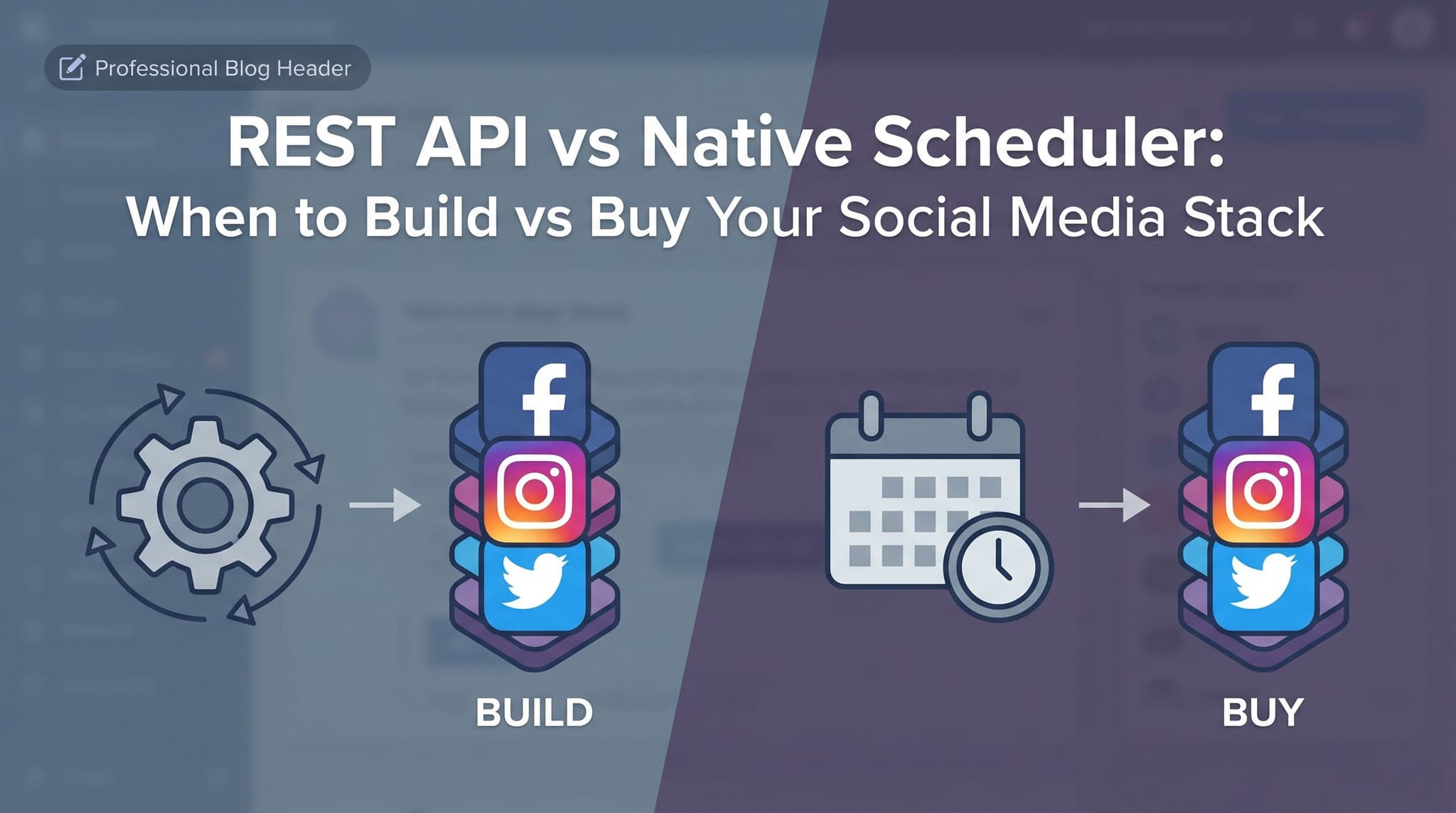
REST API vs Native Scheduler: When to Build vs Buy Your Social Media Stack
Most build vs buy decisions treat social media tools as a simple choice: write code or buy a SaaS seat. But in 2026, that framing misses the real question. Who — or what — is doing the posting? When a human clicks publish, a native scheduler works fine. When an AI agent, a CRM trigger, or an automated pipeline needs to publish across six platforms without anyone touching a button, you need an API layer. And building that from scratch means owning auth flows, rate limits, format rules, and versioning for every platform, indefinitely. This article gives developers, technical founders, and marketing ops leads a concrete framework for making this decision based on their actual use case. We cover what raw platform APIs really cost to maintain, where native schedulers hit their ceiling, and why agentic social media workflows are making this choice more urgent than it was even two years ago.

Wilzer Jean-Baptiste
11 min read
You need to publish social media content programmatically. Maybe it's part of a SaaS product. Maybe your agency wants to automate client posting. Maybe you're wiring up an AI agent that drafts and schedules content without a human in the loop. So you open the Meta Graph API docs, see it's doable, and start building.
Three months later, you've got a working prototype. Six months later, you've got a part-time engineer keeping it alive. A year later, Instagram deprecated a field, TikTok rotated their auth flow, and your LinkedIn tokens expired in production on a Friday night. You're not building a product anymore. You're maintaining infrastructure.
This is the trap. And it catches smart teams constantly, because the first sprint always looks manageable. The real cost shows up later. This article is a framework for making the build vs buy decision before you're deep in it.
What Building on Raw Platform APIs Actually Costs
Six Platforms, Six Auth Systems, Six Sets of Rules
Building on raw platform APIs sounds straightforward until you're doing it for more than one platform. Meta Graph, TikTok API, LinkedIn API, YouTube Data API, X API — each one has its own OAuth implementation, its own token refresh logic, its own rate limit structure, and its own media format requirements. A video that posts fine to Instagram needs different specs for TikTok. A post that works on LinkedIn breaks on Facebook because of a field name difference. None of these platforms coordinate with each other, and none of them warn you before they change something.
That fragmentation is the first real cost. You're not building one publishing integration. You're building six, and maintaining six, and debugging six when things break. A single platform deprecation — say, Meta retiring a Graph API version — can take down your entire pipeline overnight if you're not watching the changelog. Teams that built on raw APIs in 2024 spent real engineering hours in early 2025 just keeping up with TikTok's API changes after their policy updates. That's not product work. That's maintenance tax. A unified REST API like Aidelly's abstracts all of that into one stable endpoint. You make one call. The API handles the platform-specific translation, the auth refresh, the format rules. When Instagram changes a field name, Aidelly's team fixes it — not yours.
The Ongoing Cost Is What Kills You
The first sprint to build a social media publishing layer is usually one to three weeks. That's the number teams put in their project plans, and it's roughly accurate for a basic proof of concept. But the first sprint is not the real cost. The real cost is everything that comes after.
Token refreshes break in production. API versions get deprecated on a schedule that doesn't match your release cycle. Webhooks fail silently and you find out when a client asks why their posts didn't go out. Instagram adds a new required field for Reels. LinkedIn changes how they handle carousel posts. TikTok updates their rate limit tiers. Each of these events pulls an engineer away from your core product to go fix social media infrastructure.
If you're a SaaS company, that engineer should be building features your customers pay for. If you're an agency, that time comes out of client work. The math looks different for every team, but the pattern is the same: what started as a three-week build becomes a recurring line item in your engineering budget. Teams that have gone through this once almost always say the same thing — they wish they'd found a stable API layer earlier and pointed their engineers at actual product work instead.
Format Rules Change Without Warning
Platform format requirements are not static. Image dimensions, video length limits, caption character counts, hashtag rules, link handling — all of it changes, sometimes with notice and sometimes without. In 2026, TikTok's API has different video upload specs than it did 18 months ago. Instagram Reels has specific aspect ratio requirements that differ from feed posts. LinkedIn's document post format changed twice in the last two years.
If you're building on raw APIs, you own every one of those changes. You need to track platform developer blogs, test against staging environments, and push updates before your production pipeline breaks. For a team with dedicated platform engineers, this is manageable. For a startup with two engineers or an agency with one technical person, it's a constant low-grade emergency. The hidden cost here isn't just time. It's the cognitive load of tracking six platforms' worth of changelog noise while trying to ship your actual product.
Where Native Schedulers Stop Being Useful
They Solve the UI Problem, Not the Automation Problem
Native schedulers like Buffer, Later, and Hootsuite are genuinely good at what they do. They give you a clean interface, a visual content calendar, and a straightforward way to schedule posts across platforms without writing a line of code. For a solopreneur managing their own accounts or a small team doing manual content workflows, they work well.
But they hit a ceiling fast. They don't expose endpoints. They don't support programmatic publishing. You can't call a Buffer API to push a post from your CRM when a deal closes. You can't trigger a Later workflow from a Zapier step that fires when a new product goes live in your Shopify store. And you definitely can't plug them into an agentic workflow where an AI agent needs to create, schedule, and publish content without a human in the loop.
That ceiling is not a bug in these tools. It's a design choice. They're built for humans clicking buttons, not for machines making API calls. The problem is that more and more teams need the machine version, and they don't always realize their scheduler can't support it until they're mid-build on an automation that requires it.
The Programmatic Publishing Gap
Here's a specific scenario that comes up constantly for agencies and SaaS teams. You have a client who sells real estate. Every time a new listing goes live in their CRM, you want to automatically generate a post, pull the property photos, format it for Instagram and Facebook, and schedule it for the next optimal posting window. No human should need to touch this. It should just run.
A native scheduler cannot do this. There's no endpoint to call, no webhook to trigger, no API to authenticate against from your automation layer. You'd need a human to log in, create the post manually, and click schedule. That defeats the entire purpose of the workflow you're trying to build.
This is the programmatic publishing gap. It's the space between what native schedulers offer and what automated pipelines actually need. Filling that gap is exactly what a social media REST API is for. With Aidelly's API, that real estate workflow is a few API calls: pull the listing data, hit the content creation endpoint, attach the photos, set the schedule, done. The agent runs it. No human required.
Approval Workflows and Brand Control
One objection teams raise when moving to programmatic publishing is control. If an AI agent or an automated pipeline is creating and scheduling posts, how do you make sure nothing embarrassing goes live? This is a real concern, and it's one reason some teams stick with native schedulers even when they've outgrown them — at least a human is reviewing everything before it posts.
The answer isn't to give up programmatic publishing. It's to build approval gates into the workflow. Aidelly's approval workflows let you set up review checkpoints so posts generated by an AI agent or an automated trigger go into a queue for a human to approve before anything goes live. You get the speed and scale of automation with the safety net of human review where you need it. That combination is what makes agentic social media workflows practical for teams that care about brand consistency — and it's something no native scheduler currently supports at the API level.
A Framework for Making the Decision
Split the Decision by Use Case
The build vs buy decision for social media infrastructure splits cleanly by use case, and the split is simpler than most articles make it. If you need a human clicking buttons to create and schedule posts, buy a native scheduler. Buffer, Later, and Hootsuite are all solid for that use case. Don't overcomplicate it.
If you need an AI agent, a CRM trigger, a webhook, or any kind of automated pipeline to push content programmatically — without a human initiating each post — you need API access. And building that API layer from scratch is almost never worth it for companies that aren't in the business of building social media infrastructure. The math doesn't work. You're taking on indefinite maintenance of six platform integrations so you can avoid paying for an API that already handles all of it.
The middle case is the tricky one: teams that started with a native scheduler, outgrew it, and are now deciding whether to build or buy API access. For most of these teams, the answer is still buy. The scope of what you'd need to build to match a mature, unified social media API is larger than it looks from the outside, and the ongoing maintenance cost compounds every time a platform makes a change.
Agentic Workflows Are Changing the Calculus
Two years ago, the build vs buy question was mostly about efficiency. Do you want to spend engineering time on social media infrastructure, or spend money on a tool that handles it? That's still part of the question. But in 2026, there's a bigger factor: agentic AI.
Agentic social media workflows are changing the calculus entirely. When AI agents can autonomously draft, optimize, schedule, and analyze posts end-to-end, the right infrastructure is not a scheduler with a nice UI. It's a reliable API layer with brand voice context, approval gates, and cross-platform analytics baked in. An agent that can write a post but can't publish it is only half useful. An agent that can publish but has no brand voice guidelines is a liability. The infrastructure has to support the full loop.
This is why the decision is more urgent now than it was in 2024. Teams building AI-powered products, automating content workflows, or wiring up agents to handle social media need an API layer designed for this use case. That means programmatic publishing, yes, but also brand voice storage, analytics access, and approval workflows that an agent can trigger and a human can review. Building all of that from scratch is a multi-month project that pulls your team away from the actual AI work you're trying to do.
The Model Context Protocol Angle
There's one more piece worth naming, especially for developers building with AI assistants. The Model Context Protocol (MCP) is a standard that lets AI models like Claude or ChatGPT connect directly to external tools and data sources. When your social media infrastructure supports MCP, an AI assistant can create, schedule, and publish posts as part of a broader workflow — without you building a custom integration for each connection.
Aidelly's MCP Server supports this directly. You can connect Claude or ChatGPT to Aidelly and let the AI handle social publishing as part of a larger agentic task. That's a qualitatively different capability than anything a native scheduler offers, and it's not something you'd want to build yourself. The MCP layer, the auth handling, the platform translation — it's all infrastructure that needs to be stable and maintained. For teams building AI-powered workflows in 2026, this is the clearest argument for buying rather than building: the infrastructure you need is already there, and it's designed for exactly this use case.
The build vs buy decision for social media infrastructure comes down to one question: who or what is doing the posting? If it's a human, buy a native scheduler and move on. If it's an AI agent, a CRM workflow, or any automated pipeline, you need API access — and the cost of building and maintaining that yourself across six platforms is almost always higher than it looks on day one. The teams that figure this out early keep their engineers on core product work and their content pipelines running without constant firefighting. The ones that figure it out late usually have a war story about a Friday night outage and a deprecated API version. Whichever group you're in right now, the right infrastructure makes the difference between a social media workflow that scales and one that breaks every time a platform sneezes.
If you want a low-lift way to apply these ideas, Aidelly helps you keep your social content consistent without extra busywork.If you've made it this far, you probably already know you need more than a scheduler with a nice UI. The real question is whether you want to spend engineer hours maintaining six platform integrations indefinitely, or just let your AI agent handle it. Aidelly's agentic workflows give you the API layer, the brand voice context, and the cross-platform publishing, so your agents can create, schedule, and analyze content end-to-end without a human in the loop. See what that looks like at aidelly.ai.
Compare Social Scheduling Tools
Evaluating software for your content workflow? Use our buyer guides and comparisons to compare scheduling, approvals, analytics, and AI workflow fit.
Share this article
Related Articles
Brand Voice on Social Media: How to Stay Consistent Across Every Platform and Post
Most brands treat brand voice consistency as a writing problem. Write a good style guide, share it with the team, and done. But that is not how it works in practice. The real problem is operational. Every platform you add, every post you publish, and every person who touches your content creates another chance for your voice to drift. A word here, a tone shift there. Over weeks, your brand starts to sound like three different people. This article breaks down what brand voice actually includes, why volume is the biggest threat to consistency, how to make your voice flex across platforms without losing its core, and why agentic AI workflows are the only way to hold your brand voice at scale. If you are about to hand off social content to a team or an AI tool, this is the article to read first.
May 5, 2026
Read more
The Future of Social Media Marketing for Solopreneurs: How Agentic AI Changes Everything in 2026
If you run a one-person business, you already know the feeling. You have a product to sell, clients to serve, and somewhere in between all of that, you are supposed to be posting on Instagram, LinkedIn, TikTok, Facebook, X, and YouTube. Every day. With a consistent voice. At the right time. Without burning out. Manual social media management made sense when one or two platforms were enough. In 2026, that math does not work anymore. The solopreneurs who are winning are not working harder at content. They are stepping out of the content bottleneck entirely by using agentic AI to handle the work end-to-end. This article breaks down what that shift actually looks like, why 2026 is the inflection point, and what changes when an AI agent runs your social media instead of you spending three hours a week doing it yourself.
May 4, 2026
Read more
How to Build a Multi-Platform Content Strategy With One Brand Voice
Most guides tell you to adapt your content per platform and leave you to figure out the rest. But brand voice consistency and multi-platform execution are not two separate problems. They are one. When you solve for voice, you solve for scale. This article walks through a repeatable system used by founders, marketing managers, and content teams who publish across Instagram, TikTok, LinkedIn, YouTube, Facebook, and X without losing their minds or their brand identity. You will learn how to define your voice once, build content from a single core idea, adapt the format for each platform, and use AI and automation to hold it all together. No extra headcount. No extra hours. Just a smarter system that keeps every post sounding like you, no matter who wrote it or where it lives.
May 6, 2026
Read moreReady to never miss a post again?
Tell Aidelly what to post. It drafts, schedules, and publishes across 9 platforms while you focus on your business.