How to Build a Multi-Platform Content Strategy With One Brand Voice
Most guides tell you to adapt your content per platform and leave you to figure out the rest. But brand voice consistency and multi-platform execution are not two separate problems. They are one. When you solve for voice, you solve for scale. This article walks through a repeatable system used by founders, marketing managers, and content teams who publish across Instagram, TikTok, LinkedIn, YouTube, Facebook, and X without losing their minds or their brand identity. You will learn how to define your voice once, build content from a single core idea, adapt the format for each platform, and use AI and automation to hold it all together. No extra headcount. No extra hours. Just a smarter system that keeps every post sounding like you, no matter who wrote it or where it lives.

Wilzer Jean-Baptiste
10 min read
You already know what you want to say. You have the ideas, the expertise, and the audience. The problem is the logistics. You are posting on LinkedIn, Instagram, TikTok, and X, and somewhere between platform four and the third round of edits, your brand starts to sound like a stranger wrote it. The tone shifts. The consistency slips. And the content that goes out on Friday at 11pm feels nothing like the content you were proud of on Tuesday morning.
This is not a creativity problem. It is a systems problem. And the good news is that systems can be fixed.
This article is for people who are already active on multiple platforms and know what good content looks like. You do not need more tips about what to post. You need a repeatable process that keeps your brand voice consistent, cuts your production time, and makes multi-platform publishing feel manageable instead of exhausting. Here is how to build that system.
Your Brand Voice Is Not a Style Guide PDF Nobody Reads
What Brand Voice Actually Means
Brand voice is not a tagline or a color palette. It is the specific way your business sounds across every post, caption, reply, and headline. It is the word choices you make when you are writing a LinkedIn article at 9am and the tone you use when you are dashing off an Instagram caption at midnight. Most brands define it once, usually in a document that gets attached to a Notion page and forgotten, and then ignore it the moment they open TikTok or LinkedIn.
Here is what that looks like in practice. A SaaS founder writes a thoughtful, well-structured LinkedIn post about pricing strategy. It gets good engagement. Then they open TikTok and write something completely different in tone, almost like a different person wrote it. Not because they changed their values or their expertise, but because nobody told TikTok-them what the brand sounds like in that context. The voice drifted. And drift, over time, becomes noise.
A real brand voice document does not just say things like 'we are friendly and professional.' It gives examples. It shows what you would say versus what you would not say. It captures the rhythm of your sentences, the words you avoid, the level of formality you use with strangers. It is a working tool, not a decoration.
Why Platforms Make You Forget Your Own Voice
Each platform pulls you in a different direction. LinkedIn rewards authority and nuance. TikTok rewards speed and personality. Instagram rewards aesthetics and emotion. X rewards wit and brevity. When you are jumping between all of them in a single day, it is easy to let the platform's culture overwrite your brand's culture. You start sounding like every other account in that feed instead of like yourself.
The fix is not to resist the platform. It is to know your voice well enough that you can translate it into whatever format the platform needs without losing what makes you recognizable. That takes clarity upfront and a system to reinforce it every time someone on your team sits down to write. When your voice is documented and stored somewhere everyone can access, it stops being something you have to remember and starts being something you can rely on.
The Cost of Letting Voice Slip
When your brand sounds different on every platform, trust erodes. A potential customer who finds you on LinkedIn and then checks your Instagram should feel like they are meeting the same person. If the LinkedIn version is polished and confident and the Instagram version is chaotic and off-tone, they notice. Maybe not consciously. But it creates friction, and friction kills conversions.
Consistency is not about being boring. It is about being recognizable. The brands people trust most, whether they are solo creators or mid-sized companies, sound the same whether they are posting a meme or a case study. That kind of reliability takes work to build and almost no time at all to lose. Protecting it means treating your brand voice like the asset it actually is, not an afterthought you revisit once a year.
Same Personality, Different Format
Platform Culture Is Not Optional
Each platform has its own culture and content norms, and ignoring that is just as damaging as losing your brand voice. A LinkedIn post that performs well is usually longer, more direct, and professional. It leads with a clear point, backs it up with context or data, and ends with something worth thinking about. A TikTok caption is punchy and casual. It does not need to explain everything because the video does the heavy lifting. The caption just needs to hook or reinforce.
The mistake most brands make is thinking brand voice means identical content. It does not. It means the same personality expressed in the right format for each platform. Think of it like how you talk to your best friend versus how you present in a board meeting. You are still you. But you adjust the register. Your brand should do the same thing. The core perspective stays the same. The packaging changes.
A fitness coach with a no-excuses, direct personality might write a 300-word LinkedIn post about why most people quit their workout routines in February. That same insight on TikTok becomes a 15-word caption under a video of them walking into the gym: 'February is where excuses go to win. Not here.' Same voice. Different format. Both work because the personality is consistent even though the execution is completely different.
What Platform-Specific Adaptation Actually Looks Like
Adapting for platform does not mean rewriting from scratch. It means knowing the rules of each room. On Instagram, your caption can be longer and more personal, especially in the first line before the 'more' cutoff. On X, you have limited characters and a culture that rewards sharp, opinionated takes. On Facebook, community and relatability tend to outperform slick marketing copy. On YouTube, your description needs to work for search as much as for viewers.
Once you understand those norms, adaptation becomes fast. You are not reinventing the message. You are just dressing it for the right occasion. And when your brand voice is clearly defined and stored somewhere accessible, the adaptation stays on-brand even when it is done quickly or handed off to a team member. The voice becomes the constant. The format becomes the variable. That is a much easier system to manage than treating every platform like a blank slate.
The Trap of Platform-Hopping Without a Plan
A lot of brands add platforms reactively. TikTok blows up, so they make an account. LinkedIn starts driving leads for a competitor, so they start posting there. YouTube feels like the next step, so they start a channel. Each new platform gets its own approach, its own tone, its own vibe. And suddenly you have five accounts that feel like five different brands.
The solution is to set your voice before you set up the account. Know what you sound like. Know what you stand for. Then build the platform-specific strategy on top of that foundation, not the other way around. Adding a new platform should feel like opening a new room in a house you already own, not like moving to a different country where nobody speaks your language. Your voice is the house. The platforms are just the rooms.
Content Atomization: One Idea, Every Platform
Why Starting From Scratch Is Killing Your Output
The biggest time trap in multi-platform content is starting from scratch for each channel. It feels like the right thing to do because each platform is different. But it is the fastest way to burn out your team and create inconsistent content at the same time. When every post is built from zero, you are not just doing more work. You are also making more decisions, which means more chances for the voice to drift.
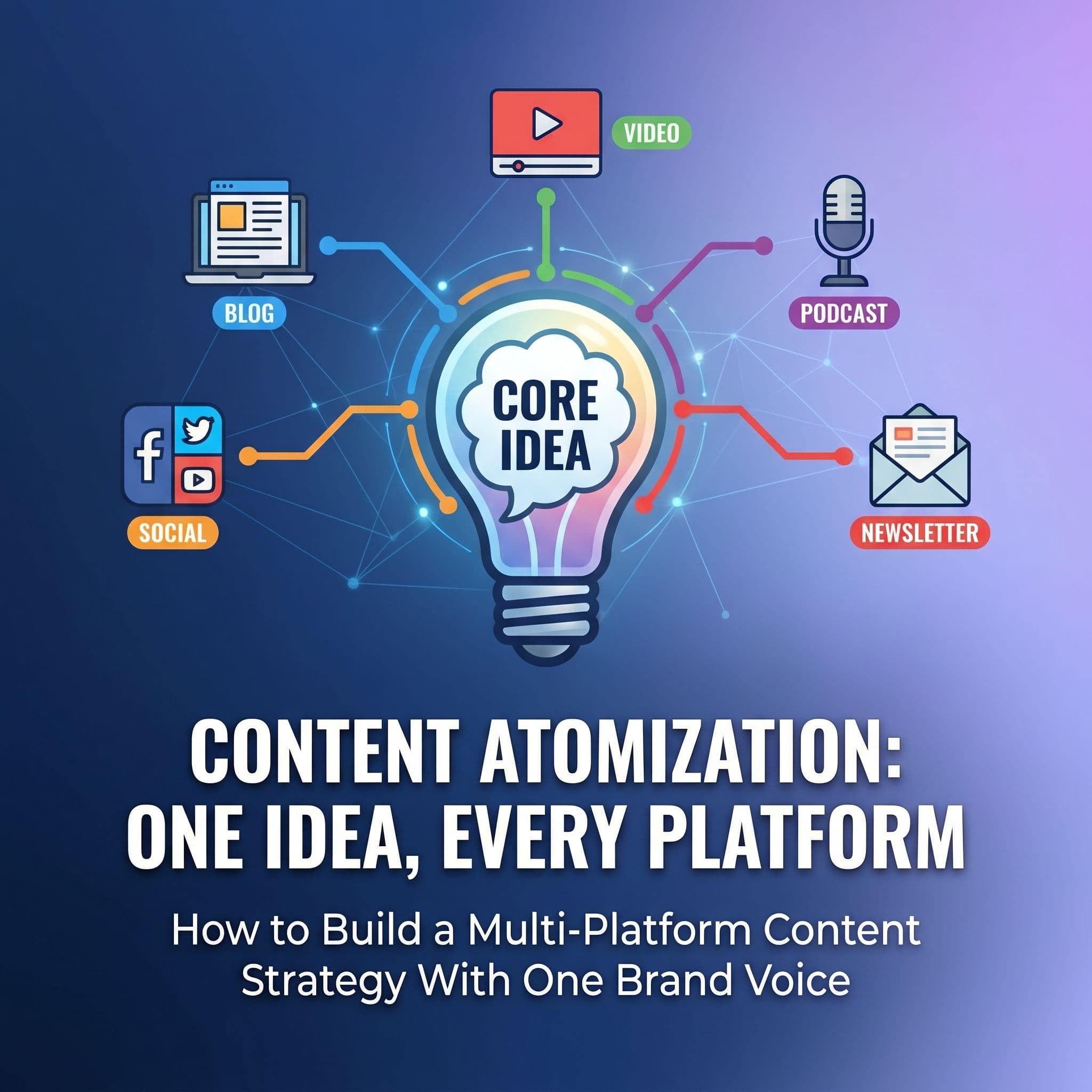
Smart teams build one core idea and then adapt it. One insight, one story, one data point becomes a LinkedIn post, a short-form video hook, an Instagram carousel, and an X thread. This is called content atomization and it cuts production time dramatically. Instead of creating five pieces of content, you are creating one and translating it four times. That is a completely different workload, and the quality goes up because you are spending your creative energy on the idea itself rather than on generating volume.
Take a real example. A marketing agency discovers that their clients who post three times per week on LinkedIn see 40% more inbound leads than those who post once. That single insight can become a LinkedIn post walking through the data, a TikTok where someone explains it in 30 seconds on camera, an Instagram carousel breaking down the three posting types that work best, and an X thread with the stat as the hook. Four pieces of content. One idea. Maybe two hours of work instead of eight.
Building Your Atomization System
Atomization works best when you have a clear process. Start with what you call a core content piece. This is usually the most detailed version of the idea, often a LinkedIn post, a blog section, or a script. From there, you strip it down for X, visualize it for Instagram, and punch it up for TikTok. Each version serves the platform's culture while carrying the same core message.
The key is to build this into your workflow before content creation starts, not after. When your team knows that every idea will be atomized into four formats, they start thinking in atoms from the beginning. The LinkedIn writer knows the TikTok version is coming. The Instagram designer knows the core message before they open their design tool. Everyone works from the same source of truth. Aidelly's AI Chat Workspace supports this by letting you draft a core idea and generate platform-optimized versions from that single input, so you are working in one place instead of copying and pasting between tabs.
What to Atomize and What to Leave Alone
Not every piece of content is worth atomizing. A quick community update or a platform-specific trend post does not need to live everywhere. Atomization is for your best ideas, your strongest insights, your most useful content. Save the effort for content that earns it.
A good rule of thumb: if you would be proud to put it in your newsletter, it is worth atomizing across platforms. If it is a reactive post tied to a moment in time, let it live where it belongs and move on. Being selective about what you atomize keeps the system from becoming another source of overwhelm. The goal is fewer decisions and better output, not more content for its own sake. Quality still drives the whole thing. Atomization just makes sure your best quality reaches every audience you have built.
The System That Keeps It All From Falling Apart
Why Teams Drift and How to Stop It
Consistency breaks down when more than one person touches content. This is one of the most common problems for growing teams, and it happens faster than most people expect. One person writes with a casual, conversational tone. Another writes more formally. A third uses a completely different vocabulary. None of them are wrong on their own. But together, they sound like three different brands.
Without a shared brand voice document, stored tone references, and a review step before posts go live, every team member drifts in their own direction. It is not laziness or carelessness. It is just what happens when people do not have a clear standard to work from. Approval workflows and centralized brand asset management are what keep a multi-person team sounding like one voice. When every post goes through a review gate before it publishes, you catch drift before it goes public, not after a client or a customer sees it.
Aidelly's brand voice storage and approval workflow features address this directly. You store your guidelines, tone references, and media assets inside the platform. Every AI-generated draft pulls from those stored guidelines. And before anything goes live, it moves through your team's approval step. The result is that your social content sounds like your brand, whether it was written by you, a contractor, or an AI agent working at 2am.
Building a Review Process That Does Not Slow You Down
A lot of teams resist approval workflows because they associate them with slow, bureaucratic processes where content gets stuck waiting for sign-off for three days. That is a process design problem, not a workflow problem. A good approval process is lightweight. One reviewer. A 24-hour window. Clear criteria for what gets approved and what goes back for revision.
The goal is not to add friction. It is to add a checkpoint. One set of eyes on every post before it publishes is enough to catch tone drift, factual errors, and off-brand choices. That checkpoint is worth the small delay. A single post that goes out in the wrong tone can undermine weeks of consistent content. Build the review step into your publishing schedule so it never becomes a bottleneck. If the review window is part of the timeline from the start, it does not slow anything down. It just becomes part of how you work.
Auto-Scheduling and the Best Time to Post
Posting at the right time on each platform matters more than most people think. Instagram, TikTok, LinkedIn, and Facebook each have different peak engagement windows. LinkedIn audiences are most active Tuesday through Thursday mornings. Instagram tends to see higher engagement in the evenings and on weekends. TikTok's algorithm is less time-sensitive but still rewards fresh content during active hours. Facebook engagement peaks mid-morning on weekdays.
Managing all of that manually is a full-time job on its own. A cross-platform scheduling tool that auto-schedules based on best time to post removes the guesswork and keeps your pipeline moving without manual calendar management. You focus on the content. The tool handles the timing. And your posts go out when your audience is most likely to see them, on every platform, without you having to think about it. Pair that with a visual content calendar that shows your entire pipeline in one view and you go from reactive posting to a publishing system you can actually plan around. Gaps become obvious. Clusters get fixed before they happen. And your content strategy starts to feel like something you control instead of something that controls you.
Building a multi-platform content strategy with one consistent brand voice comes down to three things: defining your voice clearly and storing it somewhere your whole team can use, building content from one core idea and adapting it across platforms instead of starting from scratch every time, and using automation to handle the timing and publishing so you can focus on the thinking. None of this requires a bigger team or a bigger budget. It requires a better system.
The right tools make the difference between a content operation that runs on willpower and one that runs on process. When your brand voice is stored, your approval steps are built in, and your scheduler handles the timing across every platform, consistency stops being something you have to fight for. It just happens.
If you are ready to stop managing platforms separately and start running one unified content system, the next step is setting up the infrastructure that makes it possible.
If you want a low-lift way to apply these ideas, Aidelly helps you keep your social content consistent without extra busywork.Keeping one brand voice alive across four platforms is hard enough. Doing it without a system that holds your tone, drafts your content, and moves posts from idea to scheduled without a pile of manual steps is harder. Aidelly's automation workflows are built to do exactly that, so you spend less time managing content and more time making it. See how it works at aidelly.ai.
Compare Social Scheduling Tools
Evaluating software for your content workflow? Use our buyer guides and comparisons to compare scheduling, approvals, analytics, and AI workflow fit.
Share this article
Related Articles
Brand Voice on Social Media: How to Stay Consistent Across Every Platform and Post
Most brands treat brand voice consistency as a writing problem. Write a good style guide, share it with the team, and done. But that is not how it works in practice. The real problem is operational. Every platform you add, every post you publish, and every person who touches your content creates another chance for your voice to drift. A word here, a tone shift there. Over weeks, your brand starts to sound like three different people. This article breaks down what brand voice actually includes, why volume is the biggest threat to consistency, how to make your voice flex across platforms without losing its core, and why agentic AI workflows are the only way to hold your brand voice at scale. If you are about to hand off social content to a team or an AI tool, this is the article to read first.
May 5, 2026
Read more
The Future of Social Media Marketing for Solopreneurs: How Agentic AI Changes Everything in 2026
If you run a one-person business, you already know the feeling. You have a product to sell, clients to serve, and somewhere in between all of that, you are supposed to be posting on Instagram, LinkedIn, TikTok, Facebook, X, and YouTube. Every day. With a consistent voice. At the right time. Without burning out. Manual social media management made sense when one or two platforms were enough. In 2026, that math does not work anymore. The solopreneurs who are winning are not working harder at content. They are stepping out of the content bottleneck entirely by using agentic AI to handle the work end-to-end. This article breaks down what that shift actually looks like, why 2026 is the inflection point, and what changes when an AI agent runs your social media instead of you spending three hours a week doing it yourself.
May 4, 2026
Read more
How to Run Your First Instagram Ad: A Beginner's Guide to Promoting Posts That Actually Work
Running your first Instagram ad feels intimidating until you understand one thing: the ad is not the hard part. The hard part is everything underneath it. You need the right account setup, a content calendar that is already working, and a clear idea of what success actually looks like before you spend a single dollar. This guide walks you through every step of setting up and running your first Instagram ad — from connecting your Business Manager account to reading your results without getting lost in vanity metrics. More importantly, it shows you why your organic content strategy is not separate from your paid strategy. It is the foundation. If your profile looks empty or inconsistent when paid traffic lands on it, you have wasted your budget. Get the organic side right first, then let paid amplification do its job.
May 4, 2026
Read moreReady to never miss a post again?
Tell Aidelly what to post. It drafts, schedules, and publishes across 9 platforms while you focus on your business.