TikTok Scheduling for Small Businesses: How to Stay Consistent Without Being Glued to Your Phone
Most small business owners know they should post on TikTok more often. The problem is not motivation. It is that posting consistently while running a real business feels impossible when TikTok seems to demand you show up every single day, in real time, on demand. This article makes the case that consistency is not a willpower problem. It is an infrastructure problem. When you treat TikTok like a daily task you have to remember, you will always lose to the hundred other things competing for your attention. But when you build a system that handles creation, timing, and scheduling without you touching your phone every day, consistency becomes the default. Here is how small business owners in 2026 are using batch content creation, smart scheduling, and agentic AI workflows to stay active on TikTok without it eating their week.

Wilzer Jean-Baptiste
12 min read
You know you should be posting on TikTok more. You have heard it from every marketing article, every podcast, every business owner who went viral and suddenly had a waitlist. But knowing and doing are two different things when you are also managing inventory, answering customer messages, running appointments, and trying to have a life outside your business.
The advice you usually get is some version of 'just be consistent.' Post every day. Show up. Stay active. As if the problem is that you forgot TikTok existed or that you simply lack the discipline to open your phone more often.
That advice misses the real problem entirely. Consistency is not a willpower issue. It is an infrastructure issue. When posting depends on you having a free moment, the right idea, and the energy to film something every single day, it will always lose to everything else on your plate. The fix is not trying harder. It is building a system that does not need you in the loop every day to keep running.
Why 'Just Post More' Is Bad Advice
You started strong. You posted a few videos, got some views, maybe even a comment or two. Then a busy week hit. You missed a day, then two, then a week. By the time you came back, your reach had dropped and you had to start over. Sound familiar?
This is not a discipline problem. It is a systems problem. TikTok rewards accounts that show up regularly, and it punishes gaps. When you rely on motivation and free time to decide when you post, you are setting yourself up to fail. Motivation runs out. Free time disappears. The business always wins.
The fix is not trying harder. It is removing yourself from the daily execution loop entirely. That means building a content system that runs without you having to think about it every morning.
What the Algorithm Actually Cares About
TikTok's algorithm rewards consistency above almost everything else. Posting 3 to 5 times per week dramatically outperforms sporadic bursts, no matter how good the individual videos are. An account that posts four times a week with solid content will almost always outperform an account that posts ten videos one week and then disappears for two weeks.
Here is why. TikTok's recommendation engine tracks how often your account produces content. Consistent accounts get pushed to new audiences more frequently because the algorithm has more data to work with. It learns what your content is about, who responds to it, and where to send it next. When you post in bursts and then go quiet, that learning resets. You are essentially starting over every time you come back.
Small business owners who schedule content in advance are far more likely to hit a 3 to 5 times per week cadence without burning out. Scheduling removes the daily decision of whether to post. The answer is always yes, because you already decided that last Tuesday when you batched your content.
Consistency Is an Infrastructure Problem
Think about how a restaurant handles prep work. The chef does not chop vegetables to order for every single plate. They prep in bulk at the start of the shift so service runs smoothly. Content works the same way. When you treat every post like a fresh task you have to start from scratch, you burn time and energy you do not have.
Building a content infrastructure means separating two things that most small business owners mix together: creating content and distributing content. When those two tasks live in the same moment, both suffer. You rush the creation because you feel pressure to post now. And you skip distribution decisions like timing and hashtags because you just want to hit publish and move on. Separating them fixes both problems at once.
When You Post Matters More Than You Think
Posting at the right time does not guarantee a viral video. But posting at the wrong time means fewer people see it in the first few hours, and those first hours matter a lot. TikTok's algorithm uses early engagement signals to decide whether to push a video to a wider audience. If your video goes live at 2 PM on a Tuesday and your audience is at work or school, you get weak early engagement and the algorithm moves on.
Cross-platform analytics data consistently shows that 7 to 9 AM and 7 to 9 PM in the viewer's local time zone outperform midday slots. Morning posts catch people before work or school. Evening posts catch them winding down. Both windows have higher scroll time and higher engagement rates than the middle of the day, when people are heads-down and distracted.
That said, the best time to post on TikTok varies by niche and audience. A restaurant posting lunch specials might see strong performance at 10:30 AM when people are already thinking about food. A fitness coach might do better at 6 AM. The only way to know for sure is to look at your own analytics over time and test different windows.
Why Guessing Your Posting Time Is a Losing Strategy
Most small business owners pick a time to post based on when they happen to have a free moment. That is understandable, but it leaves real reach on the table. If you are posting at 11 AM because that is when you finished editing the video, you are not posting at the time your audience is most likely to engage. You are posting at the time that was convenient for you.
This is exactly where scheduling tools earn their value. A good TikTok scheduler lets you set a posting time based on data, not convenience. Even better, tools with auto-optimization features analyze your past performance and your audience's activity patterns to pick the best window for each post automatically. You stop guessing entirely. You batch your content, hand off the timing decision to the tool, and let it go live when the data says it should.
Auto-Optimized Timing Removes the Guesswork
Scheduling tools that auto-optimize post timing do something most small business owners do not have time to do manually. They look at when your audience is online, when your past posts performed best, and what time windows have the highest engagement rates for your account. Then they schedule your post to go live at the right moment without you having to figure any of that out.
For a solo operator running a boutique, a coaching practice, or a real estate business, this is a real time saver. You are not a social media manager. You should not have to become one just to post on TikTok. Tools that handle timing decisions for you let you focus on creating content that is actually worth watching, which is the part only you can do.
The Batch-and-Schedule Method That Actually Works
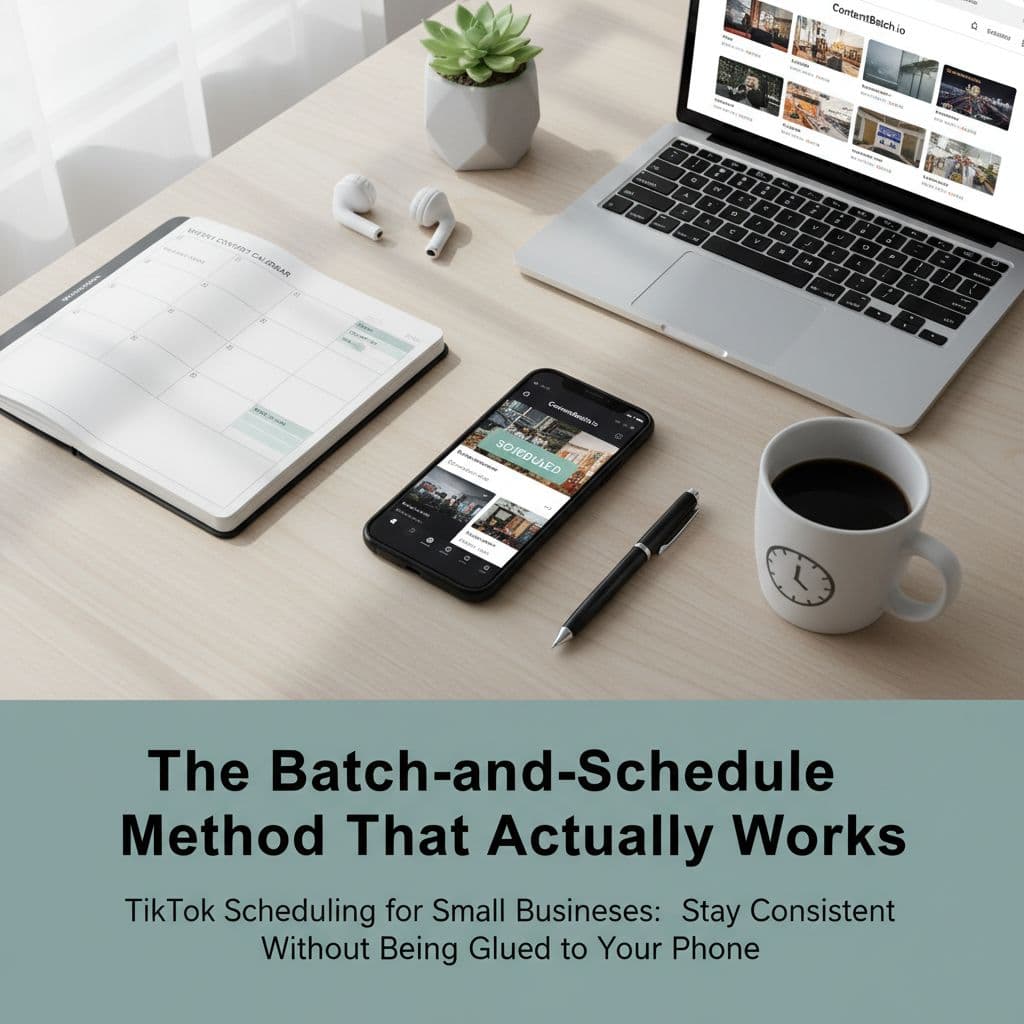
Creating content in batches and scheduling a week or two ahead is the single most effective habit shift for small business owners on TikTok. Not because it is a productivity hack or a clever trick. Because it structurally separates content creation from content distribution, so neither task suffers.
When you sit down once a week or once every two weeks to create all your content, you get into a creative flow. You are not context-switching between running your business and trying to think of something to say on camera. You block out two hours on a Sunday afternoon, film five or six videos, write the captions, and load everything into your scheduler. Done. The rest of the week, TikTok runs on autopilot while you focus on your actual business.
Compare that to the alternative: waking up every morning and trying to figure out what to post today, filming something rushed between appointments, writing a caption on your phone while standing in line, and hitting publish hoping for the best. That approach produces inconsistent content and inconsistent results. Batching produces a steady, reliable cadence that the algorithm rewards.
How to Build a Two-Week Content Pipeline
Start with a simple content calendar. Pick four to five content types that fit your business. If you run an e-commerce store, that might be product demos, packing videos, customer reviews, and behind-the-scenes clips. If you are a real estate agent, that might be property tours, neighborhood guides, buyer tips, and market updates. You do not need to reinvent the wheel every week. Rotate through the same content types and your audience will come to expect them.
Once you have your content types mapped out, block two hours every week or two to film and edit everything. Then schedule it all at once. A visual content calendar makes this easy because you can see your entire pipeline at a glance and spot gaps before they become missed posting days. Tools like Aidelly give you this view across every platform, so you are not just managing TikTok in isolation. You can see how your TikTok schedule fits alongside your Instagram Reels and LinkedIn posts, all in one place.
Separating Creation From Distribution
The biggest mistake small business owners make is treating content creation and content distribution as one task. They film a video and immediately think about when to post it, what hashtags to use, and whether the caption is right. All of that decision-making happening at once slows everything down and produces worse results on both ends.
When you batch-create content, you give yourself permission to focus on one thing at a time. During your creation block, you focus entirely on making good videos. During your scheduling block, you focus on distribution decisions: timing, captions, hashtags, and which platform each piece of content belongs on. Splitting those two jobs makes both of them faster and better. Your videos improve because you are not rushing them. Your distribution improves because you are making deliberate choices instead of reactive ones.
What Agentic AI Changes for Small Business Owners
Basic scheduling tools let you pick a time and hit publish later. That is useful, but it still puts most of the work on you. You write the caption. You pick the hashtags. You decide the timing. The tool just holds the post until the clock hits the right moment.
Agentic AI tools go much further. They can draft TikTok captions, suggest hashtags based on your content and niche, pick optimal posting times from your analytics data, and queue content without you touching the platform at all. For solo operators and small teams, this is a real operational shift. You are not just automating the publish step. You are automating the thinking that happens before the publish step.
Imagine uploading a batch of videos and having an AI agent write platform-optimized captions for each one, tag them with the right hashtags, schedule them at the best times for your audience, and queue them across TikTok, Instagram, and LinkedIn without you making a single additional decision. That is what agentic social media management looks like in practice. It is not a future concept. It is what tools like Aidelly are built to do right now in 2026.
TikTok's Native Scheduler Falls Short
TikTok does have a built-in scheduler, but it has hard limits that make it impractical for serious content planning. You can only schedule one post at a time. There is no bulk scheduling. You cannot publish to any other platform from TikTok's native tools. There is no analytics integration that helps you understand which posts performed best and why. And there is no brand voice consistency built in, so every caption starts from scratch with no memory of how you have written before.
For a small business owner trying to manage TikTok alongside Instagram, Facebook, and LinkedIn, TikTok's native scheduler creates more work, not less. You end up logging into four or five different apps, writing captions four or five separate times, and manually tracking what went live and when. Third-party tools with agentic workflows close all of those gaps at once. You get bulk scheduling, cross-platform publishing, analytics that inform future decisions, and brand voice tools that keep every post sounding like you, even when the AI is doing the drafting.
How Agentic Workflows Remove You From the Daily Loop
The goal of an agentic workflow is not to replace your creativity. It is to handle the repetitive execution work so your creativity goes further. You still decide what your brand stands for, what stories you want to tell, and what products or services you are promoting this month. But the work of turning those decisions into scheduled, optimized, platform-ready posts? That is where AI agents earn their place.
With Aidelly's agentic workflows, you can connect your brand voice guidelines and stored assets, batch-create content through the AI Chat Workspace, and let the platform handle the rest. The AI drafts captions that sound like you, picks posting times based on your analytics, and queues everything across your channels. You check in when you want to, not because you have to. For a restaurant owner, a coach, or an e-commerce seller who is already wearing five hats, that shift from daily manager to occasional reviewer is the difference between TikTok working for you and TikTok feeling like a second job.
Staying consistent on TikTok is not about posting more or trying harder. It is about building a system that posts for you, at the right time, in your voice, without you having to think about it every day. The algorithm rewards consistency, and the only way to sustain consistency while running a real business is to remove yourself from the daily execution loop. Batch your content, let smart tools handle the timing and distribution decisions, and use agentic AI to fill in the gaps that used to eat your time. The small business owners winning on TikTok in 2026 are not spending more hours on their phones. They are spending fewer hours on smarter systems. If you are ready to stop managing TikTok manually and start letting it run for you, Aidelly is built exactly for that.
Staying consistent on TikTok doesn't have to mean staying glued to your phone. With Aidelly's agentic workflows, AI agents handle the work end-to-end — drafting captions, picking posting times, queuing content, and tracking what's working — so you can batch your content once and let the system run. If you're ready to stop managing your schedule and start trusting one, visit aidelly.ai.
Compare Social Scheduling Tools
Evaluating software for your content workflow? Use our buyer guides and comparisons to compare scheduling, approvals, analytics, and AI workflow fit.
Share this article
Related Articles
Social Media Analytics for Coaches: Which Numbers Actually Tell You If It's Working
Most coaches post consistently, watch the likes roll in, and still wonder why their discovery calls aren't filling up. The problem isn't the content. It's the metrics they're watching. Follower count and likes feel good, but they don't pay the bills. The numbers that actually connect to client bookings are hiding in plain sight: profile visits, link clicks, DMs triggered by a specific post, and how many of those conversations turn into calls. This article breaks down exactly which metrics matter for coaches, how different platforms serve different stages of your client journey, and how to stop guessing about what's working. If you're posting three to seven times a week and still unsure whether social media is building your business, this is the clarity you've been looking for.
May 19, 2026
Read more
15 Marketing Tips for New Businesses (That Actually Fit Your Schedule and Budget)
Most new businesses don't fail at marketing because they lack ideas. They fail because they run out of time. You know you need to post consistently, show up on multiple platforms, and build a brand people recognize. But you're also running operations, handling customer service, and trying to sleep. This guide is for founders, solopreneurs, and first-time marketers who launched in the last 12 months and need a marketing plan that works with a one- or two-person team. Each tip here is built around the real constraint you're working with: limited hours, limited budget, and no agency on speed dial. You'll find specific tactics, honest time estimates, and a clear explanation of how AI-powered social media tools close the gap between knowing what to do and actually doing it. Bookmark this one. You'll come back to it.
May 17, 2026
Read more
9 B2B Marketing Channels That Actually Work in 2026 (Ranked by Effort vs. Return)
Most B2B marketing advice tells you which channels to use. It stops there. The real problem isn't knowing the channels — it's staying consistent across them when you're running a lean team and wearing five hats at once. This article breaks down the 9 marketing channels that move the needle for B2B companies, ranked by effort versus return. You'll get a clear picture of where to put your time and budget, why some channels compound over time while others drain fast, and how AI content creation and social media automation are changing what's actually realistic for small and mid-size teams. Whether you're a founder doing your own marketing or a two-person team trying to punch above your weight, this is the practical breakdown you've been looking for.
May 18, 2026
Read moreReady to never miss a post again?
Tell Aidelly what to post. It drafts, schedules, and publishes across 9 platforms while you focus on your business.