Agencies
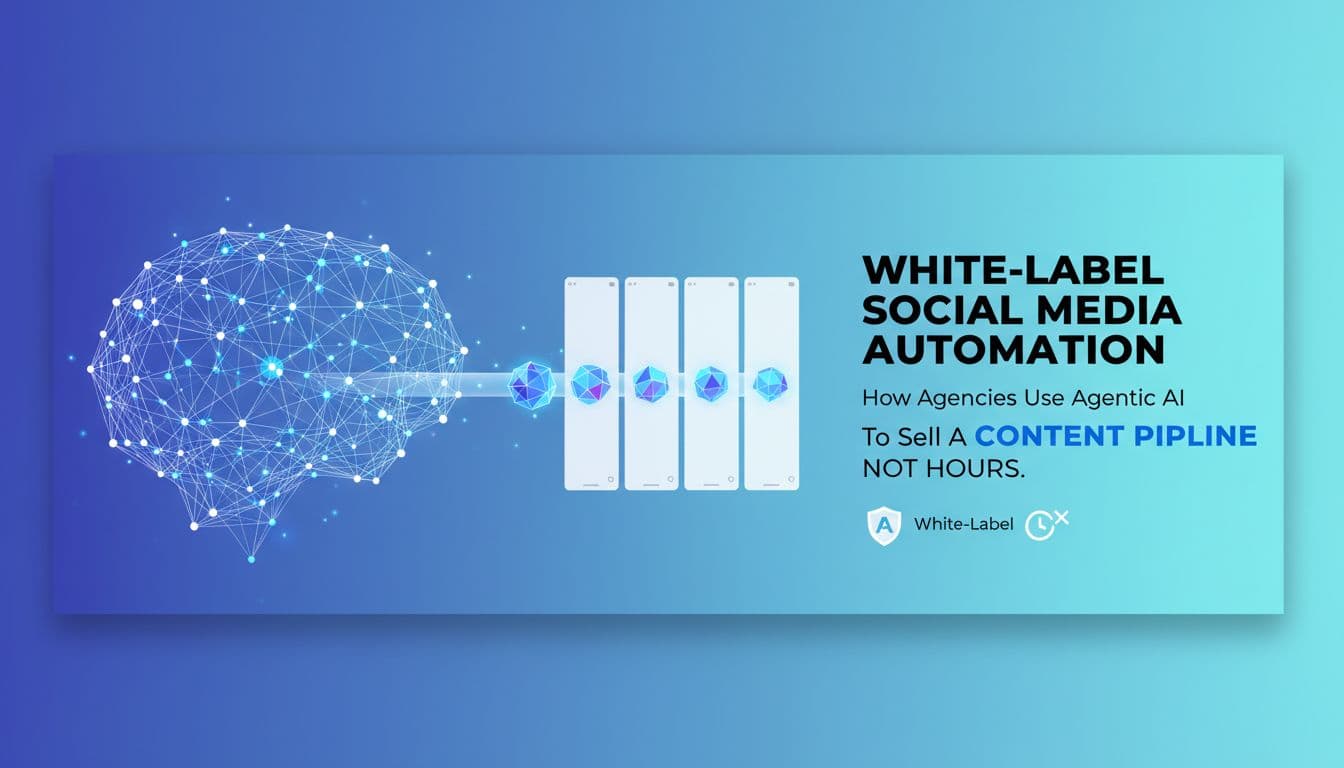
White-Label Social Media Automation: How Agencies Use Agentic AI to Sell a Content Pipeline, Not Hours
Most agencies still bill for social media by the hour. One person handles content for five clients. Another handles ten. Eventually you hit a ceiling — more clients means more hires, and margins shrink. But a different model is taking hold in 2026. Agencies are packaging AI-powered social media automation as a productized service, delivering consistent branded content for dozens of clients without growing headcount. The shift isn't just about scheduling tools. It's about agentic AI workflows that handle ideation, drafting, scheduling, and reporting end-to-end. This article walks through what that model looks like operationally: how to pick the right platform, how to protect client brand voice at scale, how to structure your service tiers, and how REST APIs and MCP server connections let you build a custom client experience on top of existing infrastructure. If you run an agency and you're still selling hours, this is worth reading.

By Wilzer Jean-Baptiste
Published Updated 12 min read
Most agencies still bill for social media by the hour. One person handles content for five clients. Another handles ten. Eventually you hit a ceiling — more clients means more hires, and margins shrink fast. But a different model is taking hold in 2026. Agencies are packaging AI-powered social media automation as a productized service, delivering consistent branded content for dozens of clients without growing headcount. To sell it under your own name, you need a platform that hides the vendor; our white label social media management comparison shows which ones do. The shift isn't just about scheduling tools. It's about agentic AI workflows that handle ideation, drafting, scheduling, and reporting end-to-end. This article walks through what that model looks like operationally: how to pick the right platform, how to protect client brand voice at scale, how to structure your service tiers, and how REST APIs and MCP server connections let you build a custom client experience on top of existing infrastructure. If you run an agency and you're still selling hours, this is worth reading.
Why White-Label Automation Changes the Math
Delivering at Scale Without Scaling Headcount
Agencies that white-label social media automation tools can deliver consistent, branded content for dozens of clients without hiring more staff. But that only works if you pick the right platform. Not every scheduling tool is built for multi-client agency work. The ones that are have three things in common: API access, stored brand voice controls, and approval workflows built into the core product — not bolted on as an afterthought.
Think about what managing 30 clients manually looks like. Thirty different brand voices. Thirty content calendars. Thirty sets of platform preferences across Instagram, LinkedIn, TikTok, Facebook, and X. If a human is touching each one every week, you need a team. But if the platform stores each client's brand guidelines, generates platform-optimized drafts automatically, and routes them through an approval gate before anything goes live, one person can oversee a much larger book of business.
The math changes because the labor model changes. You're not paying for hours per client anymore. You're paying for platform access and a small amount of human oversight. The output per team member goes up. The cost per client goes down. And your margins actually grow as you add accounts instead of shrinking.
This is why the platform you choose matters more than most agency owners realize. A basic scheduler with a pretty calendar doesn't get you there. You need brand voice storage, multi-client workspace management, and an approval layer that keeps quality consistent without requiring manual review of every single post.
What Clients Actually Pay For
Here's something worth saying plainly: most clients don't care how the content gets made. They care that it shows up, sounds like them, and performs. When you white-label an automation platform, you're not hiding that AI is involved — you're delivering a result and standing behind it with your agency's name.
That's a real service. The agency is responsible for setup, brand voice configuration, content strategy, and quality control. The AI handles the repetitive execution. Clients get consistent output. You get margin. The value you're selling is reliability and expertise — not the hours it takes to write captions.
Picking a Platform That Supports the Model
Not every tool marketed as a social media scheduler can actually support a white-label agency operation. Look for platforms that let you manage multiple client workspaces independently, store separate brand voice profiles per client, and give you approval workflow controls so nothing goes live without a review gate. REST API access is a must if you want to build anything custom on top of it. MCP server support is a newer requirement but increasingly important for agencies building AI-native workflows. If the platform you're evaluating doesn't have all of these, you'll hit a wall as you scale.
Agentic AI: From Scheduling Tool to Content Engine
What Agentic Workflows Actually Do
Agentic AI workflows change the white-label model entirely. Instead of a human manually scheduling posts for each client, an AI agent handles ideation, drafting, scheduling, and reporting end-to-end. Agencies sell the output, not the labor.
That's a meaningful distinction. A traditional scheduling tool automates the publish step. You still write the content, pick the time, and upload the asset. An agentic workflow handles the whole chain. The agent looks at a client's brand profile, their content history, what's performing, and what's coming up on the calendar — then it drafts posts, selects optimal publish times, schedules them, and flags performance data after the fact.
For an agency, this means the per-client workload drops significantly. You're not writing 20 posts a week for a client. You're reviewing 20 posts the AI drafted, approving the ones that look good, and flagging the ones that need a tweak. That's a fundamentally different job. And it's one person who can do it for a lot more clients than before.
Aidelly's agentic workflows are built for exactly this. AI agents handle content creation, scheduling, and performance analysis across Instagram, TikTok, LinkedIn, YouTube, Facebook, and X — without manual intervention at each step. The agency stays in the loop through approval gates, but the execution runs on its own.
The Shift From Selling Hours to Selling a Product
When your service runs on agentic workflows, your pricing model can change. You're not billing for the time it takes to write and schedule posts. You're billing for the pipeline itself — a consistent, branded content output delivered every week. That's a productized service. It's easier to sell, easier to scope, and easier to scale.
A client pays a flat monthly fee for 20 posts a week across three platforms. Your AI agent produces the drafts. Your team reviews and approves. The client sees the output. Nobody is tracking hours. Nobody is billing for the extra time it took to write a tricky LinkedIn post. The product is the pipeline, and the pipeline runs whether you have 10 clients or 50.
Performance Analysis Without the Manual Pull
One underrated piece of the agentic model is reporting. Most agencies spend hours pulling platform data, building decks, and summarizing results for clients. When your platform handles cross-platform analytics automatically, that work mostly disappears. The agent tracks performance, surfaces what's working, and feeds that data back into future content decisions. Your team reviews the summary. The client gets a clean report. Nobody spent four hours in spreadsheets. That recovered time goes back into strategy work — the stuff that actually justifies your retainer.
Brand Drift: The Risk That Kills Client Relationships
What Brand Drift Looks Like in Practice
The biggest operational risk in white-label agency setups is brand drift. That's when content goes out that doesn't match a client's voice or guidelines. It might be subtle — a tone that's slightly too casual for a law firm, or a caption that uses slang a luxury brand would never touch. Or it might be obvious — a post that contradicts a client's messaging, uses the wrong product name, or just sounds like it was written by someone who's never read their website.
Brand drift happens when there's no system keeping the AI grounded in what the client actually sounds like. It also happens when posts skip the approval step because the team is moving fast. Either way, the client notices before you do. And by the time it's a complaint, the damage is already out there.
Platforms with stored brand voice profiles and approval gates solve this before it becomes a client complaint. The brand voice profile tells the AI what words to use, what tone to hit, what topics to avoid, and what the client's audience expects. The approval gate catches anything that slips through before it goes live. Together, they make brand drift a rare exception instead of a recurring problem.
This is especially important when you're managing clients across very different industries. A restaurant client and a B2B SaaS client need completely different voices. If the platform doesn't store those profiles separately and apply them consistently, the AI will produce content that sounds like a blend of everything — which is to say, it sounds like nothing in particular. That's the fastest way to lose a client's trust.
How Brand Voice Storage Works at Scale
When you're managing 30 clients, you can't rely on a team member's memory of what each client sounds like. You need the platform to hold that information and apply it consistently every time content is generated. That means storing tone descriptors, example posts, key phrases, off-limits language, and any platform-specific guidelines the client has shared.
Aidelly's brand voice and asset management tools let you configure this per client. When the AI drafts a post, it pulls from that profile. The output sounds like the client — not like a generic AI caption. That's the difference between content a client approves on the first pass and content that comes back with five rounds of edits. At scale, fewer revision cycles directly translates to better margins.
Approval Workflows as a Quality Layer, Not a Bottleneck
Some agencies skip approval workflows because they feel like friction. But a well-designed approval gate is fast. The AI drafts the content. The account manager does a quick review. The client optionally sees a preview. Nothing goes live without a green light. That process can take ten minutes per client if the drafts are good. And when the brand voice profile is dialed in, most drafts are good on the first pass.
The approval workflow also protects you legally and reputationally. If a client later complains about a post, you have a record showing it was reviewed and approved. That's not a small thing. It's the kind of operational discipline that separates agencies that grow from ones that churn through clients.
Structuring Your Service Tiers Around Automation
The Three Zones Every Agency Needs to Define
Agencies packaging AI tools for clients need a clear service tier structure. What's automated, what gets human review, and what the client can touch themselves — this is where approval workflows and client-facing dashboards become a selling point, not just a feature.
Think of it as three zones. Zone one is fully automated: content ideation, drafting, scheduling, and basic performance tracking. The AI handles all of it. Zone two is human-reviewed: a team member checks drafts before they go live, catches anything off-brand, and handles anything that needs a strategic call. Zone three is client-visible: a dashboard or approval portal where the client can see upcoming posts, leave comments, and approve or flag content before it publishes.
Most agencies offer different tiers based on how much of zone two and three they include. A base tier might be fully automated with a monthly report. A mid tier adds human review before every post goes live. A premium tier gives the client their own dashboard and a dedicated account manager. The platform infrastructure is the same across all three. The price difference reflects how much human attention the client gets.
This structure also makes your service easier to sell. Instead of explaining a vague retainer, you're showing a client exactly what they get at each level. The automation handles the base workload. Human review and client access are premium features. Clients who want more involvement pay for it — and that's a fair trade that protects your team's time at every price point.
Why Dashboards Are a Sales Tool
Client-facing dashboards do two things. They reduce inbound questions — the client can see what's scheduled without emailing you. And they build trust, because the client can see the work happening in real time instead of waiting for a monthly report.
When you're pitching a new client, showing them a clean dashboard where they can review upcoming content and approve posts is a much stronger close than describing the process in a proposal. It also positions your agency as more sophisticated than competitors who are still emailing Google Docs for content approval. The dashboard is part of the product. It's a reason to choose you and a reason to stay.
Tiering Protects Your Margins
Without clear tiers, clients at every price point expect the same level of access and attention. That's where agencies quietly lose margin — not from bad pricing, but from scope creep that never gets billed. When you define what's included at each tier, you can price correctly and protect your team's time. The automation handles the base workload at every level. Human review and client access are premium features with premium prices. Clients who want more get it — at a rate that makes sense for your business. That's how you grow past 20 clients without burning out your team.
APIs and MCP: Building Your Own Branded Experience
Why Infrastructure Access Changes What's Possible
REST APIs and MCP server connections let advanced agencies build custom client-facing experiences on top of a core automation platform. They can resell AI-powered scheduling under their own brand without rebuilding infrastructure from scratch.
This is the part most white-label articles skip over. Basic white-labeling means putting your logo on someone else's dashboard. Real white-labeling means the client never sees the underlying platform at all. They see your brand, your interface, your workflow. The infrastructure runs underneath it, but the experience is yours.
To do that, you need API access. A REST API lets your developers build a custom frontend, connect your CRM, automate client onboarding, or pull performance data into your own reporting tool. You're not locked into whatever the platform's default UI looks like. You build what your clients need, on top of infrastructure that already works.
Aidelly's REST API gives agencies exactly this. A unified API that lets developers and AI agents publish to all platforms programmatically — Instagram, TikTok, LinkedIn, YouTube, Facebook, and X — from a single integration. You build the experience. Aidelly handles the platform connections. That's a meaningful advantage over building your own publisher from scratch, which would take months and cost far more than platform access.
MCP Server Connections and AI-Native Workflows
The Model Context Protocol is newer, but it's worth understanding if you're building AI-native agency workflows. An MCP server connection lets you connect AI assistants like Claude or ChatGPT directly to your social media infrastructure. That means an AI agent can create, schedule, and publish content through a protocol it already understands — no custom integration required.
For agencies, this opens up real possibilities. You can build a workflow where a client briefs an AI assistant in plain language, the assistant drafts content, and the MCP connection routes it directly into the scheduling queue. The client interacts with a conversational interface. The backend handles the rest. That's a genuinely different client experience than anything a basic scheduler can offer, and it's hard to replicate without MCP support baked into the platform.
When to Build vs. When to Use Out of the Box
Not every agency needs to build a custom experience. If you're managing under 20 clients, the platform's native interface is probably fine. But once you're scaling past that — or once you want to differentiate your agency's product offering — API and MCP access become important.
The agencies that build on top of solid infrastructure can move faster, charge more, and create switching costs that keep clients around longer. The ones that stay on the default interface are easier to replace. A competitor can show up with the same tool and the same price. But if your client is using a branded portal your agency built, leaving means losing a workflow they've gotten used to. That's a retention advantage that compounds over time.
The agencies growing in 2026 aren't the ones with the biggest teams. They're the ones that figured out how to deliver consistent, on-brand content at scale — without adding a new hire for every five clients. That means choosing a platform with agentic workflows, brand voice controls, approval gates, and real API access. It means structuring your services around what's automated and what's human. And it means thinking of your social media offering as a product, not a time-based service. When the infrastructure is right, the model works. The content goes out on time, it sounds like the client, and your team spends its time on strategy instead of scheduling. If you're ready to build that kind of operation, the tools to do it are already here.
If you want a low-lift way to apply these ideas, Aidelly helps you keep your social content consistent without extra busywork.The ceiling we talked about at the start isn't a staffing problem. It's a workflow problem. Aidelly's agentic workflows let AI agents handle content creation, scheduling, and performance analysis for every client account, so you stop trading hours for output and start delivering a content pipeline as a product. If you're building an agency that can grow without burning out, aidelly.ai is worth a look.
Compare social scheduling tools
Evaluating software for your content workflow? Use our buyer guides and comparisons to compare scheduling, approvals, analytics, and AI workflow fit.