Small Business
How Real Estate Agents Can Automate Listings Across 5 Platforms in One Workflow
Most real estate agents spend more time copying and pasting listing details into social media apps than they do talking to buyers. You write the caption on Instagram, then rewrite it for Facebook, then figure out what to say on LinkedIn, then remember you forgot TikTok. By the time you've posted everywhere, the open house is tomorrow and you're exhausted. There's a better way to handle this. This article walks through one real listing, from the day it goes live to the sold announcement, and shows exactly how a solo agent or small team can automate the whole campaign across five platforms without losing compliance control or brand consistency. You'll see what the AI handles, what you approve, and how the whole thing runs in a fraction of the time.

By Wilzer Jean-Baptiste
Published 9 min read
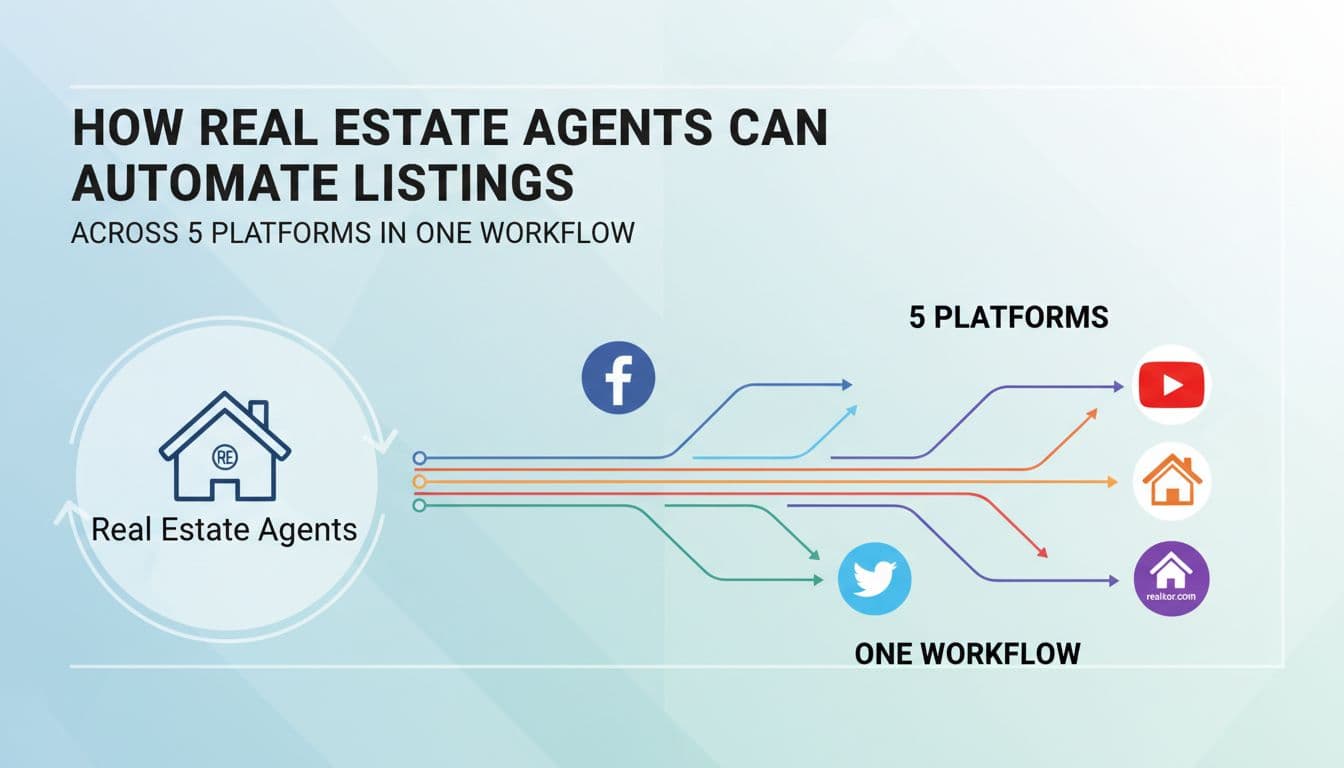
You just got a new listing. The photos came in at 9am, the MLS goes live at noon, and you need posts on Instagram, Facebook, TikTok, YouTube Shorts, and LinkedIn before the weekend. So you open five tabs, write five captions, upload the photos five times, and pray you didn't type the wrong price into the Facebook post. If that sounds familiar, you're not alone. Most real estate agents spend more time managing social media logistics than they do talking to buyers. This is a walkthrough of a better way, using one real listing campaign to show exactly how agentic social media automation works in practice, from the first photo upload to the sold announcement.
Step 1: Choose the Right Five Platforms for Real Estate
Why These Five and Not All Six
Aidelly supports six platforms: Instagram, Facebook, TikTok, YouTube, LinkedIn, and X. For most real estate listings, X gets skipped. Here's why that's a reasonable call.
X moves fast. Content has a half-life of about 20 minutes in a busy feed, and real estate content doesn't perform well there unless you're doing market commentary or building a media brand. Listing photos and open house announcements get buried almost immediately. The audience isn't actively searching for homes on X the way they browse Instagram or scroll TikTok. If you have the bandwidth to post everywhere, go ahead. But if you're a solo agent trying to work smarter, X is the one to drop from the listing rotation.
The five that do work for listings each serve a different kind of buyer or contact, and understanding that distinction changes how you write for each one.
Instagram and Facebook: Local Buyers and Neighbors
Instagram is where people browse aspirationally. A well-shot photo of a kitchen or a backyard pool stops the scroll. Stories and Reels let you show the layout in 30 seconds. Saved posts are a strong signal that someone is seriously considering a property. If a buyer saves your listing post, they're coming back to it later. That's a warm lead sitting in your analytics.
Facebook still reaches the 35-plus crowd who are actively buying, and neighborhood groups give your listing organic reach that no ad budget can replicate. A neighbor who shares your listing in the local community group is worth more than a boosted post. These two platforms are your bread and butter for local awareness. They work together, and since Meta owns both, your content workflow can overlap significantly. One strong photo and a clean caption can do real work on both.
TikTok, YouTube Shorts, and LinkedIn: Video Tours and Credibility
TikTok and YouTube Shorts are where quick video tours live. A 45-second walkthrough with good lighting and a strong hook in the first two seconds can reach thousands of people who aren't following you yet. The algorithm surfaces good content to new audiences, which matters a lot when you're trying to find buyers for a specific property. YouTube Shorts also feed into regular YouTube search, so a video tagged with the neighborhood name can show up when someone searches "homes in South Congress Austin."
LinkedIn is different. It's not where buyers browse listings on a Saturday morning. But it's where you build credibility with investors, corporate relocation leads, and other agents who might have a buyer. A post about a well-priced property in a growing neighborhood, written with some market context, can generate serious inquiries from people who would never find you on Instagram. Think of LinkedIn as your professional reputation channel, not your listing board.
Step 2: Store the Listing Facts Once, Pull Everywhere
One Source of Truth for Every Detail
Here's where most agents waste the most time and make the most mistakes. They re-enter the listing details every time they create a post. Address, price, bedrooms, bathrooms, square footage, open house date and time. Each platform gets its own version, typed from memory or copied from a notes app. That's how $489,000 becomes $498,000 on a Tuesday night when you're tired and distracted.
The smarter move is to store everything once. In Aidelly's Brand Voice and Asset Management area, you keep the listing facts, the approved photos, the open house schedule, and any specific language your brokerage requires. Every post you create for that listing pulls from the same source. When the open house time changes from 1pm to 2pm, you update it in one place and every draft reflects the change. No hunting through five apps. No wrong times going live on Instagram while Facebook still shows the old time.
This matters even more when you have multiple active listings. Keeping Maple Street's details separate from Oak Avenue's details, with photos organized by property, means you're not accidentally posting the wrong house's kitchen photo under the right address. It sounds obvious, but it happens constantly when you're managing everything manually across multiple apps with no central library.
Upload Photos and Video Once, Use Everywhere
Your photographer delivers a folder of 40 shots and a walkthrough video. Right now, you probably download them, resize some for Instagram, upload them to Facebook separately, try to figure out the vertical crop for TikTok, and lose track of which ones you've already used. That's a solid hour of your life per listing, minimum, and it gets worse when you're managing three or four active listings at once.
When your assets live in one managed library, you pull from the same folder every time you create a post. The platform formatting gets handled in the drafting step, not the asset step. You're not re-uploading. You're selecting and moving forward. The hero shot of the front exterior goes to Instagram. The vertical walkthrough clip goes to TikTok. The wide kitchen photo goes to Facebook. All from the same source. All labeled and ready to pull.
Why a Single Source Cuts Compliance Risk Too
There's a compliance angle here that most agents don't think about until something goes wrong. When every post pulls from the same approved asset library, you reduce the chance that an unapproved photo or an old price gets used in a post. If your broker has reviewed and approved the listing photos, those are the ones in the library. Nobody's grabbing a casual iPhone shot from their camera roll and posting it without realizing it doesn't meet MLS photo standards.
The same logic applies to listing language. If your brokerage has approved specific language for a property, you store that in the asset area. When the AI drafts a caption, it works from the approved brief, not from whatever someone remembers off the top of their head. That's a small thing that prevents a lot of headaches, especially for teams where multiple people might be creating content for the same listing.
Step 3: Draft, Approve, Schedule, and Analyze the Full Campaign
One Brief, Five Platform Formats
This is where the workflow gets fast. Instead of writing five different captions from scratch, you write one brief. Something like: "3-bed craftsman on Maple Street, Austin. $489,000. Hardwood floors throughout, updated kitchen, big backyard. Open house Saturday 1-3pm. Great for buyers who want character and walkability in a neighborhood that's been appreciating steadily."
Aidelly's AI-Powered Content Drafting takes that brief and produces five platform-specific versions. For Facebook, it writes a 60-word caption with the key details and a question to drive comments, paired with a square photo from the asset library. For TikTok, it scripts a hook for the first two seconds of a video tour, something like "This Austin backyard is why people move here" before cutting to the exterior shot. For LinkedIn, it writes a longer post with neighborhood context, maybe a note about the Maple Street corridor's appreciation over the past few years and what that means for buyers considering the area now.
You still read every version before it goes anywhere. The AI handles the blank-page problem and the format differences. You catch anything that doesn't sound like you, fix a detail, and move on. The whole review takes about ten minutes instead of an hour of writing from scratch.
The Compliance Check That Protects Your License
Real estate social media carries legal risk that most other industries don't deal with. The Fair Housing Act prohibits language that signals preference for or against protected classes, and the line is easier to cross than most agents realize. "Perfect for young families" is a Fair Housing violation. So is "walking distance to the church" or "quiet neighborhood" in certain contexts. MLS rules add another layer. Some brokerages have specific language requirements for listing posts, required disclosures, or restrictions on what agents can say about pricing and market conditions.
An approval workflow is not optional in this environment. It's basic risk management. Aidelly's team review gate holds every post until a broker, compliance officer, or designated team member signs off. The post doesn't go live until someone with authority has read it. For a solo agent, that might be your broker. For a team, it might be the marketing lead. Either way, there's a human checkpoint between the AI draft and the public post. You get the speed of automation, and you keep the accountability that a regulated industry requires.
Plan the Full Campaign and Measure What Works
A single listing isn't one post. It's a campaign with a beginning, a middle, and an end. A typical sequence for Maple Street looks like this: a launch post on the day the listing goes live, an open house reminder 48 hours before Saturday, a follow-up post with new photos or a price adjustment if the first weekend doesn't produce an offer, and a sold announcement once it closes. That's four to six posts per listing across five platforms. If you're managing three active listings at once, you're tracking 15 to 20 posts in various stages of drafting, approval, and scheduling.
Aidelly's Visual Content Calendar lets you map every post for every listing to a specific date and platform before you write a single word. You see the full campaign laid out in front of you. You can spot a gap, like realizing you never scheduled the open house reminder for LinkedIn, and fix it before the day arrives. Once posts are approved, they go into the queue and publish automatically.
After the listing closes, Cross-Platform Analytics shows you which platform drove the most saves, comments, and engagement. Over time, you'll see real patterns. Maybe Instagram saves consistently lead to showing requests. Maybe LinkedIn generates investor inquiries but almost no buyer traffic. That data shapes how you allocate your effort on the next listing, so you're not just posting everywhere and hoping something works.
The Maple Street listing sold in 11 days. Not because of the social media campaign alone, but because the agent spent her time on buyers and showings instead of copying captions between apps. The workflow handled the repetitive parts. She handled the relationships. That's the right division of labor, and it's available to any agent willing to set it up once and let it run. Real estate social media automation doesn't replace your judgment or your license. It removes the part of the job that was never a good use of your time anyway. The right tools give you a consistent, compliant, multi-platform presence without the manual grind, and the data to get smarter with every listing you close.
If you want a low-lift way to apply these ideas, Aidelly helps you keep your social content consistent without extra busywork.One wrong price in a listing post can cost you a buyer's trust, and five platforms multiply that risk. With agentic workflows from Aidelly, AI handles the drafting, scheduling, and performance tracking, and you check every post before it goes live. See how it works for your listings at aidelly.ai.
Compare social scheduling tools
Evaluating software for your content workflow? Use our buyer guides and comparisons to compare scheduling, approvals, analytics, and AI workflow fit.