Small Business
How Small Businesses Can Manage 5 Social Platforms Without Hiring a Social Media Manager
Running five social media platforms while also running a business sounds like a full-time job. Because it is. Most small business owners spend 10 to 15 hours every week writing captions, resizing images, remembering to post, and wondering why their Instagram gets traction but their LinkedIn feels like shouting into a void. The math on hiring a dedicated social media manager is brutal: $2,000 to $4,000 a month before you factor in benefits, onboarding, or the time it takes to manage them. So most owners do one of two things. They burn themselves out trying to keep up, or they go quiet and lose ground to competitors who stayed consistent. There's a third option. Agentic AI workflows handle your entire social media operation end-to-end, across every platform, without you needing to micromanage every post. This article breaks down exactly how that works.

By Wilzer Jean-Baptiste
Published 10 min read
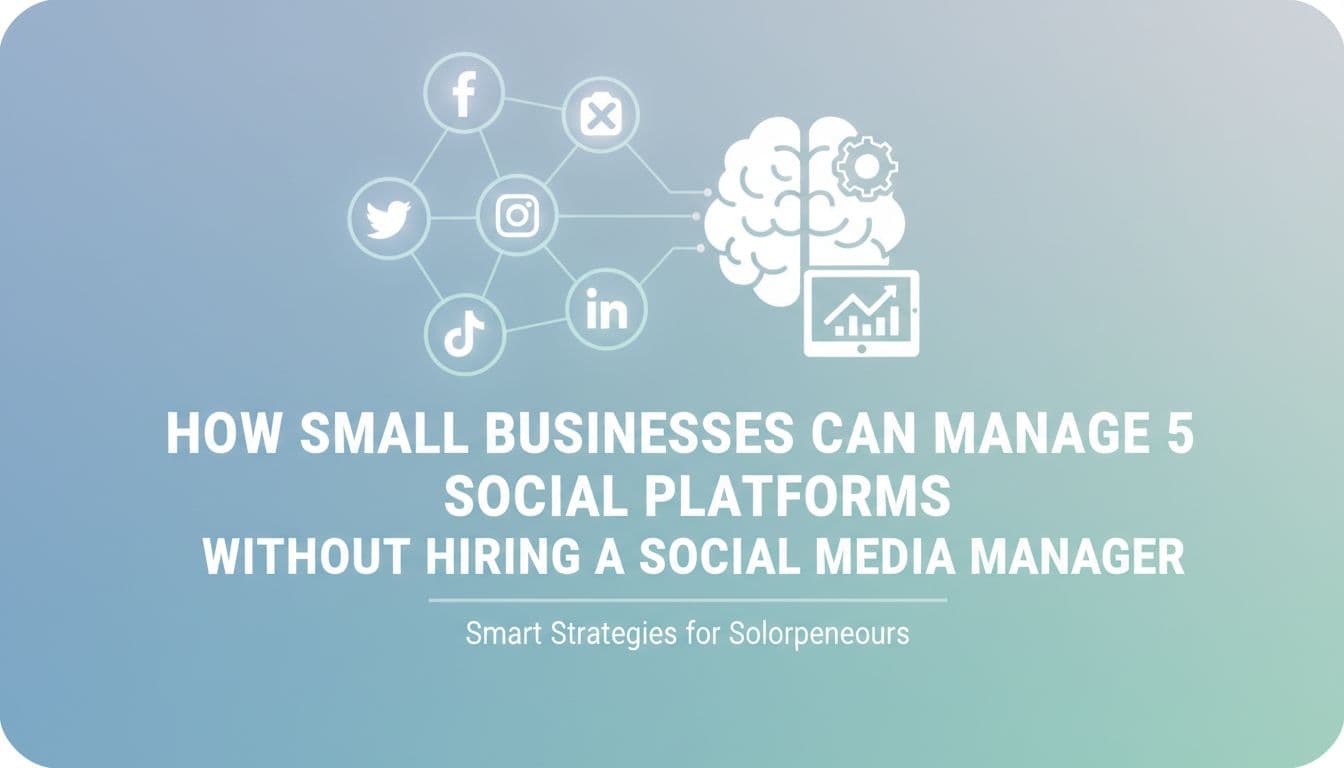
You didn't start your business to spend two hours a day writing Instagram captions. But here you are, Sunday night, trying to batch-create content for five platforms before the week starts, wondering if any of it actually matters. It does matter. And it's also completely unsustainable at the pace most small business owners are running it. Managing social media across Instagram, TikTok, LinkedIn, Facebook, and X without a dedicated team is one of the most time-consuming and underappreciated parts of running a small business in 2026. The good news is that agentic AI has changed what's possible. You no longer have to choose between burning yourself out and going dark online. Here's how to run five platforms without hiring a social media manager.
You're Losing 10 to 15 Hours Every Week
Think about everything that goes into one week of social media management. You need to come up with post ideas, write the copy, find or create the visuals, resize everything for each platform, figure out when to post, actually schedule it, and then check back to see what performed. Now multiply that across Instagram, TikTok, LinkedIn, Facebook, and X. That's not a side task you knock out in 20 minutes. Studies consistently show small business owners lose 10 to 15 hours per week on social media tasks alone.
That's nearly two full workdays gone. Not to strategy. Not to serving customers. Not to growing your business. Gone to the grind of keeping five platforms fed with content.
Agentic workflows change this completely. Instead of you doing each step manually, AI agents handle the entire process autonomously. They generate content ideas based on your business, write platform-specific captions in your brand voice, pull from your asset library, schedule posts at the right times, and analyze what's working. You set the parameters once. The agent runs the operation. You get those 10 to 15 hours back every single week.
This isn't scheduling software that saves you a few clicks. It's an autonomous system that replaces the manual labor entirely. Think of it less like a tool and more like a team member who never sleeps, never forgets to post, and never needs to be reminded.
The Hiring Math Doesn't Work for Most Small Businesses
At some point, every overwhelmed small business owner Googles "hire a social media manager." The results are sobering. A competent freelance social media manager runs $2,000 to $4,000 per month. An in-house hire with benefits and payroll taxes lands closer to $50,000 to $65,000 per year. For a restaurant, a two-person coaching practice, or a real estate agent running their own book of business, that number is simply not realistic.
So the default becomes: do it yourself, do it inconsistently, or don't do it at all. None of those options actually grow your business.
AI-powered scheduling at a fraction of that cost changes the math entirely. Platforms like Aidelly give you the output of a dedicated social media manager, including content creation, scheduling, and cross-platform management, without the payroll. You're not getting a watered-down version of what a human would do. You're getting consistent, on-brand content posted at the right times across every platform, every week, automatically. For a small business watching every dollar, that's not just convenient. It's the only model that actually makes sense.
Consistency Beats Virality Every Time
Here's something most small business owners learn the hard way. One viral post does less for your business than 90 days of consistent, quality content. The algorithm rewards accounts that show up regularly. Your audience builds trust with brands they see often. A restaurant that posts three times a week for six months will outperform a restaurant that posts 20 times in January and then goes dark until April.
The problem is that consistency requires systems. And most small business owners don't have systems. They have good intentions and a phone full of half-finished drafts. Agentic social media management solves the consistency problem by removing the human dependency entirely. The posts go out whether you're slammed with orders, traveling for a conference, or just having a week where social media is the last thing on your mind. The system doesn't get tired. It doesn't forget. It just keeps your business showing up, every week, on every platform.
Brand Voice Management Keeps Every Post On-Brand
One of the fastest ways to lose audience trust is to sound like a different business on every platform. Your LinkedIn sounds formal and corporate. Your Instagram sounds like a different person wrote it. Your Facebook page hasn't been updated since 2024. Customers notice this inconsistency even when they can't name it. It creates a vague sense that your brand isn't quite together, and that feeling affects whether they buy from you.
Centralized brand voice management fixes this at the root. You define your brand voice once: the tone, the vocabulary, the things you always say, the things you never say, the values that show up in every piece of content. That profile gets applied to every post the AI agent creates, regardless of platform. Whether it's a TikTok caption, a LinkedIn article intro, or a Facebook event post, the voice stays consistent.
This matters even more when you have a small team. If you have a part-time assistant helping with content, or you're approving posts across multiple contributors, a centralized brand voice acts as a guardrail. Nobody has to guess what your brand sounds like. The guidelines are baked into the system. Aidelly's brand voice and asset management keeps every post aligned with your business identity, so nothing goes out that feels off.
Agentic Scheduling Posts When Your Audience Is Actually Online
Most people post when they have a free moment. That's not a strategy. That's posting at 2pm on a Tuesday because that's when you finally had five minutes. The problem is your audience might be most active at 7am, or 8pm, or Sunday morning. Posting at the wrong time means your content gets buried before the people who follow you even open the app.
The best time to post varies wildly by platform and by your specific audience. What works for a B2B LinkedIn audience is completely different from what works for a local restaurant's Instagram followers. And those optimal windows shift over time as your audience grows and changes.
Agentic scheduling removes the guesswork. Instead of you picking a time based on instinct or a generic "best times to post" article, the system analyzes your actual performance data. It looks at when your posts historically get the most engagement, when your specific followers are online, and how each platform's algorithm is currently behaving. Then it auto-schedules your content to go live at those optimal windows, automatically. You don't have to remember to hit publish. You don't have to set an alarm. The agent handles it, and your content lands when it has the best chance of being seen.
Approval Workflows Keep You in Control Without Slowing Everything Down
One of the biggest concerns small business owners have about AI-generated content is losing control. What if the post sounds wrong? What if it says something inaccurate? What if it goes out before you've had a chance to review it? These are fair concerns, and they're exactly why built-in approval workflows matter.
Manual approval processes at most companies are a mess. Someone creates a post, emails it to the owner, the owner forgets to check email, the post either goes out late or doesn't go out at all. The bottleneck kills consistency and creates friction that makes the whole system fall apart.
Built-in review gates solve this without adding chaos. AI-generated content gets drafted and queued, then flagged for your approval before anything goes live. You review it in one place, approve what looks good, request edits on anything that needs a tweak, and move on. The whole process takes minutes instead of hours. You get the speed of autonomous content creation with the control of a final human review. For small teams especially, this balance between speed and oversight is what makes agentic workflows actually usable in the real world, not just impressive in theory. Aidelly's approval workflows are built exactly for this: fast enough to keep your pipeline moving, structured enough that nothing slips through without your sign-off.
Start With Your Brand Foundation
Before any AI agent can create content for your business, it needs to understand your business. This is the setup work that pays off for months. You define your brand voice, upload your logo and brand assets, describe your ideal customer, and outline the types of content you want to post. Think of this as the briefing you'd give a new hire on their first day, except you only have to do it once.
The more specific you are here, the better your output will be. Don't just say "professional but approachable." Give examples. Describe the words you use and the words you avoid. Name the topics you cover and the ones that are off-limits. A real estate agent might specify that they never talk about specific property prices in social posts but always highlight neighborhood lifestyle. A restaurant might specify that they always write in first person plural, use seasonal ingredients in their messaging, and never use food puns. These details shape every piece of content the agent creates, and they compound over time as the system learns what performs best for your specific audience.
Build Your Content Pipeline Once
Once your brand foundation is set, the next step is defining your content mix. Most small businesses do well with a simple framework: a percentage of posts that educate, a percentage that entertain or tell stories, and a percentage that directly promote products or services. A coffee shop might do 40% behind-the-scenes content, 40% product highlights, and 20% community-focused posts. A coach might do 50% value-driven tips, 30% client results, and 20% promotional content.
You set this framework once inside your content calendar. The AI agent uses it to generate a consistent mix of content across all five platforms, adapted for each platform's format and audience expectations. A LinkedIn post and a TikTok caption about the same topic will look completely different, and they should. The agent handles those adaptations automatically, so you're not manually rewriting the same idea five times for five different audiences. The visual content calendar lets you see your entire pipeline at a glance: what's drafted, what's approved, what's scheduled, and what's already live. You can spot gaps, move things around, and plan ahead without losing track of what's happening across platforms.
Let Performance Data Drive Your Strategy
The last piece of a system that runs without you is closing the feedback loop. You need to know what's working and what isn't, not so you can manually adjust every post, but so the system can get smarter over time. Cross-platform analytics give you a single view of performance across every channel. Which posts drove the most engagement? Which platform is growing fastest? What content type gets the most saves or shares?
This data feeds back into your agentic workflows. The system learns that your audience on Instagram responds better to short, punchy captions while your LinkedIn audience engages more with longer, story-driven posts. It learns that your TikTok views spike on Thursday evenings and your Facebook engagement peaks on Sunday mornings. Over time, the content gets better and the scheduling gets sharper, all without you manually analyzing spreadsheets or making gut-call adjustments.
For small business owners, this is the real payoff. You're not just saving time today. You're building a social media operation that compounds. Every week it runs, it gets more data. Every post it publishes, it gets a little smarter about what your audience wants. That's not something a manually managed social media calendar can do, no matter how organized you are.
Managing five social platforms without burning out or hiring a $4,000-a-month manager is possible. But it requires shifting how you think about social media management. Stop treating it as a task you personally complete every week. Start treating it as a system you build once and let run. Agentic workflows handle the content creation, the scheduling, the brand voice consistency, and the performance analysis. You stay in control through approval workflows and a clear analytics dashboard, without spending 15 hours a week in the weeds. The businesses winning on social media in 2026 aren't the ones with the biggest teams. They're the ones with the best systems. If you're ready to stop doing this manually and start running social media like a real operation, the tools to do it are already here.
If you want a low-lift way to apply these ideas, Aidelly helps you keep your social content consistent without extra busywork.You don't need to choose between hiring a social media manager or burning out trying to do it yourself. Agentic workflows handle the entire operation for you: creating on-brand posts, scheduling them at peak times across all 5 platforms, and analyzing what works, all without you lifting a finger. See how Aidelly turns AI into your actual social media team at aidelly.ai.
Compare social scheduling tools
Evaluating software for your content workflow? Use our buyer guides and comparisons to compare scheduling, approvals, analytics, and AI workflow fit.