Small Business
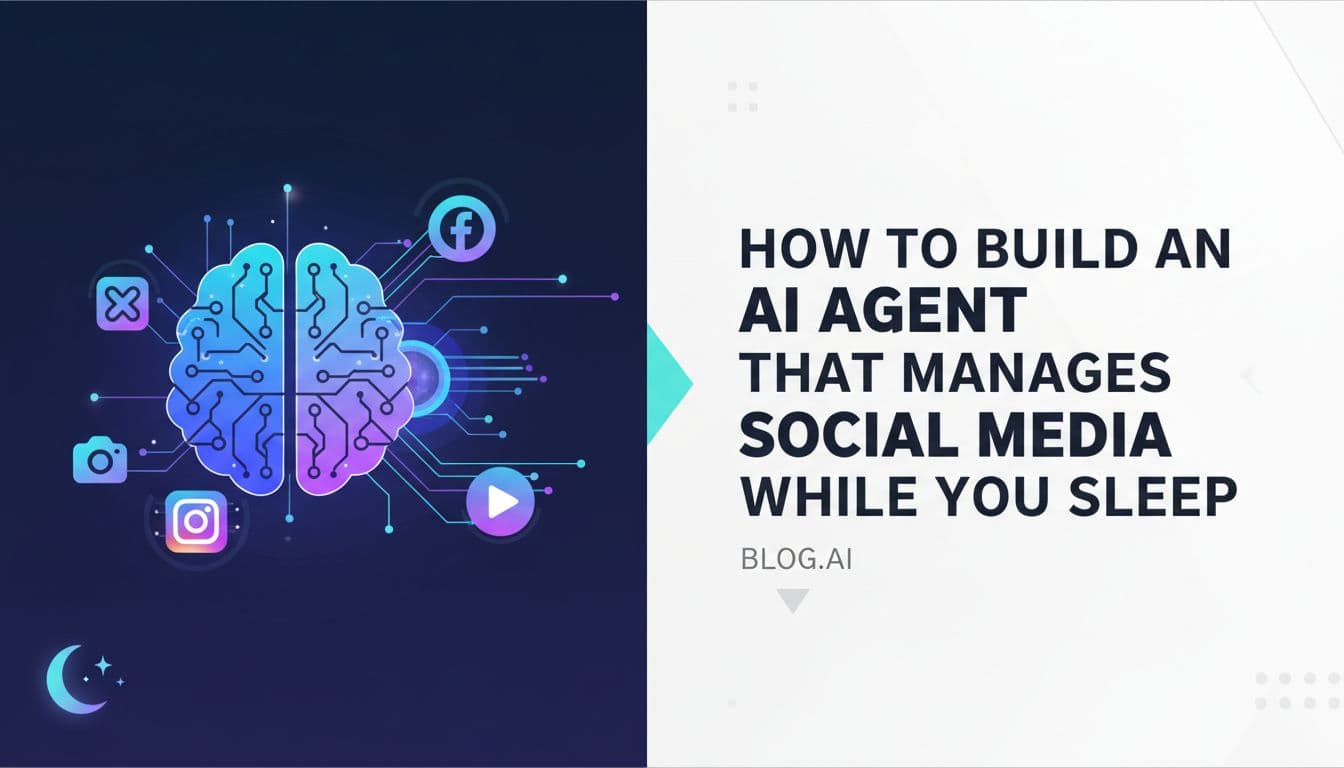
How to Build an AI Agent That Manages Social Media While You Sleep
Most small business owners spend 5 to 10 hours a week on social media and still feel behind. You write the posts, pick the times, check the analytics, and do it all over again next week. It never ends. But agentic AI is changing that equation completely. Unlike basic scheduling tools that just queue up posts you wrote, AI agents can create content, decide when to post it, analyze what worked, and adjust their approach, all without you touching a thing. This guide breaks down exactly how agentic social media management works, what you need to set it up properly, and how to build a system that keeps your channels active and growing while you focus on the parts of your business that actually need you.

By Wilzer Jean-Baptiste
Published 10 min read
You posted twice last week. Once on Monday because you remembered, and once on Thursday because someone commented on an old post and it reminded you the account existed. Your competitor posted every single day, across three platforms, with captions that actually matched each channel. They probably didn't write all of it themselves. And if you're still doing this manually, you're not just losing time. You're losing ground.
Agentic AI has changed what's possible for businesses that can't afford a full social media team. Not just scheduling tools that queue up posts you wrote, but actual AI agents that create content, decide when to publish it, analyze what worked, and adjust their approach automatically. The whole cycle, running without you, while you sleep, travel, or just focus on the work that actually needs your brain.
Here's how it works and how to build it.
What Agentic Social Media Management Actually Means
There's a big difference between a tool that posts on a schedule and an agent that manages your social media. A scheduler does what you tell it. An agent thinks, decides, and acts on its own.
Agentic AI agents can autonomously create, schedule, and optimize social media posts across multiple platforms without human intervention. That means no more Sunday night content batching sessions. No more logging into five different apps to check what went live. The agent handles the whole cycle from idea to post to performance review, and you step in only when strategy needs a human call.
This is not a small upgrade. It's a fundamentally different way of working.
The Difference Between Automation and Autonomy
Automation means you set up rules and the tool follows them. You write 10 posts, load them into a queue, and the tool fires them off on a schedule. That's useful, but it still requires your time and creative energy upfront every single week.
Autonomy means the agent makes decisions. It reads your brand guidelines, understands your content pillars, looks at what performed well last week, and generates new content based on all of that. Then it picks the best posting time based on when your audience is online, not just a generic best-practice window. It posts. It tracks results. It adjusts. You get a report.
The shift from automation to autonomy is what makes it possible to genuinely step away from social media without watching your presence go quiet. That's the version worth building toward.
Why Most Tools Stop Short
Most social media tools are built around the assumption that a human is doing the thinking. They give you a calendar to fill, a composer to write in, and analytics to review. They make the manual work faster, but they don't replace it.
True agentic tools are built differently. They're designed to hold context, remember your brand voice, connect to external data sources, and make judgment calls. That's a much harder engineering problem, which is why most platforms haven't solved it yet.
The gap between a scheduling tool and an agentic platform is not a feature gap. It's an architectural one. One is built for humans to operate. The other is built for AI to operate on your behalf. If you're evaluating tools in 2026, that distinction is the most important question to ask.
The Four Components Every AI Social Media Agent Needs
The best AI social media agents combine content generation, platform-specific optimization, scheduling intelligence, and performance analysis into one continuous workflow. If any of those four pieces is missing, you end up with a half-built system that still requires manual work to fill the gaps.
Here's what each component actually does and why all four have to work together to produce real results.
Content Generation With Platform Awareness
Generating content is the part most people think of first, and it's where a lot of AI tools stop. They'll write you a caption. Maybe suggest some hashtags. But a real content generation layer does more than that.
It understands that a LinkedIn post for a B2B software company sounds nothing like an Instagram caption for the same brand. It knows that TikTok rewards hooks in the first two seconds and that YouTube descriptions need to be keyword-rich for search. It pulls from your content pillars so posts aren't random. They're part of a coherent strategy. And it writes in your brand voice, not a generic AI voice that could belong to anyone.
When content generation is connected to the other three components, it gets smarter over time. It notices that educational posts get more saves than promotional ones for your specific audience, and it starts weighting the content mix accordingly. That's the difference between a content generator and a content agent.
Scheduling Intelligence That Goes Beyond Best Times
Scheduling intelligence is not just about posting at 9am on Tuesday because some article said that's when engagement peaks. A smart scheduling layer looks at your specific audience's behavior, your historical post performance, current platform algorithm signals, and even external factors like seasonal trends.
It decides not just when to post, but how often, in what order, and with what spacing between content types. If you've been heavy on promotional content this week, it might hold the next product post and lead with something educational instead. These are the kinds of calls a good social media manager makes instinctively. An AI agent can make them systematically, at scale, without needing a salary or a Slack message to get started.
The result is a content calendar that always feels intentional, even though you didn't plan any of it manually.
Performance Analysis That Feeds Back Into the System
This is where most automation setups break down. They post content but they don't learn from it. The performance data sits in an analytics dashboard that you have to go read, interpret, and manually act on. That's still a job. It's just a different job than writing the posts.
A real agentic workflow closes that loop automatically. The agent tracks which posts drove the most reach, saves, clicks, or conversions depending on what metrics matter to your goals. It feeds that data back into the content generation and scheduling layers. Next week's content is smarter because of last week's results.
Platforms like Aidelly are built with this loop in mind. The cross-platform analytics feed directly into the agentic workflow, so the system is always learning from what's actually working for your specific audience, not just following static rules you set up months ago. You don't have to touch the feedback loop at all. It just runs.
How to Set Up Your Agentic Workflow the Right Way
Setting up agentic workflows requires defining your brand voice, content pillars, posting schedule, and performance metrics upfront so agents can make autonomous decisions. This is the step most people rush, and it's why their AI setup produces mediocre content that doesn't sound like them.
Think of it like onboarding a new team member. The more context you give them at the start, the less you have to correct later. Agents are the same way. Front-load the thinking so the agent can execute without constantly checking in.
Brand Voice, Content Pillars, and the Setup That Makes Everything Work
Your brand voice is more than a list of adjectives. It includes the topics you talk about and the ones you avoid. It includes how formal or casual your writing is, whether you use humor, how you talk about your industry, and what kind of stories you tell about your business. The more specific you get, the better the agent performs.
Content pillars are the categories your content falls into. A fitness coach might have pillars like client transformations, workout tips, nutrition basics, and mindset. An e-commerce brand might have product education, behind-the-scenes, user-generated content, and promotions. When you define these clearly, the agent can build a balanced content calendar instead of defaulting to whatever's easiest to generate.
Aidelly's brand voice and asset management system lets you store all of this in one place so every post the agent creates pulls from the same source of truth. No drift. No off-brand surprises. Just consistent content that actually sounds like you.
Connecting Your Agent to the Tools It Needs
AI agents work best when connected to your existing tools via APIs or MCPs, allowing them to pull data from your CRM, analytics, or content management system. This is what separates a smart agent from an isolated one.
Imagine your agent can see that a customer segment in your CRM just made a purchase. It knows to shift the content mix toward retention and upsell messaging for the next two weeks. Or it can pull your latest blog post from your CMS and automatically create platform-specific social content to promote it across Instagram, LinkedIn, and X without you writing a single word.
Aidelly's MCP server makes this kind of connection possible. You can link any AI assistant, whether that's Claude, ChatGPT, or another tool, directly to your social media workflow via the Model Context Protocol. The REST API handles programmatic publishing across all platforms. This is the infrastructure layer that makes true autonomy possible, because an agent that can only see its own data is working with one hand tied behind its back. Real-time signals from connected tools beat static rules every time.
Letting the Agent Adjust Without You
True autonomous management means agents learn from performance data and adjust posting times, content types, and messaging without waiting for your approval each cycle. This is the part that feels uncomfortable for a lot of business owners at first, because it means giving up control of something that represents your brand publicly.
But you're not removing human judgment from the system. You're front-loading it. You make the strategic decisions once, during setup. You define what good looks like, what's off-limits, and what goals the agent is optimizing for. After that, the agent executes within those guardrails and gets better over time without needing a check-in.
If a certain content type consistently underperforms, the agent reduces its frequency. If Tuesday at 7pm turns out to be your best engagement window based on three months of real data, the agent shifts toward that slot. If short-form video is driving more reach than static images, the agent rebalances the content mix. None of this requires a meeting or a manual update. It just happens. For teams that still want a human checkpoint before anything goes live, approval workflows give you that gate without slowing down the whole system.
Agentic social media management is not a future concept. It's available right now, and the businesses using it are building a compounding advantage over the ones still doing everything manually. You define the strategy, configure the agent with your brand voice and content pillars, connect it to your existing tools, and let the performance loop run. Every week the system gets a little smarter. Every week you get a little more time back. That's the trade worth making.
The right platform makes the difference between a half-built automation setup that still needs you to fill the gaps and a true agentic workflow that handles social media end-to-end. Aidelly is built specifically for this, combining AI content drafting, agentic scheduling, cross-platform analytics, and API and MCP connectivity in one place so you're not stitching together tools and hoping they work together.
If you're spending more than a few hours a week on social media and still feeling behind, it's worth seeing what a real agentic setup looks like for your business.
You've built the strategy. You know your brand voice and what your audience wants. The hard part shouldn't be the execution. With agentic workflows, you hand off the entire cycle to AI—from generating on-brand posts to scheduling them at peak times to learning from performance data and adjusting next week's strategy. Your social media runs while you focus on what matters. See how it works at aidelly.ai.
Compare social scheduling tools
Evaluating software for your content workflow? Use our buyer guides and comparisons to compare scheduling, approvals, analytics, and AI workflow fit.