Solopreneurs
From Zero to Scheduled: How Solopreneurs Can Build a 30-Day Content Calendar in One Afternoon
Most solopreneurs treat their content calendar like a gym membership. They set it up with good intentions, use it for a week, and then abandon it when life gets busy. The problem isn't motivation. It's the system. When you're switching between five different apps, rewriting the same idea four different ways for four different platforms, and trying to remember whether you posted on LinkedIn this week, content planning stops feeling like strategy and starts feeling like punishment. This guide shows you a different way. You'll learn how to build a full 30-day content calendar in a single afternoon, get every post drafted and scheduled using AI, and cut your weekly social media time down to about 30 minutes. No team required. No agency budget. Just a smarter workflow that actually sticks.

By Wilzer Jean-Baptiste
Published 9 min read
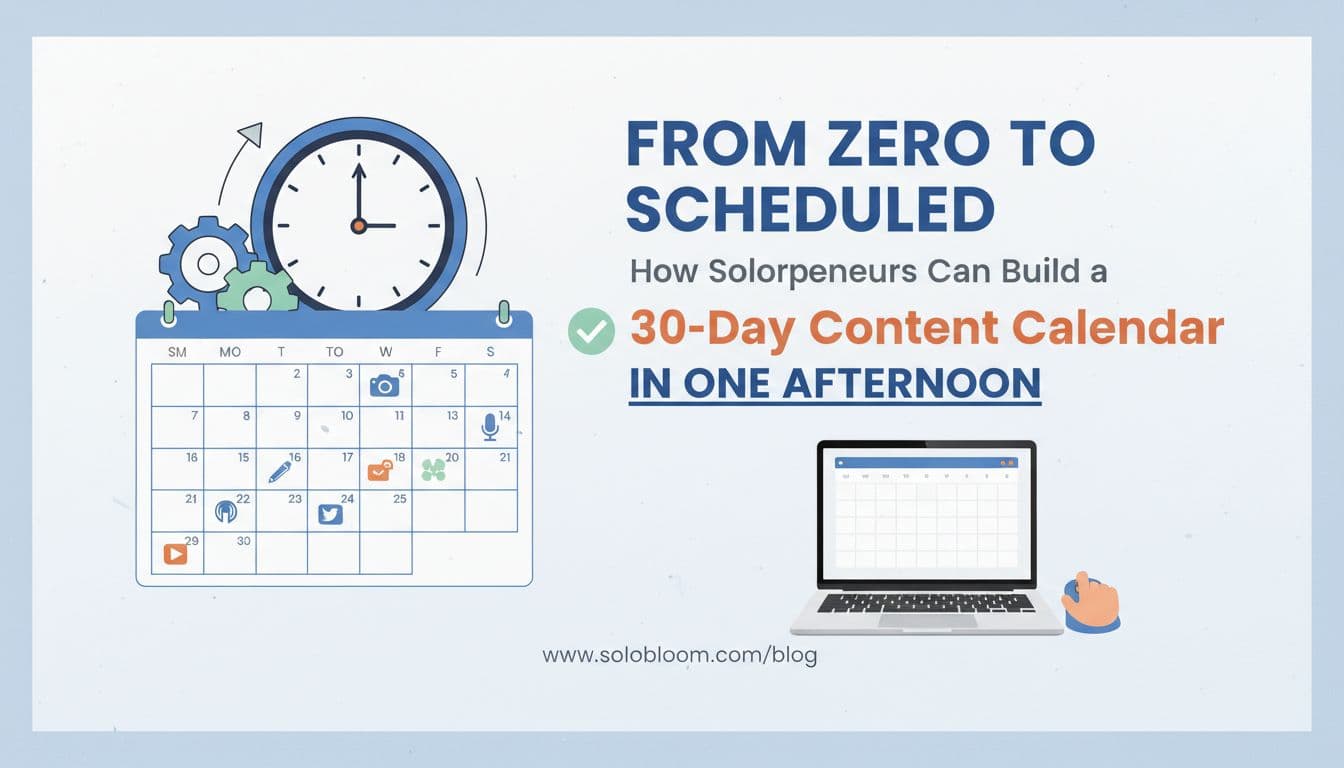
Picture this. It's Sunday afternoon. You sit down, spend about three hours, and walk away with every social media post for the next 30 days drafted, scheduled, and ready to go. No daily scrambling. No last-minute "what do I even post today" panic. No switching between six apps trying to remember your login for TikTok.
That's not a fantasy. It's a workflow. And it's exactly what AI-powered content planning makes possible for solopreneurs in 2026.
The problem most solo business owners have with content isn't creativity. It's the system. Or the lack of one. When you're running a business alone, social media is the thing that always gets pushed to tomorrow. And tomorrow turns into next week. And next week turns into three months of inconsistent posting and a feed that looks like you might have gone out of business.
This guide is going to show you how to fix that in one afternoon.
Why Your Current Content System Is Costing You Hours Every Week
Before you can fix the problem, it helps to see exactly where the time is going. For most solopreneurs, the content workflow isn't one big time drain. It's a dozen small ones that add up to a full workday every week.
The Platform-Switching Tax Is Real
Here's what a typical Tuesday looks like for most solopreneurs. You open Instagram to post something, get distracted by your notifications, remember you haven't posted on LinkedIn in four days, switch over there, write something from scratch, realize you should probably post on TikTok too, spend 20 minutes figuring out a hook, and then check the time and realize an hour just disappeared.
That's not a content strategy. That's reactive chaos.
Research consistently shows that solopreneurs lose 5 to 10 hours per week just from switching between platforms, apps, and tools. That's not time spent creating. That's time spent navigating. Logging in, logging out, reformatting, copy-pasting, second-guessing. Each context switch costs you mental energy, and mental energy is your most limited resource when you're running everything solo.
A unified content calendar changes the math completely. When your drafts, scheduling, and analytics all live in one place, you stop bouncing between tabs. You sit down once, make your decisions, and walk away. Most solopreneurs who switch to a unified system cut their weekly social media time to around 30 minutes of actual planning. The rest runs on autopilot.
The key isn't working faster. It's removing the friction that makes the work feel so heavy in the first place.
Day-by-Day Planning Is the Real Consistency Killer
Ask any solopreneur why they're inconsistent on social media and they'll usually say something like, "I just don't have time" or "I run out of ideas." But the real reason is simpler than that. They're planning one post at a time, which means every single day starts with a blank page and a decision to make.
That daily decision is exhausting. By the time you've already made a hundred other decisions about your business, clients, and finances, "what should I post today" feels like a mountain. So you skip it. Or you post something mediocre just to say you did. Or you open the app, feel overwhelmed, and close it again.
Batching content solves this completely. When you sit down once a month and plan 30 days of content in one session, you're making all your content decisions while your brain is fresh and focused on strategy. You're not reacting. You're designing.
A 30-day calendar forces you to think in themes, not posts. You see the full picture: what you're promoting this month, which topics you're covering, how your content builds on itself. That kind of visibility is impossible when you're planning post by post. And once the month is planned, you're done. No more daily decisions. No more blank page anxiety. You just show up and execute.
The Hidden Cost of Manual Platform Formatting
Even solopreneurs who do batch their content run into a second wall: reformatting. A LinkedIn post isn't an Instagram caption. A TikTok hook isn't a YouTube description. Each platform has its own tone, format, character limit, and audience expectation. If you're writing everything manually from scratch, you're essentially doing the same job four or five times.
Most people solve this by picking one or two platforms and ignoring the rest. That works until it doesn't, usually around the time you realize your audience lives somewhere you're not showing up.
The smarter move is to write once and let AI handle the reformatting. Modern AI tools can take a single core idea and generate platform-specific versions automatically, each one tuned to the right tone and format. That's not a small time savings. It's the difference between spending three hours on content and spending 30 minutes.
How to Build Your 30-Day Calendar in One Afternoon
Now for the actual process. This isn't theoretical. This is a step-by-step workflow you can run this weekend and walk away from with a full month of content ready to go.
Start With Themes, Not Posts
The fastest way to build a 30-day content calendar is to stop thinking about posts and start thinking about themes. A theme is a topic or angle that anchors a week or a set of posts. For a business coach, themes might be mindset, client results, pricing strategy, and behind-the-scenes. For a real estate agent, themes might be market updates, buyer tips, neighborhood spotlights, and personal story.
Pick four to five themes for the month. Then assign each theme to specific days or weeks. Now you have a structure. You're not staring at 30 blank slots. You're filling in a framework you already built.
From there, brainstorm three to five post ideas per theme. That gives you 15 to 25 content ideas in one sitting. Add in a few promotional posts for whatever you're selling or launching that month, and your calendar is essentially full before you've written a single caption.
This is the part most solopreneurs skip because it feels too simple. But the structure is exactly what makes everything else faster. When you sit down to write, you already know what you're writing about. The creative energy goes into execution, not ideation.
Use AI to Draft Every Post in Minutes
Once your themes and ideas are mapped out, the drafting phase is where AI earns its keep. This is where most solopreneurs used to spend the bulk of their time, and where the biggest time savings live.
AI-powered drafting tools can generate platform-optimized posts in minutes instead of hours. And the key word there is platform-optimized. Instagram captions need a strong opening line, a conversational middle, and a call to action. TikTok hooks need to create curiosity or tension in the first two seconds. LinkedIn posts need a bold opening statement and a professional but personal tone. YouTube descriptions need keywords up front and a clear structure. These aren't subtle differences. They're completely different writing jobs.
Good AI handles all of that automatically. You give it your core idea, your brand voice, and the platform, and it returns a draft that's already formatted correctly. You review it, tweak a line or two, and move on. For a 30-day calendar across three platforms, that's potentially 90 posts drafted in an afternoon instead of a week.
Aidelly's AI content drafting does exactly this. You describe what you want to post, and it generates platform-specific versions with your brand voice baked in. No reformatting. No starting from scratch. You spend your time approving and refining, not generating from zero.
Schedule Everything at Once
Drafting is only half the job. The other half is getting posts out the door at the right time, on the right platforms, without you having to manually hit publish every day.
This is where a visual content calendar becomes essential. When you can see your entire month laid out, you can spot gaps, fix imbalances, and make sure you're not posting three things on Tuesday and nothing for five days after. Drag-and-drop scheduling lets you move things around without rebuilding anything. Color-coded status indicators show you what's drafted, what's approved, and what's live.
Once everything is placed on the calendar, you schedule it all at once and walk away. The posts go out automatically. You don't have to remember. You don't have to log in. The month runs itself.
The Smarter Workflows That Make It All Stick
Building the calendar is step one. Keeping the system running month after month is where most solopreneurs fall apart. These three workflows are what turn a one-time win into a permanent habit.
Let Scheduling Handle the Timing for You
One of the most common questions solopreneurs ask is "when should I post?" The honest answer is that it depends on your platform, your audience, and your timezone. Instagram engagement peaks at different times than LinkedIn. TikTok's algorithm rewards early engagement, which means posting when your audience is most active matters more there than almost anywhere else.
Trying to track all of that manually is a full-time job. And if you're posting across multiple platforms to audiences in different timezones, the math gets complicated fast.
A content calendar with built-in scheduling handles all of this for you. It accounts for platform-specific peak times and timezone differences, so you're not guessing. You're not setting your alarm for 6 AM to post before your East Coast audience wakes up. You set it once, and the system handles the rest.
This matters more than most solopreneurs realize. Consistent posting at optimal times compounds over months. Your reach grows. Your engagement rate improves. The algorithm starts favoring your content. None of that happens if you're posting randomly whenever you remember. Automated scheduling removes the guesswork and makes sure your content lands when people are actually there to see it.
Use Claude or AI Agents to Create Without Leaving Your Flow
Here's something most solopreneurs don't know yet. You can now use Claude, ChatGPT, or other AI assistants to create, refine, and schedule social media posts without ever leaving your existing workflow. This is possible through something called the Model Context Protocol, or MCP, which lets AI assistants connect directly to tools like Aidelly.
What that means in practice is this. You're working in Claude, drafting ideas, refining your messaging, thinking through your content strategy. Instead of copying everything out, switching to your scheduler, reformatting, and pasting it in, you just tell Claude to schedule it. It happens in the same conversation. No tab switching. No copy-paste. No losing your train of thought.
Aidelly has an MCP server built for exactly this. Connect your Claude workspace to Aidelly, and you can create posts, set publish dates, assign platforms, and push content to your calendar all through a single AI conversation. For solopreneurs who already use AI assistants as part of their workflow, this removes the last remaining friction point. The whole process, from idea to scheduled post, happens in one place.
Friction kills momentum. Every extra step between "I have an idea" and "it's scheduled" is a chance to get distracted, second-guess yourself, or just not follow through. Removing those steps means more of your ideas actually make it to your audience.
Use Last Month's Data to Plan Next Month Faster
The final piece of a sustainable content system is feedback. Not gut feelings about what worked. Actual data.
Cross-platform analytics show you which posts drove the most engagement, which platforms are growing fastest, and which content types your audience responds to. That information is gold when you sit down to plan next month's calendar. Instead of guessing what to create, you're doubling down on what already works.
This is how solopreneurs get better at content over time without spending more time on it. The first month you build your calendar, you're working from themes and instincts. By month three, you're working from data. You know your audience prefers video over static posts. You know Tuesday morning outperforms Friday afternoon. You know educational content gets saved while personal stories get shared.
That knowledge makes planning faster every month because you're not starting from zero. You're building on a foundation that's already working. And the whole cycle, plan, draft, schedule, analyze, repeat, takes less time each time you run it.
A 30-day content calendar isn't a planning document. It's a decision you make once so you don't have to make it 30 times. When you batch your content, use AI to draft platform-specific posts, schedule everything at once, and let the data guide next month's plan, you stop being reactive and start being intentional. That shift is what separates solopreneurs who grow consistently from the ones who post in bursts and disappear for weeks. The right tools don't just save you time. They make consistency feel achievable instead of exhausting. If you're ready to build your first 30-day calendar and actually stick with it, the workflow is waiting for you.
If you want a low-lift way to apply these ideas, Aidelly helps you keep your social content consistent without extra busywork.Your 30-day calendar is only half the battle. The real win happens when you stop manually posting each piece of content and let AI agents handle the work for you. Agentic workflows turn your calendar into a fully automated system: AI drafts platform-optimized posts, schedules them at peak times, and analyzes what worked so you can refine next month's strategy. Start building your first calendar at aidelly.ai.
Compare social scheduling tools
Evaluating software for your content workflow? Use our buyer guides and comparisons to compare scheduling, approvals, analytics, and AI workflow fit.