Bluesky and Mastodon for Marketers: Is It Worth Adding Decentralized Platforms to Your Publishing Stack?
Your audience might be splitting across more platforms than you think. Bluesky crossed 15 million users and keeps growing. Mastodon has a small but fiercely engaged community. And a real slice of the tech-savvy, privacy-conscious crowd that used to live on X has quietly moved on. So the question isn't whether decentralized social media is real. It is. The question is whether your audience is actually there, and whether adding these platforms to your publishing stack is a smart move or a distraction. This guide breaks down what Bluesky and Mastodon actually offer marketers in 2026, who should seriously consider them, and how to test them without burning your team out or blowing up a content workflow that already works.

Wilzer Jean-Baptiste
8 min read
Something quiet has been happening to your audience. Not all at once, not with a big announcement. But over the past two years, a meaningful slice of the tech-savvy, privacy-conscious, chronically-online crowd has been moving off X and onto platforms you might not be publishing to yet. Bluesky now has around 15 million users. Mastodon has a smaller but deeply engaged community of about 1 million active users. And the question sitting in front of a lot of marketing teams right now is whether these platforms deserve a spot in their publishing stack, or whether they are just a distraction from the channels that actually move the needle. The honest answer is: it depends. Not on whether decentralized social media is interesting or ideologically appealing, but on whether your specific audience is actually there. This article helps you figure that out, and shows you how to add these platforms without blowing up a workflow that already works.
What Bluesky and Mastodon Actually Are (And Who Uses Them)
Before you make any decisions, you need to know what you are actually working with. Bluesky has around 15 million users as of 2026. Mastodon sits closer to 1 million active users. Compare that to Instagram's 2 billion or LinkedIn's 1 billion, and these platforms look tiny. But that framing misses the point entirely.
The question is not how big the platform is. The question is whether your specific audience is there. A cybersecurity SaaS company, a privacy-first fintech brand, or an open-source developer tool has a very different calculus than a fast-casual restaurant chain or a consumer skincare brand. For the right brand, 15 million niche users can outperform 2 billion distracted ones. ROI on decentralized platforms is not about reach. It is about fit. If your buyers, readers, or community members have migrated there, showing up matters. If they have not, you are posting into a void on principle, and that is not a strategy.
The Tech-Savvy Crowd That Moved There
The people on Bluesky and Mastodon are not a random sample of the internet. They skew heavily toward developers, researchers, journalists, open-source contributors, privacy advocates, and tech-adjacent professionals. Many came from Twitter during the 2022 to 2023 exodus and stayed. Others arrived because they actively wanted a platform without algorithmic manipulation or ad targeting.
This makes these platforms well-suited for B2B SaaS companies, developer tools, cybersecurity brands, academic institutions, and thought leaders in tech. If your ICP includes CTOs, senior engineers, policy researchers, or digital rights advocates, there is a real chance they are already active on Bluesky or Mastodon. For mass-market consumer brands, the math is harder to justify. The audience density is not there yet, and the platform culture does not reward polished, aspirational content the way Instagram does. Showing up with the wrong content for the wrong crowd is worse than not showing up at all. It signals that you did not do your homework.
How the Fediverse Works and Why It Matters for Your Strategy
Mastodon is part of the fediverse, a network of independently run servers that communicate using the ActivityPub protocol. Bluesky uses its own AT Protocol. Both are decentralized, meaning no single company controls the platform or the data. This is not just a technical detail. It shapes how communities form, how content spreads, and what brand behavior gets rewarded.
On Mastodon, you join a specific server often organized around a topic or community. Infosec.exchange hosts security professionals. Fosstodon.org is home to open-source enthusiasts. Your server choice signals your community alignment before you post a single thing. On Bluesky, the experience is more unified but still feels closer to early Twitter than modern Instagram. Understanding this structure helps you show up in the right places rather than broadcasting into the wrong room. A developer tools brand joining a general Mastodon server instead of a tech-focused one is like opening a B2B booth at a consumer trade show. The mechanics matter.
Why These Platforms Play by Completely Different Rules
Here is the biggest operational difference between decentralized platforms and the ones you are probably already managing. Bluesky and Mastodon do not have the algorithmic reach infrastructure that X, Instagram, and TikTok use to amplify content. There is no ad platform. There is no boosting a post to reach people outside your existing followers. There is no viral discovery engine working in your favor behind the scenes.
What this means practically is that growth on these platforms is slow and requires consistency. You do not get lucky with one post that blows up. You build an audience by showing up regularly, engaging with other people's content, contributing to conversations, and posting things that are worth reading. For teams used to optimizing for algorithmic reach, this feels like a different sport entirely. It is closer to email list building than Instagram growth. Slow, compounding, and dependent on quality over volume. If you go in expecting TikTok-style growth, you will quit within a month. If you go in expecting a slow burn with a highly engaged niche audience, the results can genuinely surprise you.
Authenticity Is Not Optional on These Platforms
The culture on Bluesky and Mastodon is noticeably different from polished brand accounts on Instagram or LinkedIn. Users on these platforms are skeptical of corporate marketing by default. They came here partly to escape it. Brands that cross-post the same glossy content they use everywhere else tend to get ignored or called out.
What works is a different register. More conversational. More specific. More willing to share a genuine opinion or admit uncertainty. Brands that let a real human voice come through, whether that is a founder, a product manager, or a content lead, build real followings. Companies that treat these platforms as another distribution channel for press releases do not last long. This is actually an opportunity if you think about it the right way. Decentralized platforms give you permission to be less polished. You can share something you are working through, ask a genuine question to your community, or post a take that is a little spikier than what your brand guidelines usually allow. That kind of content builds trust faster than any campaign ever will.
Community Engagement Is the Only Growth Engine That Works Here
On platforms without algorithmic amplification, your engagement behavior matters more than your posting frequency. Replying to posts in your niche, boosting content from others in your community, and participating in ongoing conversations is how you build visibility. This is not a side activity. It is the core of the strategy. For brands used to a broadcast model, this requires a real mindset shift. You are not just publishing. You are participating.
The good news is that genuine participation on Mastodon or Bluesky, where the communities are smaller and more tight-knit, can generate disproportionate goodwill. People notice when a brand actually shows up and engages rather than just dropping links. A cybersecurity company that consistently replies to threads on infosec.exchange with useful, non-promotional takes will build more trust in three months than a year of scheduled posts alone. The community is small enough that showing up consistently makes you visible. That is a real advantage you do not get on platforms with hundreds of millions of users.
How to Add These Platforms Without Burning Your Team Out
Here is where a lot of marketing teams get tripped up. Adding Bluesky or Mastodon to your publishing stack sounds straightforward until you actually try to manage it alongside Instagram, LinkedIn, X, and whatever else you are already running. Manually logging into separate platforms, adapting content for each one, tracking performance in different dashboards, and keeping up with engagement across all of them is a fast path to burnout.
The only sustainable way to test decentralized platforms without abandoning your core social stack is to use unified scheduling and analytics tools that bring everything into one place. When you can draft content once, adapt it for platform tone, schedule it across channels, and see performance data in a single dashboard, adding a new platform becomes a controlled experiment rather than an operational crisis. Without that infrastructure, most teams either neglect the new platforms or spread themselves too thin across all of them. Neither outcome gives you useful data. And without data, you cannot make a real decision about whether these platforms belong in your long-term stack.
This is exactly where agentic social media management changes the equation. Aidelly's agentic workflows let AI handle the repetitive parts of multi-platform publishing, from drafting platform-optimized content to scheduling at the right times, so your team can focus on the strategy and community engagement that requires human judgment. You test Bluesky without pulling someone off LinkedIn to do it.
How to Decide If These Platforms Belong in Your Stack
Start with your audience, not the platform. Before you spend any time setting up accounts, do some basic research. Are influential voices in your niche posting on Bluesky? Are relevant conversations happening on Mastodon servers your buyers might frequent? Search for topics and hashtags relevant to your industry on both platforms and see whether what you find is worth joining.
If you find active, relevant communities, that is a green light to run a 60 to 90 day test. Pick one platform to start. Bluesky is generally easier to get traction on because the interface is more familiar and the audience is slightly larger. Commit to posting three to five times per week, engaging with at least five to ten posts from others daily, and tracking follower growth, engagement rate, and any referral traffic back to your site. Set a clear success metric before you start. What does good look like after 90 days? A follower count milestone, a number of meaningful conversations, inbound leads from the community? Without a defined benchmark, you will not know whether to keep going or cut your losses. Vague experiments produce vague conclusions.
Building a Workflow That Actually Scales Across Platforms
The brands that succeed on decentralized platforms are not the ones with the biggest teams. They are the ones with the most efficient workflows. A solo founder can build a real Bluesky following with the right tools. A ten-person marketing team can fail on the same platform if they are managing it manually across too many channels without any unified view of what is working.
A practical workflow looks like this. Use a tool like Aidelly to draft and schedule your base content across all platforms, with platform-specific tone adjustments built into the process. Block 15 to 20 minutes each day for live engagement on Bluesky or Mastodon, the replies, boosts, and conversations that no scheduler can replace. Review your cross-platform analytics weekly to see what is working and where your time is generating the most return. Aidelly's visual content calendar and cross-platform analytics make this kind of multi-platform management genuinely manageable. You can see your entire publishing pipeline in one place, track how decentralized platform posts perform relative to your core channels, and make data-driven decisions about whether to scale up or step back. That visibility turns a platform experiment into a real strategic decision instead of a gut feeling.
Bluesky and Mastodon are real platforms with real audiences, but they are not for every brand. The smart move is to figure out whether your specific audience is there, run a structured test with clear success metrics, and match your tone to the culture of the platform rather than just cross-posting what you already make. If you do that, you have a real shot at building something valuable in a less crowded space. If you skip those steps, you will spend three months posting into a void and walk away with the wrong conclusion. The operational challenge of managing multiple platforms, including newer ones like Bluesky alongside your core stack, is real. But it is solvable when you have the right tools handling the scheduling, content adaptation, and analytics so your team can focus on the engagement and strategy that actually moves the needle. That is the difference between a platform experiment that teaches you something and one that just burns time.
If you want a low-lift way to apply these ideas, Aidelly helps you keep your social content consistent without extra busywork.The real barrier to testing Bluesky and Mastodon isn't deciding if they're worth it—it's managing them alongside your existing platforms without doubling your team's workload. You can use agentic workflows to let AI agents handle everything from adapting your content to each platform's culture, to scheduling posts at the right times, to pulling analytics so you actually know if these audiences convert. That way you test decentralized platforms strategically, not chaotically. See how aidelly.ai can simplify your multi-platform game.
Compare Social Scheduling Tools
Evaluating software for your content workflow? Use our buyer guides and comparisons to compare scheduling, approvals, analytics, and AI workflow fit.
Share this article
Related Articles
How Marketers Are Using Agentic AI to Run Quarterly Campaigns Without a Full Team
Running a quarterly campaign with a team of two used to mean cutting corners somewhere. Either the content calendar fell apart by week six, or the posts went out inconsistent, or someone spent every Sunday scheduling the week ahead. In 2026, that trade-off is gone. Agentic AI doesn't just help marketers write faster — it handles the full campaign loop from ideation to publishing to performance analysis, without someone managing each step manually. This article walks through exactly how lean marketing teams are using agentic workflows to run campaigns that used to require five people. You'll see what the AI handles, where you plug in, and why the teams doing this aren't just saving time — they're running better campaigns than they were before.
Jun 28, 2026
Read more
How to Audit Your Social Media Brand Consistency Across Six Platforms in One Hour
Most brands post inconsistently across platforms without realizing it. A tone that feels polished on LinkedIn sounds stiff on Instagram. Colors that look sharp on your website appear washed out on TikTok. Fonts change. Filters drift. The message you think you're sending isn't always the one your audience receives. The good news is you don't need a full week or a brand consultant to find these gaps. A structured one-hour audit across all six major platforms will show you exactly where your brand is slipping. This guide walks you through the full process, from pulling your last 20 posts on each channel to scoring your visual consistency, to building a system that stops the drift from happening again. Audit first. Then automate. That's the move.
Jul 29, 2026
Read more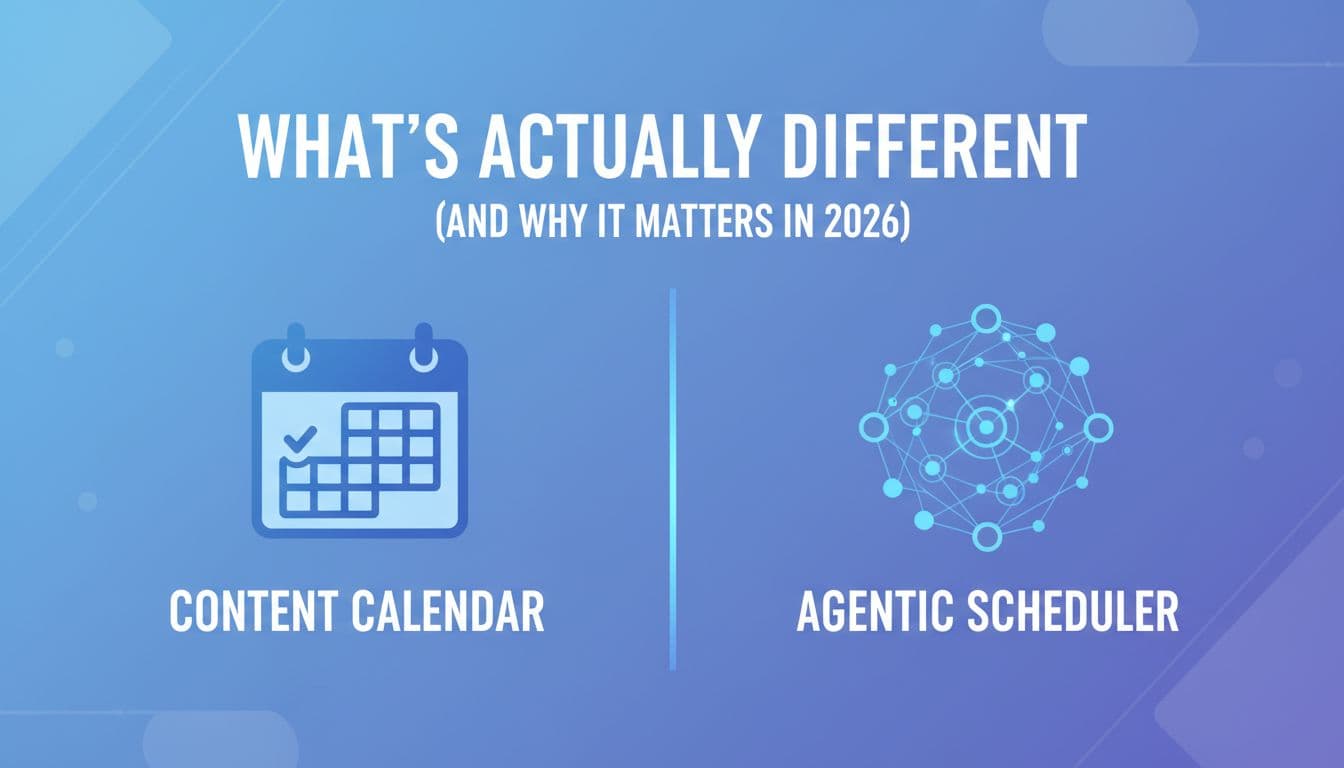
Content Calendar vs. Agentic Scheduler: What's Actually Different (And Why It Matters in 2026)
Most people use the terms 'content calendar' and 'social media scheduler' like they mean the same thing. They do not. A content calendar is where you plan. A scheduler is how you publish. And an agentic scheduler is what handles both for you, without waiting for you to do the work first. If you have ever spent a Sunday night writing captions for the week ahead, you already know the manual model has a cost. This article breaks down exactly what each tool does, where the real friction lives in a traditional content workflow, and what it means when people say a scheduler is 'agentic.' No jargon. No hype. Just a clear look at how social media management is changing in 2026 and what that shift means for solopreneurs, small business owners, and anyone who is tired of content eating their week.
Jun 23, 2026
Read moreReady to never miss a post again?
Tell Aidelly what to post. It drafts, schedules, and publishes across 9 platforms while you focus on your business.