How to Audit Your Social Media Brand Consistency Across Six Platforms in One Hour
Most brands post inconsistently across platforms without realizing it. A tone that feels polished on LinkedIn sounds stiff on Instagram. Colors that look sharp on your website appear washed out on TikTok. Fonts change. Filters drift. The message you think you're sending isn't always the one your audience receives. The good news is you don't need a full week or a brand consultant to find these gaps. A structured one-hour audit across all six major platforms will show you exactly where your brand is slipping. This guide walks you through the full process, from pulling your last 20 posts on each channel to scoring your visual consistency, to building a system that stops the drift from happening again. Audit first. Then automate. That's the move.

Wilzer Jean-Baptiste
10 min read
You've been posting for months. Instagram, LinkedIn, TikTok, Facebook, X, YouTube. You're showing up. You're consistent on the calendar. But something feels off, and you can't quite name it.
Here's what's probably happening. Your brand sounds like three different companies depending on which platform someone finds you on. Your LinkedIn posts are polished and formal. Your Instagram captions are casual and playful. Your TikTok sounds like someone else entirely made it. And your visuals? Different filters, different fonts, different energy on every channel.
Your audience notices this even when they can't articulate why. It makes your brand feel unreliable. And unreliable brands don't build the kind of trust that turns followers into customers.
The fix starts with an audit. Not a week-long brand overhaul. Not a consultant. A structured, one-hour process that shows you exactly where your brand is slipping across all six platforms. Then you build a system to keep it from happening again.
Why Brand Inconsistency Is Costing You More Than You Think
You post on Instagram, LinkedIn, TikTok, Facebook, X, and YouTube. Each platform has its own vibe, its own audience, its own format. So it makes sense that your content looks a little different on each one, right?
Sort of. Adapting your format is smart. Losing your brand identity in the process is a problem.
Most brands post inconsistently across platforms without realizing it. A one-hour audit reveals tone shifts, visual inconsistencies, and messaging gaps that confuse your audience. And confused audiences don't convert. They scroll past.
Here's what's actually happening behind the scenes for most small businesses and solo operators. You're writing LinkedIn posts in a professional headspace on Monday morning. You're dashing off Instagram captions on your phone Thursday night. Your TikTok content sounds like a completely different person made it, because honestly, it kind of did. Different moods, different contexts, different levels of care. The result is a brand that feels scattered even if every individual post looks fine on its own.
A brand consistency audit is the diagnostic tool that makes the invisible visible. It takes what you've already published and holds it up against what your brand is supposed to sound and look like. The gaps become obvious fast.
The Hidden Cost of Tone Drift
Tone drift is subtle. It doesn't announce itself. One week you're writing with confidence and authority. The next week, you're hedging every sentence with phrases like "we think" and "it might be worth considering." Three weeks later, you've gone full casual and your LinkedIn posts read like text messages.
Your audience picks up on this even when they can't name it. They start to feel uncertain about who you are and what you stand for. That uncertainty makes them less likely to follow, engage, or buy. A quick audit of your last 20 posts on each platform will show you exactly where the tone started slipping and how far it's gone. Look for shifts in sentence length, changes in how you address your audience, and posts where you used words or phrases that don't sound like you. Those are your red flags.
Messaging Gaps That Confuse Your Audience
Messaging gaps happen when different platforms tell different stories about your brand. Your Instagram bio says you help freelancers build six-figure businesses. Your LinkedIn headline says you're a business consultant for enterprises. Your TikTok content is all productivity hacks with no mention of who they're for.
Each platform is attracting a different audience with a different expectation. When those people find you on another channel, the disconnect is jarring. A brand audit maps your core message across every platform so you can see where the story breaks down. You're looking for places where your value proposition changes, where your target audience shifts, or where your content promises something your other platforms don't back up. Fix the gaps and your brand starts to feel like one coherent thing instead of a collection of separate accounts.
Why One Hour Is Actually Enough
Most people avoid audits because they assume it'll take forever. And if you approach it without a system, it will. Clicking through six platforms, reading old posts, trying to remember what your brand guidelines say, comparing vibes in your head. That's a four to six hour project that ends with you feeling overwhelmed and no clearer on what to fix.
Manual audits across six platforms take 4-6 hours and miss patterns. A structured checklist approach using screenshots, timestamps, and comparison tools cuts this to 60 minutes. You're not reading every caption word for word. You're scanning for patterns. You're checking specific things in a specific order. The checklist does the thinking. You do the reviewing. Set a timer, open a simple scoring sheet, and move through each platform in sequence. Speed is actually an advantage here because it forces you to trust your gut reaction instead of overthinking each post.
The 60-Minute Audit: A Step-by-Step Checklist
Set a timer. Open a spreadsheet or grab a notebook. You're going to move fast and score as you go. The goal isn't perfection. It's pattern recognition.
Here's how to structure the hour so you actually finish it.
Step One: Pull Your Last 20 Posts on Each Platform
Brand voice drift happens fast. Comparing your last 20 posts on each platform against your brand guidelines uncovers where you've strayed from your core message. Twenty posts is enough to reveal patterns without burying you in data.
For each platform, open your profile and screenshot your most recent 20 posts. Don't read them deeply yet. Just capture them. Then open your brand guidelines document. If you don't have one written down, write three sentences right now that describe how your brand sounds. Something like: "We're direct and confident. We use plain language. We never sound corporate or salesy." That's your baseline.
Now skim your screenshots against that baseline. For each post, give it a simple score: on-brand, slightly off, or way off. Mark the ones that feel wrong and note why in a single phrase. Did the tone shift? Did you use jargon you normally avoid? Did you suddenly start writing in third person? Do this for all six platforms. It takes about five to seven minutes per platform, and you'll already have a clear picture of where the drift is worst. Platforms where you post less frequently tend to show more drift because you're not in a rhythm and you default to whatever feels right in the moment.
Step Two: Score Your Visual Consistency
Visual consistency matters as much as copy. Mismatched filters, fonts, colors, and image styles tank recognition. An audit catches these before they damage your brand.
Think about brands you recognize instantly. You know a Nike post before you see the logo. That recognition is built through relentless visual consistency, and you can build it too, but only if you know where your visuals are currently breaking down.
Open each platform's grid or feed and look at it as a whole, not post by post. Ask yourself: do the colors feel consistent? Are you using the same two or three fonts, or are you mixing five different ones? Do your photos have a similar editing treatment, or does every post look like it came from a different brand? Common problems to flag include filters that vary wildly between posts, stock photos mixed with personal photos with no visual thread connecting them, and graphics that use your brand colors on some posts and random colors on others. Give each platform a visual consistency score from one to five. Most brands land around a two or three on their first audit. That's fixable, but you need to see it clearly before you can fix it.
Step Three: Check Your Profile and Bio Consistency
Your bios and profile information are the first thing a new follower reads. They're also the thing most brands forget to update when their messaging evolves.
Spend five minutes checking that your username or handle is consistent across platforms, your profile photo matches your current brand look, your bio communicates the same core value proposition even if the words are different, your website link is current and goes to the right page, and your contact information is accurate. This sounds basic, but it's shocking how many brands have an outdated tagline on Facebook, a broken link on Instagram, and a bio on LinkedIn that describes a service they stopped offering a year ago. These small things erode trust faster than a bad post does. A new visitor who finds you on two different platforms and sees conflicting information will question whether you're still active, still relevant, or still the right fit for them.
From Audit to Automation: How to Stop the Drift for Good
The audit shows you the problem. But if you fix it manually and don't change your process, you'll be back in the same place in six months. The real work happens after the audit, when you build a system that enforces consistency automatically.
Build Your Brand Voice Document First
If your audit revealed tone drift, the root cause is almost always the same: your brand voice isn't written down anywhere accessible. It lives in your head, which means it changes based on your mood, your schedule, and how much sleep you got.
A brand voice document doesn't have to be long. It needs four things: a description of your tone in three to five sentences, a list of words and phrases you use often, a list of words and phrases you never use, and two or three example posts that perfectly represent your voice. That's it. Print it out. Pin it somewhere. Share it with anyone who writes content for you.
Tools like Aidelly let you store your brand voice guidelines, tone references, and media assets directly in the platform so every AI-generated post starts from the right place. Instead of hoping your content stays on-brand, you build the guardrails in from the start. When your brand voice is stored in the system, the AI drafts content that already sounds like you, not like a generic version of your industry.
Set Up Approval Workflows Before You Scale
Approval workflows and centralized asset management prevent future inconsistency. Once you audit and identify gaps, you need a system to enforce consistency automatically, not a checklist you remember to check sometimes.
Here's the problem with most content processes: the person creating the content and the person approving it are either the same person with no structured review step, or there's no approval step at all. Content goes straight from draft to published. Nobody checks it against brand guidelines. Nobody catches the off-brand caption before it goes live.
An approval workflow creates a mandatory review gate. Before anything publishes, it passes through a check. This can be you reviewing your own drafts in a structured way, a team member doing a brand check, or an AI-assisted review against your stored guidelines. The key is that the gate exists and content can't skip it. Aidelly's approval workflows give teams exactly this kind of structure. Drafts go into a review queue before they publish. Nothing goes live until it's been checked. For small teams and solopreneurs, this is the difference between a brand that stays consistent at scale and one that slowly fragments as you post more.
Centralize Your Assets and Automate the Routine
One of the biggest drivers of visual inconsistency is scattered assets. Your logo is in an email from last year. Your brand colors are in a Canva file you can't find. Your approved photo library is split across Google Drive, Dropbox, and your phone camera roll.
Centralizing your assets means putting everything in one place: logos in all formats, brand colors with hex codes, approved fonts, photo libraries, and graphic templates. When everything lives in one place, the right assets are always one click away instead of a ten-minute search.
Pair that with agentic workflows that handle the routine parts of content creation and scheduling, and you remove most of the opportunities for inconsistency to creep in. You're not starting from scratch every time you post. You're working from a system that already knows your brand. Aidelly's agentic workflows can autonomously create, schedule, and optimize posts across all six platforms while staying inside the brand guardrails you've set. The result is a content pipeline that moves fast without drifting.
A one-hour audit is a powerful diagnostic. It shows you exactly where your brand is inconsistent, which platforms have drifted the furthest, and what specific things need to change. But the audit is only valuable if you act on what it reveals. The brands that stay consistent over time aren't the ones who audit more often. They're the ones who build systems that make inconsistency harder to create in the first place. Centralized assets, stored brand guidelines, approval workflows, and agentic content tools turn brand consistency from something you have to remember into something that happens automatically. Run the audit today. Then build the system that makes the next audit a formality.
If you want a low-lift way to apply these ideas, Aidelly helps you keep your social content consistent without extra busywork.You now know where your brand is slipping. The next step is making sure it doesn't slip again. Instead of manually policing consistency across six platforms, let AI agents handle it for you. Agentic workflows take your brand guidelines and enforce them automatically, from content creation to scheduling to performance analysis. Start building your brand consistency system at aidelly.ai.
Compare Social Scheduling Tools
Evaluating software for your content workflow? Use our buyer guides and comparisons to compare scheduling, approvals, analytics, and AI workflow fit.
Share this article
Related Articles
How Marketers Are Using Agentic AI to Run Quarterly Campaigns Without a Full Team
Running a quarterly campaign with a team of two used to mean cutting corners somewhere. Either the content calendar fell apart by week six, or the posts went out inconsistent, or someone spent every Sunday scheduling the week ahead. In 2026, that trade-off is gone. Agentic AI doesn't just help marketers write faster — it handles the full campaign loop from ideation to publishing to performance analysis, without someone managing each step manually. This article walks through exactly how lean marketing teams are using agentic workflows to run campaigns that used to require five people. You'll see what the AI handles, where you plug in, and why the teams doing this aren't just saving time — they're running better campaigns than they were before.
Jun 28, 2026
Read more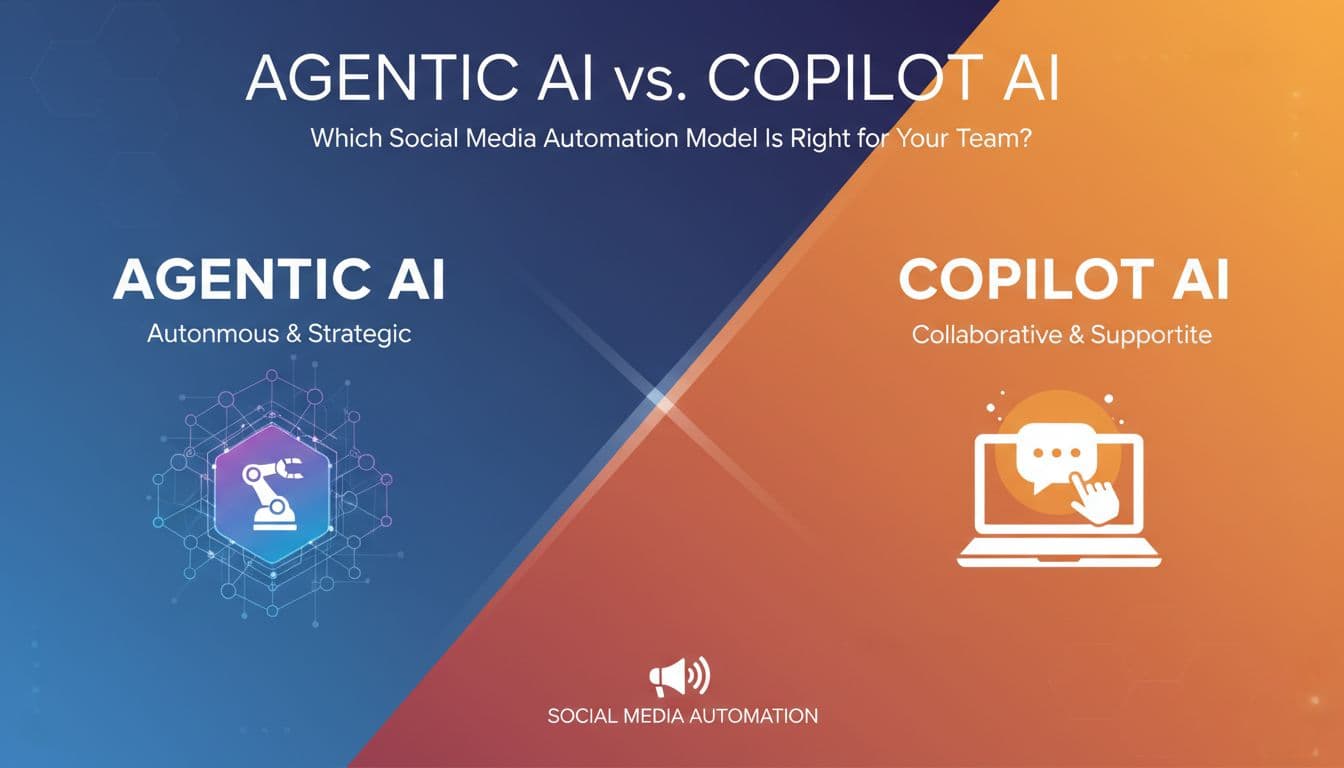
Agentic AI vs. Copilot AI: Which Social Media Automation Model Is Right for Your Team
Most AI tools make you faster. Agentic AI makes certain tasks disappear entirely. If you're still spending hours each week writing captions, picking post times, and moving content through approval chains, the problem isn't your output speed. It's that you're still in the loop for decisions an AI agent could handle on its own. This article breaks down the real difference between copilot AI and agentic AI for social media management — not as a technology explainer, but as a workflow decision. We walk through what each model actually looks like for a solopreneur juggling six platforms, a small in-house team trying to scale content without adding headcount, and an agency managing a dozen client accounts. By the end, you'll know which model fits your team right now and how to move toward more autonomy as your confidence in AI grows.
Jun 2, 2026
Read more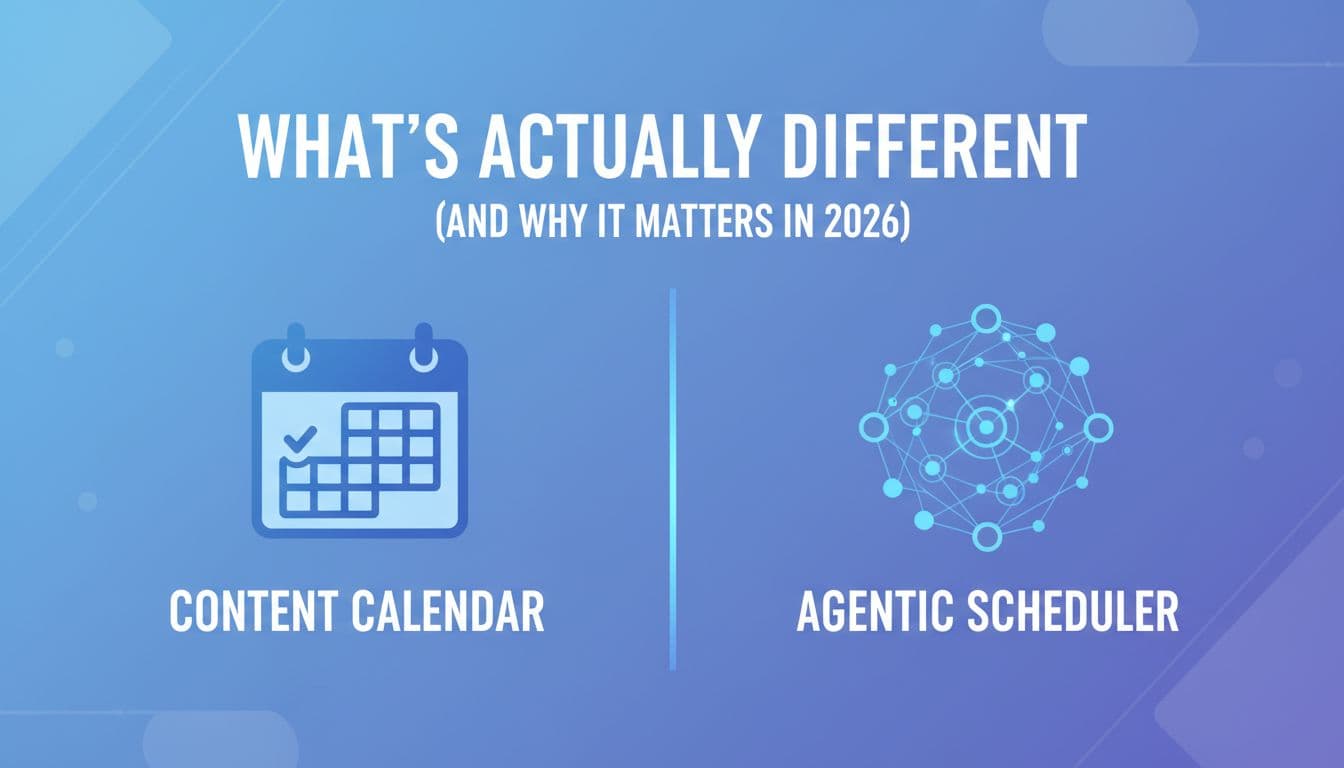
Content Calendar vs. Agentic Scheduler: What's Actually Different (And Why It Matters in 2026)
Most people use the terms 'content calendar' and 'social media scheduler' like they mean the same thing. They do not. A content calendar is where you plan. A scheduler is how you publish. And an agentic scheduler is what handles both for you, without waiting for you to do the work first. If you have ever spent a Sunday night writing captions for the week ahead, you already know the manual model has a cost. This article breaks down exactly what each tool does, where the real friction lives in a traditional content workflow, and what it means when people say a scheduler is 'agentic.' No jargon. No hype. Just a clear look at how social media management is changing in 2026 and what that shift means for solopreneurs, small business owners, and anyone who is tired of content eating their week.
Jun 23, 2026
Read moreReady to never miss a post again?
Tell Aidelly what to post. It drafts, schedules, and publishes across 9 platforms while you focus on your business.