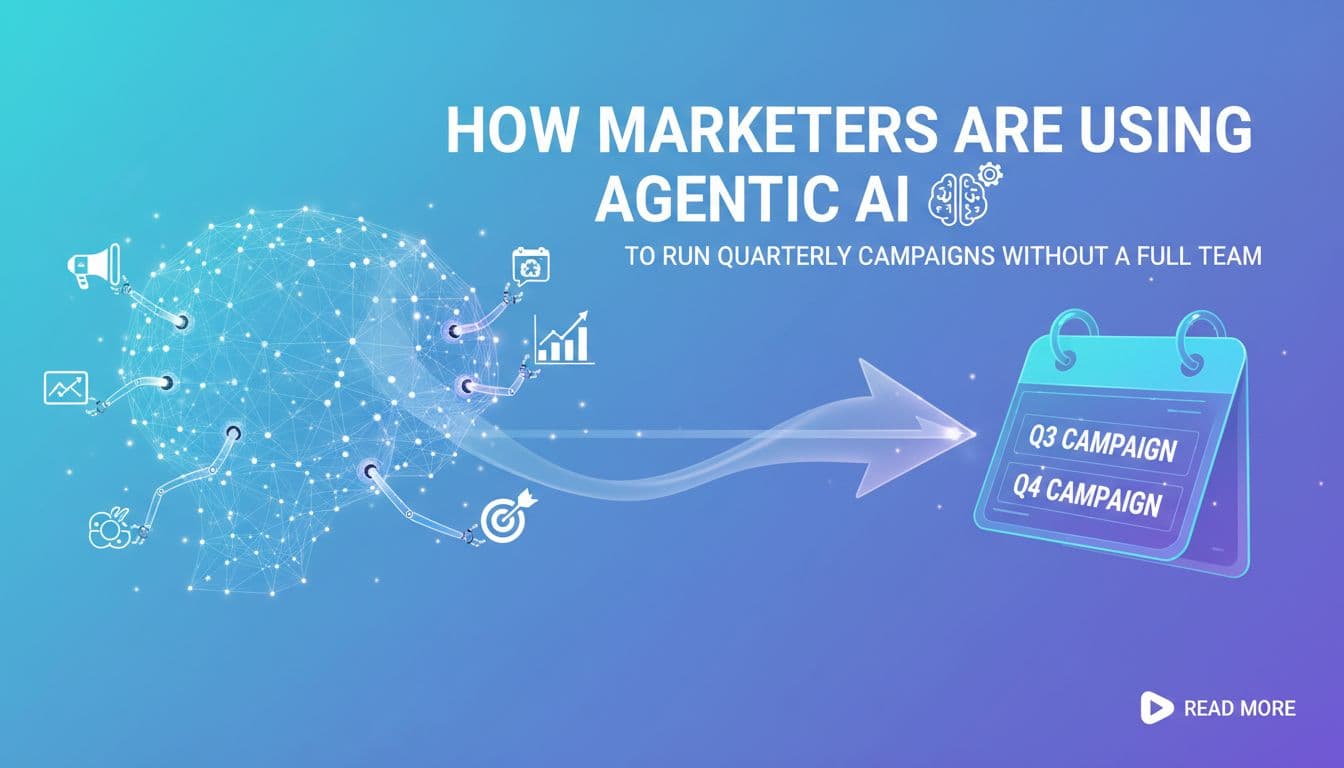
How Marketers Are Using Agentic AI to Run Quarterly Campaigns Without a Full Team
Running a quarterly campaign with a team of two used to mean cutting corners somewhere. Either the content calendar fell apart by week six, or the posts went out inconsistent, or someone spent every Sunday scheduling the week ahead. In 2026, that trade-off is gone. Agentic AI doesn't just help marketers write faster — it handles the full campaign loop from ideation to publishing to performance analysis, without someone managing each step manually. This article walks through exactly how lean marketing teams are using agentic workflows to run campaigns that used to require five people. You'll see what the AI handles, where you plug in, and why the teams doing this aren't just saving time — they're running better campaigns than they were before.

Wilzer Jean-Baptiste
10 min read
Running a quarterly campaign with a team of two used to mean choosing what to sacrifice. Either the content calendar fell apart by week six, or the posts went out generic and copy-pasted across every platform, or someone spent every Sunday night scheduling the week ahead. The strategy was solid. The execution was the problem. In 2026, that trade-off is gone — not because teams got bigger, but because the execution layer of a campaign can now run itself.
The Campaign That Runs Itself (Almost)
Most quarterly campaigns don't fail because the strategy was bad. They fail because execution falls apart somewhere around week five. The content calendar gets stale, the person who was supposed to write three posts this week got pulled into a client fire, and suddenly you're two weeks behind with nothing scheduled. Sound familiar?
Agentic AI changes the structure of how a campaign runs. Not by writing posts faster, but by owning the execution layer entirely — so you can stay focused on strategy, pivots, and the decisions only you can make.
What 'Agentic' Actually Means for a Campaign
A lot of tools call themselves AI-powered. What makes something agentic is different. An agentic system doesn't wait for you to prompt it. It takes a goal, breaks it into tasks, executes those tasks, checks the results, and adjusts. For a quarterly campaign, that means the AI isn't just drafting a caption when you ask — it's managing the content pipeline across 13 weeks, publishing on schedule, and flagging when something needs your attention.
Think about what a full campaign loop actually involves: you need content ideas, platform-specific copy, images or video briefs, a publishing schedule, team review, and then performance data to know what's working. That's not a writing task. That's a coordination task. And agentic AI handles the coordination layer, not just the writing layer.
Agentic AI doesn't just draft content — it handles the full campaign loop: ideation, scheduling, publishing, and performance analysis, without someone managing each step manually. Marketers with teams of one or two can now run campaigns that used to require a five-person crew. One person handles strategy and approvals. The agent handles everything in between.
Week One vs. Week Eight vs. Week Twelve
Here's what this actually looks like in practice. Imagine you're running a 13-week product launch campaign for a DTC skincare brand. You have two people: a marketing manager and a part-time content person.
In week one, you set the campaign brief. You define the goal, the audience, the key messages, the brand voice, and the content mix — maybe 60% educational, 30% social proof, 10% promotional. You feed that into your agentic workflow. From that point, the agent starts building out the content calendar, drafting posts for each platform, and queuing them for review.
By week eight, you're not starting from scratch each Monday. The agent has already drafted the next two weeks of content based on what's performed well so far. It's noticed that carousel posts on Instagram are outperforming single images by 34%, so it's weighted the next batch toward carousels. You review, approve, and move on. That whole process takes 20 minutes instead of three hours.
By week twelve, you're not scrambling to pull together a post-mortem. The analytics have been running the whole time. You already know which messages landed, which platforms drove the most link clicks, and what you'd do differently next quarter. The campaign closes clean.
Why Execution Breaks Down Mid-Quarter
Quarterly campaigns fail because execution breaks down mid-quarter, not because the strategy was wrong. Agentic workflows fix this by keeping content moving on a set cadence even when the team is slammed with other work.
The pattern is predictable. Week one and two go great. The team is energized, the calendar is full, the posts go out on time. Then a client escalation hits, or a product issue needs attention, or someone takes a week of PTO. The content pipeline stalls. By week seven, you're posting inconsistently, and the audience momentum you built in the first month starts to erode.
An agentic system doesn't have bad weeks. It doesn't get pulled into other projects. The content queue keeps moving because the agent is working in the background regardless of what else is happening on the team. That consistency isn't just a time-saver. It's what keeps a campaign from losing the audience it spent the first six weeks building.
The Coordination Tax Is Killing Your Campaign
Here's the thing most productivity articles miss. The biggest time drain in a quarterly campaign isn't writing posts. It's everything around the writing. Briefing a freelancer, waiting for the draft, revising it, getting it approved, formatting it for each platform, scheduling it, and then doing that again next week. That cycle is what exhausts lean teams. It's not the work — it's the overhead of managing the work.
Where the Time Actually Goes
If you've ever tracked your hours during a campaign, you know that writing the actual content might take two hours a week. But the coordination around it — the back-and-forth, the approval chain, the reformatting, the scheduling — adds another four to six hours on top. For a 13-week campaign, that's somewhere between 52 and 78 hours of coordination overhead. That's almost two full work weeks spent not on strategy, not on creative, but on logistics.
The biggest time drain in a quarterly campaign isn't writing posts — it's the coordination tax: briefing, reviewing, revising, approving, and scheduling. Approval workflows and agentic scheduling cut that overhead significantly. When the AI drafts the content, formats it for each platform, and queues it for a single approval step, you're not managing a process anymore. You're making one decision: does this go out or does it need a tweak? That's a 10-second call, not a 45-minute review session.
Aidelly's approval workflows work exactly this way. The agent drafts, the platform formats, and the content lands in a review queue for a human sign-off before it publishes. The coordination tax drops from hours to minutes per week.
The Briefing Problem
One specific place teams lose time is briefing. Every time you bring in a new piece of content — whether it's from a freelancer, a team member, or an AI — you have to re-explain the context. What's the campaign about? Who's the audience? What's the tone? What did we already say last week so we don't repeat it?
Agentic systems with brand voice memory don't need re-briefing. They already know the campaign context, the brand guidelines, and the content history. You set it once at the start of the quarter. The agent carries that context through every post it creates, every platform it formats for, and every scheduling decision it makes. That alone saves hours over a 13-week run. And it means the content produced in week ten sounds as consistent and on-brand as the content from week one — without you having to police it manually.
Approvals Without the Back-and-Forth
The approval step is where campaigns stall. A post needs to go out Thursday. The person who approves it is in back-to-back meetings all day Wednesday. It misses the window. Now you're posting Friday instead, which gets half the engagement, and the momentum you were building slips.
When approval workflows are baked into the agentic system, the content is ready days in advance. The reviewer gets a clean queue, not a panicked Slack message. And if the reviewer is unavailable, the system holds the post rather than letting it go out unreviewed or missing the window entirely. The cadence stays intact even when the team is buried. That reliability is what separates a campaign that builds compounding momentum from one that posts when it gets around to it.
Platform Fit and Real-Time Pivots
Two things separate campaigns that work from campaigns that just exist: the content fits each platform, and the team can adjust when something isn't landing. Most small teams fail at both — not because they don't care, but because they don't have time to do it right. Agentic AI solves both problems at the same time.
Why Platform-Specific Optimization Matters More Than You Think
Platform-specific optimization is where most small teams cut corners. And it's understandable. When you're a team of two trying to maintain a presence on Instagram, LinkedIn, TikTok, and Facebook, writing four different versions of the same post feels like a luxury. So you write one version and copy-paste it everywhere. The LinkedIn post sounds too casual. The Instagram caption is too long. The TikTok hook doesn't land because it was written for a reader, not a viewer.
Agentic AI that understands brand voice and formats content for Instagram differently than LinkedIn means every post fits the platform without extra manual work. This isn't just about character counts. It's about tone, structure, hook style, hashtag strategy, and call-to-action format. A LinkedIn post about a product launch should lead with a business insight. An Instagram post about the same launch should lead with a visual hook and a short punchy line. A TikTok script needs a pattern interrupt in the first two seconds.
These are different skills, and an agentic system trained on platform behavior handles all of them simultaneously. The result is that your content doesn't just go out on time. It goes out in a form that actually fits where it's landing. That's the difference between a campaign that builds an audience and one that just fills a calendar.
Mid-Campaign Course Correction
Analytics at the end of a quarter are useless if you can't act on them mid-campaign. This is one of the most common mistakes lean teams make. They run the campaign, pull the numbers in week 13, and write up a lessons-learned doc that shapes next quarter's plan. But by then, the campaign is over. The audience you could have reached in weeks eight through twelve got a version of the campaign that wasn't working as well as it could have.
Cross-platform analytics paired with autonomous agents let marketers course-correct in real time, not in a post-mortem. If your LinkedIn content is driving three times the click-through rate of your Instagram content in week four, an agentic system can shift the content weight toward LinkedIn for weeks five through eight. If a particular message angle is getting saved and shared at a higher rate than your other content, the agent produces more content in that direction without you having to notice the pattern yourself and manually redirect the whole plan.
This is what separates agentic social media management from a standard scheduler with an analytics tab. The analytics aren't just a report. They're an input that the agent acts on. The campaign gets smarter as it runs, not after it ends.
Staying On-Brand Across 13 Weeks
One quiet problem with running a long campaign is brand drift. In week one, the content sounds exactly like you. By week ten, after a few rounds of edits from different people and a couple of rushed posts, the tone has shifted. The voice is a little off. The visual style is inconsistent. Readers might not consciously notice, but they feel it — and it erodes the trust you spent the first half of the quarter building.
Agentic systems with stored brand guidelines and asset libraries don't drift. Aidelly's brand voice and asset management keeps every post anchored to the same guidelines, the same tone, and the same visual direction — across all 13 weeks and all six platforms. The campaign sounds like one coherent voice from start to finish, even if the person managing approvals changes in week ten. That consistency is what makes a campaign feel like a campaign and not just a series of random posts.
Running a quarterly campaign with a lean team used to mean accepting that something would slip. The content would get inconsistent, the platforms would get the same generic copy, and the analytics would arrive too late to matter. Agentic AI changes that equation. The execution layer — drafting, formatting, scheduling, publishing, analyzing — runs on its own. You stay focused on strategy, approvals, and the decisions that actually need a human.
The right infrastructure makes the difference between a campaign that runs you and one you actually run. If you're managing social media across multiple platforms with a small team and a full calendar, the tools you use aren't just a productivity choice — they're what determines whether your campaign holds together in week ten the same way it did in week one.
That's what agentic social media management is built for.
If you want a low-lift way to apply these ideas, Aidelly helps you keep your social content consistent without extra busywork.If your quarterly campaigns keep stalling around week five, the problem probably isn't your strategy. It's the execution gap that opens up when your team gets pulled in ten directions at once. Aidelly's agentic workflows keep the campaign moving end-to-end, from content creation to scheduling to mid-quarter performance analysis, without someone manually pushing each step forward. See how it works at aidelly.ai.
Compare Social Scheduling Tools
Evaluating software for your content workflow? Use our buyer guides and comparisons to compare scheduling, approvals, analytics, and AI workflow fit.
Share this article
Related Articles
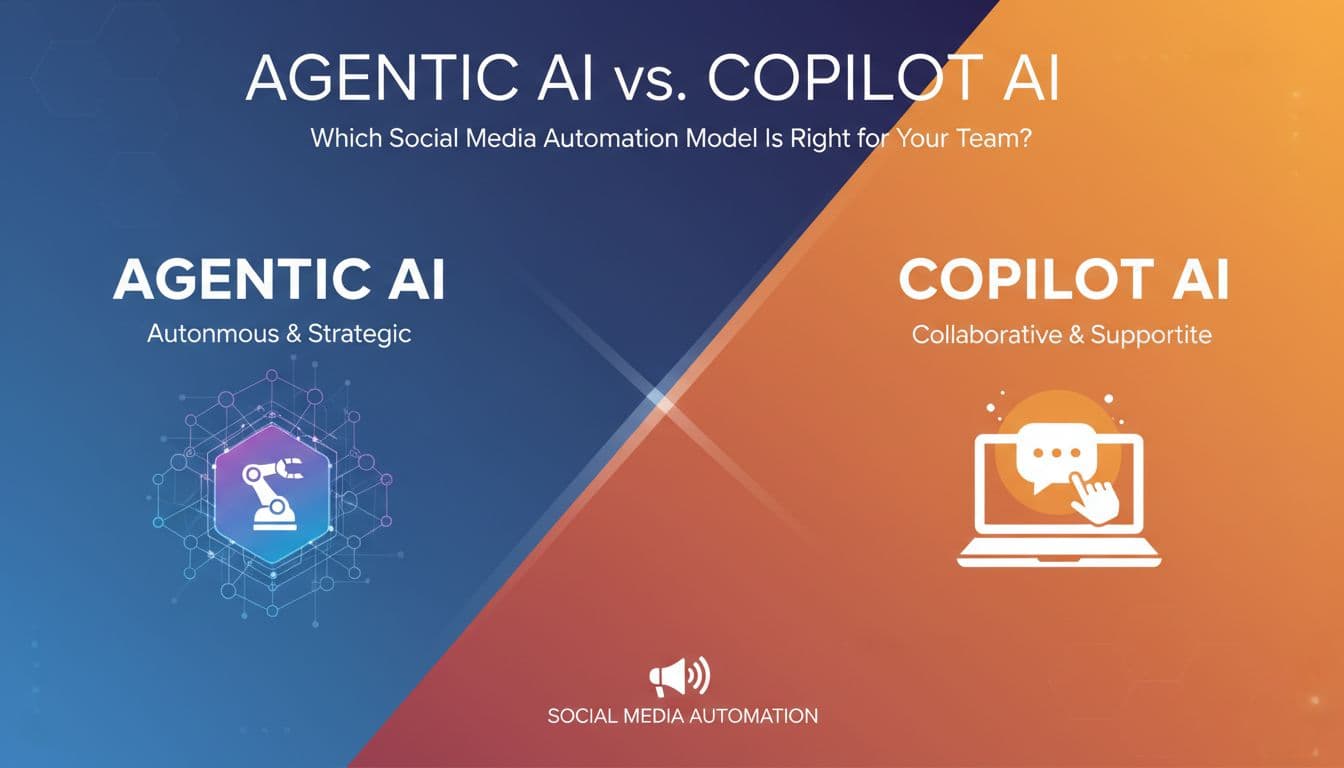
Agentic AI vs. Copilot AI: Which Social Media Automation Model Is Right for Your Team
Most AI tools make you faster. Agentic AI makes certain tasks disappear entirely. If you're still spending hours each week writing captions, picking post times, and moving content through approval chains, the problem isn't your output speed. It's that you're still in the loop for decisions an AI agent could handle on its own. This article breaks down the real difference between copilot AI and agentic AI for social media management — not as a technology explainer, but as a workflow decision. We walk through what each model actually looks like for a solopreneur juggling six platforms, a small in-house team trying to scale content without adding headcount, and an agency managing a dozen client accounts. By the end, you'll know which model fits your team right now and how to move toward more autonomy as your confidence in AI grows.
Jun 2, 2026
Read more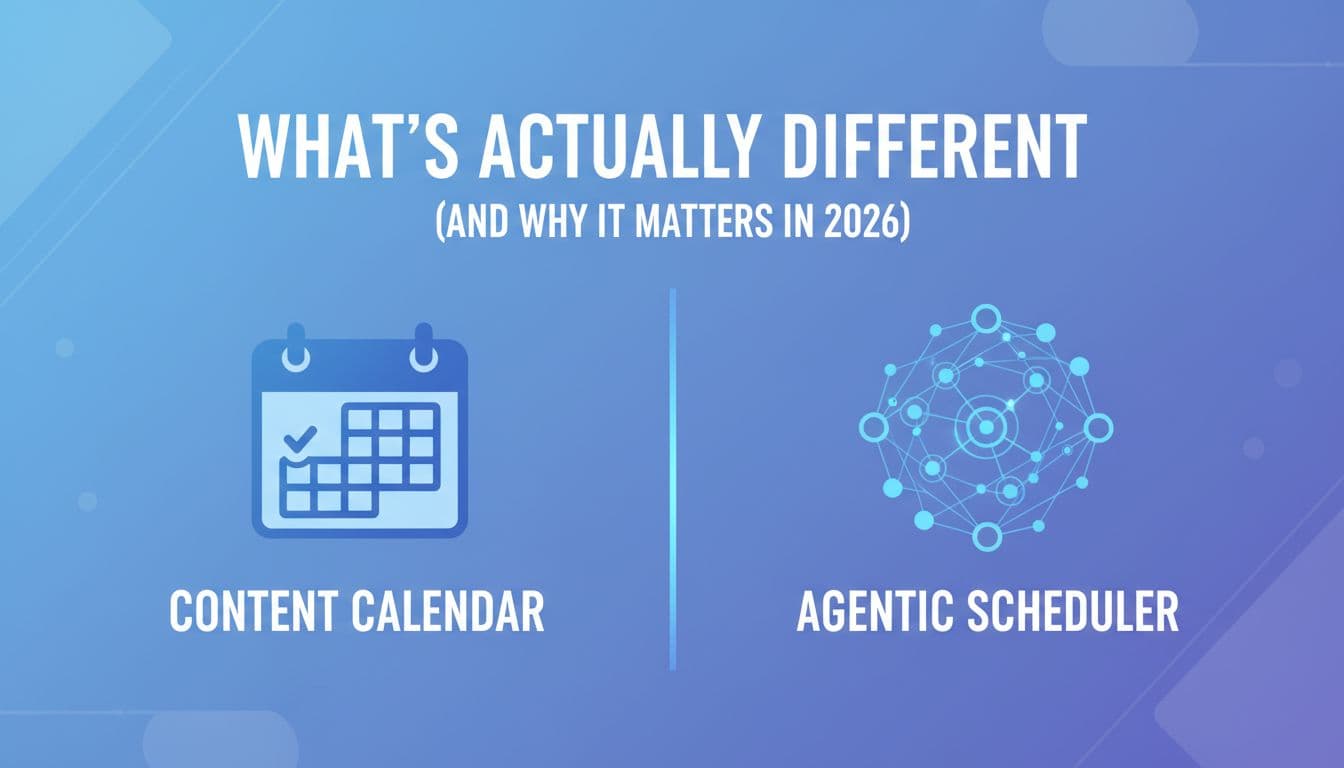
Content Calendar vs. Agentic Scheduler: What's Actually Different (And Why It Matters in 2026)
Most people use the terms 'content calendar' and 'social media scheduler' like they mean the same thing. They do not. A content calendar is where you plan. A scheduler is how you publish. And an agentic scheduler is what handles both for you, without waiting for you to do the work first. If you have ever spent a Sunday night writing captions for the week ahead, you already know the manual model has a cost. This article breaks down exactly what each tool does, where the real friction lives in a traditional content workflow, and what it means when people say a scheduler is 'agentic.' No jargon. No hype. Just a clear look at how social media management is changing in 2026 and what that shift means for solopreneurs, small business owners, and anyone who is tired of content eating their week.
Jun 23, 2026
Read moreReady to never miss a post again?
Tell Aidelly what to post. It drafts, schedules, and publishes across 9 platforms while you focus on your business.