Agencies
How to Build a White-Label Social Media System for Agency Clients Using AI Agents
Most social media agencies hit the same wall. You land a few new clients, everyone celebrates, and then three weeks later your team is drowning. More accounts mean more content, more approvals, more reporting, and more late nights. Hiring fixes the problem temporarily, but your margins shrink every time you add a salary. There's a different way to grow. Agencies that build agentic social media systems, where AI handles content creation, scheduling, and analysis autonomously, are delivering better results for more clients without adding headcount. This post breaks down exactly how to build that system, from setting up brand voice guardrails to white-labeling the whole platform under your agency's brand. If you manage five or more client accounts and feel the operational weight of manual posting, this is the model shift you've been looking for.

By Wilzer Jean-Baptiste
Published 10 min read
Most social media agencies hit the same wall around client number five or six. Revenue is growing, but so is the chaos. Your team is copying brand guidelines into spreadsheets, manually scheduling posts across six platforms, writing captions from scratch every week, and pulling performance screenshots into PowerPoint decks at 11pm before a client call. You hire another coordinator. Margins drop. You land more clients. The cycle repeats. The agencies winning in 2026 aren't hiring faster. They're building smarter systems, specifically agentic AI workflows that handle the repeatable, time-consuming parts of social media management autonomously, so their people can focus on work that requires a human: strategy, client relationships, and creative direction. This post breaks down exactly how to build that system.
The Agency Growth Problem Nobody Talks About
When you manage social media manually, your capacity is directly tied to headcount. One coordinator can realistically manage three to five client accounts well. Add a sixth and quality starts slipping. Add a tenth and you're putting out fires instead of driving results. The math never works in your favor because every new client adds roughly the same amount of labor, regardless of how efficient your processes are.
The problem isn't effort. It's the model. Manual social media management is labor-intensive by design. Content creation, platform-specific formatting, scheduling, community management, and reporting all require human time at every step. When that time is finite and expensive, your growth ceiling is low.
Agentic AI changes the equation. Instead of adding labor to handle more clients, you add a workflow that runs autonomously. The AI handles content drafts, scheduling, and performance summaries. Your team reviews, approves, and optimizes. You can go from managing 10 accounts to managing 30 with the same core team, because the AI is doing the work that used to fill everyone's calendar.
Why the Traditional Agency Model Breaks at Scale
When you manage social media manually, your capacity is directly tied to headcount. One coordinator can realistically manage three to five client accounts well. Add a sixth and quality starts slipping. Add a tenth and you're putting out fires instead of driving results. The math never works in your favor because every new client adds roughly the same amount of labor, regardless of how efficient your processes are.
The problem isn't effort. It's the model. Manual social media management is labor-intensive by design. Content creation, platform-specific formatting, scheduling, community management, and reporting all require human time at every step. When that time is finite and expensive, your growth ceiling is low. Agentic AI changes the equation. Instead of adding labor to handle more clients, you add a workflow that runs autonomously. The AI handles content drafts, scheduling, and performance summaries. Your team reviews, approves, and optimizes. You can go from managing 10 accounts to managing 30 with the same core team.
What 'Agentic' Actually Means in Practice
The word gets thrown around a lot, so let's be specific. An agentic workflow doesn't just suggest content. It acts. It pulls from your client's brand voice guidelines, generates platform-optimized posts for Instagram, LinkedIn, TikTok, and X, routes them through an approval queue, schedules them at optimal times, and then tracks performance automatically. No one has to manually trigger each step.
Think of it like having a junior social media manager who never sleeps, never forgets a posting schedule, and can handle 30 accounts simultaneously. The difference is this one doesn't need a salary, benefits, or onboarding time. Your senior team stays focused on decisions that require judgment, like pivoting a content strategy after a campaign underperforms, or advising a client on a rebrand. Platforms like Aidelly are built specifically for this kind of workflow, with agentic scheduling that handles content creation through publishing end-to-end, with approval gates built in so nothing goes live without a human sign-off when you need one.
Building the System: From Brand Setup to Autonomous Publishing
Setting up an agentic social media system for your agency clients isn't a one-afternoon project, but it's also not as complex as it sounds. The key is doing the setup work once per client so the system can run autonomously from there. Here's how to think about it.
Scaling Client Services Without Scaling Headcount
White-label social media agencies can use AI agents to deliver managed services at scale without proportionally increasing headcount, and this fundamentally changes the unit economics of running a client services business. Here's what that looks like in real numbers. If you charge $1,500 per month per client and your coordinator handles five accounts, you're generating $7,500 in revenue per coordinator salary. Add agentic workflows and that same coordinator can oversee 20 to 25 accounts, because they're reviewing and approving instead of creating from scratch. That's $30,000 to $37,500 in monthly revenue per coordinator. Your cost of delivery drops dramatically while your output stays high or gets better.
This isn't theoretical. Agencies using agentic workflows report being able to take on two to three times more clients within the same staffing structure. The key shift is moving your team from content producers to content directors. They set the strategy, review AI-generated drafts, catch anything off-brand, and spend their energy on client relationships instead of caption writing. That's a better use of skilled people, and clients notice the difference in the quality of strategic conversations they're having with your team. The agencies that figure this out first will own their market segment. They can price competitively because their margins are better, deliver faster because the AI never has a backlog, and scale without the cash flow stress of hiring ahead of revenue.
Reducing Manual Work by 70 to 80 Percent
Agentic workflows that handle content creation, scheduling, and performance analysis autonomously reduce manual work by 70 to 80 percent, and that number feels dramatic until you actually map out where your team's hours go each week. Content drafting typically takes 40 to 50 percent of a social media manager's time. Scheduling and reformatting content for different platforms takes another 15 to 20 percent. Pulling analytics and building reports takes another 10 to 15 percent. Combined, that's nearly 80 percent of the workload that an agentic system can handle autonomously.
What's left is the 20 percent that requires human judgment: reviewing drafts for tone and accuracy, making strategic pivots based on performance data, advising clients on content direction, and managing relationships. That's the work your team should be doing anyway. The problem is that manual operations bury them in the other 80 percent before they ever get to it. When you free up that time, something interesting happens. Your team starts doing better work. They're not rushing through approvals at the end of the day. They're reading the performance data and making smart recommendations. Clients notice. Retention improves. And because your team isn't burned out from repetitive tasks, turnover drops too. The operational savings compound in ways that go beyond the obvious time math.
White-Labeling and Client-Facing Infrastructure
Getting the internal workflow right is half the job. The other half is how this system shows up for your clients. A white-label social media system done well feels like your agency built something proprietary. Done poorly, it feels like you handed your client a login to a third-party tool with your logo slapped on it. The difference matters for retention.
Building a Branded Platform Clients Won't Want to Leave
Agencies can white-label an AI-powered social media system by integrating via API or MCP to offer clients a branded platform that feels native to the agency's service offering, and this is one of the most powerful retention moves available to a modern agency. When a client logs into a dashboard that carries your agency's branding, uses your terminology, and shows them only the data relevant to their account, they're not thinking about switching providers. They're thinking about the results they're seeing. That psychological stickiness is worth more than any contract clause.
Aidelly's REST API and MCP Server make this kind of integration practical. You can connect your agency's branded client portal directly to the scheduling, publishing, and analytics infrastructure. Clients see a polished, professional experience that feels like your agency built it from scratch. Under the hood, the AI agents are doing the heavy lifting. The MCP Server capability is worth highlighting specifically for agencies with technical resources or developer clients. It lets you connect AI assistants like Claude or ChatGPT directly to social media publishing via the Model Context Protocol, which means you can build custom workflows that fit exactly how your agency operates. That level of flexibility isn't something most agencies are offering yet, which means early adopters have a real competitive edge.
Approval Workflows and Brand Voice Guardrails
Setting up approval workflows and brand voice guardrails ensures AI agents produce on-brand content that meets client standards without requiring manual review of every post, and this is where a lot of agencies get nervous about automation. The fear is reasonable: if AI is generating content for a law firm, a restaurant chain, and a fitness brand simultaneously, how do you make sure none of it sounds generic or off-tone? The answer is in how you configure the system upfront.
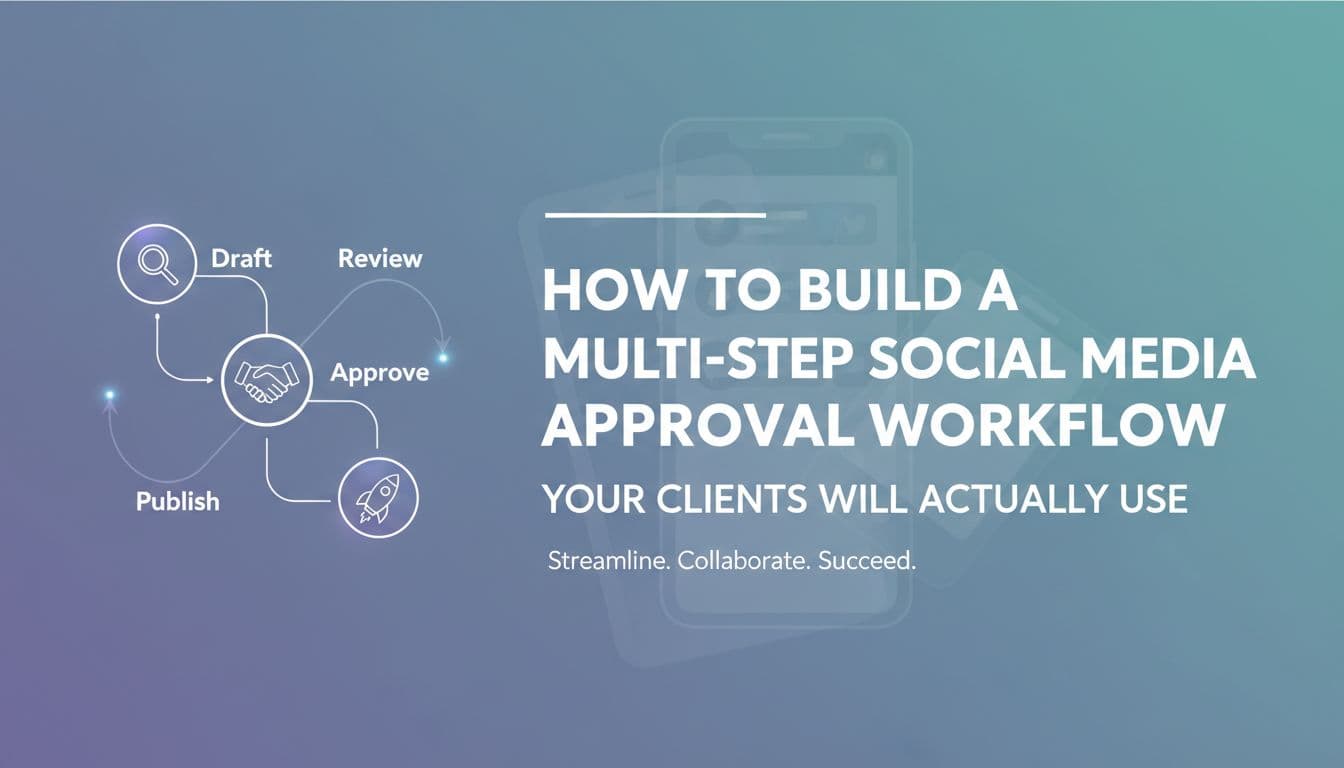
Good agentic social media platforms let you store detailed brand voice profiles for each client. That means the AI knows that Client A uses formal language and never makes jokes, Client B is casual and emoji-friendly, and Client C has specific phrases they never use because of a legal settlement. Those guardrails aren't suggestions. They're constraints the AI works within every time it generates content. Approval workflows add the human checkpoint. You can configure the system so certain content types, like promotional posts or anything mentioning pricing, always go through a human review before publishing. Evergreen content or standard weekly posts might go straight to scheduled after passing an AI quality check. This lets you balance automation with quality control without creating a bottleneck where every single post requires manual sign-off. Your team reviews the 20 percent that needs eyes on it and trusts the system with the rest.
Cross-Platform Analytics That Justify Your Retainer
Cross-platform analytics and performance dashboards let agencies show clients concrete ROI across all channels, turning social media from a cost center into a measurable revenue driver that justifies higher retainer fees. This is the piece most agencies underinvest in, and it's costing them money. When a client can't see clear results, social media management feels like an expense. When they can see exactly how their LinkedIn content is driving website traffic, how their Instagram Reels are growing brand awareness, and how their TikTok engagement compares to industry benchmarks, it feels like an investment. That's a completely different conversation at renewal time.
Unified analytics dashboards that pull data from Instagram, TikTok, LinkedIn, YouTube, Facebook, and X into one view save your team hours of manual reporting every month. More importantly, they give you the data to make smart strategic recommendations. You're not just telling a client their follower count went up. You're showing them which content formats drove the most profile visits, which posting times produced the highest reach, and where their audience is most active. That's the kind of insight that justifies a $3,000 retainer instead of a $1,500 one. Agencies that build reporting into their client deliverables as a standard part of the service, rather than a quarterly afterthought, consistently see better retention. Clients who understand what they're getting stay longer. And when you can show a direct line between your social media work and business outcomes like leads, traffic, or sales, you move from being a vendor to being a strategic partner. That's a much harder relationship to walk away from.
The agencies that thrive in 2026 and beyond won't be the ones with the biggest teams. They'll be the ones that built the smartest systems. Agentic social media workflows, white-label client platforms, brand voice guardrails, and unified analytics aren't features you bolt onto an existing service. They're the foundation of a fundamentally better agency model, one where you can serve more clients, deliver better results, and protect your margins at the same time. The right tools make the difference between an agency that's always hiring to keep up and one that's growing because the system scales with you. If you're ready to stop trading hours for dollars and start building something that runs autonomously, Aidelly is where that system starts.
The agencies winning right now aren't hiring faster. They're automating smarter. With agentic workflows, you hand off content creation, scheduling, and performance analysis to AI agents that work 24/7, freeing your team to focus on strategy and client relationships instead of repetitive tasks. That's how you scale from five clients to fifty without burning out your team or tanking your margins. See how it works at aidelly.ai.
Compare social scheduling tools
Evaluating software for your content workflow? Use our buyer guides and comparisons to compare scheduling, approvals, analytics, and AI workflow fit.