Agencies
TikTok vs. Instagram Reels in 2026: How Agencies Automate Their Way Out of the Dilemma
Every agency managing short-form video in 2026 is asking the same question: TikTok or Instagram Reels? But that's the wrong question. Choosing one platform over the other forces your clients into a corner — and leaves real reach and revenue on the table. The smarter move is figuring out how to run both platforms without doubling your workload. That's where automation changes everything. Agencies that build automated video pipelines across TikTok and Reels are turning out content 3-5x faster, scaling to more client accounts without adding headcount, and protecting their clients from platform-level risk. This article breaks down what each platform actually delivers in 2026, where agencies bleed time in their video workflows, and how AI-powered automation makes the TikTok vs. Reels debate irrelevant.

By Wilzer Jean-Baptiste
Published 10 min read
Every agency managing short-form video in 2026 is stuck on the same question: TikTok or Instagram Reels? It feels like a strategy decision. Pick the right platform, focus your energy, win for your clients. But the more you dig into it, the more you realize the question itself is the problem. Choosing one platform over the other means leaving reach or revenue behind, depending on which one you cut. And for agencies managing 10, 20, or 50 client accounts, the real issue isn't which platform to use. It's how to run both without your team collapsing under the volume. That's the conversation worth having.
What TikTok and Instagram Reels Actually Deliver in 2026
Agencies love a clean answer. TikTok or Reels? Pick one, go all in, win. But the data in 2026 doesn't support that kind of simplicity. Each platform has a distinct strength, and the agencies doing the best work for their clients understand both.
TikTok Still Wins on Organic Reach
TikTok's algorithm remains the most powerful organic discovery engine in short-form video. A brand-new account with zero followers can post a video on Monday and have 200,000 views by Wednesday. That still happens on TikTok in 2026. Instagram Reels doesn't work that way. Reels leans on your existing network and engagement history, which means newer accounts or brands without an established Instagram following start at a real disadvantage.
For agencies managing clients who need visibility fast — a new product launch, a local business entering the market, a personal brand just getting started — TikTok's reach potential is hard to ignore. The For You Page treats every video as a fresh bet. Your client's content gets served to people who've never heard of them, based purely on how the content performs in the first hour. That's a fundamentally different distribution model than what Reels offers, and for pure top-of-funnel awareness, TikTok still leads.
But Instagram Reels consistently outperforms TikTok when the goal is conversion. Instagram's shopping features, link-in-bio tools, and the platform's overall user intent make it the better home for e-commerce brands and service businesses trying to move people from viewer to buyer. Users on Instagram are more conditioned to shop. They expect to click through to a product page or book a call. TikTok users are there to be entertained first. That difference in intent shows up in conversion data across the board. So the real answer for most agency clients isn't TikTok or Reels. It's TikTok for reach, Reels for conversion.
The Conversion Gap Is Real and It Matters
When an e-commerce brand asks you why their TikTok views aren't turning into sales, the answer usually comes down to platform behavior. TikTok users scroll fast and engage emotionally. They'll watch a video twice, share it with a friend, follow the account. But clicking through to buy something requires a different kind of intent, and TikTok's in-app shopping experience, while improving, still lags behind Instagram's.
Instagram has spent years building purchase intent into the platform. Product tags, shoppable Reels, the ability to move from a video to a checkout page in two taps — these features exist because Instagram's user base expects them. For a skincare brand, a boutique clothing shop, or a fitness coach selling a program, Reels is where the conversion happens. TikTok is where new people find out the brand exists.
Agencies that understand this split can set smarter KPIs for each platform. You're not measuring TikTok and Reels the same way. TikTok gets measured on reach, follower growth, and video completion rates. Reels gets measured on click-throughs, profile visits, and direct sales attribution. When you automate your posting across both platforms, you also get the cross-platform analytics to see this picture clearly instead of guessing.
Platform Risk Is a Real Budget Conversation
TikTok's regulatory situation has been a slow-moving story for a few years now, and in 2026 it still hasn't fully resolved. The threat of bans, forced sales, or sudden policy changes remains real in several markets. For agencies managing client budgets, that uncertainty carries real weight. If a client's entire short-form video strategy lives on TikTok and the platform gets restricted in their primary market, you've got a serious problem to explain.
A diversified strategy protects against that. When you're posting to both TikTok and Instagram Reels as a standard part of your workflow, a policy shift on either platform doesn't crater a client's content program. You adjust the weight of your focus, not the entire strategy. This is a conversation worth having with clients directly. Putting all short-form video eggs in one basket, regardless of which platform it is, introduces unnecessary risk that's easy to avoid with the right automation setup. Clients who understand this tend to trust your agency more, because you're thinking about their long-term stability, not just their weekly post count.
Where Agencies Waste the Most Time in Their Video Workflows
Most agencies don't have a content problem. They have a production and distribution problem. The ideas are there. The creative is solid. But somewhere between filming a video and getting it live on two platforms with the right captions, hashtags, and posting times, the process falls apart and hours disappear.
The 40% Problem Nobody Talks About
Agencies waste roughly 40% of their video production time on platform-specific formatting and publishing tasks. Not on strategy. Not on creative. On reformatting aspect ratios, rewriting captions to fit character limits, adjusting hashtag sets for each platform, downloading files from one tool and uploading them to another, and manually scheduling posts one at a time.
This is where the real inefficiency lives. A video that takes two hours to film and edit can take another hour just to get published correctly across TikTok and Instagram. Multiply that across 10 clients posting three to five videos per week, and you're looking at a significant chunk of your team's hours going to tasks that add zero creative value.
Automated workflows eliminate this entirely. Cross-posting, caption adaptation, platform-specific formatting, and scheduling all happen without anyone on your team touching a file manually. The video goes in once. The workflow handles the rest. That 40% of time your team was spending on distribution gets redirected to actual creative work, client strategy, or onboarding new accounts. Aidelly's agentic workflows handle exactly this kind of end-to-end distribution — you create the content once, and AI agents manage the formatting, captioning, and scheduling across Instagram and TikTok without you babysitting the process.
Caption Adaptation Is Harder Than It Looks
TikTok and Instagram Reels are not the same audience, even when they're watching the same video. TikTok captions tend to be shorter, more casual, and often function as a hook to pull people into watching. Instagram captions can go longer, carry more brand voice, and often include a clearer call to action because the audience is more likely to read them.
When agencies manually write separate captions for every video on every platform, it's time-consuming and inconsistent. When they copy-paste the same caption everywhere, they leave performance on the table. The middle ground is automated caption adaptation, where AI rewrites the same core message for each platform's tone and format while keeping the brand voice intact.
This is one of those small workflow improvements that compounds fast. Across a roster of 20 clients posting four videos per week, automated caption adaptation saves hours every single week and produces better-performing posts than the copy-paste approach. It's not glamorous, but it's one of the biggest practical wins you get from building an automated video pipeline.
Approval Workflows Slow Everything Down When They're Manual
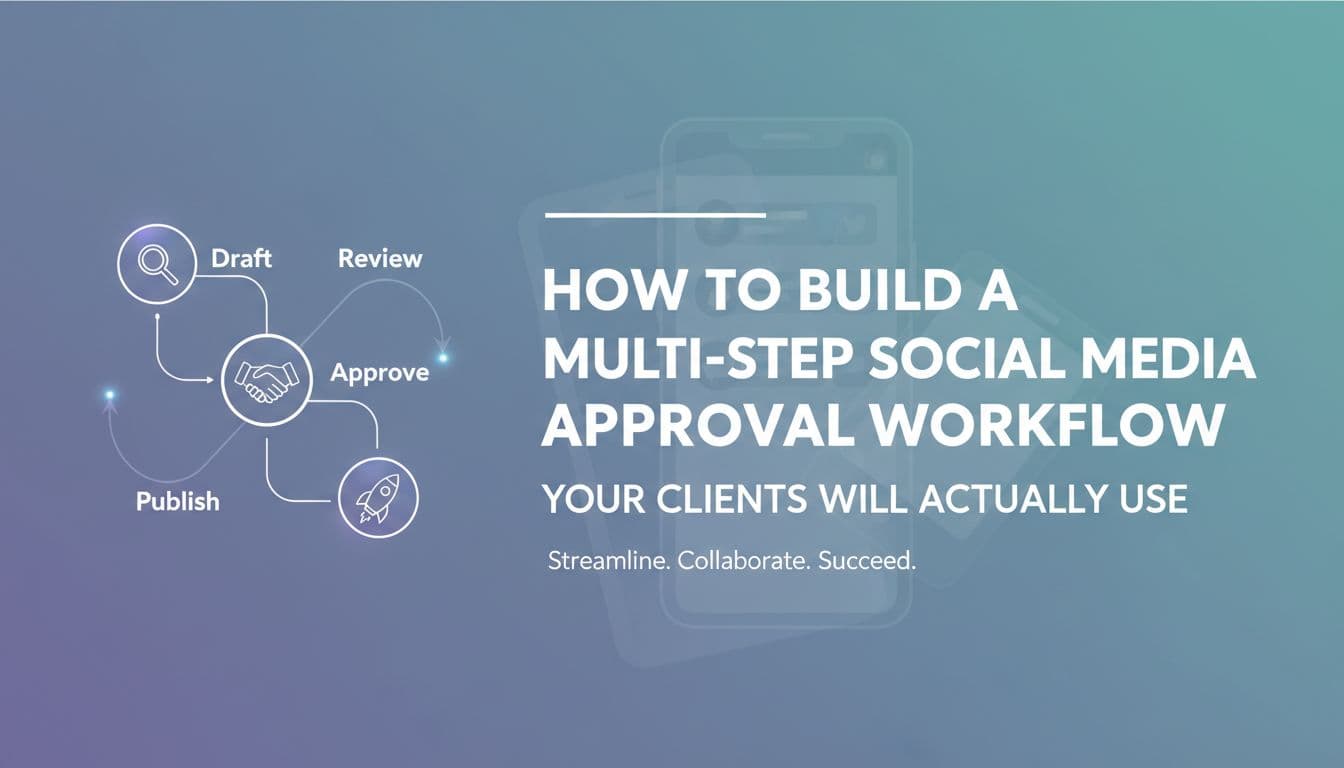
Client approvals are a necessary part of agency life, but they don't have to be a bottleneck. When approval happens over email threads or Slack messages, things get lost, feedback gets misapplied, and posts go live late or with errors. A structured approval workflow built into your scheduling process fixes this cleanly.
With the right setup, a client can review a week's worth of TikTok and Reels content in one place, leave comments, approve or request changes, and the approved posts flow directly into the publishing queue. No back-and-forth. No missed feedback. No scrambling to update a caption at 10pm before a 7am post. The whole process runs cleaner, and clients trust the work more because they can see exactly what's going live and when. For agencies managing 20 or more clients, this kind of structured approval process is the difference between a manageable week and a chaotic one.
How Automation Lets You Scale Without Hiring
The agencies winning right now aren't the ones with the biggest teams. They're the ones with the tightest workflows. Automation is the difference between an agency that caps out at 15 clients and one that handles 40 with the same headcount. The math is that straightforward.
AI Scheduling That Actually Hits the Right Windows
Manual scheduling is a guessing game. You pick a time that worked last month, post it, and hope for the best. But short-form video performance is driven by factors that change constantly: audience timezone distribution, competitor posting patterns, trending sounds, and the platform's own algorithmic windows for new content.
AI agents that analyze real performance data and auto-schedule posts based on those signals consistently outperform manual scheduling. They're not guessing when your audience is online. They're reading the data and posting at the exact moment each client's specific audience is most likely to engage. For a client with a global following, this matters enormously. A fitness brand with 60% of its audience in Australia needs different posting windows than a restaurant in Chicago.
Trending sounds on TikTok are another variable that manual scheduling can't keep up with. A sound that's trending hard on a Tuesday afternoon might be oversaturated by Thursday. AI agents that monitor trending audio and factor it into scheduling recommendations give your clients a real edge on organic reach. Missing that window by 48 hours means your client's video rides a dead trend instead of a live one. This is where AI-powered social media scheduling stops being a convenience and starts being a competitive advantage.
The 3-5x Turnaround Advantage
Agencies that automate their video content pipeline across both TikTok and Instagram Reels see content turnaround improve by 3 to 5 times compared to manual workflows. That's not a small efficiency gain. It's the difference between delivering one video per client per week and delivering five.
When content ideation, drafting, scheduling, and publishing all run through an automated pipeline, the bottlenecks disappear. Your team stops spending time on repetitive distribution tasks and starts spending time on the creative and strategic work that actually differentiates your agency. A team of three can manage what previously required a team of eight, not because they're working harder, but because the workflow is doing the heavy lifting.
This also changes how you price and package your services. When you can produce more content faster without adding headcount, your margins improve. You can offer clients more volume at a price point that still works for your business. Or you can take on more clients without increasing operational costs. Either way, the financial math gets better, and the work stays sustainable for your team instead of turning into a grind.
Scaling to 2-3x More Clients Without Adding Staff
The ceiling for most social media agencies isn't talent or ideas. It's capacity. Every new client adds hours to your team's week, and at some point the math breaks down. You either hire, which cuts into margins, or you cap growth, which limits revenue. Neither option is great.
Automated video pipelines break that ceiling. Agencies running automated cross-platform workflows consistently report the ability to scale to 2 to 3 times their previous client load without bringing on additional team members. The work that used to require a dedicated person for publishing, formatting, and scheduling now runs in the background while your team focuses on strategy and creative.
Aidelly's platform is built for exactly this kind of scale. The visual content calendar, cross-platform publishing, and AI-powered drafting tools let a small agency team manage a large client roster without the operational chaos that usually comes with growth. When a new client comes on, you're not rebuilding a workflow from scratch. You're adding them to a system that already runs. That's how agencies go from 15 clients to 40 without burning anyone out.
The TikTok vs. Instagram Reels debate is real, but it's the wrong thing to optimize for. The agencies that win in 2026 are the ones that stop choosing and start automating. TikTok gives your clients reach. Reels gives them conversions. Automated workflows give you the capacity to run both without losing your team to repetitive publishing tasks. When you combine AI scheduling, cross-platform posting, and automated caption adaptation into one pipeline, you're not just saving time. You're building a more resilient, more scalable agency. The right tools make this possible without adding headcount or sacrificing the quality your clients expect.
If you want a low-lift way to apply these ideas, Aidelly helps you keep your social content consistent without extra busywork.The real win for agencies in 2026 isn't picking between TikTok and Reels—it's automating the work so you can own both. Agentic workflows handle the heavy lifting: your AI agent schedules posts across platforms, adapts captions for each audience, analyzes performance in real time, and adjusts posting windows based on what actually works for your clients. That's how you scale from managing a few accounts to managing dozens without burning out your team. See how it works at aidelly.ai.
Compare social scheduling tools
Evaluating software for your content workflow? Use our buyer guides and comparisons to compare scheduling, approvals, analytics, and AI workflow fit.