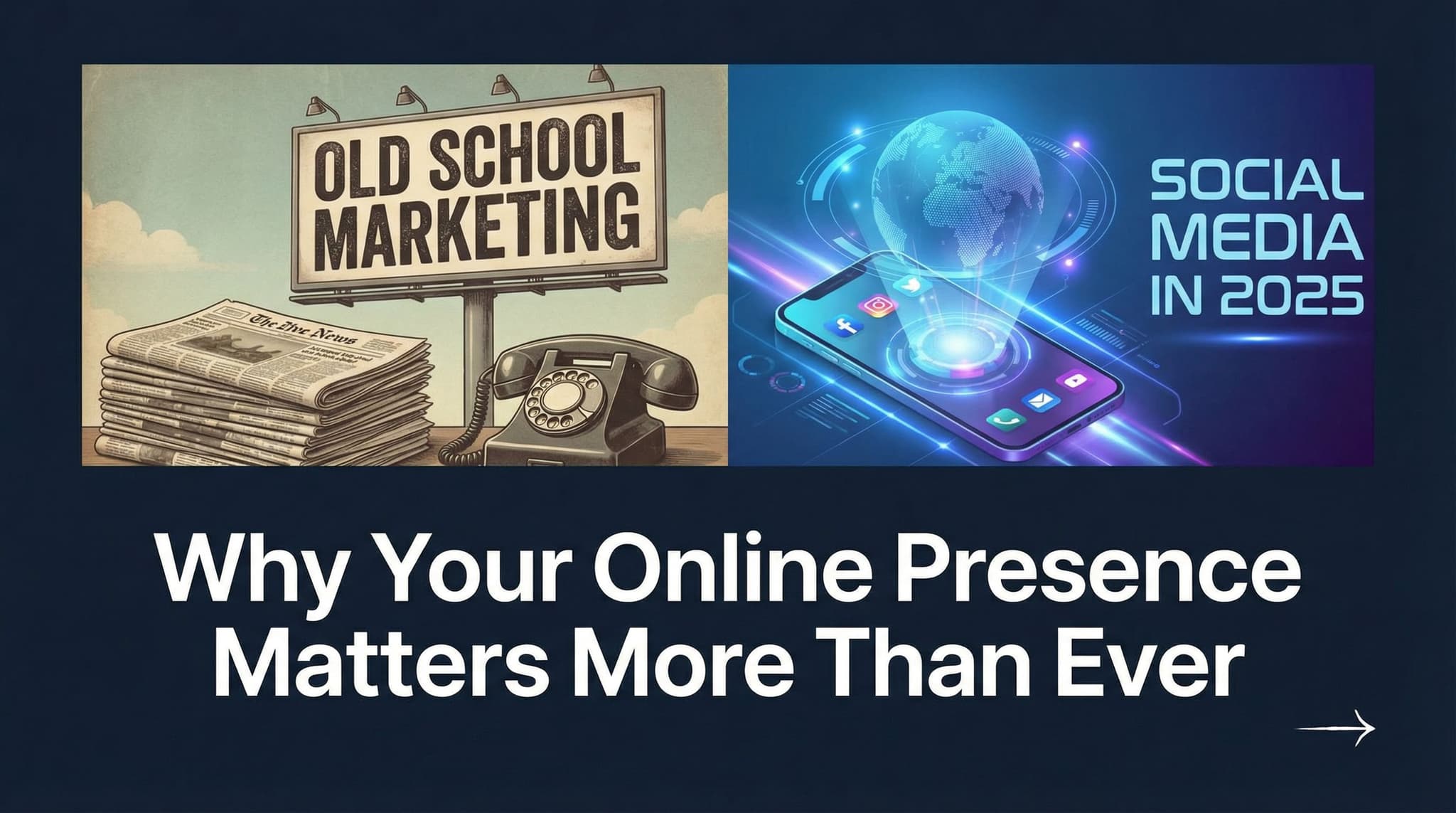
Old School Marketing vs Social Media in 2025: Why Your Online Presence Matters More Than Ever
The debate between traditional and digital marketing isn't about choosing sides anymore—it's about understanding where your customers actually are. In 2025, the landscape has shifted dramatically. While TV commercials and print ads still have their place, the real competitive advantage lies in building a strategic presence across digital channels. This comprehensive guide explores why social media and online platforms have become non-negotiable for business success, how traditional marketing's ROI has fundamentally changed, and most importantly, how smart business owners are blending both approaches to dominate their markets.

Wilzer Jean-Baptiste
12 min read
Remember when a solid billboard campaign and a few radio spots were enough to keep your business thriving? Yeah, those days are pretty much gone. We're not here to bury traditional marketing—it still works in specific contexts—but let's be honest: if your 2025 marketing strategy doesn't center on digital channels and social media, you're essentially operating with one hand tied behind your back.
The shift hasn't happened overnight, but it's been relentless. Your customers are researching you online before they ever walk through your door or pick up the phone. They're reading reviews on social media, watching user-generated videos, and checking out your competitors' Instagram feeds. They're making decisions based on what they find—or don't find—in the digital space.
The good news? You don't have to choose between old school credibility and digital agility. The businesses winning right now are the ones who've figured out how to blend both approaches strategically. Let's dig into what's actually changed, why it matters, and how you can position your business to thrive in this hybrid marketing era.
The Reality Check: Why Traditional Marketing's ROI Has Fundamentally Shifted
Let's start with the uncomfortable truth that many business owners are reluctant to admit: traditional marketing channels are bleeding money. Not because they're inherently bad, but because the landscape they were designed for no longer exists.
Think about your own behavior for a moment. When was the last time you saw a TV commercial and immediately felt compelled to buy something? Or when you flipped through a magazine and that print ad changed your purchasing decision? For most of us, it's been years. We've all become expert ad-avoiders, and we barely register traditional advertising anymore. But that's not even the biggest problem.
The real issue is measurement and accountability. With traditional marketing, you're operating in a fog of uncertainty. You spend $5,000 on a radio campaign, but how do you know which customers actually heard it? How many people saw your print ad? Which ones converted to paying customers? You're essentially making educated guesses, hoping the math works out in your favor.
The Declining ROI of Traditional Channels
The numbers tell a compelling story. Television advertising costs continue to climb while viewership fragments across streaming platforms. A 30-second national TV spot can run you $5,000 to $50,000 depending on the time slot and network, yet cord-cutting has reduced the actual audience you reach. Print advertising? The death of newspapers and magazines has been well-documented, and circulation numbers are a fraction of what they were just a decade ago. Radio still has pockets of strength, but even there, the audience is aging and increasingly switching to podcasts and satellite radio.
Meanwhile, these channels offer minimal tracking. You can't see real-time performance. You can't adjust your message mid-campaign if it's not resonating. You're locked into static creative, fixed time slots, and broad demographic targeting that inevitably wastes money reaching people who will never buy from you.
Compare this to digital marketing. For the same $5,000 budget, you could run highly targeted social media campaigns, track every single impression, see exactly who clicked your ads, understand which messages resonated, and optimize in real-time. You'd have data on conversion rates, customer acquisition costs, and lifetime value. You'd know what worked and what didn't.
Real-Time Analytics: The Game-Changer
Here's what separates digital marketing from traditional channels: visibility. With social media advertising and digital campaigns, you get real-time analytics that show you exactly what's happening. You can see impressions, clicks, engagement rates, and conversions as they happen. If something isn't working, you know within hours, not weeks. If something's performing exceptionally well, you can double down immediately.
This level of transparency fundamentally changes how you allocate your budget. Instead of hoping your traditional campaign works, you're making data-driven decisions. You're testing headlines, images, audience segments, and messaging—then scaling what works. Digital platforms give you the tools to run sophisticated experiments at a fraction of the cost of traditional media buys.
For a small business owner managing a limited marketing budget, this is transformative. You're not gambling with your money anymore. You're investing based on evidence. Every dollar spent is tracked, measured, and optimized. That's not just better marketing—that's responsible business stewardship.
Building Real Relationships: How Social Media Changes Customer Engagement
Traditional marketing is inherently one-way. You broadcast your message, and customers either receive it or they don't. There's no dialogue, no relationship-building, no opportunity to understand what your customers actually think or want. It's marketing from the megaphone era, and it hasn't aged well in a world where customers expect to be heard.
Social media flips this dynamic on its head. Suddenly, you're not just talking at people—you're having conversations with them. They comment on your posts, ask questions, share their experiences, and engage with your brand directly. This shift from broadcasting to dialogue is one of the most underrated advantages of digital marketing, and it's where small and mid-sized businesses can genuinely compete with larger competitors.
Think about the psychology here. When a big corporation runs a TV commercial, you're a passive observer. But when you engage with a small business on Instagram, when the owner responds to your comment personally, when you feel like you're part of a community—that creates loyalty that no amount of traditional advertising can match. You're not just a customer; you're part of the brand's story.
Direct Engagement at a Fraction of the Cost
Let's talk about the economics. Running a traditional advertising campaign requires hiring agencies, producing high-quality creative, buying media slots, and hoping it resonates. A professional print campaign might cost $10,000 to $50,000+ for design, production, and placement. A radio or TV campaign? We're talking tens of thousands of dollars minimum.
Now consider what you can do on social media with a fraction of that budget. You can create engaging content, respond to customers, build a community, and establish yourself as an authority in your field—often with just a smartphone and some thoughtful effort. Yes, you might invest in paid advertising to amplify your reach, but even then, you're looking at far more cost-efficient targeting and measurable results.
But here's what really matters: the relationships you build through social engagement are incomparably valuable. A customer who feels heard, who's had their questions answered by your team, who's been thanked for their business publicly—that customer becomes a repeat buyer and a brand advocate. They refer their friends. They leave positive reviews. They defend your business when competitors attack. That kind of loyalty is worth far more than any traditional advertising campaign could ever generate.
Community Building as a Competitive Moat
One of the most powerful aspects of social media that traditional marketing simply cannot replicate is the ability to build a community around your brand. Not just customers, but people who feel connected to your mission, who engage with each other, who create a sense of belonging.
Look at successful brands across industries—whether it's fitness, food, fashion, or B2B services. The ones with the strongest customer loyalty have built genuine communities. Their followers don't just buy from them; they participate in challenges, share their own stories, celebrate wins together, and support each other. That's the opposite of traditional advertising, which is fundamentally transactional.
For small business owners, this is particularly powerful. You can't outspend larger competitors on traditional media, but you can out-engage them. You can be more authentic, more responsive, more human. You can create a community where customers feel like they know you personally because, in many cases, they actually do. That competitive advantage is difficult to replicate, and it compounds over time.
The Winning Strategy: Why Omnichannel Approaches Outperform Single-Channel Efforts
Here's where the conventional wisdom breaks down: the debate of traditional versus digital isn't actually the right conversation. The real question is how to strategically integrate both approaches to create a more powerful, cohesive brand presence.
Think about your own customer journey. Maybe you first hear about a business through a local event (traditional), then you research them online (digital), then you see an ad on Facebook (digital), then you read reviews (digital), then you walk past their storefront (traditional), and finally you make a purchase. Each touchpoint influences the next. A customer who has multiple exposures to your brand across different channels is significantly more likely to convert than someone who encounters you in just one place.
This is the omnichannel reality: customers don't think in terms of marketing channels. They experience your brand holistically. Your job is to ensure that experience is consistent, compelling, and present wherever they look. That might mean maintaining a strong local presence while also dominating social media. It might mean running a print campaign in industry publications while simultaneously building an engaged Instagram community. The channels aren't competing—they're reinforcing each other.
Why Hybrid Approaches Create Stronger Brand Presence
Consider a practical example. Imagine you're a mid-sized accounting firm targeting small business owners. You could rely solely on digital marketing—running LinkedIn ads, building a strong social presence, creating educational content. That's certainly more efficient than traditional approaches alone.
But what if you combined it? You maintain your digital presence as described, but you also sponsor a local business networking event (traditional), you get featured in the Chamber of Commerce newsletter (traditional/print), and you run targeted Facebook ads to people in your local area (digital). You create a podcast about small business finance (digital), but you also do quarterly in-person workshops (traditional). You're not competing in a single channel; you're creating multiple touchpoints.
The result? Your brand becomes omnipresent in your target market. Potential customers encounter you repeatedly across different contexts. Someone sees your ad on Facebook, then meets you at a networking event, then listens to your podcast, then sees your name in the Chamber newsletter. Each encounter reinforces the others. Your credibility compounds. Your top-of-mind awareness increases dramatically.
This is why omnichannel strategies outperform single-channel approaches. You're not just reaching more people—you're creating a more persuasive, comprehensive brand experience. You're addressing different preferences (some people prefer digital, some prefer in-person interactions) while maintaining consistency across all touchpoints.
Integration Without Waste: Doing Omnichannel Right
The key to making omnichannel work without breaking your budget is strategic integration. You're not simply doing everything everywhere. You're identifying which channels make sense for your specific business, customer base, and goals—then ensuring they work together rather than in silos.
Start by understanding where your customers are and how they prefer to engage. If you're a B2B software company, LinkedIn might be far more valuable than Instagram. If you're a fitness brand, Instagram and TikTok might be essential while traditional radio is wasteful. If you're a luxury brand, print advertising in high-end magazines might drive more qualified leads than social media.
Once you've identified your core channels, the goal is consistency and reinforcement. Your messaging should be coherent across platforms, but adapted to each channel's strengths. Your brand voice should be recognizable whether someone encounters you on social media, at an event, or in print. Your visual identity should be consistent. Your value proposition should be clear everywhere.
The integration also means using data from digital channels to inform traditional efforts and vice versa. If your social media analytics show that a particular message resonates strongly, you might amplify that message in other channels. If you're getting strong engagement at local events, you might invest more in community-based traditional marketing. You're letting data guide resource allocation across all channels.
The marketing landscape in 2025 is fundamentally different from even a few years ago, but that doesn't mean everything you knew about building a brand is obsolete. What has changed is where customers are looking, how they make decisions, and what kinds of engagement actually drives loyalty and conversion. Traditional marketing still has value in specific contexts, but digital channels—particularly social media—have become the baseline competitive requirement for any business serious about growth.
The businesses winning right now understand that this isn't an either/or choice. They're building omnichannel strategies that combine the credibility of traditional approaches with the agility, measurability, and relationship-building power of digital marketing. They're meeting customers where they are, engaging in real-time conversations, measuring what works, and continuously optimizing. They're using algorithm-driven targeting to reach the right people, leveraging user-generated content to build trust, and ensuring seamless mobile experiences because that's how most customers interact with brands today.
The question isn't whether you should embrace digital marketing—that ship has sailed. The question is how you'll strategically integrate it with your existing efforts to create a cohesive, powerful brand presence that drives real business results. Start by auditing where your customers actually spend their time, which channels are already working for you, and where the biggest gaps are in your current strategy. Then build a plan that fills those gaps with digital-first thinking while maintaining the traditional touchpoints that still matter in your market.
The real challenge isn't deciding between old school and digital marketing—it's managing the complexity of maintaining a consistent, authentic presence across multiple social channels while keeping up with the pace of modern consumer expectations. That's where the friction happens for most business owners: you know your social media presence matters, but creating fresh, on-brand content daily while tracking what actually resonates feels overwhelming on top of everything else. Aidelly takes that burden off your plate by letting you create and schedule engaging content effortlessly while maintaining a consistent brand voice across all your platforms, so you can focus on the strategic blend of traditional credibility and digital agility that actually drives results. If you're ready to build that hybrid marketing engine without the daily stress, get started at aidelly.ai.Compare Social Scheduling Tools
Evaluating software for your content workflow? Use our buyer guides and comparisons to compare scheduling, approvals, analytics, and AI workflow fit.
Share this article
Related Articles
Social Media Scheduling for SaaS Companies: How to Automate Demand Gen Without a Full Team
Most SaaS companies are running social media with one or two people who are also doing five other things. The content calendar slips. Posts go out late or not at all. And when something does get published, it's usually a product update that nobody outside the company cares about. There's a better way to run this. Agentic social media tools can turn your existing blog posts, case studies, and product docs into a scheduled demand gen engine that runs without a dedicated content team. This guide walks through exactly how lean SaaS marketing teams can use AI-powered scheduling, smart repurposing, platform-specific timing, approval workflows, and pipeline-focused analytics to build a social presence that actually moves the needle on demo requests and trial starts, not just follower counts.
Oct 6, 2026
Read more
The 10 best social media management tools in 2026
Compare ten social media management tools by agency workflow, approvals, AI drafting, reporting, and client branding—including Aidelly.
Oct 4, 2026
Read more
The 9 best AI tools for social media management in 2026
Compare nine AI social media tools by drafting, design, agent integrations, approvals, and agency workflow—not just caption quality.
Oct 4, 2026
Read moreReady to never miss a post again?
Tell Aidelly what to post. It drafts, schedules, and publishes across 9 platforms while you focus on your business.