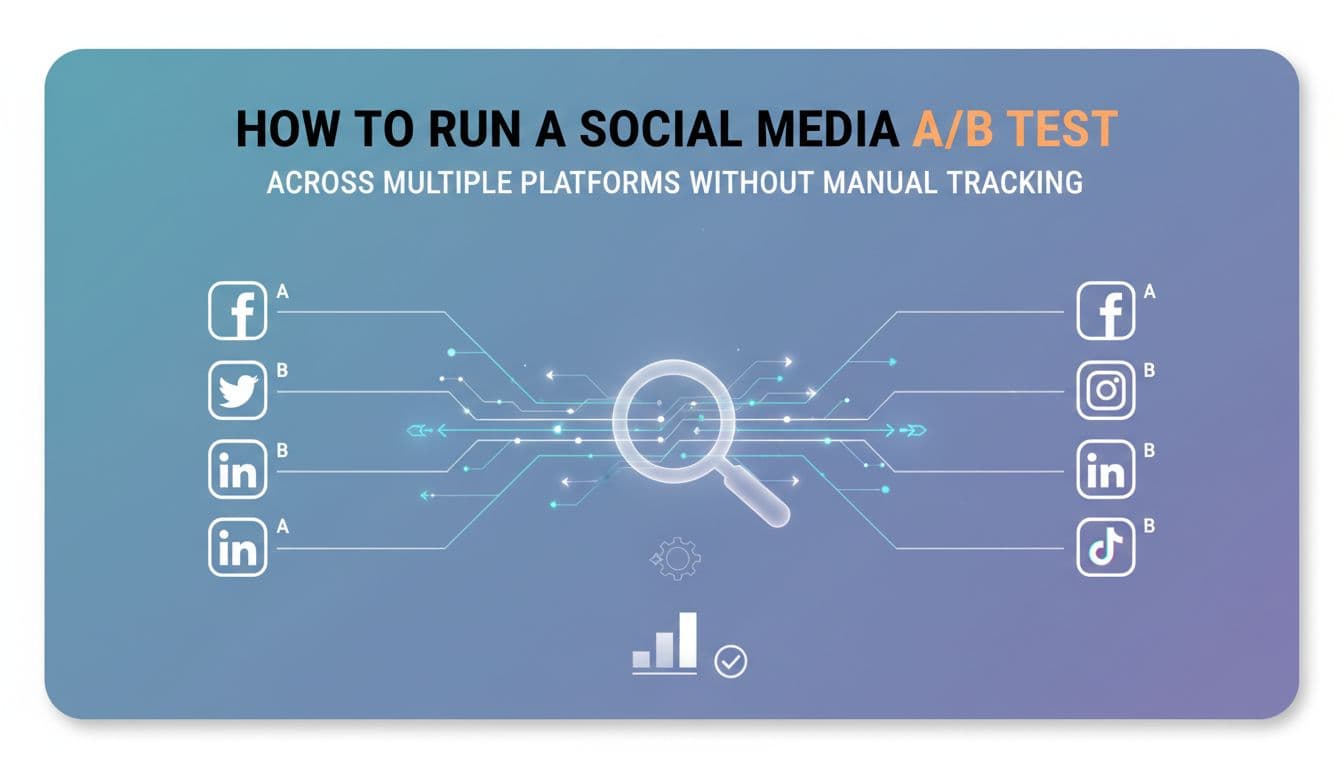
How to Run a Social Media A/B Test Across Multiple Platforms Without Manual Tracking
Most social media A/B tests fail before they even start. Not because the ideas are bad, but because the process falls apart. You post two versions of something, wait a few days, check the numbers on four different apps, copy everything into a spreadsheet, and then try to remember what you were even testing. By the time you have the data, you have already moved on to the next campaign. This guide shows you a better way. You will learn how to set up cross-platform A/B tests with a clear hypothesis, one variable at a time, and let automation handle the tracking so you can focus on what the results actually mean. When you treat social media testing as a continuous agentic workflow instead of a one-off task, you build a compounding advantage that most brands never develop.

Wilzer Jean-Baptiste
11 min read
You ran a test last month. You posted two versions of the same caption, waited a few days, and then spent an hour logging into Instagram, LinkedIn, TikTok, and X to collect the numbers. You copied everything into a spreadsheet. By the time you finished, you had already forgotten which variant was which, and the data was stale anyway. Sound familiar?
Cross-platform social media A/B testing is one of the highest-leverage things you can do for your content strategy. But the manual version of it breaks down fast. The platforms multiply. The spreadsheets get messy. The tests run too short, or they change too many variables at once, and the results tell you nothing you can actually use.
There is a better way to run this. One that uses automation to handle the tracking, keeps your tests clean and focused, and turns every experiment into a lesson you can build on. Here is how to do it right.
How to Set Up a Test That Actually Tells You Something
Before you schedule a single post, you need a setup that gives you clean data. Most tests fail at this stage because people skip the structure and go straight to posting. The three rules below fix that.
Define One Variable Per Test
This is the rule that most people break, and it is the one that kills the whole experiment. You cannot test your hook, your image, your CTA, and your posting time all at once and expect to learn anything useful. If version A outperforms version B, you will have no idea which change made the difference. And if version B wins, you still do not know why.
Pick one variable. Just one. Test the headline on LinkedIn. Test the opening hook on TikTok. Test whether a direct CTA like "Book a call today" beats a softer one like "Learn more" on Instagram. Test whether posting at 7 AM gets more reach than posting at noon on Facebook. One change, two versions, clean data.
This discipline feels slow at first. It is not. Running focused single-variable tests means every test teaches you something you can actually use. Over time, you build a real picture of what works for your audience on each platform. That picture is worth more than a hundred messy experiments where you changed everything and learned nothing.
A good rule of thumb: write out your two variants side by side before you post them. If you spot more than one difference, cut it down until there is only one. If you are testing the hook, the rest of the post should be word-for-word identical.
Write a Hypothesis Before You Post
A hypothesis is just a prediction. But writing it down before you post changes everything about how you run the test and read the results.
Here is a simple format that works: "I believe [Variant A] will outperform [Variant B] on [platform] because [reason], and I will measure this by [metric]."
For example: "A question-based hook will get more LinkedIn comments than a statement-based hook, because questions invite a response and LinkedIn's algorithm rewards comment activity." Or: "A carousel post on Instagram will get more saves than a single image post, because carousels deliver more value per swipe."
When you write the hypothesis first, you force yourself to be specific about what you are testing and why. You also set the metric before you see the results, which keeps you from cherry-picking the number that makes your preferred version look like a winner. That is a real trap. You run a test, your gut says version A should have won, and suddenly you are looking at story views instead of link clicks because that is the stat where A came out ahead.
The hypothesis keeps you honest. Write it down. Keep it somewhere you can find it when the results come in.
Keep Everything Else Consistent Across Platforms
Cross-platform A/B testing only works when you control for everything except the one variable you are testing. That means the audience targeting, the content format, the creative assets, and the goal all need to stay consistent across both variants.
If you are testing two different hooks on LinkedIn and Instagram at the same time but treating them as one test, you are not running one test. You are running two separate tests with different audiences, different algorithms, and different content norms. That is fine, but treat them as separate tests with separate hypotheses and separate results.
For a true cross-platform comparison, keep the post format the same on both platforms. Use the same image or video. Use the same body copy. Change only the one variable you identified. Then compare how that one change performed differently depending on the platform. That data is useful because it tells you whether a tactic that works on TikTok translates to Instagram, or whether LinkedIn audiences respond to questions the same way Facebook audiences do.
Same creative. Different variable. That is the whole framework.
Running the Test Without Drowning in Spreadsheets
The setup is done. Now the test needs to actually run, and the data needs to come back to you in a form you can use. This is where most cross-platform testing programs fall apart, and where automation makes the biggest difference.
Let Automation Track Performance So You Do Not Have To
Manual tracking is where most cross-platform testing programs die. You can stay disciplined about your hypothesis and your single variable, but when you are managing tests across Instagram, TikTok, LinkedIn, YouTube, Facebook, and X simultaneously, the spreadsheet becomes a second job. You end up logging into six different dashboards, copying numbers into rows, and hoping you did not mix up which variant was which.
This is exactly the problem that agentic social media workflows solve. An agentic social media scheduler can log your variants at the moment you schedule them, publish each version at the right time, and pull performance data back into one unified view automatically. You do not have to touch a spreadsheet. You just check the results when the test window closes.
Aidelly's agentic workflows handle this end-to-end. You set up your two variants in the platform, schedule them through the content calendar, and the system tracks performance across every channel in one dashboard. When the test runs, you see the results side by side without ever opening a separate analytics tab or copying a number by hand. For agencies running tests across multiple client accounts, this is the difference between a scalable process and a chaotic one.
The goal of automation here is not to replace your judgment. It is to give you clean, complete data so your judgment is actually worth something when you apply it.
Measure the Right Metric for Each Platform
Not every platform measures success the same way, and using the wrong metric will send you in the wrong direction. This is one of the most common mistakes in cross-platform social media testing.
On Instagram and TikTok, engagement rate is the right starting point. These platforms are built around content discovery and community interaction. Likes, comments, shares, and saves tell you whether your content is resonating. A high save rate on Instagram is a strong signal that your content delivered real value, because people only save things they want to come back to.
On LinkedIn and X, click-through rate matters more. These platforms are used differently. People are there to read, learn, and take action. If you are testing two different CTAs for a lead magnet or a blog post, the number of people who actually clicked the link is the metric that connects to your business goal.
On YouTube, watch time and average view duration tell you more than raw views. On Facebook, reach and post engagement together give you a clearer picture than either one alone.
The key is to match the metric to your actual business goal, not to the vanity number that looks impressive in a screenshot. Set the metric before the test starts and do not change it when the results come in.
Run Tests Long Enough to Matter
A few hours of data is not a test. It is a snapshot. And snapshots lie. Posting at 9 AM on a Tuesday and checking results at 3 PM the same day tells you almost nothing about whether your hook works. It tells you about Tuesday afternoon traffic patterns on one platform.
The minimum useful test window is three to seven days. Ideally, you want each variant to reach at least a few thousand impressions before you draw any conclusions. On smaller accounts, that might take longer than a week. That is okay. Patience here is not weakness. It is rigor.
There are two reasons the longer window matters. First, platform algorithms take time to distribute your content. A post that looks like a loser at hour six might be a winner by day three once the algorithm pushes it to a broader audience. Second, audience behavior varies by day of the week. A post that performs well on Monday might perform differently on Thursday because your audience's habits shift across the week.
If you are running tests through an agentic scheduling tool, you can set the test window in advance and get a notification when the window closes and results are ready to review. You do not have to keep checking. The system watches the clock so you do not have to.
Turning Test Results Into a Compounding Advantage
Running a test is one thing. Turning what you learn into something that makes every future post better is another. This is the part most teams skip, and it is the part that separates brands that keep improving from brands that keep guessing.
Document What You Learn Every Single Time
Running a test and not writing down what you learned is like reading a book and throwing it away. The real value of social media A/B testing is not the single result. It is the pattern that emerges after ten, twenty, fifty tests. But you can only see the pattern if you keep the records.
Build a living test log. It does not have to be complicated. A simple table works fine: the date, the platform, the variable you tested, the two variants, the metric you measured, which variant won, and the one-sentence lesson you took from it.
Over time, this log becomes your brand's playbook. You will start to see things like: question-based hooks consistently outperform statement hooks on LinkedIn for this account. Video posts with a direct CTA in the first three seconds get higher click-through rates on Instagram than posts where the CTA comes at the end. Carousel posts drive more saves on Tuesday mornings than on Friday afternoons.
None of these lessons come from a single test. They come from the accumulation of tests, documented consistently. When a new team member joins, you hand them the playbook and they start from a position of knowledge instead of guessing. When a campaign underperforms, you check the playbook and see whether you broke a pattern that has historically worked. Aidelly's cross-platform analytics dashboard makes this easier because your performance data is already in one place. You pull the data, write the lesson, and add it to the log in about ten minutes after each test cycle.
Use Your Test Log to Decide What to Test Next
The test log does more than record history. It tells you what to test next. When you look at your results and see that hooks are consistently the biggest variable driving engagement, you focus more test cycles on hook variations. When you see that posting time barely moves the needle for your audience on LinkedIn but makes a big difference on Instagram, you stop wasting test cycles on LinkedIn timing and put that energy somewhere more productive.
This is how A/B testing becomes a compounding advantage instead of a one-off exercise. Each test informs the next one. Your hypotheses get sharper because they are built on real data from your actual audience on your actual accounts. You stop guessing and start iterating with real information behind every decision.
A good cadence for most teams and solopreneurs is one to two tests per platform per month. That is manageable, it gives each test enough time to run properly, and it means you are generating twelve to twenty-four data points per platform per year. After six months, you know your audience better than most brands ever will. After a year, your content strategy is built on evidence, not instinct.
Make Testing a Continuous Workflow, Not a One-Off Task
The biggest mindset shift in effective social media A/B testing is moving from "we ran a test" to "we run tests." Testing is not a campaign. It is a system. And like any system, it only works if it runs continuously.
Agentic AI social media management makes this possible at a scale that was not realistic before 2025. AI agents can generate content variants based on your brand voice and past performance data, schedule them at the best time to post for each platform, collect cross-platform analytics automatically, and surface recommendations for what to test next. The whole loop runs without you manually managing every step.
This is where tools like Aidelly's AI Chat Workspace and agentic scheduling become useful for ongoing testing programs. You brief the AI on your current hypothesis, generate two variants, schedule them with one workflow, and come back to clean results. The friction of running tests drops low enough that you keep doing it week after week, instead of treating it as a quarterly project that always gets deprioritized.
Autonomous social media management does not mean you stop thinking. It means the thinking you do has better inputs, cleaner data, and more time behind it. That is how you build content that keeps getting better.
Social media A/B testing works when you keep it simple, stay patient, and let automation do the heavy lifting on data collection. One variable per test, a written hypothesis before you post, the right metric for each platform, and a test window long enough to produce real signal. Do those four things consistently and document every result, and you will have a brand playbook inside of six months that most of your competitors will never build.
The manual version of this process is exhausting and breaks down fast. The agentic version, where AI handles variant scheduling, cross-platform tracking, and performance reporting, is what makes continuous testing actually sustainable for real teams and solopreneurs running real businesses.
If you have been putting off systematic testing because the tracking felt like too much work, the right tools make that excuse disappear.
If you want a low-lift way to apply these ideas, Aidelly helps you keep your social content consistent without extra busywork.Running A/B tests across every platform does not have to mean more tabs, more spreadsheets, and more guessing. With agentic workflows, Aidelly's AI agents create your variants, schedule them at the best times, and pull the results into one place so you can see what worked without doing the busywork. If you are ready to turn testing into a habit instead of a headache, start at aidelly.ai.
Compare Social Scheduling Tools
Evaluating software for your content workflow? Use our buyer guides and comparisons to compare scheduling, approvals, analytics, and AI workflow fit.
Share this article
Related Articles
How Agencies Manage 50+ Client Approval Cycles Without Losing Their Minds
Managing social media approvals for 50+ clients is one of the most underestimated operational challenges in agency life. You're not just tracking one review cycle. You're tracking dozens of them simultaneously, each with different stakeholders, different feedback styles, and different definitions of 'approved.' One client responds in 20 minutes. Another goes silent for four days and then wants everything live by Friday. Meanwhile, your team is buried in follow-up emails, Slack pings, and spreadsheet updates that could be automated. This article breaks down exactly why approval bottlenecks happen at scale, what a smarter workflow looks like, and how agentic AI is changing the game for agencies that manage high client volumes. If you've ever lost a campaign launch to a missed approval email, this one's for you.
Sep 10, 2026
Read more
YouTube Shorts Automation: How Agencies Schedule and Publish at Scale
Managing YouTube Shorts for five, ten, or twenty clients at once is a different beast than running a single channel. The volume alone is brutal. Add approval rounds, brand guidelines, optimal posting windows, and cross-platform repurposing, and you've got a workflow that can swallow an entire team whole. Agencies that crack the automation side of Shorts production don't just save time. They produce more content, keep clients happier, and grow their accounts faster than competitors still doing everything by hand. This article breaks down exactly how agencies are using batch creation, AI-powered scheduling, centralized asset management, and cross-platform publishing to run Shorts at scale without burning out their teams or hiring a dozen new people. If you manage multiple client accounts and feel like Shorts is eating your week, this is the playbook you need.
Sep 4, 2026
Read more
LinkedIn Automation for B2B Agencies: What You Can Safely Automate and What You Should Not
B2B agencies are under pressure to produce more LinkedIn content, faster, for more clients. But LinkedIn's automation policies are strict, and the wrong tools can get accounts restricted or permanently banned. The good news is that safe, profitable LinkedIn automation is absolutely possible. You just need to know exactly where the line is. This guide breaks down what LinkedIn's policies actually allow, which automation tactics will get you in trouble, and how to build a hybrid workflow that scales content production without sacrificing brand trust or client credibility. Whether you manage LinkedIn for five clients or fifty, this is the framework that keeps you compliant, efficient, and ahead of the curve in 2026.
Aug 29, 2026
Read moreReady to never miss a post again?
Tell Aidelly what to post. It drafts, schedules, and publishes across 9 platforms while you focus on your business.