Agencies
How to Build a Brand Voice System That Every AI Agent Follows Automatically
AI can write your social posts faster than any human. But speed without consistency is just noise. If your AI-generated content sounds like it could belong to anyone, the problem isn't the AI. It's that you haven't given it a system to follow. A vague brand voice document doesn't cut it anymore. AI agents need rules, not inspiration. They need phrase lists, banned words, platform-specific tone shifts, and sample posts they can check against. This guide walks you through building a brand voice system that actually works at machine scale. You'll learn how to layer your voice, build a shared brand library, set up approval gates that catch drift before it goes live, and measure consistency month over month. Whether you're a solopreneur, an agency managing ten clients, or a creator who wants to sound like yourself at scale, this is the setup that makes it happen.

By Wilzer Jean-Baptiste
Published 9 min read
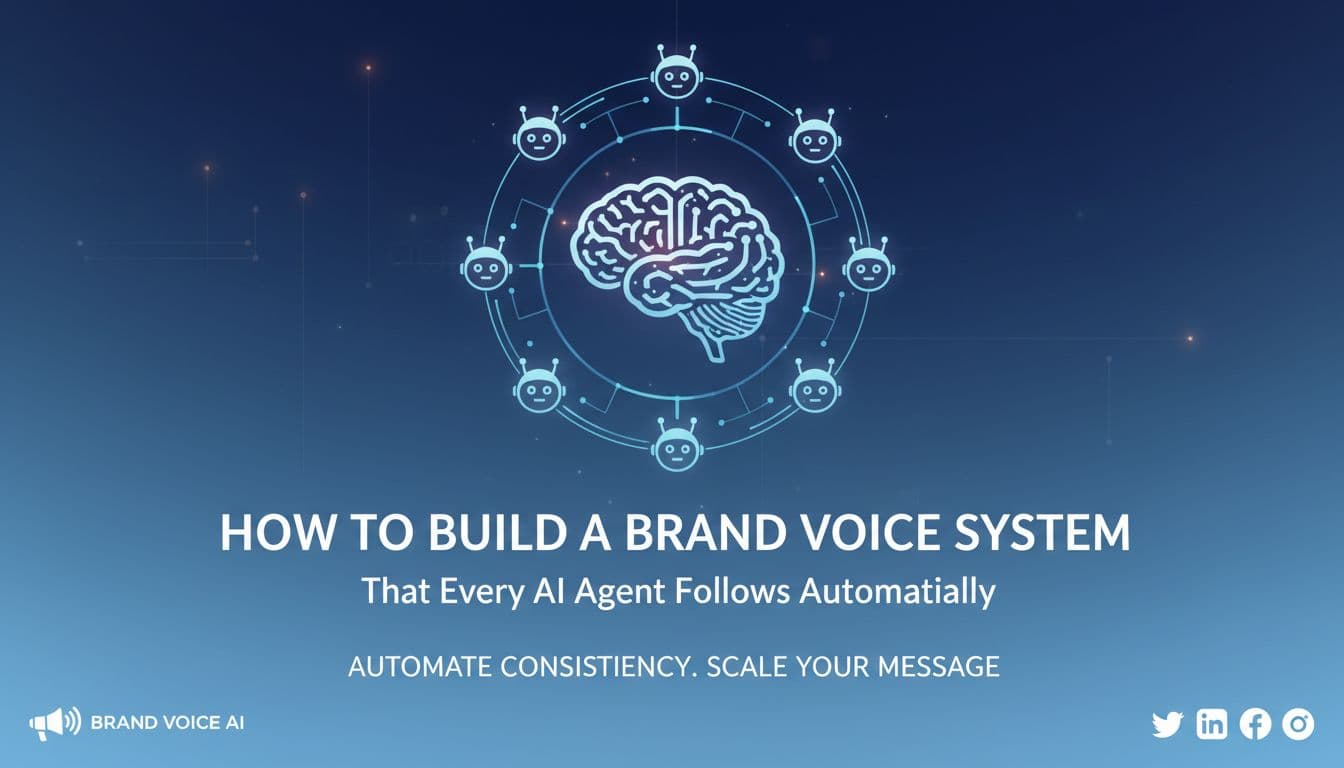
AI can write your social posts faster than any human. But speed without consistency is just noise. If your AI-generated content sounds like it could belong to anyone, the problem isn't the AI. It's that you haven't given it a system to follow. A vague brand voice document doesn't cut it anymore. AI agents need rules, not inspiration. They need phrase lists, banned words, platform-specific tone shifts, and sample posts they can check against. This guide walks you through building a brand voice system that works at machine scale.
Layer Your Brand Voice So Agents Know Exactly What to Do
Turn Your Brand Voice Into Rules an Agent Can Check
The first thing to get right is specificity. 'We're warm and approachable' means nothing to an AI agent. 'We open posts with a question or a direct observation, never a generic greeting' means something it can act on.
Start by pulling 10 to 15 phrases you actually use. Not aspirational phrases. Real ones from your best-performing posts, your emails, your DMs. For a fitness coaching brand, that might look like: 'You don't need more motivation, you need a better system,' 'Small reps, big shifts,' 'This is the part nobody talks about,' or 'Here's what I wish someone told me.' These become anchors. An agent checks new drafts against them for rhythm and word choice.
Then build a 'never use' list. Words and phrases that kill your tone. For that same fitness brand, it might be: 'crush your goals,' 'hustle harder,' 'smash it,' 'beast mode,' or 'no excuses.' These are the words that make your audience scroll past.
Finally, write two or three sample posts that nail your tone. One for LinkedIn, one for Instagram, one for TikTok if you're on it. Label them clearly. These are the gold standard every agent drafts toward. When Aidelly's AI drafting tool generates a new post, it checks against your stored voice rules and samples before it ever reaches your content calendar. That's the difference between a tool that helps and one that creates more editing work.
Split Voice Into Three Layers
A single voice document fails because it tries to cover everything at once. Your LinkedIn audience and your TikTok audience are different people looking for different things, even if they follow the same brand.
Layer one is core personality. This is the stuff that never changes regardless of platform. Your values, your point of view, the topics you take a stand on. A financial planning brand might always be direct, never preachy, and always focused on real numbers over abstract advice. That stays consistent whether the post is on LinkedIn or Instagram.
Layer two is platform tone. LinkedIn usually needs more context and a calmer register. You can be warm, but you lead with insight. TikTok rewards faster pacing, more personality, and a willingness to be a little unpolished. Instagram sits somewhere in between, depending on whether you're writing a caption or a Reel script. Agents need explicit instructions for each platform, not just one general tone setting.
Layer three is content pillars. These are the three to five topic areas you consistently post about. For a restaurant, that might be: behind-the-scenes prep, sourcing stories, and seasonal menu updates. For a SaaS founder, it might be: product lessons, hiring mistakes, and customer wins. Pillars give agents a framework for what to write about, not just how to write it. Without pillars, agents default to whatever feels topically relevant, and you end up with an inconsistent content mix that confuses your audience.
Store Guidelines Next to the Assets They Govern
Here's where most brand voice systems fall apart. The voice guide lives in a Google Doc. The logo files live in Dropbox. The approved product names and pricing rules live in someone's head. Agents can't access any of that automatically, and humans forget to check it.
The fix is a single brand library where everything lives together. Approved logos and color codes. Product names spelled exactly as they should be, including capitalization. Pricing rules, like whether you list prices publicly or direct people to book a call. Banned claims, especially anything that could be read as a guarantee or a medical or legal claim. And the voice rules from the section above, right next to the assets they apply to.
When an agent drafts a post about your newest product, it should be pulling the correct product name, the approved price point if relevant, and the right tone layer for the platform, all from one place. Aidelly's brand asset management does exactly this. Your voice guidelines, media files, and content rules sit in one library that every agent checks before drafting. You stop correcting the same mistakes over and over because the agent never had access to the right information in the first place.
Build Gates That Catch Drift Before It Goes Live
Add Approval Gates Where Voice Drift Is Most Likely
You can't review every post manually if you're publishing daily across five platforms. But you also can't let agents run completely unsupervised, especially when a post makes a price or performance claim.
The smarter approach is targeted approval gates. Review the first draft of every new campaign, because that's when agents are working with the least context about what you're trying to accomplish. Review any post that mentions a specific price, a discount percentage, or a result like 'clients who do this see 30% more engagement.' These are the posts where a small wording mistake creates a real problem.
For everything else, a weekly spot-check is enough. Pull five to ten posts at random and read them against your voice samples. You're looking for drift. Sentences that feel stiff. Words from your never-use list. Platform tone that doesn't match the channel. Catch it early and update your rules before it becomes a pattern.
Aidelly's approval workflow lets you set exactly these kinds of gates. You decide which post types require a human review before scheduling, and which ones can go straight to the calendar. Your team sees only the posts that need a real decision, not every single draft. That's how you stay consistent without spending your whole day in a content queue.
What Voice Drift Actually Looks Like
Voice drift is subtle. It doesn't usually show up as an obviously wrong post. It shows up as a slow slide toward something generic.
A brand that used to open every Instagram post with a specific observation starts opening with questions. Then with 'Have you ever wondered.' Then with 'In today's fast-paced world.' Three months later, the posts are indistinguishable from every other account in the niche. No single post was wrong. The pattern was the problem.
This is why approval gates alone aren't enough. You need a way to see the pattern, not just individual posts. A quick monthly read-through of your last 20 posts, side by side, tells you more than any single review ever will. When you read them together, the drift becomes obvious. Individual posts can hide it. The batch view can't.
For agencies managing multiple client accounts, this problem multiplies fast. One account drifts and you might not catch it for weeks. Building a spot-check habit, and storing clear voice samples per client in a shared library, is what separates agencies that scale from ones that constantly firefight.
Measure Voice Consistency Like You Measure Anything Else
Track the Right Metrics for Voice
Most brands measure social media performance with reach, likes, and follower growth. Those are outcome metrics. They tell you what happened, not why. For brand voice, you need process metrics that tell you whether your content is staying consistent.
Four simple ones to start with: average post length, emoji count per post, reading level, and save or share rate. Average post length tells you if your copy is drifting longer or shorter than your baseline. Emoji count catches tone drift fast, especially if your brand uses zero emojis and suddenly posts start showing up with three per caption. Reading level is easy to check with a free tool like Hemingway, and it tells you if your writing is getting more complex or more accessible over time. Save and share rate tells you which posts your audience found worth keeping, which is a signal that the post felt specific and useful rather than generic.
Set a monthly baseline in your first month of consistent posting. Then compare each subsequent month against it. You're not looking for perfection. You're looking for drift. A two-point jump in reading level or a 40% drop in saves is a signal to look at recent posts and figure out what changed.
Update the Guide When the Audience Shifts
Brand voice isn't static. Your audience changes. Your product evolves. What resonated in early 2025 might feel off by mid-2026. The goal isn't to freeze your voice in place. It's to change it deliberately instead of accidentally.
When your metrics show a consistent shift in what's performing, that's your cue to revisit the voice guide. Maybe your audience is responding better to longer, more detailed posts than they did six months ago. Maybe the emoji-free tone you started with is feeling cold compared to what's working in your category now. Update the sample posts in your guide. Revise the phrase list. Brief your agents on the change explicitly.
This is the part most brands skip. They update their content style but never update the rules the agents are checking against. So the agents keep drafting against an old standard while humans manually override the output. You end up doing more editing, not less. Keep the guide current and the agents stay useful. Think of the voice guide as a living document you review quarterly, not a one-time setup you forget about.
A Before and After: What the System Actually Changes
Here's a real example of what this looks like in practice. A business coach wants to post about a client win on LinkedIn.
Before the system:
'Excited to share that one of my clients just hit a major milestone! After working together for three months, they've seen incredible growth in their business. This is why I love what I do. If you're ready to level up, let's connect!'
That post could belong to any coach on LinkedIn. It's vague, enthusiastic about nothing specific, and it asks for something without giving anything.
After the system:
'One of my clients booked 11 discovery calls in a single week last month.
She had been averaging three.
We didn't change her offer. We changed the one sentence she used to open every conversation.
The specific thing she said, and why it worked, is in the comments.'
Same topic. Completely different post. The second one is specific, it delivers real value, it matches the coach's platform tone for LinkedIn (calm, direct, no exclamation points), and it fits the content pillar of 'client wins with a teachable moment.' An agent with a proper voice system drafts the second version. An agent with a vague paragraph drafts the first. That gap is what this whole system is designed to close.
Brand voice consistency at scale isn't about writing better prompts every time. It's about building a system once and letting it run. Phrase lists, platform tone layers, a shared brand library, targeted approval gates, and a monthly drift check. That's the full stack. When those pieces are in place, AI agents stop producing generic output and start producing content that actually sounds like you. The right social media tool makes this system easier to run because it keeps your voice rules, assets, and approval workflows in one place instead of scattered across five different apps. That's where the real time savings show up, and where brand consistency stops being a goal and starts being the default.
If you want a low-lift way to apply these ideas, Aidelly helps you keep your social content consistent without extra busywork.A brand voice stored in a PDF won't survive a busy Tuesday. With Aidelly, your voice rules sit in one place, and your agents check every draft against them before anything goes live, so you can let agentic workflows handle creation, scheduling, and performance tracking while you step in only when a post needs your eye. If you want to see how that works for your brand, take a look at aidelly.ai.
Compare social scheduling tools
Evaluating software for your content workflow? Use our buyer guides and comparisons to compare scheduling, approvals, analytics, and AI workflow fit.