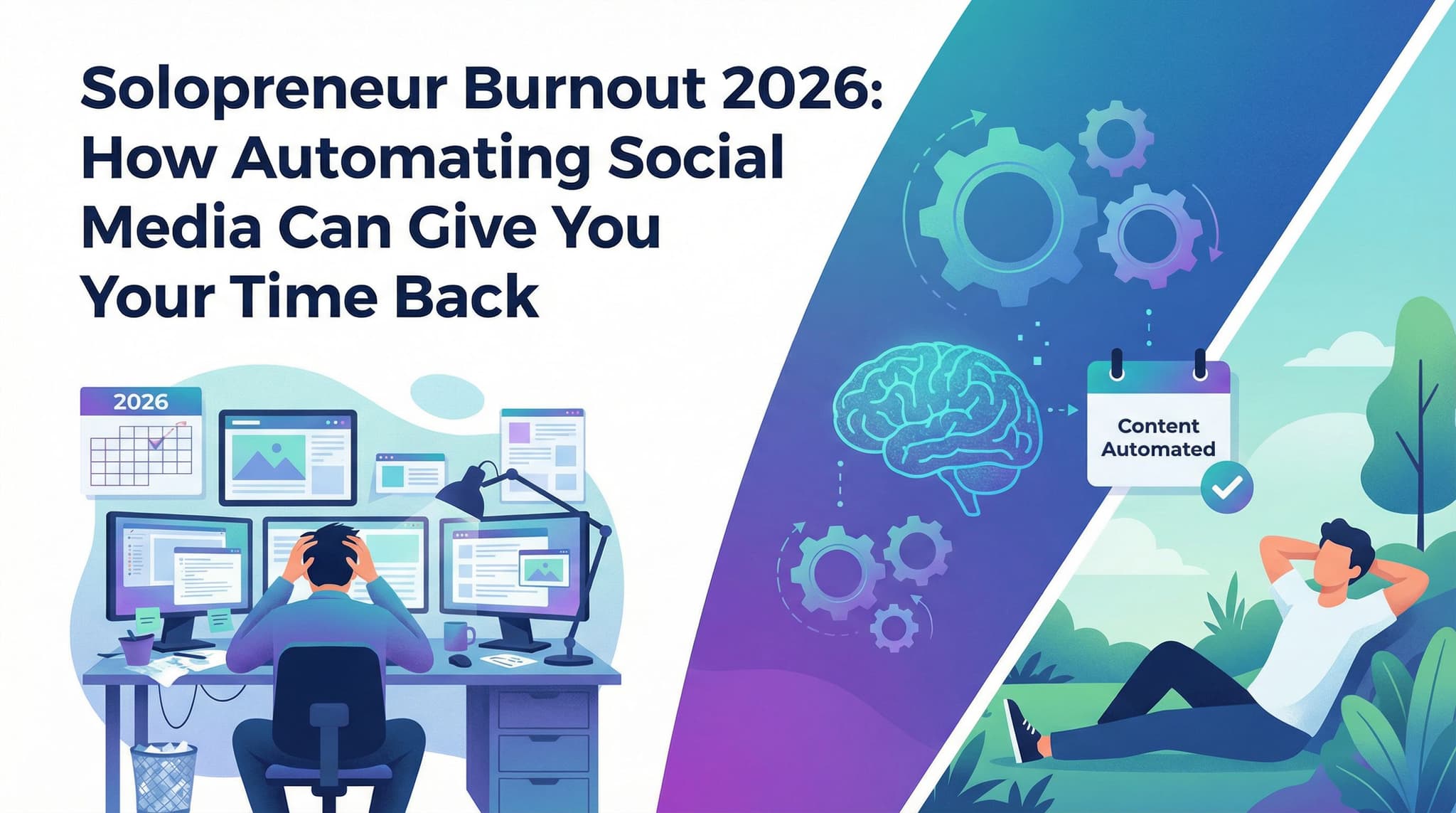
Solopreneur Burnout 2026: How Automating Social Media Can Give You Your Time Back
You're grinding 15-20+ hours every week on social media, yet your core business is suffering. Solopreneur burnout is real, and it's costing you both your sanity and your revenue. But here's the truth: you don't need to quit social media—you need to automate it strategically. Discover how top solopreneurs are reclaiming 8-12 hours weekly through smart automation, maintaining authentic connections while protecting their mental health. Learn the framework that separates sustainable businesses from burnout traps.

By Wilzer Jean-Baptiste
Published 20 min read
It's 11 PM, and you're still scrolling through comments on a post you published at 6 AM. Your laptop glows in the dark bedroom while your partner sleeps beside you, silently asking why you're still working. You promised yourself you'd stop checking social media by 9 PM, but "just one more quick response" turned into an hour of engagement. Sound familiar?
You're not lazy for wanting this to stop. You're not unmotivated. You're burned out—and the irony is that the very tool meant to grow your business is actively destroying your ability to do the work that actually generates revenue.
Here's what nobody tells solopreneurs: the social media treadmill is engineered to be addictive. Algorithms reward constant posting and real-time engagement. Clients expect immediate responses. The fear of being "inactive" keeps us glued to our screens, refreshing notifications like slot machines. And because you're running a solo operation, there's no team to delegate to, no relief valve, no escape.
But what if I told you that you could maintain a thriving, authentic social media presence while reclaiming 8-12 hours every single week? What if you could actually sleep through the night without anxiety about what you're missing? That's not fantasy—it's the reality for solopreneurs who've discovered strategic social media automation.
This isn't about becoming a "lazy" entrepreneur. It's about working smarter, protecting your mental health, and building a sustainable business instead of a burnout trap. Let's dive into how.
Section 1: The Hidden Cost of Social Media Management on Your Business
Before we talk about solutions, we need to confront the real problem. Social media management isn't just eating your time—it's consuming the hours you should be spending on activities that directly generate revenue.
The math is brutal, but it's important to see it clearly.
1.1: The 15-20+ Hour Weekly Reality: Where Your Time Actually Goes
Let's be specific about what's happening to your week. Research consistently shows that solopreneurs spend between 15-20+ hours managing social media, and honestly? Most of us underestimate because we don't count all the fragmented moments.
Here's a realistic breakdown of how those hours accumulate:
- Morning check-in: 30 minutes—responding to overnight comments, checking notifications, seeing what's trending
- Content creation: 4-6 hours—filming, writing, editing, designing, finding images
- Posting and scheduling: 1-2 hours—uploading, writing captions, adding hashtags, timing posts
- Engagement throughout the day: 3-4 hours—liking, commenting, responding to messages in real-time, staying "active"
- Evening wind-down: 30 minutes—final check before bed, catching up on what you missed
- Analytics review and planning: 2-3 hours weekly—checking what worked, planning next week's content
- Unexpected crisis management: 1-2 hours—responding to a critical comment, managing a negative review, jumping on a trending topic
That's easily 12-18 hours right there, and that's before you factor in the mental overhead—the constant thinking about content ideas, the worry about not posting enough, the anxiety about engagement rates dropping.
Now here's the part that should make you angry: none of those hours are billable. You're not charging clients for social media management (unless that's your actual service). You're doing it in addition to your real work—coaching sessions, client projects, product development, strategy calls. So you either work those 15-20 hours on top of your billable work (hello, 60-hour weeks), or you sacrifice billable time to do social media (goodbye, revenue).
The burnout isn't a personality flaw. It's a math problem. You're trying to fit 40 billable hours and 20 non-billable social media hours into a 50-hour work week. Something has to give, and usually it's your sleep, your sanity, and your actual business growth.
1.2: How Social Media Management Directly Sabotages Your Core Business Activities
This is the part where we get uncomfortable, because it requires admitting something most solopreneurs won't say out loud: social media is preventing you from doing the work that actually makes you money.
Think about your ideal client. They don't hire you because you posted a cute carousel on Instagram. They hire you because you delivered exceptional results, solved a real problem, or created something they couldn't find anywhere else. That transformation happens in your core business activities—the work only you can do.
For a coach, that's creating breakthrough sessions with clients. For a consultant, it's strategic planning and implementation. For a designer, it's the actual creative work. For an e-commerce business, it's product development and customer experience. For a digital product creator, it's building the course or template that changes lives.
But when you're spending 4-6 hours creating social content and another 3-4 hours managing engagement, you're not doing that work. You're not creating the transformative product. You're not deepening client relationships. You're not innovating. You're not building the business that scales.
Worse, the constant context-switching between social media and deep work destroys your ability to think strategically. Research on attention shows that it takes 23 minutes to fully refocus after an interruption. Every time you check a notification, respond to a comment, or refresh your analytics, you're fragmenting your focus. By the end of the day, you've been interrupted dozens of times, and you've never had a sustained block of time to do your best work.
The result? Lower quality work, fewer completed projects, slower business growth, and the gnawing feeling that you're always busy but never productive. That's not laziness. That's burnout masquerading as productivity.
1.3: The Burnout Spiral: When Social Media Becomes a Mental Health Crisis
Let's talk about what burnout actually feels like, because it's not just about being tired.
Burnout is waking up at 3 AM with anxiety about your engagement metrics. It's feeling guilty when you take a day off because you didn't post anything. It's the constant low-level stress of wondering if you're doing enough, posting enough, engaging enough. It's checking your phone during dinner, during conversations, during moments meant for rest. It's the shame of scrolling social media for "research" when you should be working, followed by the guilt of not working when you should be resting.
Solopreneur burnout specifically is insidious because there's no separation between work and life. Your business is you. Your social media presence is your personal brand. When the algorithm doesn't favor your post, it feels like a personal rejection. When engagement drops, it feels like failure. When someone leaves a critical comment, it stings differently than it would if you were just an employee.
The mental health impact is real and measurable. Chronic social media management stress contributes to anxiety, depression, sleep disruption, and decreased motivation. It erodes the joy you originally felt about your business. It damages relationships because you're physically present but mentally scrolling. It kills creativity because your brain never gets genuine rest.
And here's the cruel irony: the more burned out you become, the worse your social media content gets, which means worse engagement, which means more stress, which means more time trying to fix it. It's a downward spiral, and the only way out isn't to work harder. It's to work differently.
Section 2: The Automation Solution—Reclaiming Your Time and Sanity
Okay, we've established the problem. Now let's talk about the solution that actually works: strategic social media automation. This isn't about being lazy or losing the human touch. This is about being smart enough to use technology to handle the repetitive, time-consuming parts of social media so you can focus on the parts that actually require your unique voice and genuine connection.
2.1: How Automation Tools Free 8-12 Hours Weekly (And What You'll Actually Do With Them)
Let's start with the core benefit: time recovery. When you implement social media automation tools like Buffer, Later, Hootsuite, or Meta Business Suite, you're not just saving time—you're fundamentally restructuring how you work.
Here's how the time breakdown changes:
Before Automation:
- Content creation: 4-6 hours (spread throughout the week)
- Posting and scheduling: 1-2 hours (daily posting at optimal times)
- Engagement: 3-4 hours (real-time responses throughout the day)
- Analytics and planning: 2-3 hours
- Total: 12-18 hours fragmented across your entire week
After Automation:
- Content creation batching: 3-4 hours (one or two dedicated sessions)
- Scheduling in bulk: 30 minutes (upload 30-90 days of content at once)
- Planned engagement windows: 1 hour daily or 5-7 hours weekly (specific times for responding)
- Analytics review: 1-2 hours weekly (consolidated review instead of constant checking)
- Total: 6-8 hours consolidated, leaving 8-12 hours reclaimed
The difference isn't just numerical—it's structural. Instead of social media fragmenting your entire week, it occupies specific time blocks. You're not checking notifications constantly. You're not jumping between content creation and engagement. You're batching similar tasks together, which your brain actually prefers.
But here's where it gets really valuable: what are you going to do with those 8-12 reclaimed hours?
If you're a coach, that's two additional client sessions per week, translating to $500-2,000 in additional revenue depending on your rates. If you're a consultant, that's time for strategic work that deepens client results and justifies higher fees. If you're a product creator, that's the time to actually build the thing you've been planning. If you're an e-commerce business, that's time for product photography, inventory management, or supplier relationships that directly impact your bottom line.
This is why automation isn't lazy—it's strategic delegation. You're not eliminating social media. You're automating the parts that don't require your unique expertise so you can focus on the parts that do. It's exactly what successful entrepreneurs do at every scale.
2.2: Batch Content Creation and Templates—Multiplying Your Output 3-4x
One of the biggest time-savers isn't the automation tool itself—it's changing how you create content. Instead of creating one post at a time, scattered throughout the week, you batch-create content in dedicated sessions. This is where the 3-4x efficiency multiplier comes from.
Here's how it works:
The Old Way: Monday morning you think of a post, spend 30 minutes creating it, post it. Wednesday afternoon you have another idea, spend 45 minutes on it, post it. Friday you remember you need content for next week, frantically create something, schedule it. You're constantly context-switching between your core work and content creation, and each piece takes longer because you're starting from scratch every time.
The Batch Way: You block off 3 hours on a Sunday afternoon (or whatever day works). You create 8-12 pieces of content in one sitting. You're already in "content creation mode," so your creativity flows. You have templates ready to speed up the design process. You're thinking about your content themes holistically instead of randomly. By the end of the session, you have a month of content ready to schedule.
The efficiency gain comes from several factors:
- No context-switching overhead: You stay in creator mode the entire time instead of jumping between client work and social media
- Templates reduce design time: Instead of creating each graphic from scratch, you use templates that maintain brand consistency and speed up production by 50%+
- Repurposing multiplies output: One core idea becomes multiple pieces—a blog post becomes a carousel, a quote, a video script, an infographic, a LinkedIn article. What took 1 hour of creation becomes 4-5 content pieces
- Batching creates momentum: Once you get in the flow, ideas build on each other. Your second post is faster than your first, your third faster than your second
- Planning prevents writer's block: You're not staring at a blank screen wondering what to post. You have a content theme for the month, so you're just executing a plan
Real example: A business coach we know used to spend 6 hours weekly creating social content. She switched to batching with templates and repurposing. Now she spends 3 hours every two weeks and has more content than before—because each piece gets repurposed across 3-4 formats. She's created 3-4x the content output in less than half the time. That's the power of smart batching combined with automation tools.
2.3: Decision Fatigue Reduction—Why Your Brain Needs This
There's a cognitive science concept called decision fatigue, and it's absolutely destroying solopreneur productivity. Every decision you make depletes your mental energy. By the end of the day, you have less capacity for good decision-making. This is why successful people often wear the same outfit every day—they're conserving decision energy for things that matter.
Social media is a decision-making nightmare. What time should I post? Which platform first? Should I respond to this comment? How do I word this caption? Should I add hashtags? What image should I use? Which Reel trend should I jump on? Should I engage with this competitor's post? These aren't big decisions, but there are dozens of them daily, and they're all draining your mental reserves.
When you batch content creation and schedule 30-90 days in advance, you eliminate most of these decisions upfront. You decide your content themes for the month in one planning session. You decide posting times based on analytics (not gut feeling). You create all your captions together. You schedule everything at once. Then for the next month, those decisions are made. Your brain is free to focus on actual business decisions: pricing, product development, client strategy, marketing approaches that move the needle.
The psychological benefit is massive. You're not constantly deciding "should I post now?" or "is this good enough?" Those decisions are already made. You're operating from a plan instead of reacting to the moment. Research shows that this type of structured planning reduces anxiety and increases focus on high-value activities.
Additionally, batching removes the perfectionism trap. When you're creating one post at a time, you obsess over it. Is it perfect? Will people like it? Should I rewrite the caption? When you're creating twelve posts in a row, you accept that they'll be good, not perfect. You move faster, you stress less, and ironically, your content often improves because it's more authentic and less over-thought.
Section 3: Building a Sustainable Social Media Strategy—Automation Without Losing Your Soul
Here's where most automation advice fails. People read that they can schedule 90 days of content and think "great, I'm done with social media." Then they disappear for three months, comments pile up unanswered, DMs go ignored, and they lose the trust they built. That's not smart automation—that's abandonment.
Real strategic automation is about automating the posting while protecting the connecting. It's about using tools to handle the repetitive, time-consuming parts so you can focus on the genuine relationship-building that actually grows your business.
3.1: Strategic Automation + Genuine Engagement = Authentic Growth
Let's be clear about what automation should and shouldn't do. Automation is perfect for:
- Scheduling content posts at optimal times
- Batching content creation into dedicated sessions
- Managing your content calendar and planning
- Distributing the same core message across multiple platforms
- Organizing your workflow so nothing falls through cracks
- Handling routine, repetitive tasks
Automation is terrible for:
- Responding to comments (always respond personally)
- Answering DMs (always respond personally)
- Engaging with community members' content (always do this personally)
- Handling sensitive or critical comments (always respond with nuance)
- Building relationships (this is 100% human work)
The mistake most solopreneurs make is automating everything, including engagement. They schedule 90 days of posts, then disappear. They set up auto-responses for DMs. They don't engage with their audience. And within a few weeks, their community feels the absence. Engagement drops. Trust erodes. The whole point of social media—building genuine connection—disappears.
Smart automation works differently. You schedule your content strategically, which frees up time. Then you use that freed-up time for genuine engagement. You're not spending 3 hours daily on fragmented engagement. You're spending 1 focused hour daily (or 5-7 hours weekly) on intentional community building.
Here's what that looks like in practice:
Example: A consultant's weekly rhythm
- Sunday, 3 hours: Batch-create and schedule 8-10 posts for the month across LinkedIn, Twitter, and Instagram
- Monday-Friday, 15 minutes daily: Dedicated engagement window—respond to all comments, answer DMs, engage with 5-10 community members' content
- Wednesday, 30 minutes: Review analytics from scheduled posts, note what resonated, adjust next month's themes slightly
- Total weekly time: 5.5 hours instead of 15-18 hours
The posts are automated. The relationships are not. You're present in your community, but in a structured, sustainable way. You're responding to people, not broadcasting into the void. That's what maintains trust and builds authentic engagement.
Data shows that this hybrid approach actually increases engagement compared to constant, fragmented posting. Your audience gets consistent content (thanks to automation) and genuine responses (thanks to your dedicated engagement time). It's the best of both worlds.
3.2: Data-Driven Scheduling—30-50% Higher Engagement With Less Active Management
Here's something most solopreneurs never do: they post at random times based on "when they think people are online." Then they wonder why engagement is inconsistent.
Automation tools like Buffer, Later, and Hootsuite don't just schedule posts—they analyze your audience data and tell you the exact optimal times to post. This is powerful because it means your content gets maximum visibility without you having to be actively managing it.
The data is clear: when you post at times when your specific audience is most active and engaged, your engagement rates increase 30-50% compared to random posting times. This isn't theoretical—it's measurable across platforms.
Here's how it works:
Step 1: Gather baseline data. Post consistently for 2-3 weeks, tracking which times get the best engagement. Most platforms and automation tools show you this data automatically.
Step 2: Identify patterns. You'll notice that your audience is most active at specific times. Maybe your coaching clients are on Instagram at 6 PM on weekdays and 10 AM on Saturdays. Maybe your B2B audience is on LinkedIn at 8 AM and 12 PM on weekdays.
Step 3: Schedule strategically. Use your automation tool to schedule all posts at those optimal times. You're not guessing anymore—you're using data.
Step 4: Adjust based on performance. Track engagement on the scheduled posts. Most tools show you this automatically. If you're still not hitting your targets, adjust your schedule based on the new data.
The beauty of this approach is that it's hands-off once you've set it up. Your content is going out at the best possible times, automatically, without you having to be present. You could be in a client session, working on your product, or actually resting, and your posts are still getting maximum visibility.
Many solopreneurs report that switching to data-driven scheduling actually improved their engagement metrics while reducing their active management time. You're working smarter, not harder. Your content is reaching more people because it's posted when they're actually paying attention, not when you happened to remember to post.
3.3: The Mental Health Multiplier—Why This Matters Beyond Time Savings
Let's talk about something that doesn't usually make it into productivity articles: the mental health benefits of social media automation are profound, and they're worth more than the time savings.
When you automate your social media strategically, several things happen to your mental health:
Reduced Anxiety: You're no longer checking notifications constantly, wondering if you're "doing enough." Your content is scheduled. It's going out. It's fine. The constant low-level anxiety of "I should be posting" or "I'm not engaging enough" disappears. You can actually relax, knowing you have a plan.
Improved Sleep Quality: This is huge. When you're not checking social media before bed, your sleep improves. When you're not waking up at 3 AM thinking about engagement metrics, you sleep better. When you're not mentally "on" for social media 24/7, your brain gets actual rest. The quality of sleep improvement is measurable—people report better sleep within days of implementing automation and engagement boundaries.
Restored Work-Life Boundaries: This might be the biggest one. When social media isn't a constant demand, you can actually have time off. You can have dinner without checking notifications. You can take a weekend without guilt. You can be present with your family or friends. The boundary between work and life becomes real again, not theoretical.
Reduced Burnout Symptoms: Burnout isn't just about time—it's about autonomy and control. When you're constantly reactive to social media (responding to comments, jumping on trends, checking analytics), you feel out of control. When you're proactive (scheduling content, planning engagement windows, using data to guide decisions), you feel in control. That psychological shift is massive.
Restored Joy in Your Business: Many solopreneurs report that automating social media actually makes them enjoy their business again. Instead of social media being a source of stress, it becomes a tool that supports their business. They remember why they started their business in the first place.
These mental health benefits aren't nice-to-have extras. They're core to sustainable business success. A burned-out entrepreneur makes bad decisions, loses creativity, and eventually quits. A mentally healthy entrepreneur builds momentum, innovates, and grows. The mental health ROI of automation is as important as the time ROI.
3.4: Avoiding the Automation Mistakes That Kill Community Trust
Before you go all-in on automation, let's talk about the mistakes that can actually hurt your business if you're not careful.
Mistake 1: Over-automating all interactions. This is the biggest one. Some solopreneurs automate comments, DMs, and engagement. They set up auto-responses that make it clear they're not really there. They schedule comments on other people's posts. This destroys trust immediately. People can tell when they're talking to a bot, and it feels impersonal and inauthentic. Your community needs to know that a real human is reading their comments and caring about their input.
Mistake 2: Ignoring comments and DMs. This is the flip side. You schedule 90 days of content and then disappear. Comments pile up unanswered. DMs go unresponded. People feel ignored. Your engagement drops. Your community feels abandoned. Automation should free up your time for engagement, not replace it.
Mistake 3: Losing the personal touch in your scheduled content. When you batch-create content, it's easy to create generic, templated posts that feel robotic. "Here's a tip for you!" "Don't forget to engage!" "Check out this resource!" Blah. Your scheduled content should still sound like you. It should still have personality, vulnerability, and genuine value. Automation should make your posting consistent, not make your voice disappear.
Mistake 4: Scheduling content without flexibility for current events. You schedule 90 days of content, then something happens in your industry, your niche, or the world. You need to respond in real-time, but your content is locked in. Smart automation includes flexibility—you schedule most of your content but leave room for real-time posts when needed.
Mistake 5: Not reviewing your content before it goes live. Automation tools are powerful, but they're not perfect. A scheduled post might go out with a typo, broken link, or outdated information. Always review scheduled content before it publishes, especially if you're scheduling far in advance.
The key to avoiding these mistakes is remembering the core principle: automate the posting, protect the connecting. Your technology should serve your community relationships, not replace them. When you keep that principle at the center, automation becomes a tool for better community building, not worse.
The truth about solopreneur burnout is that it's not inevitable—it's a design problem. You've been trying to manually manage social media the way big companies with social media teams do it, which is why you're drowning. But you don't need a team. You need a system.
Strategic social media automation isn't about being lazy or losing your authentic voice. It's about working intelligently: automating the repetitive, time-consuming parts (posting, scheduling, planning) so you can protect and prioritize the parts that matter (genuine engagement, relationship building, community connection). When you implement this framework—batching content creation, scheduling 30-90 days in advance, using data-driven posting times, and protecting dedicated engagement windows—you reclaim 8-12 hours weekly. That's 10+ additional billable hours that translate directly to revenue. It's sleep you actually get. It's boundaries that hold. It's a business that doesn't require you to sacrifice your mental health to keep it running.
The solopreneurs who thrive in 2026 aren't the ones grinding harder. They're the ones who've learned to automate the work that doesn't require their unique genius, so they can focus on the work that does. Your social media can support your business instead of destroying it. It just takes one decision: to work smarter, not harder.
The path to sustainable solopreneur success isn't about working harder—it's about working smarter, protecting your mental health, and reclaiming the hours that social media steals from your best work. Aidelly makes this possible by letting you create and schedule engaging content in focused batches while maintaining that authentic brand voice that keeps your community coming back, so you can automate the repetitive posting without losing the genuine connections that actually drive your business forward. If you're ready to reclaim 8-12 hours a week and finally break free from the burnout cycle, Get started at aidelly.aiCompare social scheduling tools
Evaluating software for your content workflow? Use our buyer guides and comparisons to compare scheduling, approvals, analytics, and AI workflow fit.