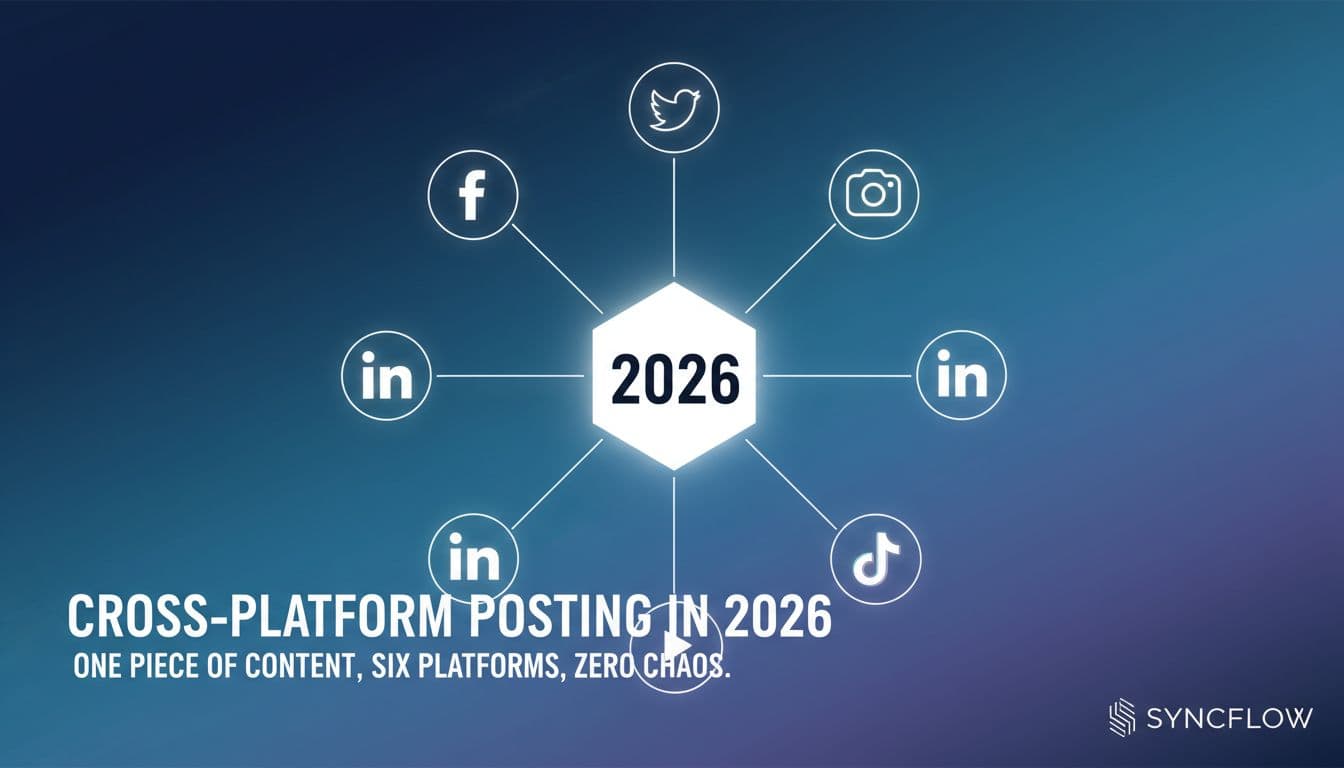
Cross-Platform Posting in 2026: One Piece of Content, Six Platforms, Zero Chaos
If you're still copying and pasting the same post across Instagram, TikTok, LinkedIn, YouTube, Facebook, and X, you're not saving time. You're just spreading the same mistake six ways. Cross-platform posting in 2026 isn't a formatting challenge anymore. It's a systems challenge. The platforms have different rules, different audiences, and different content formats. What works as a LinkedIn post will tank on TikTok. What performs on Instagram Reels won't translate to a YouTube description. And doing all of this manually, for multiple brands or clients, across multiple posts per week, adds up to hours of repetitive work that most social media managers and solopreneurs simply can't afford. This article breaks down what true cross-platform publishing looks like now that agentic AI exists, how MCP is changing the way developers and teams connect AI assistants to their publishing pipelines, and why a unified analytics dashboard is the missing piece most people overlook.

Wilzer Jean-Baptiste
10 min read
You probably already know you should be posting on multiple platforms. You might even be doing it. But if you're doing it manually in 2026, you're spending most of your time on the part that adds the least value: reformatting, copy-pasting, resizing, and rewriting the same content over and over for six different audiences. That's not a content strategy. That's a production bottleneck. The platforms have gotten more demanding, the volume expectations have gone up, and the gap between teams that have automated this and teams that haven't is starting to show in the numbers. This article is about closing that gap.
The Formatting Problem Is Actually a Systems Problem
Why Copy-Paste Cross-Posting Kills Your Reach
Here's what most people do: they write one post, copy it, and paste it into six different platforms. Maybe they tweak the hashtags. Maybe they don't. Either way, the result is usually the same. Flat engagement, low reach, and a vague feeling that social media isn't working.
The problem isn't the content. The problem is the format.
Each platform has its own rules, and they're not subtle differences. Instagram captions cap out around 2,200 characters and reward hashtag use, but the real action happens in the first 125 characters before the 'more' cutoff. LinkedIn posts can run up to 3,000 characters and perform better when they feel personal and professional, not promotional. TikTok captions are short, punchy, and built around hooks in the first two seconds of a video. X gives you 280 characters. YouTube descriptions are SEO documents as much as they are summaries. Facebook still rewards longer, conversational posts in certain communities.
Beyond character limits, there are aspect ratios. A square image from Instagram looks wrong on YouTube. A vertical 9:16 video built for TikTok or Reels won't work as a LinkedIn post thumbnail. A landscape 16:9 video made for YouTube needs to be reformatted entirely before it belongs on a Story.
Copying and pasting the same post to six platforms without adapting it doesn't just look lazy. It actively hurts your reach because platform algorithms penalize content that doesn't match native behavior. True cross-platform publishing means reformatting, not just reposting. That means rewriting the caption, adjusting the format, resizing the asset, and rethinking the hook for each platform's audience. That's not a small lift. It's a system.
The Math Nobody Talks About
Let's put some numbers on this. Say you manage social media for three small business clients. Each client needs five posts per week across six platforms. That's 30 posts per client, 90 posts total. Now multiply each post by the formatting requirements: a rewritten caption for each platform, an adjusted image or video format, a different set of hashtags or keywords, and a review pass before anything goes live.
Manual cross-platform posting in 2026 is a math problem: six platforms, multiple posts per week, per client or brand, multiplied by formatting requirements equals hours of repetitive work. For a small agency handling three to five clients, this can easily eat 15 to 20 hours a week. That's half a full-time job spent on reformatting and copy-pasting instead of strategy, creative direction, or client relationships.
AI agents can now handle this end-to-end without a human in the loop. Not AI that suggests edits. Not AI that gives you a draft you still have to reformat yourself. Agents that take a content brief, generate platform-optimized versions for every channel, apply your brand voice, and queue everything up for publishing. The math doesn't change. The person doing the math does.
This is why the conversation has shifted from 'which scheduler should I use' to 'how do I build a content system that runs without me.' The volume of work hasn't gone down. The tools have just gotten smart enough to absorb it.
What Platform-Optimized Actually Means
Platform-optimized doesn't mean slightly different. It means built for how that platform's audience actually behaves.
A LinkedIn post about a product launch should open with a personal observation or a business lesson, not a promotional headline. The same launch on Instagram should lead with a visual hook and a short, punchy caption that earns the tap. On TikTok, the video itself needs to answer a question or create curiosity in the first three seconds or it's already lost. On X, you have one sentence to make someone stop scrolling.
These aren't formatting preferences. They're audience expectations. And when you meet them, the algorithm rewards you. When you don't, it buries you. A good cross-platform system doesn't just distribute content. It translates it. That translation layer is where most manual workflows fall apart, and it's exactly where a well-trained AI agent earns its keep.
Agentic Workflows and the End of Manual Publishing
From Scheduler to Autonomous Content System
Scheduling tools used to be the answer. You'd write your posts, load them into a queue, pick your times, and let the tool publish them. That was progress. But it still required a human to write every version, format every asset, and make every decision.
Agentic workflows change that entirely. The rise of agentic AI means a single content brief can now spin into platform-optimized posts for Instagram, TikTok, LinkedIn, YouTube, Facebook, and X automatically, with brand voice preserved across every output. This is the shift from scheduling tools to autonomous content systems.
Here's what that looks like in practice. You give an AI agent a brief: 'We're launching a new product on Friday. It's a lightweight project management tool for freelancers. The tone is direct and a little playful.' The agent takes that brief and generates a LinkedIn post that opens with a freelancer pain point, an Instagram caption with a strong hook and relevant hashtags, a TikTok script with a 3-second opener, an X post that fits 280 characters and still lands the punchline, a Facebook post written for community engagement, and a YouTube description optimized for search. All of it carries the same brand voice. None of it sounds like it was written by a robot or copy-pasted from a template.
Aidelly's agentic workflows do exactly this. You start with a brief in the AI Chat Workspace, and the system builds out the full content pipeline across every platform, queues it to your content calendar, and flags anything that needs a human review before it goes live. The approval workflow is there when you want oversight. But the heavy lifting is done.
MCP: The Shift Nobody Saw Coming
MCP, which stands for Model Context Protocol, sounds technical until you understand what it actually does. Then it sounds like the thing you've been waiting for.
MCP is changing how teams and developers interact with social media management. You can now connect AI assistants like Claude or ChatGPT directly to your publishing pipeline, meaning you can tell Claude to write and schedule a post without ever opening a separate app. You stay in your AI assistant. You give it a natural language instruction. The post gets written, formatted, and scheduled.
Think about what that removes from your workflow. No switching tabs. No logging into a dashboard. No copying a draft from one tool and pasting it into another. You're already talking to Claude about your content strategy. Now Claude can act on it directly.
For developers and technical marketers, this is even bigger. Aidelly's MCP Server lets you connect any AI assistant to your social media publishing pipeline via the Model Context Protocol. You can build publishing workflows directly into your existing AI stack. If you're building an agent that handles content research, drafting, and distribution, you no longer need a separate integration layer. The MCP server handles the connection between your AI assistant and the publishing infrastructure. This isn't a feature. It's a new way of working. The interface for social media management is becoming conversational, and the tools that support that shift are the ones worth building on.
Brand Voice at Scale
One of the real risks of automating content across six platforms is losing the thing that makes your brand sound like you. Generic AI content is easy to spot. It's technically correct and completely forgettable.
The fix isn't less automation. It's smarter automation. When your brand voice guidelines are stored in the system, every piece of content the AI generates gets filtered through them. The tone stays consistent whether the post is going to LinkedIn or TikTok. The vocabulary matches. The personality comes through.
Aidelly's Brand Voice and Asset Management tools let you store those guidelines once and apply them across every output, so you're not re-briefing the AI every time or manually editing posts back into your brand's voice after the fact. You set it up once. Every post that comes out of the system sounds like it came from the same person, because in a sense, it did.
Analytics: The Part Most People Skip
Publishing Is Only Half the System
Most conversations about cross-platform posting focus on getting content out. That's understandable. Publishing is the visible part. But if you're not tracking what happens after you publish, you're flying blind on your repurposing strategy.
Cross-platform analytics matter as much as cross-platform publishing. Knowing which version of a piece of content performed best on which platform lets you refine your repurposing strategy over time instead of guessing. A unified dashboard that tracks all six channels in one place turns data into a repeatable system.
Here's a real example of why this matters. You publish a post about a client's product launch across all six platforms. The LinkedIn version gets strong engagement in the first 24 hours. The Instagram version underperforms. The TikTok video gets three times the expected views. Without a unified dashboard, you're looking at three separate analytics tools, trying to compare numbers that aren't formatted the same way, and making gut-call decisions about what to do next.
With a unified dashboard, you see all of it in one place. You can tell that the hook you used in the TikTok video worked better than the hook in the Instagram caption, and you can apply that learning to the next piece of content. You can see that LinkedIn is your strongest channel for this client and increase the posting frequency there. You stop guessing and start iterating with actual data.
Turning Data Into a Repeatable System
The goal of cross-platform analytics isn't to produce reports. It's to build a feedback loop. Every piece of content you publish is a data point. Over time, those data points tell you which formats your audience responds to, which platforms drive the most meaningful engagement for your specific niche, and which content angles consistently outperform the others.
That feedback loop is what separates a content strategy from a content habit. A habit is posting consistently and hoping something works. A strategy is posting, measuring, learning, and adjusting. The adjustment is where growth actually happens.
When your publishing system and your analytics system live in the same place, the loop closes faster. You don't have to export data, build a spreadsheet, and manually connect the dots. The insights sit right next to the content calendar. You can see what's working and act on it in the same workflow where you're planning next week's posts. That's not a small efficiency gain. It's a fundamentally different way of running a content operation.
What Good Looks Like in 2026
A well-built cross-platform content system in 2026 looks something like this. You write one brief. An AI agent generates platform-optimized posts for all six channels with your brand voice intact. The posts land in your content calendar for review. You approve them or request edits through a structured workflow. They publish at the optimal times for each platform. The analytics roll into a single dashboard. You review performance, spot patterns, and feed those insights back into the next brief.
That's the loop. Brief, generate, review, publish, measure, repeat. At no point are you reformatting captions by hand, resizing images one by one, or logging into six different platforms to check your numbers. The system handles the repetitive work. You handle the thinking.
And for developers or teams who want to go deeper, Aidelly's REST API gives you a unified publishing endpoint for all platforms, so you can build this loop directly into your own tools, your own agents, or your own internal workflows without being locked into a single interface. The infrastructure is there. The question is whether you're using it.
Cross-platform posting in 2026 isn't about working harder across more channels. It's about building a system that handles the volume, preserves your brand voice, and gets smarter with every post you publish. The platforms aren't getting simpler. The content expectations aren't going down. But the tools have finally caught up to the problem, and teams that build the right infrastructure now are the ones that will pull ahead over the next 12 months. If you're still doing this manually, or if you're using a scheduler that just queues posts without adapting them, you're leaving reach, time, and data on the table. The path forward is an autonomous content system that publishes, learns, and improves without you babysitting it every step of the way.
If you want a low-lift way to apply these ideas, Aidelly helps you keep your social content consistent without extra busywork.If you're still manually reformatting posts for six platforms, you're spending hours on work that AI agents can handle in minutes. Aidelly's agentic workflows take a single content brief and turn it into platform-optimized posts across Instagram, TikTok, LinkedIn, YouTube, Facebook, and X — with your brand voice intact, scheduled, and tracked in one place. See how it works at aidelly.ai.
Compare Social Scheduling Tools
Evaluating software for your content workflow? Use our buyer guides and comparisons to compare scheduling, approvals, analytics, and AI workflow fit.
Share this article
Related Articles
Best Social Media Scheduling Tools in 2026: Manual vs AI-Agent Platforms, Compared With Pricing
Most social media tool comparisons give you a checkbox table and call it a day. This one is different. The scheduling market has split into two very different camps in 2026: legacy tools built around manual workflows and agentic tools that let AI handle your entire content lifecycle. Before you pick a tool, you need to know which camp you actually want to be in. This article walks through the real differences between Buffer, Hootsuite, Later, and Aidelly — covering pricing transparency, auto-scheduling accuracy, developer and agency use cases, and the shift toward autonomous AI workflows. No sponsored rankings. No vague feature lists. Just an honest look at what each tool actually does, where each one wins, and how to match the right tool to how you actually work.
May 25, 2026
Read more
How Restaurants Can Schedule a Month of Social Content in Under Two Hours
Most restaurant owners spend 5 to 10 hours a month on social media and still post inconsistently. The problem is not effort. It is the lack of a repeatable system. This guide gives you a real, three-phase framework that takes under two hours once a month and keeps your restaurant visible all 30 days. You will learn how to batch your content, use agentic AI to handle the heavy lifting, and schedule everything across Instagram, Facebook, TikTok, and more without touching it again until next month. Whether you are running a busy dinner service solo or managing social for a handful of restaurant clients, this system works because it is built around how restaurants actually operate, not how marketing textbooks say they should.
May 21, 2026
Read more
AI Brand Voice Training: How to Make Every Scheduled Post Sound Like You
Most AI-generated social media posts have a problem. They sound like AI wrote them. The sentences are clean, the tone is polite, and nothing about them sounds like the person behind the brand. If you've pasted your content into an AI tool and gotten back something that technically works but feels completely wrong, you already know what this means. The fix isn't a better prompt. It's better infrastructure. Brand voice documentation — written down, structured, and stored somewhere your AI tools can actually use it — is what separates generic output from posts that sound like you wrote them on your best day. This article walks through how to build that foundation, how to train AI on your specific voice, and how tools like Aidelly put that voice to work across every platform you post on.
Jun 3, 2026
Read moreReady to never miss a post again?
Tell Aidelly what to post. It drafts, schedules, and publishes across 9 platforms while you focus on your business.