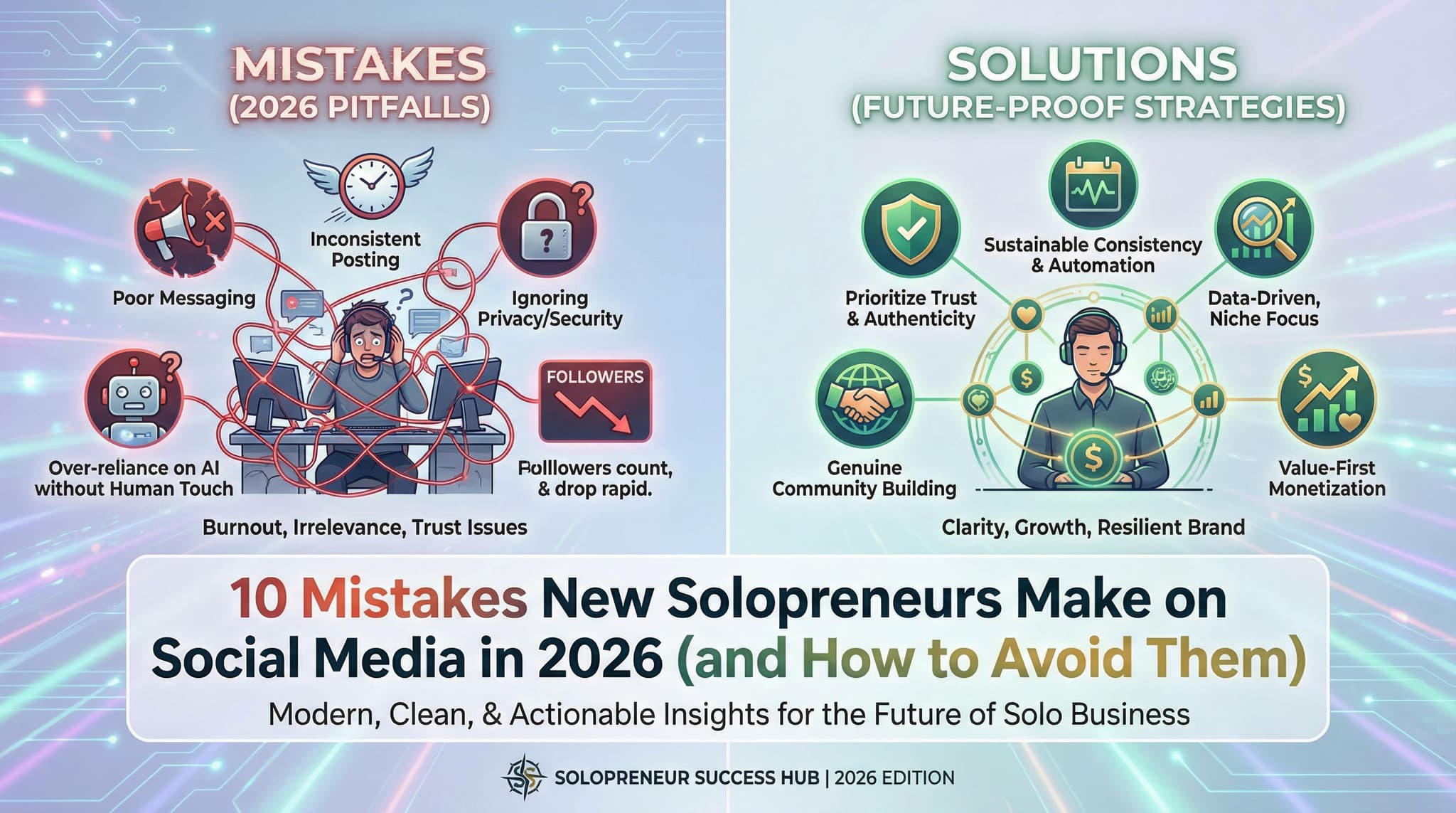
10 Mistakes New Solopreneurs Make on Social Media in 2026 (and How to Avoid Them)
You're juggling everything—client work, admin tasks, and now you're supposed to be active on social media too. As a solopreneur, you're probably making at least one of these ten social media mistakes that's quietly killing your growth. The good news? These aren't fatal errors. They're fixable, and most of them stem from the same root cause: trying to do too much with too little. This guide walks you through each mistake, explains why solopreneurs fall into these traps, and gives you practical, budget-friendly solutions that actually fit into your chaotic schedule.

Wilzer Jean-Baptiste
10 min read
Let's be honest. When you decided to go solo, nobody handed you a manual for social media marketing. You're probably wearing seventeen different hats already—sales, operations, customer service, product development—and now everyone's telling you that you need to be on social media to grow your business. So you dive in with good intentions, maybe post a few times, and then... life happens. Months pass. You wonder why nobody's engaging with your content. You see competitors posting daily and start questioning whether you're doing this all wrong.
Here's the thing: you're not doing it all wrong. You're just making the same mistakes almost every new solopreneur makes. And the best part? Once you understand these mistakes and why you're making them, avoiding them becomes so much easier. This isn't about achieving perfection on social media. It's about making strategic, small adjustments that compound over time. It's about working smarter while respecting the reality that you're one person with limited time and budget.
In this guide, we're covering the ten most common social media mistakes I see solopreneurs make—and more importantly, exactly how to fix them without burning out or hiring an expensive agency.
Section 1: The Foundation Mistakes (Strategy & Consistency)
When you're starting out as a solopreneur, the biggest mistakes aren't usually about tactics or trending sounds. They're about foundation. They're about having no plan, showing up randomly, and spreading yourself too thin. These three mistakes form a domino effect—one leads to another, and suddenly your social media presence becomes just another source of stress instead of a business-building tool.
Think about it this way: if you walked into a client meeting without a strategy, without knowing what you were going to say, and without a clear timeline, you'd lose that client. Yet many solopreneurs do exactly this on social media every single day. The difference is, with a client meeting, the failure is obvious and immediate. With social media, the failure is slow and invisible until you realize you've been posting for months with zero growth.
The good news? These foundation mistakes are also the easiest to fix. They don't require money. They don't require fancy tools. They just require a shift in how you think about social media and a tiny bit of upfront planning that will save you countless hours down the road.
Mistake #1: Posting Inconsistently Without a Content Calendar
Let's start with the one mistake that affects almost everything else: posting without consistency or a plan. You know you should post regularly, but what does that even mean when you're running a business solo? So you post when you remember. Maybe three times this week, nothing for two weeks, then a desperate flurry of posts on a Tuesday evening when you suddenly realize your Instagram hasn't been updated since March.
Here's why solopreneurs make this mistake: it's not laziness. It's overwhelm. When you don't have a plan, deciding what to post feels like a massive creative task that requires energy you don't have right now. So you put it off. And off. And off. Meanwhile, the algorithm is basically ghosting you because it can't rely on you for consistent content, and your audience (the few you have) stops checking in because you're unpredictable.
The algorithm penalty is real. Social platforms reward consistency. They want predictable creators because it keeps users coming back. When you post sporadically, the platform doesn't push your content to as many people. Your engagement suffers. Your reach shrinks. It becomes a vicious cycle.
The solution: Create a simple content calendar. Not a complicated Asana project with color-coding and dependencies. Just a basic spreadsheet or even a Google Calendar where you plan out what you're posting and when. Start with just 2-3 posts per week on your main platform. Yes, you read that right—2-3, not 10. Consistency beats volume every single time.
Sarah, a freelance copywriter, was posting whenever inspiration struck. Some weeks she'd post five times; other weeks, zero. Her engagement was flatlined at about 15 likes per post. She created a simple content calendar and committed to posting three times per week on LinkedIn (where her audience actually was). Within two months, her average engagement jumped to 60+ likes per post. The posts didn't change. The consistency did.
Download a free content calendar template and batch your content on Sundays for the week ahead. Spend one hour per week planning. That's it. This single change alone will put you ahead of 70% of solopreneurs who are still posting randomly.
Mistake #2: Trying to Be Active on Every Platform Instead of Focusing on 2-3
You've got a LinkedIn profile, an Instagram account, a TikTok that your niece said you should have, a Facebook business page because that's where older customers might be, and you're thinking about YouTube. You're basically everywhere... and nowhere. This is the solopreneur's version of the shiny object syndrome, and it's absolutely killing your efforts.
Here's the psychological trap: it feels like you're being lazy if you're not on every platform. You see other businesses posting on six platforms and think, "I should do that too." But those other businesses usually have a team. Or a social media manager. Or they're actually just using scheduling tools and reposting the same content everywhere (which, spoiler alert, doesn't work well because every platform has different cultures and audiences).
As a solopreneur with limited time, spreading yourself across every platform is like trying to dig six wells at the same time instead of digging one well really deep. You end up with six shallow holes and zero water.
The solution: Identify where your ideal customer actually spends time. Not where you think they should be. Where they actually are. If you're a B2B consultant, LinkedIn is probably your goldmine. If you're a visual brand like an interior designer, Instagram and Pinterest matter. If you're targeting Gen Z, TikTok and Instagram Reels are non-negotiable. Pick 2-3 platforms maximum and absolutely crush it there before you even think about expanding.
Marcus, a business coach, was exhausted trying to maintain presence on five platforms. He was barely posting on any of them. After analyzing his client base, he realized 80% of his clients found him through LinkedIn recommendations and blog searches. He stopped posting everywhere else and doubled down on LinkedIn and his blog. His client acquisition actually increased, and his stress decreased. He was doing less but achieving more.
When you focus on 2-3 platforms, you can actually show up authentically. You can engage in conversations. You can build real relationships. You're not just broadcasting into the void.
Mistake #3: Creating Overly Salesy Content Without Providing Value
You post about your services. Then you post about your services again. Then you share a testimonial about your services. Rinse, repeat. And then you wonder why people aren't engaging. Welcome to the 80/20 rule that most solopreneurs get completely backward.
The mistake here is confusing social media with a sales brochure. Social media is a relationship-building platform first and a sales channel second. When you're constantly selling, you're not building relationships. You're just being annoying. And people follow people they like and trust, not people who are always trying to extract money from them.
Why do solopreneurs make this mistake? Because you're trying to make sales. You're worried about revenue. You feel like you should be constantly promoting because time is money and every post should generate a return. This scarcity mindset actually sabotages your results. The irony is that the solopreneurs who post the most value-driven content end up making more sales, not fewer.
The solution: Adopt the 80/20 rule: 80% of your content should provide value (tips, insights, behind-the-scenes, education, entertainment, inspiration), and only 20% should be promotional. This isn't a magic formula—it's just the ratio that feels natural and non-salesy to human beings. When you follow this ratio, people actually want to see your content. And when they see 20 pieces of valuable content from you, that 1 promotional post hits differently. They're more likely to take action because they already trust you.
Jennifer, a virtual assistant, was posting daily about her services and booking calls. Her engagement was terrible. She switched her content strategy to share productivity tips, templates she created, and honest behind-the-scenes looks at her day. She posted about her services maybe once a week. Within three months, she had a waitlist and was turning down clients. The value-first approach built trust. The trust built demand.
Your audience doesn't care about your features. They care about their problems and how you can solve them. Lead with the solution, not the sales pitch.
Mistake #4: Ignoring Analytics and Not Measuring What Content Performs Best
You post content and hope for the best. Maybe you glance at your metrics once a month and think, "Oh, that one got more likes." But you're not actually studying the data. You're not learning. You're just guessing what works and then wondering why your growth is inconsistent.
Most social platforms give you analytics for free. LinkedIn shows you which posts got the most engagement, what time your audience is most active, what type of content resonates. Instagram has Insights. TikTok has Analytics. But most solopreneurs never look at this stuff because it feels boring, or they think it requires a data science degree to understand.
The truth is simpler: if you're not measuring, you're just throwing spaghetti at the wall. You're wasting your limited time on content that doesn't work while ignoring what does.
The solution: Spend 15 minutes every two weeks looking at your analytics. Don't get obsessive about it. Just notice patterns. Which posts got shared the most? Which ones generated comments (not just likes—comments are more valuable)? What time did your best-performing posts go live? What was the topic? Write these observations down. After a month, you'll see patterns. After three months, you'll have a content playbook based on data, not guesses.
Tom, a freelance designer, was posting random project showcases with no rhyme or reason. When he finally looked at his analytics, he noticed that posts showing his process (not just the final product) got 3x more engagement and comments. Posts at 9 AM on Tuesdays performed better than posts at other times. Once he identified these patterns, he intentionally created more process-focused content and adjusted his posting schedule. His engagement doubled in two months.
You don't need fancy analytics tools. The built-in platform analytics are more than enough to get started. Use them.
Compare Social Scheduling Tools
Evaluating software for your content workflow? Use our buyer guides and comparisons to compare scheduling, approvals, analytics, and AI workflow fit.
Share this article
Ready to never miss a post again?
Tell Aidelly what to post. It drafts, schedules, and publishes across 9 platforms while you focus on your business.