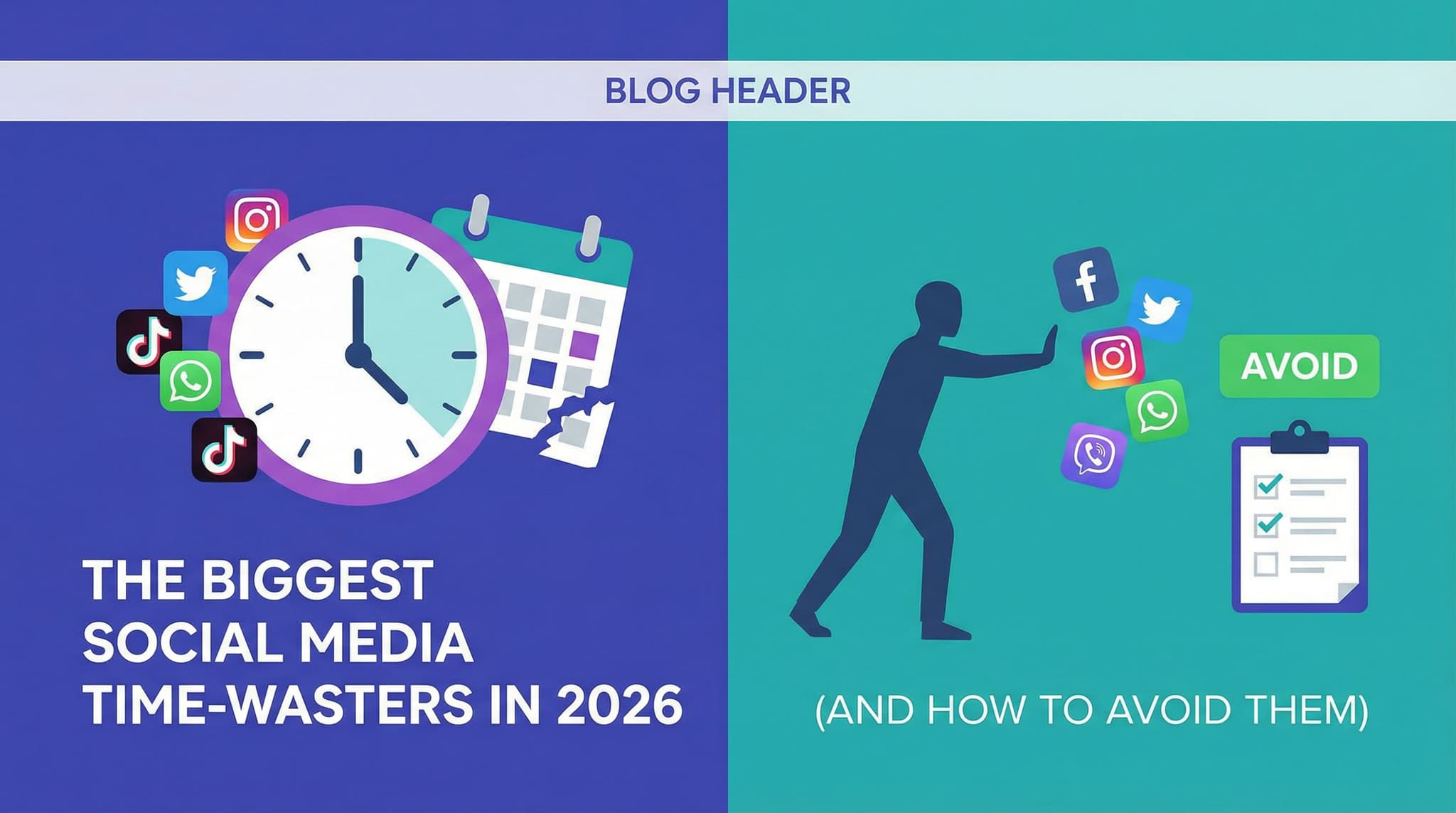
The Biggest Social Media Time-Wasters in 2026 (and How to Avoid Them)
We're spending an average of 2-3 hours daily on social media, with Gen Z pushing even higher. But here's the thing: that time isn't disappearing by accident. Social media platforms employ sophisticated psychological tactics—infinite scrolls, algorithmic feeds, dopamine-driven reward systems—specifically designed to keep you engaged. This comprehensive guide exposes how these platforms trap your attention and provides science-backed, actionable strategies to reclaim your time without abandoning social media entirely.

Wilzer Jean-Baptiste
22 min read
You open Instagram to quickly check a message. Thirty minutes later, you're watching someone's vacation highlights, reading heated comments on a stranger's post, and wondering where your afternoon went. Sound familiar? You're not alone, and more importantly, you're not weak-willed. What you're experiencing is the result of intentional design—platforms engineered by teams of engineers and psychologists specifically to maximize your engagement and minimize your ability to leave.
The average person now spends 2-3 hours daily scrolling through social media, with younger generations spending significantly more. That's roughly 730 to 1,095 hours per year—equivalent to working a full-time job just for the platforms. But unlike work, these hours often leave you feeling depleted rather than accomplished. The frustrating part? The platforms aren't just addictive by accident. They're addictive by design.
The good news is that understanding how these systems work is the first step toward reclaiming your time. This isn't about quitting social media entirely—that's unrealistic for most of us. It's about becoming intentional. It's about recognizing the psychological triggers, the architectural traps, and the dopamine loops that keep you scrolling, and then taking back control.
Section 1: How Platforms Hijack Your Brain
Social media platforms aren't just apps—they're psychological laboratories designed to exploit how your brain naturally works. Every feature, every notification, every algorithmic recommendation exists for one primary reason: to maximize the time you spend on the platform. Understanding these mechanisms isn't about feeling guilty; it's about recognizing the game so you can play it differently.
The architecture of modern social media is built on principles that neuroscientists have understood for decades. When you get a like on your post, your brain releases dopamine—the same neurotransmitter associated with reward-seeking behavior. This isn't a side effect; it's the entire point. Platforms have weaponized our brain chemistry against our own interests, creating feedback loops so powerful they rival gambling in their addictive potential.
What makes this particularly insidious is that these aren't conscious choices by users. You're not deciding to waste time; you're responding to stimuli that have been carefully engineered to trigger automatic behavior. The infinite scroll doesn't stop because there's genuinely more content worth seeing. It stops because the platform wants to maximize engagement metrics. Your compulsive checking of notifications isn't about missing something important—it's about your brain anticipating the dopamine hit of a new interaction.
1.1: Infinite Scroll and Algorithmic Feeds—The Never-Ending Trap
Remember when websites had a 'bottom'? When you could actually finish scrolling and reach the end of a feed? That was by design—literally. Social media platforms deliberately eliminated the concept of a finishing line. The infinite scroll is one of the most psychologically manipulative features ever created, and it's not an accident that it exists.
Infinite scroll works by removing friction. In the old model, you'd reach the bottom of a feed, see a 'Load More' button, and have a moment to reconsider whether you actually wanted to keep browsing. That moment of friction was an off-ramp. Someone might think, 'You know what? I've been here for 20 minutes. Maybe I should close the app.' But with infinite scroll, there's no decision point. New content just keeps appearing, seamlessly, endlessly. Your thumb keeps moving. Your brain keeps seeking the next dopamine hit.
What makes this worse is the algorithmic layer. Platforms don't just show you chronological content anymore. They use machine learning algorithms that understand your behavior patterns better than you understand them yourself. These algorithms have one job: predict what content will keep you engaged the longest. It's not about showing you what you want to see. It's about showing you what will make you stay. This might be outrage-inducing political content, comparison-triggering vacation photos, or mildly interesting videos that keep playing one after another. The algorithm doesn't care about your wellbeing; it cares about your engagement time.
The result is a feed that's engineered to be impossible to leave. Just when you're thinking about closing the app, the algorithm serves you something perfectly calibrated to your interests—something you can't help but click on. It's a slot machine, and you're the person pulling the lever.
1.2: Psychological Triggers—Notifications, Likes, and Comments
Your phone buzzes. Your heart rate quickens slightly. You reach for it almost involuntarily. That's not you being weak; that's operant conditioning—the same principle that made Pavlov's dogs salivate at the sound of a bell. Social media platforms have conditioned us to respond to notifications with the same automatic response a dog has to a dinner bell.
Notifications are the most direct psychological trigger that platforms use. Every alert—whether it's a like, a comment, a message, or a mention—is designed to pull you back into the app. Platforms have discovered that the uncertainty of what the notification might be is actually more powerful than the notification itself. You don't know if that red badge means someone agreed with you, disagreed with you, or just tagged you in a meme. That uncertainty creates curiosity, and curiosity pulls you in.
Once you're in the app, the likes and comments take over. The social validation of a like is a real, measurable reward. Studies using fMRI technology have shown that receiving likes activates the same reward centers in the brain as winning money or eating chocolate. This isn't metaphorical—it's neurochemical. Each like is a little hit of dopamine, and your brain learns to crave more of them. This is why some people compulsively check their posts to see how many likes they're getting. They're not being vain; they're responding to a genuine neurochemical reward system.
Comments create an even more complex psychological dynamic. A comment means someone engaged deeply enough with your content to write something. That's social validation on steroids. But comments also create urgency—you feel compelled to respond, to defend your position, or to continue the conversation. This turns passive scrolling into active engagement, which keeps you on the platform even longer.
1.3: Video Content and Autoplay—The Dopamine Accelerant
If infinite scroll is the trap, video autoplay is the accelerant. TikTok, Instagram Reels, and YouTube Shorts have fundamentally changed how we consume social media, and the time drain is exponentially worse than text-based content. A single video might be 15 to 60 seconds long, but the autoplay feature means you're not watching one video—you're watching dozens without ever making a conscious decision to continue.
Video is inherently more engaging than text. It requires less cognitive effort to consume, which means your brain doesn't get tired from it the way it does from reading. You can mindlessly watch video after video without feeling mentally exhausted, even though you're actually consuming content more rapidly than you would if you were reading. This is why people regularly lose 2-3 hours to TikTok without realizing it. They'll open the app 'for just a minute' and suddenly it's dinner time.
The autoplay feature is where the real trap lies. Each video ends, and immediately—without any action on your part—the next one starts playing. There's no friction, no decision point, no moment to ask yourself, 'Do I actually want to keep watching?' The platform makes that decision for you. And because the algorithm is constantly improving at predicting what you'll find engaging, each video tends to be slightly more interesting than the last one, creating an irresistible pull to keep watching.
The dopamine hit from video is also different than from text or images. Video has movement, sound, storytelling, and emotional peaks that create stronger neurochemical responses. This is why you can watch 50 TikToks and feel more mentally drained than reading 50 articles, even though the articles required more cognitive processing. Video is optimized for dopamine production in a way that text simply isn't.
Section 2: The Psychology of Compulsion—Why You Can't Stop Checking
At this point, you might be thinking, 'Okay, I get it. The platforms are designed to be addictive. But why do I feel compelled to check them even when I'm not enjoying it? Why do I open Instagram when I'm bored, even though I know I'll regret it?' The answer lies in understanding the deeper psychological patterns that platforms exploit—comparison culture, FOMO, and the dopamine-driven feedback loops that function exactly like gambling.
These aren't separate issues; they're interconnected psychological systems that reinforce each other. When you feel FOMO, you check the app. When you check the app, you see content that triggers comparison. Comparison makes you feel inadequate, which triggers more FOMO. Round and round it goes. And underneath all of this is a dopamine reward system that's literally rewiring your brain to seek these experiences, even when they make you feel worse.
The most insidious part is that these systems are self-perpetuating. The more time you spend on social media, the more your brain adapts to expect these dopamine hits. This is called tolerance. Just like someone who uses drugs needs increasingly larger doses to achieve the same high, someone who spends hours on social media needs increasingly more engagement to feel satisfied. It's a vicious cycle that gets harder to break the longer you stay in it.
2.1: Comparison Culture and FOMO—The Compulsion Engine
Social media has created an environment where comparison is not just possible—it's inevitable. You're constantly exposed to curated highlight reels of thousands of people's lives. Everyone's vacation looks better than yours. Everyone's relationship looks more romantic. Everyone's kids look better behaved. Everyone's career looks more successful. This isn't because everyone's life is objectively better; it's because you're only seeing the moments people choose to share.
But your brain doesn't process it that way. Your brain sees the highlight reel and compares it to your entire life—the boring moments, the failures, the times when you're just sitting on the couch in sweatpants. This creates a constant sense of inadequacy. Research has shown that the more time people spend on social media, the higher their rates of anxiety and depression. This isn't a coincidence. It's a direct result of constant comparison.
FOMO—fear of missing out—is what drives you to keep checking. Even when you're not enjoying social media, even when you know it makes you feel worse, you feel compelled to check because you're afraid you're missing something. Someone might be talking about you. There might be important news. Your best friend might have posted something. This fear is powerful enough to override your conscious desire to put the phone down.
What's clever about how platforms use this is that they've created features specifically designed to amplify FOMO. Stories disappear after 24 hours, creating urgency. Live streams happen in real-time, creating FOMO about missing them. Group chats create urgency about responding quickly. These aren't accidental design choices; they're deliberate mechanisms to keep you checking frequently.
The result is a compulsion that feels almost involuntary. You check your phone first thing in the morning, not because you want to, but because the FOMO is pulling at you. You check during meetings, during meals, during conversations. You're not choosing this behavior; you're responding to a psychological system that's been engineered to trigger this exact response.
2.2: Dopamine Loops and Reward-Seeking Behavior
Underneath all of this is a neurochemical system that's being directly manipulated. Dopamine is often called the 'pleasure chemical,' but that's not quite accurate. Dopamine is actually about anticipation and reward-seeking. It's the chemical that makes you want something, not the one that makes you happy when you get it. This distinction is crucial because it explains why social media can be so addictive even when it doesn't actually make you happy.
When you post something on social media, you don't get an immediate dopamine hit. You get a dopamine hit from the anticipation of potential likes and comments. Your brain starts wondering: 'Will people like this? Will anyone comment?' That anticipation triggers dopamine release. Then, when the likes start coming in, your brain gets another dopamine hit—but it's weaker than the anticipation hit. This is why people constantly check their posts to see how many likes they're getting. They're chasing that anticipation dopamine, not the reward dopamine.
This is virtually identical to how gambling works. In a slot machine, you pull the lever not knowing what you'll get. That uncertainty creates dopamine release. Sometimes you win, sometimes you lose, but the unpredictability is what keeps people pulling the lever. Social media works the same way. You post something, and you don't know how many likes you'll get. That uncertainty creates dopamine. The variable reward schedule (sometimes you get lots of likes, sometimes you don't) is actually more addictive than a consistent reward would be.
The really insidious part is that this system trains your brain to crave the dopamine hit of checking social media. Your brain learns that opening the app might result in a reward (a like, a comment, an interesting video). That anticipation becomes powerful enough to override your conscious desires. You're sitting in a meeting thinking about checking your phone not because you consciously want to, but because your brain is anticipating the dopamine hit.
This is why breaking social media habits is so hard. You're not just fighting a habit; you're fighting your own neurochemistry. Your brain has been rewired to crave these dopamine hits, and it will continue to crave them even when you consciously recognize that social media isn't making you happy.
2.3: Features Designed for Urgency—Stories, Live Streams, and Group Chats
If infinite scroll is the basic trap, then Stories, Live streams, and group chats are the advanced mechanisms designed to create urgency and frequent returns. These features don't just encourage engagement; they create artificial time pressure that makes you feel like you have to check the app constantly.
Stories are a perfect example. They disappear after 24 hours, which creates a false sense of urgency. You might not actually care about seeing someone's daily life, but knowing that the content will disappear forever creates pressure to check. This is a psychological principle called scarcity—people value things more when they're limited. By making Stories temporary, platforms ensure that people check more frequently throughout the day.
Live streams take this further. When someone you follow goes live, you get a notification. Unlike a regular post that you can see anytime, a live stream is happening right now, and if you miss it, it's gone. This creates real urgency. People will interrupt what they're doing to watch a live stream they might have skipped if it were posted as a regular video. Platforms know this, which is why they push live features so heavily.
Group chats create a different kind of urgency—social urgency. When multiple people are messaging in a group chat, you feel pressure to respond quickly and stay engaged. You don't want to miss the conversation or have people think you're ignoring them. This creates a constant background anxiety that drives frequent checking. Unlike Stories or Live streams, group chats can create a sense of obligation that's hard to shake.
The genius of these features is that they create multiple reasons to check the app throughout the day. It's not just about seeing new content; it's about not missing time-sensitive content. This transforms social media from something you choose to check into something you feel compelled to check. The app goes from optional entertainment to something that feels necessary.
Section 3: Reclaiming Your Time—Actionable Strategies That Actually Work
Understanding how social media manipulates you is important, but it's not enough. You need concrete strategies to break these patterns. The good news is that once you understand the mechanisms, you can use them against the platforms. You can't change how the platforms are designed, but you can change how you interact with them.
The key principle here is intentionality. Every interaction with social media should be a conscious choice, not an automatic response. This doesn't mean you have to quit social media entirely. It means being strategic about when, where, and how you use it. It means recognizing that you have more control than you think, even if the platforms have spent millions of dollars trying to make you feel like you don't.
These strategies work because they address the root causes of social media addiction. They remove the friction that makes the platforms work, they eliminate the triggers that pull you back in, and they help you rebuild healthier habits. None of these strategies are about willpower or discipline. They're about changing your environment and your patterns so that the healthy choice becomes the easy choice.
3.1: Time-Blocking, App Timers, and Notification Management
The most effective strategy for reducing social media time is time-blocking—designating specific times when you'll use social media and sticking to those times. This works because it removes the constant availability that makes social media so addictive. Instead of checking the app whenever you have a moment, you check it at designated times. This might be 15 minutes after lunch and 15 minutes before bed. That's it.
Time-blocking works for several reasons. First, it creates friction. Instead of mindlessly opening the app when you're bored, you have to wait until your designated time. That waiting period often means the urge passes. Second, it creates a limited window, which paradoxically makes the experience more satisfying. When you know you only have 15 minutes, you're more likely to be intentional about what you look at. Third, it removes the constant background anxiety of 'I should probably check my phone.' You know when you're checking it, so you can relax at other times.
App timers are the enforcement mechanism for time-blocking. Most phones now have built-in app limit features (Screen Time on iOS, Digital Wellbeing on Android). You can set a daily limit on specific apps, and once you hit that limit, the app becomes inaccessible for the rest of the day. This isn't about willpower—it's about making the choice for yourself in advance, when you're thinking clearly, and then letting technology enforce that choice when you're tempted.
Notification management is equally crucial. Every notification is a trigger designed to pull you back into the app. The solution is to disable almost all notifications. You don't need notifications for likes, comments, or new followers. You don't need notifications for Stories or Live streams. The only notifications you might want to keep are direct messages from people you actually care about—and even then, you might want to batch them rather than getting them in real-time.
Here's the practical implementation: Go into your phone settings right now. Open the notification settings for each social media app. Disable everything except direct messages. Then, disable the badge icons (the little red circles showing how many notifications you have). Out of sight, out of mind. Without these constant visual reminders, you'll check the apps far less frequently.
Set your app timers to a specific amount of time per day. For most people, 30-45 minutes total is reasonable if you actually need social media for work or staying connected. Once you hit that limit, the app locks you out. This isn't punishment; it's protection. You're protecting yourself from the addictive mechanisms that you can't resist through willpower alone.
3.2: Multitasking Awareness and Cognitive Performance
Here's something most people don't realize: when you're multitasking with social media, you're not actually multitasking. You're rapidly switching between tasks, and each switch comes with a cognitive cost. Research has shown that multitasking reduces your productivity by up to 40% and significantly impairs your cognitive performance on complex tasks. Every time you check your phone while working, you're not just losing the time you spend on the phone—you're losing your focus and mental clarity for 15-20 minutes after you put it down.
This is called 'attention residue.' When you switch from a complex task to social media and back again, part of your attention stays on the first task. You're not fully present in either activity. This is why people who check their phones frequently during work take longer to complete tasks and produce lower-quality work. It's not laziness; it's neuroscience.
The solution is simple: eliminate the opportunity for multitasking. When you're working on something that requires focus, put your phone in another room. Not on silent, not face-down—in another room. Out of sight, out of mind. This removes the temptation entirely. You can't check something you can't see. After a few weeks of this, you'll notice a dramatic improvement in your focus, productivity, and the quality of your work.
If you absolutely need your phone nearby (for legitimate reasons like work calls), use app-level restrictions. Some phones allow you to put specific apps in 'focus mode,' where they're completely inaccessible until you disable the focus mode. Use this during work hours. Make social media impossible to access, not just discouraged.
The cognitive benefits of reducing social media multitasking extend beyond work. You'll notice you're better at conversations because you're actually present. You'll enjoy meals more because you're tasting the food instead of scrolling. You'll read books more effectively because your brain isn't divided. These might seem like small things, but they add up to a significantly better quality of life.
3.3: Intentional Usage Strategies—Designated Hours and Curated Feeds
Beyond the blocking and limiting strategies, you need intentional usage strategies that change how you interact with social media during the time you do spend there. The goal is to make your social media use active and purposeful rather than passive and reactive. This means being intentional about when you check, what you look at, and why you're using the platform.
Designated social media hours are your primary strategy. Instead of checking throughout the day, you pick specific times to check. This might be 12:15 PM to 12:30 PM and 6:00 PM to 6:15 PM. These become your 'social media windows.' Outside these windows, you don't check at all. This creates a psychological boundary that's surprisingly effective. Your brain learns that social media is a scheduled activity, not something available on demand.
During your designated hours, be intentional about what you're looking at. Most platforms allow you to choose between algorithmic feeds and chronological feeds. Choose chronological. Unfollow accounts that make you feel bad about yourself. Unfollow people who trigger comparison or FOMO. Follow accounts that actually provide value—educational content, humor, genuine connection, inspiration. This might seem like a small change, but your feed is the primary input that determines your experience. A curated feed is exponentially less addictive than an algorithmically-optimized one because the algorithm is specifically designed to show you things that keep you engaged, not things that make you happy.
Consider using app alternatives that are designed for intentional use rather than addictive engagement. Some third-party apps let you access social media with limited feeds and no infinite scroll. Others allow you to set strict time limits. These aren't as feature-rich as the official apps, but that's the point. You're intentionally choosing a less engaging experience because you value your time more than you value convenience.
Finally, make a rule about when and where you use social media. No phones at meals. No phones in bed. No phones in the bathroom (yes, this is important). No phones during conversations. These boundaries might seem arbitrary, but they're actually protecting your most important experiences from being interrupted by notifications and the urge to check. The time you spend with people you care about, the meals you eat, the sleep you get—these are the things that actually matter. Social media is secondary to all of them.
Track your actual usage for a week using your phone's built-in analytics. Most people are shocked to discover how much time they're actually spending. Seeing the data—'I spent 3 hours and 47 minutes on Instagram today'—creates a cognitive dissonance that motivates change in a way that abstract awareness doesn't. Use this data to set realistic targets. If you're currently spending 3 hours a day, don't try to drop to 15 minutes. Drop to 90 minutes first. Gradual change is more sustainable than radical change.
The reality is that social media platforms have invested billions of dollars in making themselves addictive. They've hired the best neuroscientists and psychologists to exploit how your brain works. They've engineered infinite scrolls, algorithmic feeds, and dopamine-driven reward systems specifically to maximize your engagement time. Understanding these mechanisms isn't about self-blame; it's about recognizing that you're not fighting a fair fight—and you don't have to win by willpower alone.
The strategies in this article—time-blocking, app timers, notification management, curated feeds, and intentional usage patterns—aren't about willpower. They're about changing your environment and your patterns so that the healthy choice becomes the easy choice. They're about taking back control from systems designed to control you. The goal isn't to quit social media entirely; it's to use it intentionally rather than compulsively, to reclaim the 2-3 hours daily that most of us are losing to these platforms, and to rebuild a relationship with technology that works for you instead of against you.
The first step is awareness, which you now have. The second step is action. Pick one strategy from this article—maybe it's disabling notifications, maybe it's setting your first app timer, maybe it's designating your first social media hour. Start there. Small changes compound into significant results. Your time is your most valuable resource, and it's worth protecting.
Now that you understand how these platforms are engineered to steal your attention, the irony is that managing your social presence *effectively* doesn't require spending more time scrolling—it requires working smarter. If you're responsible for maintaining a brand presence across multiple platforms, Aidelly takes the guesswork and time-drain out of social media by letting you create and schedule engaging content in advance, so you can maintain a consistent voice without falling into those dopamine-driven traps yourself. Instead of reactive posting and endless platform-hopping, you'll have a strategic system that keeps your audience engaged while protecting your own time and mental energy. Ready to reclaim your hours while still building a strong social presence? Get started at aidelly.ai.Compare Social Scheduling Tools
Evaluating software for your content workflow? Use our buyer guides and comparisons to compare scheduling, approvals, analytics, and AI workflow fit.
Share this article
Ready to never miss a post again?
Tell Aidelly what to post. It drafts, schedules, and publishes across 9 platforms while you focus on your business.