Social Media Marketing for Beginners 2026: The Complete Do's and Don'ts Guide
 By Wilzer Jean-Baptiste22 min read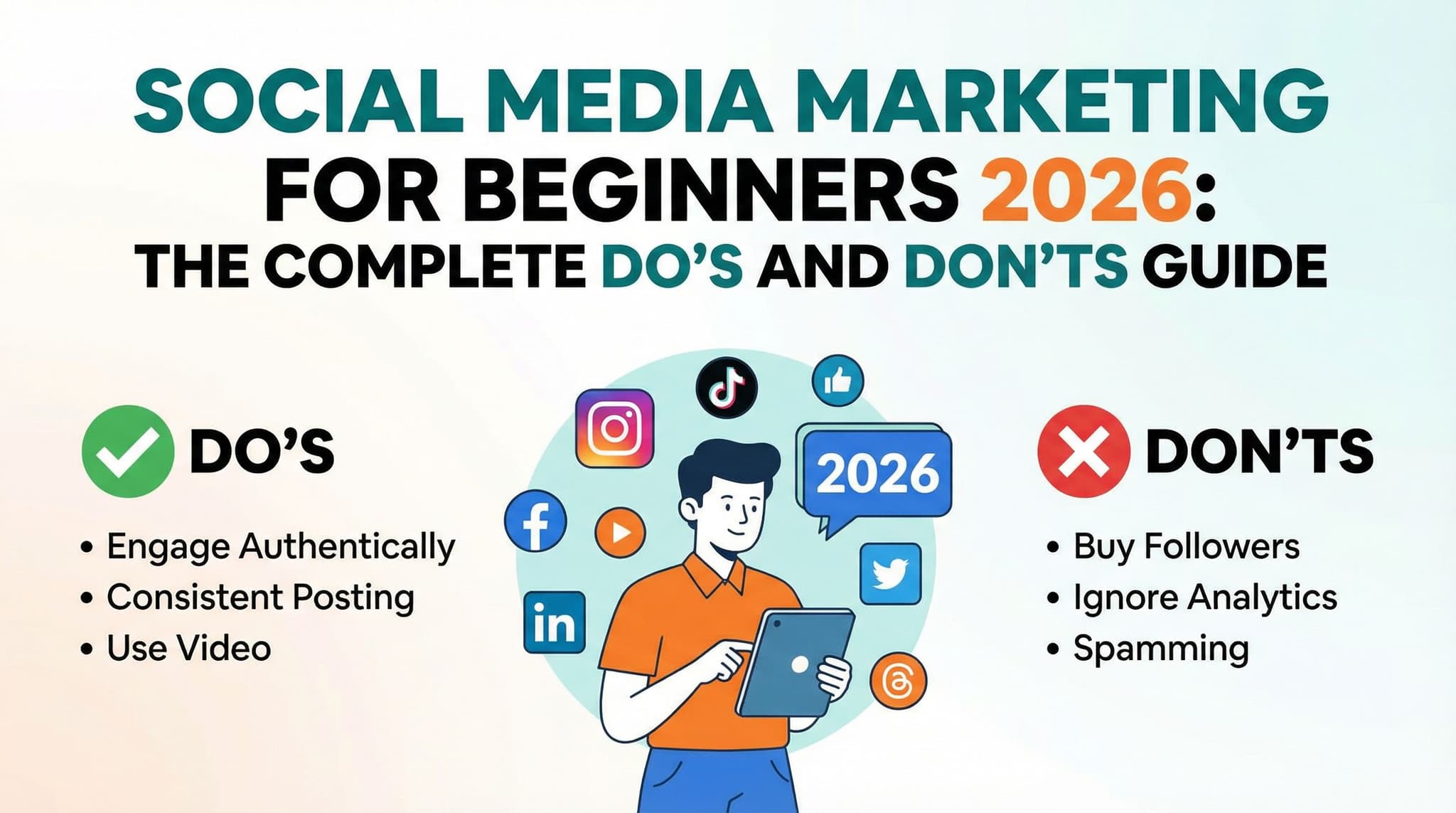
Let me be honest with you: when I first started managing social media for my small business back in 2023, I was an absolute mess. I posted randomly whenever I felt like it, threw hashtags at the wall hoping something would stick, and spent three weeks perfecting a single Instagram post that got 12 likes. I was exhausted, discouraged, and convinced that social media marketing was some mystical art only big brands with unlimited budgets could master.
Here's what I didn't know then: social media marketing isn't complicated. It's just different from traditional marketing, and once you understand the fundamentals—and more importantly, the pitfalls to avoid—you can build genuine connections with your audience without losing your mind or your money.
If you're sitting where I was, staring at your business and wondering how to build an online presence, this guide is for you. We're going to skip the generic "best practices" nonsense and focus on what actually matters: the specific mistakes beginners make, how to avoid them, and a realistic 30-day action plan to get you started on the right foot.
Section 1: Building Your Foundation (Before You Post Anything)
Here's the biggest mistake I see beginners make: they jump straight into creating content without any real strategy. They open a TikTok account because their competitor has one, or they start posting on LinkedIn because someone told them that's where "serious businesses" hang out. Then they wonder why they're getting zero engagement and burning out within two months.
The truth is, social media success starts long before you write your first caption or schedule your first post. It starts with understanding what you actually want to accomplish and how you'll measure success. Without this foundation, you're basically throwing spaghetti at the wall and hoping something sticks. Let's build that foundation properly.
1.1: Define Your Business Goals and KPIs Before Posting
This is the single most important step, and it's the one most beginners skip. You need to know exactly what you want social media to do for your business before you spend a single minute creating content.
Here's what I mean by this: social media can serve different purposes depending on your business. Maybe you want to drive traffic to your website to generate sales. Maybe you're a service provider and you want to build authority and trust so people book consultations with you. Maybe you run a local coffee shop and you want to increase foot traffic. Maybe you're launching a new product and you want to build buzz. These are completely different goals, and they require completely different strategies.
Once you know your main goal, you need to define your KPIs—key performance indicators. These are the metrics you'll actually track to know if you're succeeding. Don't pick vague metrics like "get more followers" or "increase engagement." That's not specific enough. Instead, pick metrics that directly connect to your business goal.
For example: If your goal is to drive website traffic, your KPI might be "increase clicks to website from social media by 25% in the next three months." If your goal is to generate leads, your KPI might be "collect 50 email addresses from social media followers in 60 days." If your goal is to increase foot traffic, your KPI might be "track how many people mention our location in their visit posts each week."
Write these down. Put them somewhere you can see them. When you're tempted to chase every viral trend or copy what another business is doing, you'll look at your actual goals and realize whether it's worth your time. This is what separates successful social media marketers from the burned-out ones constantly chasing shiny objects.
1.2: Choose the Right Platforms Based on Your Audience
This is where so many beginners go wrong. They think they need to be everywhere. Instagram, TikTok, LinkedIn, Facebook, Pinterest, YouTube Shorts—they try to maintain a presence on all of them simultaneously and inevitably burn out because it's genuinely impossible to do well.
Here's the reality: your target audience is not on every platform. A 45-year-old B2B consultant looking for enterprise software solutions is not hanging out on TikTok. A 26-year-old fashion designer is probably not finding inspiration on LinkedIn. A 35-year-old mom looking for parenting advice isn't scrolling through Twitter looking for industry news.
Before you open a single account, do some research on where your specific target audience actually spends their time. Not where you think they should be. Where they actually are. Ask yourself: Who am I trying to reach? What age range are they? What's their income level? What are they interested in? What problems are they trying to solve?
Once you have a clear picture of your ideal customer, research which platforms they use. Look at the demographics for each platform. Instagram skews younger and visual. TikTok is primarily Gen Z and younger millennials. LinkedIn is professionals. Facebook has a broad demographic but skews older. Pinterest is heavily female-dominated and great for DIY, fashion, home decor, and wellness. YouTube is massive and works for almost any niche if you're willing to invest in video content.
My recommendation? Start with just one or two platforms where your audience actually is. Become really good at those before you expand. A small business owner running a boutique fitness studio should probably focus on Instagram and TikTok. A B2B software company should focus on LinkedIn. A lifestyle brand might do well on Instagram and Pinterest. Choose based on data, not gut feeling.
1.3: Create a Realistic Posting Schedule and Define Your Brand Voice
Consistency is one of those words that gets thrown around a lot in social media marketing, and I think it confuses beginners because they interpret it as "post as much as possible." That's not what consistency means. Consistency means showing up regularly on a schedule you can actually maintain.
I've seen so many beginners start out posting three times a day for a week, then disappear for two weeks because they burned out. That's worse than posting once a week consistently. The algorithm rewards consistency, but it also rewards the quality of your content and your engagement. You can't do all three if you're posting yourself into exhaustion.
Figure out a posting schedule that you can genuinely sustain. If you're a solopreneur with a full-time job, posting once a day on your main platform might be realistic. If you have a bit more bandwidth, maybe it's twice a day. If you're just starting out and testing things, maybe it's three times a week. The number doesn't matter. What matters is that you can stick to it for at least three months without wanting to quit.
Now, brand voice. This is equally important and often overlooked. Your brand voice is how you communicate. Are you funny and casual? Professional and authoritative? Warm and approachable? Edgy and rebellious? Your brand voice should be consistent across all your platforms, but it should also be authentic to who you actually are.
Here's the mistake I see: beginners try to sound like what they think a successful business should sound like, rather than sounding like themselves. They write stiff, corporate captions when they're actually a fun, casual person. Or they try to be hilarious when they're naturally more serious. This inconsistency makes people feel like they don't actually know you, which makes it harder to build real connections. Choose a voice that feels natural to you and stick with it.
Section 2: Creating Content That Actually Works (The Execution Phase)
Now that you have your foundation in place, it's time to actually create and share content. This is where the rubber meets the road. But here's the thing: most beginners approach content creation completely wrong. They focus on quantity instead of quality. They chase trends instead of playing to their strengths. They ignore what's actually working and keep doing the same things that aren't.
This section is about shifting your mindset from "I need to post a lot" to "I need to post strategically." It's about understanding that 10 really good posts that spark genuine engagement are infinitely more valuable than 100 mediocre posts that get scrolled past. It's also about learning from your data and iterating instead of just hoping for the best.
2.1: Invest in Quality Content Over Quantity
I'm going to say something that might contradict what you've heard: you don't need to post every single day to succeed on social media. In fact, if you're a beginner with limited time, posting every day while producing mediocre content will actually hurt you more than help you.
Here's why: the social media algorithm cares about engagement. If you post once a day and get 5 likes and zero comments, your post performed poorly. If you post once every three days and get 50 likes, 10 comments, and 5 shares, you've performed much better. Quality engagement signals to the algorithm that your content is worth showing to more people. Quantity of posts doesn't matter if nobody's actually engaging with them.
So what does quality content look like? It depends on your platform and your audience, but generally speaking, it's content that provides value, tells a story, or sparks emotion. It might be educational content that teaches your audience something useful. It might be behind-the-scenes content that shows the real, human side of your business. It might be content that makes people laugh or feel inspired. It might be a question that gets people thinking and commenting.
The key is that you're not just broadcasting into the void. You're creating something that actually matters to your audience. When I shifted from posting mediocre content daily to posting fewer, higher-quality posts, my engagement tripled. Not because the algorithm suddenly liked me, but because people actually wanted to engage with what I was sharing.
Here's a practical tip: spend your time on one really good post instead of three mediocre ones. Write a caption that actually tells a story or asks a genuine question. Choose a photo that's well-lit and on-brand. Add a graphic if it makes sense. Take 30 minutes per post if you need to. You'll see better results, and you'll be less likely to burn out because you're not churning out content mindlessly.
2.2: Use Platform-Specific Features and Formats for Maximum Reach
Here's something that separates successful social media marketers from the ones stuck in mediocrity: they understand that each platform is different and requires different content. Posting the same caption and photo to Instagram, Facebook, and LinkedIn is a huge missed opportunity. Each platform has its own algorithm, its own culture, and its own best-performing formats.
Let me give you specific examples. On Instagram, Reels (short-form video) get significantly more reach than static posts. If you're posting only square photos and captions, you're leaving engagement on the table. On TikTok, the algorithm rewards authenticity and "realness" way more than polished, professional content. A 15-second video of you actually using your product or explaining something is going to perform way better than a highly edited promotional video. On LinkedIn, longer-form content and thought leadership posts perform well. On Facebook, community engagement and groups are huge.
The mistake beginners make is thinking that using platform-specific features means more work. It doesn't. It just means being intentional about the format. If you're creating a piece of content, ask yourself: what's the best way to present this on each platform I'm using? For Instagram, maybe it's a Reel. For LinkedIn, maybe it's a longer caption with a photo. For TikTok, maybe it's a quick video. You're not creating four different pieces of content; you're adapting one core idea to fit each platform's strengths.
Similarly, use the features each platform offers. Instagram Stories, Reels, and carousel posts. TikTok sounds, trends, and duets. LinkedIn articles and newsletters. Facebook groups and polls. YouTube Shorts and playlists. These features exist because they drive engagement. The platform literally rewards you for using them. If you're not using them, you're making the algorithm's job harder, which means it shows your content to fewer people.
2.3: Engage Authentically and Build Real Community
This is the part where social media becomes actually social. And yet, so many beginners treat it like a broadcast platform. They post and then disappear. They don't respond to comments. They don't visit other people's content. They don't engage in conversations. Then they wonder why nobody's engaging with them.
Real engagement is the secret weapon that most beginners are ignoring. When someone comments on your post, respond to them. Actually respond. Not a generic "thanks for the comment!" but a real response that shows you read what they said and you care about the conversation. This does two things: it makes that person feel valued (which builds loyalty), and it signals to the algorithm that your post is sparking conversation, which means it gets shown to more people.
Beyond responding to comments on your own posts, spend time engaging with other people's content too. Find accounts in your niche or accounts that serve your target audience. Leave thoughtful comments on their posts. Share their content. Have conversations. This isn't about being fake or trying to get something from them. It's about genuinely being part of a community. When you do this consistently, people start noticing you. They check out your profile. They follow you back. They start engaging with your content.
I know this sounds time-consuming, but it doesn't have to be. If you spend 15-20 minutes a day genuinely engaging with 5-10 other accounts, you'll see a massive difference in your growth and engagement within 30 days. This is one of the most underrated strategies because it feels less "productive" than creating content, but it's actually incredibly powerful.
The psychological barrier here is that many beginners feel like they're being inauthentic if they're "just" engaging with other people's content. But here's the truth: social media is a community. If you only ever broadcast and never listen or participate, you're not really part of it. The accounts that grow fastest are the ones that are genuinely involved in their communities, not the ones that just post and hope for the best.
Section 3: Avoiding Common Pitfalls and Scaling What Works
You've got your foundation. You're creating quality content. You're engaging authentically. Now it's time to talk about the specific mistakes that can derail all of that progress. These are the pitfalls I see beginners stumble into repeatedly, and they're preventable if you know what to look for.
This section is about learning from common mistakes without having to make them yourself. It's about understanding the shortcuts that don't actually work (and why), monitoring your progress without obsessing over it, and scaling the things that are actually working instead of randomly trying new tactics.
3.1: Avoid Common Mistakes (And Learn From Them)
Let's talk about the specific mistakes that can tank your social media growth. I'm going to walk you through the most common ones because they're so easy to fall into, especially when you're new and feeling pressure to "do something."
Mistake #1: Posting too frequently without quality control. I touched on this earlier, but it bears repeating because it's so common. You see someone say "post three times a day" and think that's a magic formula. It's not. If you don't have three pieces of quality content to share, don't force it. Posting mediocre content more frequently tanks your engagement rate, which hurts you long-term. The algorithm learns that your audience doesn't care about your posts, so it stops showing them to people.
Mistake #2: Using irrelevant hashtags. This is another one I see constantly. Beginners think hashtags are like a magic wand that brings more visibility, so they stuff their captions with 30 hashtags, half of which have nothing to do with their actual content. Here's what actually happens: Instagram's algorithm sees this and flags it as spam. Your reach goes down. Additionally, if you use hashtags with millions of posts, your content gets buried instantly. Instead, use 10-15 relevant hashtags. Mix some high-volume hashtags (1M+ posts) with medium and low-volume ones (10K-100K posts). Make sure every single hashtag is actually relevant to your post. Research hashtags that your target audience is actually using and searching for.
Mistake #3: Ignoring analytics. This is the big one. You post content, but you never look at what's actually working. Which posts got the most engagement? Which captions resonated? Which times of day do your followers most likely to engage? You have all this data available to you, and you're just ignoring it. That's like running a business without looking at your sales numbers. Start checking your analytics at least weekly. Look for patterns. What type of content consistently performs well? Double down on that. What consistently underperforms? Stop doing that. This is how you improve over time.
Mistake #4: Buying followers or engagement. I'm going to be blunt: don't do this. Ever. It's tempting because you see your follower count not growing as fast as you'd like, and suddenly there's an ad promising 1,000 real followers for $20. It's not real. Those followers are either bots or people who have no interest in your business. They won't engage with your content. They won't buy from you. And if the platform catches you (and they do), your account can be shadowbanned or suspended. Organic growth takes longer, but it's the only growth that actually matters. Real followers who are interested in what you do are infinitely more valuable than thousands of fake ones.
Mistake #5: Ignoring your own brand voice and copying others. This is the perfectionism and comparison trap. You see another business in your niche absolutely crushing it, and you try to copy their style, their content, their tone. It doesn't work. Your audience followed you because you're you, not because you're a knockoff version of someone else. The businesses that stand out are the ones that are authentically themselves, even if they're not the "perfect" version of a business. Be weird. Be specific. Tell your story. That's what people connect with.
3.2: Don't Buy Your Way to Growth—Focus on Organic Development
I want to expand on the "don't buy followers" point because it's so tempting and so misunderstood. There's a massive industry around social media growth hacks and shortcuts, and most of them are either scams or they're actively harmful to your account.
Beyond just buying followers, there's also the temptation to buy engagement—paying for likes, comments, or shares. Or using engagement pods where people artificially boost each other's posts. Or using automation tools that just leave generic comments on other people's posts. All of these are shortcuts that don't work, and they actually signal to the algorithm that something is off.
Here's why organic growth is the only growth that matters: the algorithm can detect when engagement is fake. When you get a comment from an account with no profile picture and zero posts, the algorithm knows that's not genuine engagement. When you suddenly get 500 likes in 5 minutes on a post that usually gets 20, the algorithm flags it as suspicious. These things actually hurt your reach, not help it.
But beyond the algorithmic reasons, there's the practical reason: fake followers and fake engagement don't convert to real business results. If your goal is to drive sales, get leads, or build a real community, buying your way there is pointless. Those fake followers will never buy from you. They'll never book a consultation with you. They'll never become loyal customers.
Real organic growth is slower, but it's real. It's people who actually care about what you do. It's followers who will buy from you, refer you to their friends, and stick with you long-term. Yes, it takes longer. But it's the only strategy that builds a real business on social media.
The psychological barrier here is impatience. You want to see results now. You see other accounts with huge followings and assume they must have done something you don't know about. Maybe they did buy followers. But the accounts with real influence, real engagement, and real business results? They grew organically. They put in the work. You can too, but you have to be willing to play the long game.
3.3: Monitor Competitors and Trends Without Losing Your Identity
Staying aware of what's happening in your industry is important. Trends shift. New features launch. Your competitors are doing things. If you're completely oblivious to all of it, you might miss opportunities or fall behind. But there's a balance between staying informed and constantly chasing every new thing.
Here's what I recommend: pick 5-10 competitors or accounts in your industry that you genuinely respect. Follow them. Look at what they're doing. What content resonates? What hashtags are they using? What trends are they jumping on? This isn't about copying them; it's about understanding the landscape you're operating in. You'll notice patterns. You'll see what's working in your industry. You'll get ideas for content types you haven't tried yet.
Similarly, pay attention to trends. But here's the key: only jump on trends that actually align with your brand and make sense for your business. Not every trend is for you. If you're a B2B financial services company, the latest TikTok dance trend probably isn't your lane. But if you're a fitness brand and there's a trending audio about motivation or transformation, that might be perfect for you. The difference is intentionality. You're choosing trends that fit your brand, not just doing every trend that pops up.
The mistake beginners make is either ignoring trends completely (which means missing opportunities) or chasing every single trend (which makes you look desperate and unfocused). The sweet spot is in the middle: stay aware, pick what makes sense for you, and execute it in a way that feels authentic to your brand.
This also ties back to your brand identity. Don't let competitor-watching or trend-chasing erode what makes you unique. Your unique perspective, your specific angle, your authentic voice—these are your competitive advantages. A trend might get you temporary attention, but your unique identity is what builds lasting loyalty. Balance staying informed with staying true to who you are.
3.4: Start Small, Test, and Scale What Works
Here's the framework that changed everything for me: start small, test different content types, measure the results, and scale what works. This is how you move from guessing to actually knowing what your audience wants.
When you're first starting out, you have no data. You don't know if your audience prefers educational content or entertaining content. You don't know if they engage more with carousels or videos. You don't know if they're more active in the morning or evening. The only way to find out is to test.
Pick your main platform. Choose 3-4 different content types to test. Maybe it's: educational carousel posts, behind-the-scenes videos, customer testimonials, and personal stories. For the next 2-4 weeks, create a mix of these content types. Track which ones get the most engagement (not just likes, but comments and shares). Which ones spark conversations? Which ones get saved (a sign that people find it valuable)? Which ones get the least engagement?
After 2-4 weeks, look at your data. You'll probably see a clear pattern. Maybe videos consistently outperform static posts. Maybe carousel posts get more shares. Maybe educational content gets more comments than entertaining content. This is your signal. Double down on what's working. Do less of what's not.
Then, once you have a winning formula on your main platform, test it on your secondary platform. You might find that what works on Instagram doesn't work exactly the same on TikTok. That's fine. Test, measure, adjust.
This testing and scaling approach is so much more effective than just trying random things and hoping something sticks. You're being scientific about it. You're using data to inform your decisions. And you're not burning out because you're not trying to do everything at once—you're focused on what actually works.
The timeline for this is important: don't expect to figure everything out in a week. Give yourself at least 30 days to test different content types and see patterns emerge. The more data you have, the better decisions you can make. This is why starting small is so important. You can't test and iterate if you're trying to maintain a presence on five platforms simultaneously. Pick one or two, test thoroughly, then expand.
Social media marketing for beginners doesn't have to be overwhelming or mysterious. It's about starting with a clear strategy, creating content that actually matters to your audience, and learning from data instead of guessing. The businesses that succeed aren't the ones with the biggest budgets or the most followers—they're the ones that understand their goals, show up consistently, engage authentically, and have the patience to scale what works.
The beautiful thing about this approach is that it's actually less work than constantly chasing trends or trying to post everywhere. When you're strategic, intentional, and focused on quality over quantity, you spend less time creating content and more time seeing real results. And once you have a system in place—a consistent posting schedule, a clear understanding of what resonates with your audience, and a regular routine of engagement and monitoring—you can even streamline the process further with tools that help you schedule, analyze, and optimize your efforts without adding more complexity to your day.
You've got this. Start with your goals, pick your platform, and commit to 30 days of strategic, quality content and genuine engagement. The results will speak for themselves.
Managing all these moving pieces—staying consistent, tracking what actually works, resisting the urge to post frantically, and keeping your brand voice intact across multiple platforms—is a lot to juggle when you're starting out, which is exactly why so many beginners feel overwhelmed before they even get momentum. The good news is you don't have to figure it all out alone or manually; tools like Aidelly are designed to take the friction out of social media by letting you create and schedule engaging content in advance while automatically maintaining your brand voice across every platform, so you can focus on the strategy and creative thinking instead of the busywork. If you're ready to stop spinning your wheels and actually see results from your social media efforts, give yourself the advantage that wish-I'd-known-this-at-the-start version of you would want—get started at aidelly.ai.Compare Social Scheduling Tools
Evaluating software for your content workflow? Use our buyer guides and comparisons to compare scheduling, approvals, analytics, and AI workflow fit.
Share this article
Related Articles
How to Choose the Right Social Media Platforms for Your Business in 2026: A Data-Driven Framework
Stop wasting time on every social media platform. In 2026, the smartest businesses aren't chasing vanity metrics across ten different channels—they're strategically focusing on the 2-3 platforms where their actual customers spend time. This comprehensive guide walks you through a practical decision-making framework that helps you identify which platforms deserve your limited budget and resources. Learn how to analyze your audience, evaluate platform capabilities, test before committing, and build a sustainable social media strategy that actually drives ROI.
Jan 24, 2026
Read more
Social Media Trends 2026: What Solopreneurs Need to Know to Stay Ahead
The social media landscape has shifted dramatically, and if you're running a solo business, you can't afford to ignore what's happening. Gone are the days of posting once a day and hoping for the best. In 2026, solopreneurs who want real, sustainable growth need a smarter approach—one that leverages AI, focuses on genuine community, and ditches the vanity metrics game. This guide breaks down the trends that actually matter and shows you how to implement them without burning out.
Jan 23, 2026
Read more
AI in Social Media Marketing for Solopreneurs 2026: Your Virtual Marketing Team Guide
Running a solo business in 2026 means wearing every hat—including the marketing one. But what if you could clone yourself? AI-powered social media tools are doing exactly that for solopreneurs worldwide, enabling one person to manage the social presence of a small agency. From generating endless content to automating customer conversations, discover how artificial intelligence is leveling the playing field between solo entrepreneurs and larger competitors, all without breaking the bank.
Jan 23, 2026
Read moreReady to never miss a post again?
Tell Aidelly what to post. It drafts, schedules, and publishes across 9 platforms while you focus on your business.