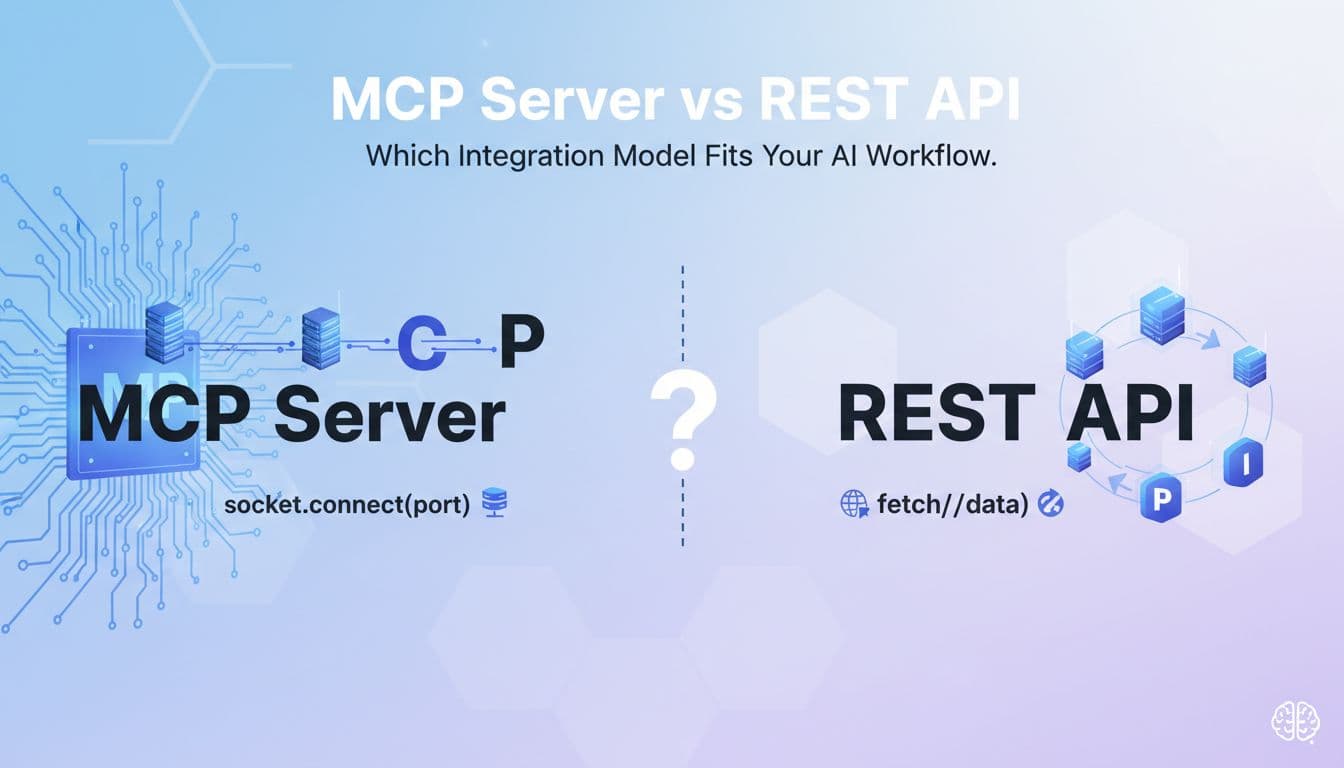
MCP Server vs REST API: Which Integration Model Fits Your AI Workflow
If you're building AI-powered workflows and want an AI assistant or agent to manage social media, you've probably run into two paths: MCP and REST API. Most articles explain the protocols in abstract terms and leave you to figure out the rest. This one doesn't. MCP lets AI assistants like Claude and ChatGPT take direct action on social media through natural language, with no custom code in between. REST APIs give developers precise, programmatic control over every post, every platform, every time. These aren't competing tools fighting for the same job. They solve different problems depending on who, or what, is doing the work. This article breaks down both models with real workflow examples, explains when each one makes sense, and shows why the choice of integration model matters more than most developers expect when they first start building.

Wilzer Jean-Baptiste
10 min read
You're building something with AI and you need it to post to social media. Sounds simple. Then you start researching and you run into two paths: MCP and REST API. Most of what you find online explains the protocols in abstract terms and leaves you to figure out which one actually fits your workflow. This article skips the theory and answers the real question: if an AI assistant or agent is doing the work, which integration model do you build on, and why does it matter?
What MCP Actually Does (and Why It's Different)
Natural Language as the Integration Layer
MCP, short for Model Context Protocol, lets AI assistants like Claude and ChatGPT take direct action on connected platforms through natural language. There's no custom code required on your end to make the assistant do something. You tell Claude to schedule a LinkedIn post for Thursday at 9am, and it does it. The assistant understands the intent, calls the right tool through the MCP server, and executes. The whole thing happens inside a conversation.
This is a fundamentally different model from a REST API. With a REST API, a developer writes the integration logic. You handle authentication, you manage the endpoints, you build the request structure, and you maintain all of it when something changes. MCP removes that layer entirely when an AI assistant is the one doing the work. The assistant connects to the MCP server, and the server handles the bridge to the platform. You don't write a custom integration. You just talk to the assistant.
That shift sounds small, but it changes what's possible. A non-technical founder can tell Claude to post a product update across three platforms and it happens. A developer building an agentic tool doesn't need to write a social media integration from scratch. The assistant already knows how to act.
When MCP Is the Right Call
MCP works best when the AI is the one reasoning about what to do and when. Think of a workflow where Claude monitors a Slack channel for product announcements, drafts a platform-appropriate post for each one, and schedules it without anyone reviewing a dashboard. That's an agentic loop. The AI is deciding, not just executing a pre-written script.
MCP is also the right model when you want speed of iteration. If you're prototyping an AI assistant that helps a small business owner manage their social presence, you don't want to spend two weeks building a REST integration before you can test the core idea. Connect the MCP server, and the assistant can start posting in an afternoon. The integration overhead drops to near zero.
The catch is that MCP gives the AI more autonomy. If you need tight control over exactly what gets posted, with human approval gates and specific formatting rules baked into the request, REST API gives you more precision. MCP is optimized for the AI acting on its own. REST API is optimized for the developer staying in control.
The Rarity Problem Most Developers Don't Know About
Here's something worth knowing before you start building: only a handful of platforms in the world currently support MCP for social media. That's not an exaggeration. As of 2026, the number of social media scheduling tools with a working MCP server is somewhere around seven globally. Most platforms only expose REST APIs, which means even if you're using Claude or ChatGPT, you still need a developer to build the bridge between the AI and the platform manually.
This matters a lot if you're evaluating tools for an agentic workflow. If the platform you're using doesn't support MCP, your AI assistant can't take direct action on social media. It can draft content, sure, but it can't publish. You're back to writing custom integration logic, which defeats the purpose of using an agentic AI in the first place. MCP social media scheduling is a rare capability right now, and the tools that offer it have a real head start on the ones that don't. When you find a platform that supports it, that's worth paying attention to.
What REST API Gets Right
Precision, Control, and Repeatable Pipelines
REST APIs give developers precise control over what gets posted, when, and how. You define the payload, you set the schedule, you handle the logic. Nothing happens without your code telling it to happen. That level of control is exactly what you want when you're building a scheduled content pipeline, running bulk publishing for a content agency, or wiring social media into a custom internal dashboard.
Imagine you're running a SaaS product and you want to auto-publish a weekly recap post every Friday at 10am across LinkedIn and X, pulling data from your analytics database. MCP isn't the right tool for that. You need a REST API call that fires on a cron schedule, formats the data, and sends it to the right endpoints. The developer writes that logic once, and it runs reliably every week. The AI isn't reasoning about what to post. The developer already made that decision and encoded it in the pipeline.
REST APIs also work well for teams that need approval workflows built into the process. You can write logic that creates a draft, routes it through a review system, and only publishes after a specific condition is met. That kind of structured control is hard to replicate with MCP, where the AI is the one making decisions.
Unified APIs and the Cross-Platform Problem
One of the biggest headaches in programmatic social media publishing is that every platform has its own API, its own auth system, its own rate limits, and its own quirks. Building direct integrations with Instagram, TikTok, LinkedIn, YouTube, Facebook, and X separately is a significant engineering investment. You're not just writing one integration. You're writing six, and maintaining all of them when the platforms update their specs.
A unified social media API solves this by giving you one endpoint that handles the routing to every platform. You send one request with the content and the target platforms, and the API handles the rest. For developers building AI agent workflows, this is especially useful because your agent doesn't need to know the specifics of each platform's API. It just calls one endpoint and the infrastructure figures out the delivery.
This is the model that makes programmatic social media posting practical at scale. Whether you're publishing 10 posts a week or 10,000, a unified API keeps the integration surface small and manageable. Your code stays clean, and your agent stays focused on the content logic instead of the platform plumbing.
REST API for AI Agents That Execute, Not Reason
There's a specific use case where REST API and AI agents work together really well: when the AI is executing a pre-defined task rather than reasoning about what to do. Say you've built an agent that takes a product description as input, generates five platform-optimized post variations, and publishes the best one based on a scoring function you wrote. The AI is doing the content work, but the publishing logic is deterministic. That's a REST API job.
The agent calls the API with the chosen post, the target platform, and the scheduled time. The API handles the rest. You get the creative output of an AI with the reliability and control of a programmatic pipeline. This hybrid model is where a lot of sophisticated teams end up. They use AI for the thinking and REST API for the doing. It keeps the architecture clean and gives you predictable behavior at every step of the publishing process.
Choosing the Right Model for Your Stack
The One Question That Decides It
The real decision between MCP and REST API comes down to one question: who is doing the work? If a human developer is building an automated pipeline, REST API is the right tool. The developer defines the logic, writes the integration, and controls every step. The API executes what the developer designed.
If an AI agent is the one deciding what to post and when, MCP removes the friction. The agent doesn't need a custom integration layer sitting between it and the platform. It connects to the MCP server, reasons about the task, and acts. No middleware, no custom code, no developer in the loop for every decision. The agent handles it end-to-end.
This distinction matters because a lot of teams try to use REST API for agentic workflows and end up building a lot of scaffolding just to let the AI take action. MCP was designed specifically for the case where the AI is the actor. Using it for that purpose isn't just convenient. It's the architecture the protocol was built for. Getting this choice right early saves you weeks of rework later.
When You Need Both
Some workflows need both models at the same time, and that's not a contradiction. A marketing team might use MCP to let Claude handle ad-hoc posts when someone on the team asks for one through a chat interface. That same team might also run a REST API pipeline that auto-publishes scheduled evergreen content every week without any human input. Two different workflows, two different integration models, one platform handling both.
This is where most teams end up once they've been building for a while. The agentic, conversational work goes through MCP. The repeatable, scheduled, high-volume work goes through REST API. Having both options available without switching platforms is a real operational advantage. You're not locked into one model because that's all your tool supports. The best setup is one where you can choose based on the workflow, not based on what the platform happens to offer.
Aidelly: Built for Both Models
Aidelly supports both integration models, and that's genuinely rare. Its MCP server lets Claude, ChatGPT, and Cursor schedule and manage posts through natural conversation. You connect the MCP server to your AI assistant, and the assistant can start publishing to social media directly. No custom integration code, no developer required for the assistant to act. For teams building agentic workflows or just wanting their AI assistant to handle social media tasks, this is the path of least resistance.
Aidelly's REST API gives developers and AI agents a unified endpoint for publishing to Instagram, TikTok, LinkedIn, YouTube, Facebook, and X. One API, six platforms, one auth system to manage. Whether you're building a scheduled content pipeline, a custom analytics dashboard that triggers posts based on performance data, or an AI agent that executes publishing decisions programmatically, the REST API handles the delivery. Teams can pick the model that fits their workflow, or use both at the same time for different parts of their content operation. That flexibility is what makes the platform worth evaluating if you're serious about AI-powered social media publishing.
MCP and REST API aren't competing for the same job. MCP is for when the AI is the actor. REST API is for when the developer is the architect. Getting that distinction right changes how you build, how fast you ship, and how much maintenance you're signing up for. Most social media platforms only give you one option, which means you're either locked into custom integration work or locked out of true agentic automation. The tools that support both models give you the flexibility to build the right workflow for the right use case, without starting over when your needs change. If you're evaluating platforms for an AI-powered social media workflow, the integration model question should be one of the first things you ask about.
If you want a low-lift way to apply these ideas, Aidelly helps you keep your social content consistent without extra busywork.If you want an AI agent to handle social media end-to-end, from deciding what to post to scheduling it to analyzing what worked, the integration model underneath matters. Aidelly's agentic workflows are built for exactly that, whether you're connecting through MCP or the REST API. See how it fits your setup at aidelly.ai.
Compare Social Scheduling Tools
Evaluating software for your content workflow? Use our buyer guides and comparisons to compare scheduling, approvals, analytics, and AI workflow fit.
Share this article
Related Articles
MCP Server for Social Media: What It Is and Why Developers Are Paying Attention
Something changed in how AI agents interact with the world, and most social media teams haven't noticed yet. The Model Context Protocol (MCP) is an open standard from Anthropic that lets AI assistants like Claude, ChatGPT, and Cursor connect directly to external tools and take real actions — not just generate text. For social media, that means an AI agent can now draft a post, pick the best time to publish, and schedule it across Instagram, LinkedIn, and TikTok without a human touching a dashboard. Only around 7 platforms in the world support MCP for social media publishing right now. That gap is real, and it matters. This article explains what MCP actually is, why it changes the way AI agents handle content publishing, and what developers and AI-forward marketers can build with it today.
Jun 29, 2026
Read more
How to Connect Claude to Your Social Media Accounts Using MCP in 2026
Most marketers are still copying and pasting content between AI tools and social media schedulers. In 2026, that workflow is already outdated. MCP (Model Context Protocol) lets AI assistants like Claude talk directly to external tools, which means Claude can draft, schedule, and publish your social media posts without you touching a thing. Only a handful of platforms support MCP for social media publishing right now. Aidelly is one of them. This guide walks you through exactly how to connect Claude to your Aidelly MCP server, what to ask Claude once it's wired up, and what a real agentic social media workflow looks like when it's running. No coding required. Just a smarter way to manage content across Instagram, TikTok, LinkedIn, YouTube, Facebook, and X.
Jul 3, 2026
Read more
How to Use Claude and ChatGPT to Publish Social Posts via MCP in 2026
Your AI assistant already writes your social posts. But then you copy the text, open your scheduler, pick a time, format it for each platform, and post it manually. That gap between 'AI wrote it' and 'it's live' costs you more time than you think. In 2026, that gap doesn't have to exist. The Model Context Protocol (MCP) lets AI assistants like Claude and ChatGPT connect directly to tools like Aidelly and handle the entire workflow, from drafting to scheduling to publishing, without you switching tabs. This guide shows you exactly how to set it up, what the agent can do on its own, and where you still want a human in the loop. If you use Claude or ChatGPT every day and you're tired of being the copy-paste middleman, this is the workflow you've been waiting for.
Jul 6, 2026
Read moreReady to never miss a post again?
Tell Aidelly what to post. It drafts, schedules, and publishes across 9 platforms while you focus on your business.