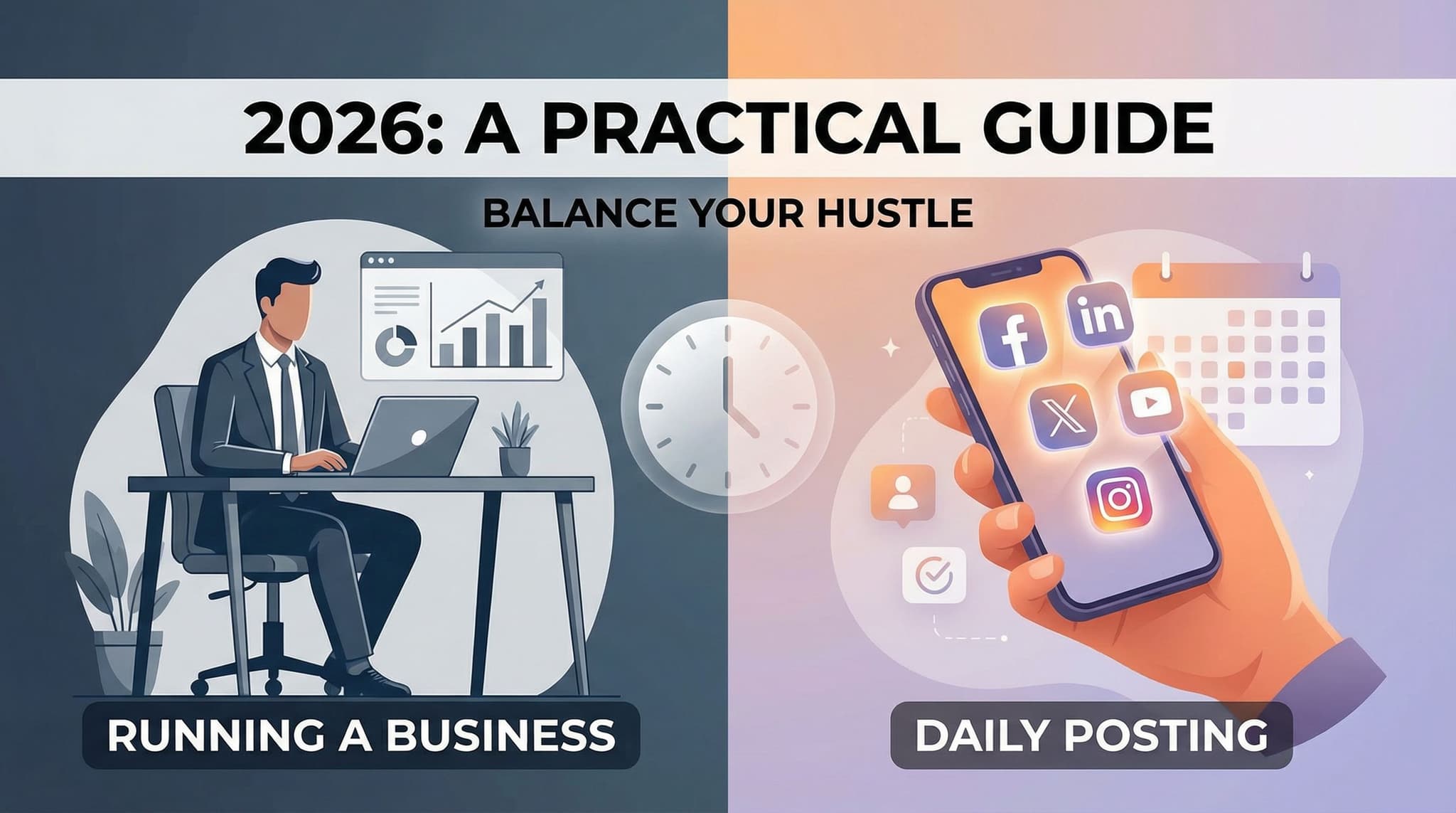
How to Balance Running a Business and Daily Social Media Posting in 2026: A Practical Guide for Entrepreneurs
Running a business while maintaining an active social media presence feels impossible—until it doesn't. This comprehensive guide reveals how successful entrepreneurs in 2026 are ditching the daily posting grind and building sustainable systems instead. Discover proven time management strategies, automation tactics, and delegation approaches that let you maintain authentic brand visibility without sacrificing your core business operations or your sanity.

Wilzer Jean-Baptiste
20 min read
It's 3 PM on a Tuesday, and you're staring at a blank screen trying to figure out what to post on Instagram. Meanwhile, your email inbox has 47 unread messages, a client is waiting for a callback, and you haven't touched your actual business goals all day. Sound familiar?
If you're a solopreneur, small business owner, or startup founder, you've probably experienced this exact scenario more times than you'd like to admit. The pressure to maintain a constant social media presence while actually running your business feels like an impossible juggling act. You're told you need to post daily, engage constantly, and create viral content—all while keeping your business afloat.
Here's the truth: you don't. And this article is going to show you why, plus exactly how to build a social media strategy that actually works with your business instead of against it.
Section 1: Mastering Your Time and Building Your Foundation
The foundation of balancing business operations with social media isn't about working harder—it's about working smarter. Too many entrepreneurs approach this problem by adding more hours to their day, when what they really need is a completely different system. The entrepreneurs who've cracked this code in 2026 aren't the ones burning out at midnight; they're the ones who've built strategic frameworks that actually save time.
The key insight here is that social media management isn't separate from your business—it's an extension of it. When you treat it as a distinct task that demands your attention multiple times per day, you're creating unnecessary friction. But when you integrate it into your existing business workflows and systems, it becomes almost effortless.
Think about it this way: you're already doing the work that could become content. You're serving clients, creating products, solving problems, and having conversations. The trick is capturing those moments and repurposing them strategically rather than starting from scratch every single day.
1.1 Time Management Strategies for Entrepreneurs Balancing Business Operations with Social Media Responsibilities
Let's start with the uncomfortable truth: you probably don't have more time than you think you do. What you have is time you're wasting on inefficient processes. Most entrepreneurs spend 2-4 hours per week on social media, and the majority of that time is spent deciding what to post, not actually creating or engaging meaningfully.
The first game-changing strategy is time-blocking. Instead of treating social media as something you handle whenever it pops into your head, assign it a specific block of time—ideally once or twice per week, not daily. Many successful entrepreneurs dedicate one 2-3 hour block on Monday or Tuesday morning to handle all their social media planning, creation, and scheduling for the entire week. During this block, your phone is on silent, notifications are off, and you're focused exclusively on this one task.
The second strategy is the "batching" mindset, which we'll explore more deeply in the next subsection. But the time management angle here is crucial: when you batch your social media work, you eliminate the context-switching tax. Every time you switch between tasks, your brain needs 15-20 minutes to refocus. If you're jumping in and out of social media throughout the day, you're losing massive amounts of productive time.
Third, implement the "80/20 rule" for social media. Identify which platforms and content types actually drive business results for you. Many entrepreneurs discover they're spending 40% of their social media time on platforms that generate 5% of their results. Maybe TikTok isn't where your customers are. Maybe LinkedIn is where the magic happens for your B2B business, but you're also maintaining Instagram and Twitter out of habit. Give yourself permission to focus on the 20% of activities that drive 80% of your results.
Finally, create a "social media hour" policy. This means you handle all social media tasks during designated times only. Outside of those times, you don't check notifications, respond to comments, or even think about it. This psychological boundary is surprisingly powerful for reducing the mental burden of social media. You're not constantly wondering if you should be posting or engaging. You have a system, and you trust it.
1.2 Content Batching and Scheduling Tools to Automate Posting While Maintaining Authenticity
Content batching is the secret weapon that transforms social media from a daily obligation into a weekly task. The concept is simple: create multiple pieces of content in one focused session, then schedule them to post at optimal times throughout the following weeks.
Here's how a real batching session works: Let's say you're a fitness coach. You dedicate a Wednesday afternoon to creating content. You film 8-10 short videos of different exercises, tips, or transformations. You take 15-20 photos of your workspace, you with clients, or motivational quotes. You write out captions and hooks for all of them. In that single 3-hour session, you've created enough content for 4-6 weeks of consistent posting.
The authenticity concern is valid—people worry that batched content feels robotic or inauthentic. But here's the reality: batching actually improves authenticity because you're less likely to post desperate, low-quality content just to fill the void. When you batch, you're intentional. You're thoughtful. You're creating your best work in a focused state rather than scrambling at midnight.
Tools like Buffer, Later, Hootsuite, and Metricool have made scheduling incredibly accessible. These platforms let you write captions, add images, schedule posts, and even handle carousel posts across multiple platforms simultaneously. The best part? They often include analytics so you can see when your audience is most active and schedule accordingly. Many of these tools offer free tiers for small businesses, making them accessible regardless of your budget.
The batching process also creates natural content variety. When you're creating content in one session, you're forced to think about different angles, formats, and messages. You're not defaulting to the same type of post repeatedly because you're under time pressure. You're creating Reels and static posts and carousel posts and Stories all at once, which creates a more interesting feed for your audience.
1.3 Setting Realistic Social Media Goals Aligned with Business Objectives
This is where most entrepreneurs go wrong. They set social media goals in a vacuum, completely disconnected from actual business objectives. You end up chasing vanity metrics like follower count instead of focusing on what actually matters: business growth.
Start by asking yourself: What is social media supposed to do for my business? Is it supposed to drive sales directly? Build brand awareness? Generate leads? Create community? The answer determines everything about your strategy. A B2B software company's social media strategy should look completely different from a fitness coach's, which should look different from a fashion brand's.
Once you've identified the primary purpose, set realistic goals. Instead of "get 10,000 followers in 6 months," try "convert 5 followers into paying customers per month" or "generate 20 qualified leads through LinkedIn per quarter." These goals are connected to actual business outcomes, which means you can measure ROI and justify your time investment.
For most small businesses, this means posting less frequently than you think. A B2B company might only need 2-3 quality LinkedIn posts per week. A service-based business might do well with 4-5 Instagram posts per week. A product-based business might need daily content on TikTok. The frequency should be determined by your business goals and audience behavior, not by some arbitrary "best practice."
Section 2: Building Systems That Run Without You
The entrepreneurs who've truly cracked the code aren't the ones working the hardest on social media—they're the ones who've built systems that require minimal daily attention. This section is about creating infrastructure that handles the repetitive, time-consuming parts of social media management so you can focus on what actually matters: running your business and creating genuine connections with your audience.
The beauty of building systems is that they scale. Once you've created a content calendar, identified your best-performing content types, and set up your automation workflows, you can replicate that system month after month with minimal tweaking. You're not reinventing the wheel every single week.
This is also where delegation becomes crucial. You don't have to do everything yourself. Whether you're bringing on a team member, hiring a freelancer, or using AI tools to assist with certain tasks, the goal is the same: free up your time for high-value activities that only you can do.
2.1 Creating a Content Calendar System That Requires Minimal Daily Maintenance
A content calendar is non-negotiable. But here's the key: it shouldn't be complicated. Many entrepreneurs create elaborate content calendars with color-coding, multiple tabs, and detailed descriptions that take longer to maintain than the actual social media work.
The best content calendar system is one that's simple enough to maintain but detailed enough to actually guide your content creation. Here's what needs to be in there: the date and platform, the content type (video, carousel, static image, Story, etc.), the topic or hook, and which business objective it supports. That's it. You don't need paragraphs of description or color-coded categories unless those things genuinely help you.
Many successful entrepreneurs use a simple Google Sheet or Notion database for their content calendar. You can view it by week or month, easily drag posts around if you need to reschedule, and share it with team members or freelancers if you're delegating. The critical piece is that you plan this out in batches—ideally at the start of each month—then don't touch it again unless something major changes.
The structure might look like this: Monday column for Monday posts, Tuesday column for Tuesday posts, etc. Each cell contains the basic info about what's going out that day. Once you've planned your month, you're done. No daily decisions. No wondering what to post. You just execute the plan.
Pro tip: Build in 20-30% flexibility. Don't schedule every single day of the month. Leave some gaps for timely content, trending topics, or spontaneous engagement opportunities. This prevents your feed from feeling robotic and allows you to capitalize on unexpected moments.
2.2 Delegation Tactics: Outsourcing Social Media to Team Members or Freelancers
Here's something that might surprise you: you probably shouldn't be managing your own social media. Not because you're bad at it, but because it's not the best use of your time. Your time is better spent on activities that directly generate revenue or move your business toward its core objectives.
Delegation doesn't have to mean hiring a full-time social media manager. For many solopreneurs and small business owners, a part-time virtual assistant (10-15 hours per week) is perfect. They can handle scheduling, responding to comments, basic engagement, and even some content creation. You provide the strategy and create the core content; they handle the execution and maintenance.
The key to successful delegation is creating clear systems and guidelines. Before you hand off social media to someone, document your brand voice, content preferences, the types of posts you want, your response guidelines for comments, and what situations require your approval. This documentation becomes your delegation blueprint.
For freelancers specifically, platforms like Upwork, Fiverr, and specialized agencies can provide various levels of support. Some entrepreneurs hire freelancers just to handle content creation based on a content calendar they've created. Others hire someone to manage the full social media operation. The cost varies widely depending on the scope, but even hiring someone for 5-10 hours per week can free up significant time on your end.
The financial calculation is straightforward: if you're earning $100/hour doing your core business work, and you're spending 10 hours per week on social media, you're essentially costing yourself $1,000 per week to manage your own social accounts. A VA at $20-30/hour suddenly looks like a great investment.
If delegation isn't in your budget yet, consider starting smaller. Hire someone just for engagement (responding to comments and messages) or just for scheduling. This handles the most time-consuming parts and gives you back hours per week immediately.
2.3 Quality Over Quantity: Reducing Posting Frequency Without Losing Engagement
The "post every day" mentality is one of the most damaging myths in social media marketing. It's based on outdated thinking and doesn't reflect how modern algorithms actually work. In 2026, quality and consistency beat frequency every single time.
Here's what the data actually shows: a business that posts 3 times per week with high-quality, valuable content will outperform a business posting 7 times per week with mediocre content. Your audience would rather see fewer posts they actually care about than constant noise.
The shift to quality over quantity has a beautiful side effect: it's sustainable. You can maintain 3-4 quality posts per week indefinitely without burning out. You cannot maintain daily posting of excellent content for years on end. You'll either burn out or the quality will suffer, and then you're stuck in a cycle of mediocre content.
Quality content means different things for different platforms. On LinkedIn, quality might mean thoughtful insights, industry trends, or personal stories. On Instagram, it might mean polished, cohesive aesthetics. On TikTok, it might mean authentic, entertaining short-form video. The common thread is that it's intentional and valuable to your specific audience.
Start by reducing your posting frequency to what's actually sustainable for you, then monitor your engagement metrics. You might find that engagement actually increases because your content is better. Your audience has time to actually see and interact with your posts instead of them being buried under your own constant stream.
Section 3: Measuring Results and Protecting Your Energy
The final piece of this puzzle is understanding what actually matters and protecting yourself from burnout. Too many entrepreneurs spend months or years maintaining a social media presence without ever measuring whether it's actually contributing to their business. This section is about getting intentional with measurement and building boundaries that protect your mental health.
The reality is that social media can feel like an infinite task. There's always more you could do, another platform to consider, more content to create, more comments to respond to. Without clear boundaries and measurement systems, it becomes a black hole that consumes your time and energy without clear return.
By implementing robust measurement systems and clear automation workflows, you transform social media from a nebulous time-sink into a strategic business tool with defined inputs and outputs. You'll know exactly how much time you're investing, what return you're getting, and whether adjustments are needed.
3.1 Measuring ROI on Social Media Time Investment to Justify Resource Allocation
Here's a question most entrepreneurs can't answer: Is your social media actually generating business value? You might have followers and engagement, but are those things translating to customers, revenue, or leads?
The measurement framework needs to connect social media activity to actual business outcomes. This looks different for every business, but here's the structure: First, identify what "success" means for your social media. For some businesses, it's direct sales. For others, it's lead generation. For others, it's brand awareness that eventually leads to sales. You need to know which one applies to you.
Second, set up tracking. This might mean using UTM parameters in your social media links so you can track exactly which clicks come from social. It might mean asking customers "how did you find us?" and tracking social media as a referral source. It might mean tracking how many LinkedIn connections turn into consulting clients. The tracking method depends on your business model.
Third, do the math. Let's say you spend 5 hours per week on social media. That's roughly 250 hours per year. If your time is worth $100/hour (conservative estimate for a business owner), that's $25,000 per year in time investment. Is your social media generating at least $25,000 in value annually? Is it generating qualified leads that have a reasonable conversion rate? Is it building brand awareness that you can quantify?
If the answer is yes, great—you're investing in something that works. If the answer is unclear or no, you need to make changes. Maybe you need to shift your strategy. Maybe you need to focus on different platforms. Maybe you need to allocate less time to social media and more to channels that actually work for your business.
The most important metric for most small businesses is actually quite simple: how many customers or leads have come from social media, and what's the revenue associated with that? If you're not tracking this, start immediately. It will completely change how you think about social media investment.
3.2 Leveraging User-Generated Content and Repurposing Existing Business Materials
One of the biggest mistakes entrepreneurs make is creating social media content from scratch when they already have a goldmine of content right in front of them. Your existing business materials—client testimonials, past projects, blog posts, customer photos, email newsletters—can all be repurposed into social media content.
User-generated content (UGC) is particularly powerful. When your customers post about you, take that content and share it. With permission, of course. This serves multiple purposes: it's authentic social proof, it requires zero effort on your part, your customers feel recognized, and it fills your content calendar. A simple repost with a thank you message is powerful marketing.
Repurposing existing materials is equally valuable. If you wrote a detailed blog post, you can turn that into 5-8 social media posts: pull out key statistics for a carousel post, extract a quote for a static post, create a short video summarizing the main point, turn it into an infographic, etc. One piece of comprehensive content becomes a month of social media material.
This approach also maintains authenticity while reducing your workload. You're not creating artificial content just to fill your calendar. You're sharing real things your business is already doing and real things your customers are saying about you. This naturally feels more genuine than manufactured posts.
Create a simple system for capturing UGC: ask customers to tag you when they post about your business, set up a hashtag for your brand that customers can use, encourage reviews on Google or other platforms that you can screenshot and share. Then, make it a regular practice to share this content. Once per week, share a customer testimonial or photo. This is low-effort, high-impact content that builds community and social proof simultaneously.
3.3 Avoiding Burnout Through Boundary-Setting and Automation Workflows
Perhaps the most important element of sustainable social media management is protecting your mental health and energy. Social media was designed to be addictive and attention-grabbing. Without intentional boundaries, it will consume far more of your time and mental energy than you intended.
The first boundary is temporal. Decide when you will and won't engage with social media. Many entrepreneurs find that checking social media first thing in the morning or right before bed triggers a spiral of endless scrolling and stress. Instead, designate specific times—maybe 9 AM and 3 PM—when you check notifications and respond to comments. Outside those times, you don't look at it. This requires discipline, but it's transformative for your mental health.
The second boundary is emotional. Remember that social media is a highlight reel. Don't compare your behind-the-scenes to someone else's curated content. Don't feel pressure to match the posting frequency of accounts with larger teams or bigger budgets. Don't let negative comments or lack of engagement affect your self-worth. Social media is a tool, not a measure of your value as a person or business owner.
Automation workflows are your secret weapon against burnout. Set up your scheduling system so that posts go out automatically without you manually hitting publish every time. Use tools that auto-respond to common DM questions. Use templates for your captions and content so you're not starting from scratch each time. Set up email alerts for important mentions or messages so you don't have to constantly check the platform.
Finally, give yourself permission to take breaks. If you need to step away from social media for a week or two, do it. Your business won't collapse. Your audience will still be there. You're better off taking a planned break than burning out completely and disappearing for months. Some of the most successful entrepreneurs build in regular social media sabbaticals—maybe one week per quarter where they're completely offline. This recharge is essential for long-term sustainability.
3.4 Integration of Business Operations with Social Media Strategy for Efficiency
The final piece of this puzzle is recognizing that social media shouldn't be a separate function in your business. It should be integrated into your existing workflows and operations. When you treat social media as part of your core business process rather than an add-on task, everything becomes more efficient.
This integration looks different depending on your business, but here are some examples: If you're a consultant, every client project becomes potential case study content. If you're a product-based business, every new product launch includes a social media campaign built into your launch timeline. If you're a service provider, your client onboarding process includes a section where clients agree to be featured in testimonials and case studies. If you're a coach or educator, every lesson or training becomes potential short-form video content.
The key is embedding content creation into your existing business activities rather than treating it as something separate. When you're already doing client calls, record clips for social media. When you're already creating course materials, think about how to repurpose them for social. When you're already solving problems for clients, document that solution for your audience.
This integration also extends to your team. If you have employees, everyone should understand how their work connects to your content strategy. The customer service rep who solves a unique problem has content. The product developer testing new features has content. The team member who has a great insight about your industry has content. When content creation is part of your culture and operations, you're never scrambling for ideas.
Balancing business operations with social media doesn't require superhuman time management or sacrificing your sanity. It requires intentional systems, realistic expectations, and permission to do less while achieving more. By implementing time-blocking, content batching, strategic delegation, and clear measurement systems, you transform social media from a daily obligation into a sustainable part of your business strategy.
The entrepreneurs thriving in 2026 aren't the ones posting every day—they're the ones who've built systems that run efficiently, platforms that matter, and boundaries that protect their mental health. They've integrated social media into their existing business operations, measured what actually works, and automated everything possible. Most importantly, they've given themselves permission to prioritize quality over quantity and business outcomes over vanity metrics.
Start small. Pick one strategy from this article—maybe it's content batching, or setting up a simple content calendar, or delegating to a VA—and implement it this week. As each system starts working, add another. Within a few months, you'll have a social media operation that requires minimal daily maintenance while actually contributing to your business growth. That's not just sustainable; that's strategic.
The truth is, you don't need to choose between building a thriving business and maintaining an engaged social media presence—you just need the right systems in place. If you're ready to reclaim hours from your week while keeping your brand consistently visible and authentic, Aidelly makes it easy to create and schedule engaging content across all your platforms, so your voice stays strong without the daily grind. Give yourself permission to work smarter instead of harder—get started at aidelly.ai and see how much breathing room you can create in your entrepreneurial life.Compare Social Scheduling Tools
Evaluating software for your content workflow? Use our buyer guides and comparisons to compare scheduling, approvals, analytics, and AI workflow fit.
Share this article
Related Articles
7 Ways to Automate Your Social Media Content Creation in 2026: A Practical Guide for Busy Business Owners
Managing multiple social media accounts while running a business is exhausting. Between crafting posts, scheduling content, researching hashtags, and analyzing performance, you're probably spending hours every week on tasks that could be automated. The good news? In 2026, social media automation tools have evolved dramatically, making it easier than ever to maintain a consistent, authentic presence without burning yourself out. This comprehensive guide walks you through seven proven automation strategies that will free up your time, keep your content flowing, and actually improve your results—all while maintaining the genuine voice that makes your brand worth following.
Jan 13, 2026
Read more
Top 5 AI-Powered Social Media Tools in 2026: A Comprehensive Comparison Guide for Modern Marketers
Social media management has transformed dramatically with AI integration. This guide breaks down the five most powerful AI-driven tools reshaping how teams schedule content, analyze sentiment, engage customers, create visuals, and forecast performance. Whether you're managing a small business or leading a digital agency, discover how to build a unified workflow that combines these tools strategically—and avoid the pitfalls that come with overhauling your entire social media stack.
Jan 13, 2026
Read moreReady to never miss a post again?
Tell Aidelly what to post. It drafts, schedules, and publishes across 9 platforms while you focus on your business.